Most people learn about SIPs in their first year of investing. Far fewer ever hear about STPs and SWPs even though both can solve very real, very common problems: what to do with a lump sum you’re nervous about investing all at once, and how to draw a steady income from your investments without selling everything in one go.
If you’ve ever had a bonus sitting in your savings account for months because you weren’t sure how to invest it, or wondered how retirees actually convert a mutual fund corpus into monthly income, this is the concept you were missing.
What Is an STP (Systematic Transfer Plan)?
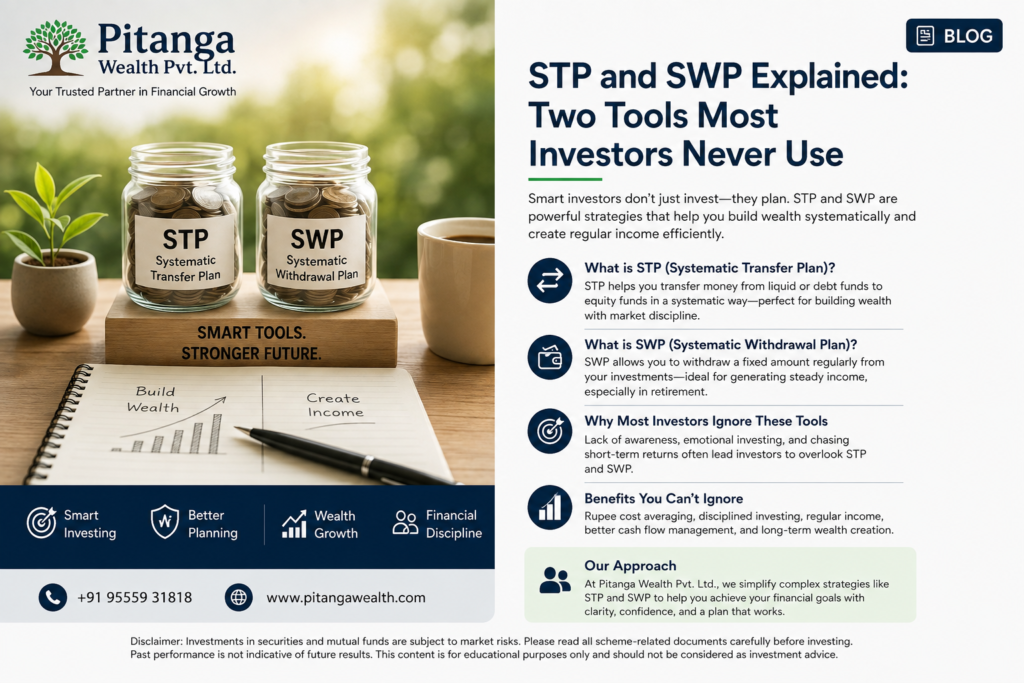
An STP moves a fixed amount of money, at regular intervals, from one mutual fund scheme to another usually from a debt or liquid fund into an equity fund, within the same fund house.
Here’s the practical use case. Say you receive a lump sum of ₹6,00,000 and want equity exposure, but you’re not comfortable putting it all into the market on a single day. Instead, you could park the full amount in a liquid or debt fund, and set up an STP of ₹50,000 a month into an equity fund. Over 12 months, your money moves across gradually, the same way a SIP would work except the source is a lump sum sitting in a fund, not fresh money from your salary.
The idea is the same discipline as a SIP spreading your entry into the market over time so you’re not depending on getting the timing right in one shot. The part of your money still waiting in the debt fund also earns a return in the meantime, instead of sitting idle in a savings account.
What Is an SWP (Systematic Withdrawal Plan)?
An SWP works in the opposite direction. Instead of putting money in, you’re taking a fixed amount out of a mutual fund at regular intervals commonly monthly.
This is most often used by investors who’ve already built a corpus and now need it to generate regular income, such as during retirement. Instead of withdrawing the entire investment and losing out on further growth, an SWP lets the remaining money stay invested and continue growing (or at least attempt to, since returns are never guaranteed) while a fixed portion is paid out on schedule.
For illustration only not a projection or promise of returns — imagine a corpus of ₹50,00,000 growing at a hypothetical, illustrative rate of around 8% a year, with a monthly SWP withdrawal of ₹25,000. As long as the withdrawal rate stays well below the fund’s long-term growth rate, the corpus can potentially keep supporting withdrawals for many years. If withdrawals are too aggressive relative to returns, the corpus depletes faster. This is exactly the kind of trade-off worth working through with a professional before setting up an SWP for real money.
STP vs SWP: The Core Difference
It’s easy to mix these up because both involve “regular, fixed amounts moving on a schedule.” The difference is direction and purpose:
- An STP moves money between two funds — typically to phase a lump sum into the market gradually.
- An SWP moves money out of a fund and into your bank account — typically to create a regular income stream from an existing corpus.
Both use the same underlying mechanism: an instruction to transact a fixed amount at fixed intervals, without needing to place a fresh order each time.
When Might Each One Be Useful?
STP tends to suit investors who:
- Have received a lump sum (bonus, maturity payout, inheritance, sale proceeds) and want equity exposure without a single large entry point
- Want their money to keep earning something in a debt fund while it’s gradually deployed
- Are trying to reduce the emotional pressure of “is this the right day to invest?”
SWP tends to suit investors who:
- Are retired or approaching retirement and need a predictable monthly payout
- Want an alternative to breaking a fixed deposit or withdrawing a large sum at once
- Are looking to structure withdrawals in a way that may be more tax-efficient than a one-time redemption, depending on their individual situation
Whether either of these fits your situation depends on your goals, time horizon, existing investments, and risk profile — this article is meant to explain the concepts, not to recommend a specific plan for your money.
Frequently Asked Questions
Is an STP the same as a SIP? Not quite. A SIP invests fresh money usually from your bank account into a fund at regular intervals. An STP moves money that’s already invested in one fund into another fund. The disciplined, staggered approach is similar, but the source of the money is different.
Can I stop an STP or SWP once it’s started? Generally yes. Both are typically set up as standing instructions with the fund house or your distributor and can usually be modified or stopped, subject to the specific terms of the schemes involved.
Is there a minimum amount required for STP or SWP? Minimum amounts vary by fund house and scheme, so it’s worth checking the specific scheme’s terms before setting one up.
Does an SWP guarantee I won’t run out of money? No. An SWP is a withdrawal mechanism, not a guarantee. If withdrawals are consistently higher than what the fund earns, the corpus will eventually reduce. This is why the withdrawal amount should be planned carefully against realistic, long-term expectations rather than fixed arbitrarily.
Are STP and SWP taxed? Both involve redemption of mutual fund units (an STP redeems from the source fund; an SWP redeems from the fund you’re withdrawing from), which may attract capital gains tax depending on the fund type and holding period. Tax rules can change, so it’s worth checking current provisions or speaking with a tax advisor for your specific case.
If you’re trying to figure out whether an STP or SWP fits into your own financial plan whether that’s phasing in a lump sum or setting up a retirement income stream our team at Pitanga Wealth can walk you through how these tools work within a broader plan built around your goals.
Mutual Fund investments are subject to market risks. Read all scheme-related documents carefully before investing. The information in this article is for educational purposes only and should not be construed as investment advice or a recommendation to invest in any particular scheme.
Written by the Pitanga Wealth team — AMFI-Registered Mutual Fund Distributor (ARN-134606).