

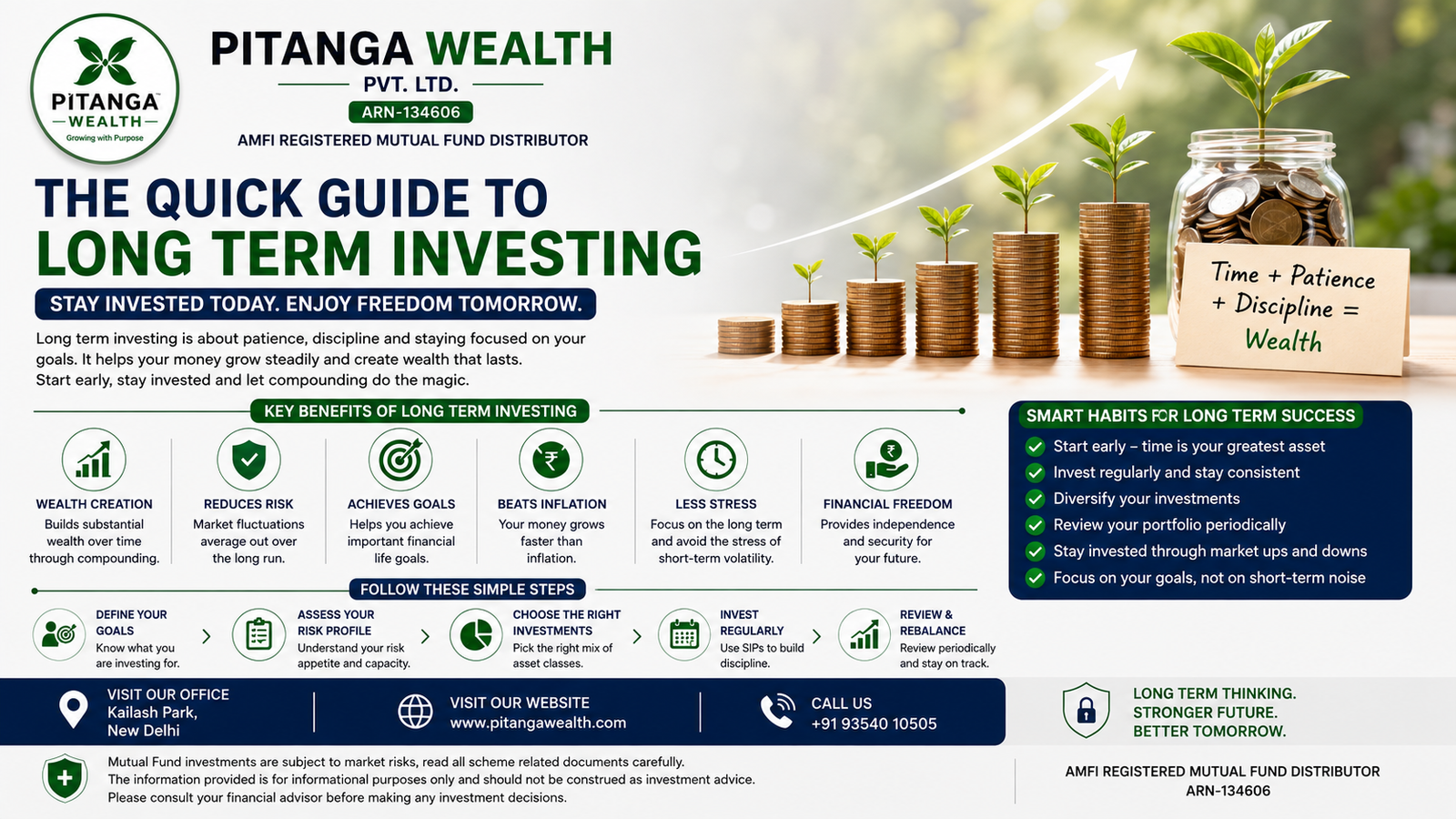
Investing for the long term sounds simple: put money aside, stay invested and allow time to do its work.
In reality, long-term investing involves more than simply waiting for an investment to increase in value. Investors need to understand their financial goals, investment horizon, risk tolerance, asset allocation and the risks associated with different investments.
The good news is that you do not need to predict every market movement to understand the basic principles of long-term investing.
A sensible starting point is to focus on what you can control: how much you invest, why you are investing, how much risk you can accept, how diversified your investments are and whether your approach remains aligned with your goals.
SEBI’s investor-education material similarly encourages investors to consider their goals, investment horizon, risk-taking capacity, liquidity requirements and other factors before investing.
What Is Long-Term Investing?
Long-term investing generally means holding investments for an extended period with the intention of working towards a future financial objective rather than focusing primarily on short-term price movements.
The exact meaning of “long term” can vary depending on the investment and the financial goal.
For one person, a long-term investment may be intended for retirement. For another, it may be part of planning for a future education expense or another financial objective.
The important point is that the investment horizon should be connected to the goal.
Long-term investing is therefore not simply about holding something for many years. It is about giving an investment approach enough time to work toward a defined objective while understanding the risks involved.
Why Do People Invest for the Long Term?
One major reason investors consider a longer investment horizon is that it provides more time to deal with market fluctuations.
Financial markets can rise and fall considerably over shorter periods. Trying to react to every movement can lead to emotional decisions, particularly when markets are volatile.
A longer horizon can allow investors to focus more closely on their underlying financial objectives rather than making decisions based entirely on short-term market movements.
However, a longer holding period does not guarantee profits or eliminate the possibility of loss.
SEBI’s investor guidance makes it clear that investments involve risk and that returns are not guaranteed.
Start With a Financial Goal
Before deciding where to invest, consider why you are investing.
A goal gives an investment strategy some context.
For example, long-term financial goals might include:
- Building a retirement corpus
- Planning for a child’s future education
- Saving for a future property purchase
- Building long-term wealth
- Creating a financial reserve for a future objective
The amount required, time available and acceptable level of risk can differ substantially between these goals.
An investment decision therefore should not begin with “Which investment will give me the highest return?”
A more useful starting point is:
“What am I investing for, and when will I need the money?”
Understand Your Investment Horizon
Your investment horizon is the length of time you expect to remain invested before you need the money.
This matters because different investments can experience different levels of short-term fluctuation.
Someone investing for a goal that is many years away may have more time to experience market cycles than someone who needs the money in the near future.
This is one reason SEBI’s investor-education resources recommend considering investment horizon alongside financial goals and risk appetite.
A longer horizon, however, should not be treated as permission to ignore risk.
The investment still needs to be appropriate for the objective and the investor’s circumstances.
The Role of Compounding in Long-Term Investing
Compounding is one of the concepts most often associated with long-term investing.
In simple terms, compounding occurs when returns generated on an investment remain invested and can themselves contribute to future growth.
Consider a simplified illustration.
Suppose ₹1,00,000 grows at an assumed annual rate of 8%, with all returns remaining invested.
After one year:
₹1,00,000 × 1.08 = ₹1,08,000
If the same hypothetical rate continued for another year:
₹1,08,000 × 1.08 = ₹1,16,640
The second year’s growth is calculated on ₹1,08,000 rather than the original ₹1,00,000.
Over long periods, this effect can become increasingly significant.
But there is an important qualification: the 8% figure above is only a mathematical illustration, not an expected or guaranteed investment return.
Actual investment returns can vary, and market-linked investments can lose value.
SEBI itself cautions investors not to assume fixed market returns and notes that stock-market returns cannot be predicted with certainty.
Starting Early vs Waiting for the “Perfect” Time
Time can be an important component of long-term investing because it gives investments more opportunity to experience compounding.
Waiting indefinitely for what appears to be the perfect market entry point can also make it difficult to follow a consistent investment plan.
That does not mean investors should ignore valuation, risk or suitability.
Rather, the lesson is that long-term investing generally benefits from having a clear process instead of depending entirely on predictions about what the market will do next.
There is no reliable way to know with certainty when markets will reach their highest or lowest point.
Risk Is Part of Long-Term Investing
One of the biggest misconceptions about long-term investing is that time automatically makes an investment safe.
It does not.
An investment can remain volatile or lose value even after being held for many years.
The appropriate level of risk depends on factors such as:
- Financial goals
- Investment horizon
- Income and financial commitments
- Liquidity requirements
- Ability to withstand losses
- Willingness to tolerate market fluctuations
- Existing investments
SEBI’s investor-education material recommends assessing how much fluctuation or potential loss an investor can withstand before making investment decisions.
Long-Term Investing and Diversification
Diversification means spreading investments across different assets, securities, sectors or other categories rather than concentrating too much money in one area.
The objective is to reduce the impact that poor performance in one investment or category may have on the overall portfolio.
For example, an investor may have exposure to more than one asset class rather than relying entirely on a single type of investment.
However, diversification does not guarantee profits or completely protect against losses.
SEBI’s financial education material describes diversification as a way of spreading investments across different asset classes and other categories, while also noting that diversification does not guarantee against loss.
The goal is not to own as many investments as possible.
The goal is to build an allocation that makes sense for the investor’s goals and risk profile.
Asset Allocation Matters
Diversification and asset allocation are closely related but are not exactly the same thing.
Asset allocation refers to how an investment portfolio is distributed across asset classes such as equity, debt and other investments.
The appropriate allocation can depend on factors including:
- Financial goals
- Investment horizon
- Risk tolerance
- Financial circumstances
- Liquidity requirements
For example, a portfolio intended for a long-term goal may have a different allocation from one intended for a near-term financial requirement.
SEBI’s investor-education material recommends considering factors such as age, lifestyle, financial commitments, goals, risk tolerance and investment horizon when thinking about asset allocation.
There is no single asset allocation that is appropriate for every investor.
Long-Term Investing Does Not Mean “Buy and Forget”
Staying invested for the long term does not mean ignoring your investments completely.
Financial circumstances can change.
Your income may change. A new financial responsibility may arise. Your investment horizon may become shorter. Your risk tolerance may change.
For these reasons, investors can periodically review whether their investment allocation continues to make sense for their objectives.
SEBI’s investor guidance also recommends monitoring investments and reviewing them when circumstances or financial goals change.
The purpose of reviewing a portfolio is not necessarily to trade frequently.
It is to check whether the overall investment approach remains aligned with the intended goal.
What About Market Corrections and Volatility?
Market declines are an unavoidable part of investing in market-linked assets.
During a correction or broader market decline, it can be tempting to make decisions based purely on fear.
This is where having a long-term plan can be useful.
Instead of asking only:
“Why is the market falling?”
an investor can also ask:
- Has my financial goal changed?
- Has my investment horizon changed?
- Has the underlying investment changed materially?
- Is the level of risk still appropriate for me?
- Am I reacting to short-term market movements or to a genuine change in my circumstances?
This approach does not prevent losses, but it can help distinguish between a change in market prices and a change in the reason for holding an investment.
Common Long-Term Investing Mistakes
1. Chasing the latest high-performing investment
An investment that performed well in the past may not necessarily continue to do so.
Past performance should not be treated as a promise of future returns.
SEBI specifically cautions investors that past performance does not guarantee future performance.
2. Trying to time every market movement
Predicting short-term market highs and lows consistently is difficult.
Building an investment approach around repeated market predictions can introduce unnecessary uncertainty.
3. Ignoring risk because the goal is far away
A long investment horizon does not remove investment risk.
Investors should still understand the possibility of losses and fluctuations.
4. Concentrating too much in one investment
Putting a large portion of a portfolio into one security, sector or asset class can increase concentration risk.
5. Investing without an emergency reserve
Long-term investments may not always be suitable as a substitute for readily accessible funds.
Before investing money for a long-term goal, investors should consider their near-term liquidity requirements as well.
6. Making decisions based on tips or social media
Investment decisions based on rumours, unsolicited messages or promises of quick returns can expose investors to unnecessary risk.
SEBI advises investors to conduct their own research and be cautious of unsolicited investment advice and unrealistic return promises.
7. Expecting guaranteed returns
Market-linked investments do not come with guaranteed outcomes.
SEBI warns investors to be suspicious of anyone promising assured, guaranteed or near-certain returns from securities-market investments.
A Simple Long-Term Investing Checklist
Before making a long-term investment, consider these questions:
What is the goal?
Be clear about what the money is intended for.
When will I need the money?
Your investment horizon can influence how much volatility you may be able to tolerate.
How much risk can I handle?
Consider both your willingness and your financial ability to withstand losses.
Do I understand the investment?
You should understand how it works, what risks it carries and what costs may apply.
Is my portfolio diversified?
Consider whether you have excessive exposure to one investment, sector or asset class.
Do I have sufficient liquidity?
Money required for near-term expenses may need to be treated differently from money intended for a distant goal.
Am I relying on verified information?
Be cautious about tips, social-media claims and unrealistic return promises.
How Much Should You Invest for the Long Term?
There is no universal amount that every investor should invest.
The appropriate amount depends on income, expenses, financial responsibilities, existing savings, investment objectives and risk capacity.
A useful principle is to avoid treating investing as a race to put as much money into the market as possible.
Instead, consider what amount can be invested while still maintaining an appropriate financial buffer for foreseeable needs.
The objective of long-term investing is not simply to maximise the amount invested today. It is to build a sustainable approach that can remain workable as your circumstances change.
Long-Term Investing vs Short-Term Trading
Long-term investing and short-term trading are different approaches.
A long-term investor generally focuses on a future financial objective and may be willing to hold investments through multiple market cycles.
A trader may instead focus more heavily on shorter-term price movements and potential opportunities.
Neither description automatically makes one approach suitable for every person.
However, investors should understand what they are actually doing rather than confusing long-term investing with frequent market speculation.
Should You Check Your Investments Every Day?
For a long-term investor, checking portfolio values every day may not necessarily improve decision-making.
Daily market movements can create emotional reactions even when the underlying long-term objective has not changed.
A more useful approach may be to review investments at reasonable intervals and whenever there is a meaningful change in financial circumstances, goals or risk tolerance.
The exact frequency will depend on the investor and the nature of the investments.
The Importance of Staying Consistent
Long-term investing is often less about finding one perfect investment decision and more about maintaining a sensible process over time.
Consistency can involve:
- Investing according to a defined financial plan
- Maintaining an appropriate asset allocation
- Reviewing goals periodically
- Avoiding unnecessary concentration
- Understanding investment costs
- Staying informed about material changes
- Avoiding decisions based purely on fear or excitement
Consistency does not mean refusing to change.
If circumstances or objectives change, reviewing an investment approach can be sensible.
Final Thoughts
Long-term investing is not about predicting the future perfectly.
It is about giving yourself a reasonable framework for working toward future financial goals.
Start with the goal. Understand your time horizon. Assess the amount of risk you can accept. Diversify appropriately. Understand the investments you own. Keep sufficient liquidity for your needs. And avoid making decisions based on unrealistic promises or short-term market excitement.
Most importantly, remember that long term does not mean risk free.
Markets can fall, investments can lose value and future returns cannot be guaranteed. A longer investment horizon can provide more time to experience market cycles, but it cannot remove investment risk.
The most useful long-term investment strategy is therefore not necessarily the one promising the highest return. It is one that you understand, can realistically maintain and that remains aligned with your financial objectives and risk profile.
Important Disclaimer
This article is provided solely for educational and informational purposes and should not be construed as investment advice, a recommendation, solicitation or an offer to buy or sell any securities, mutual fund schemes or other financial products. The information provided is general in nature and does not take into account any individual’s financial situation, investment objectives, risk profile or circumstances. Investments in securities markets are subject to market risks. Past performance is not indicative of future results. Investors should carefully read all relevant documents and consider applicable risks, costs, taxes and other terms before making an investment decision. Where appropriate, investors may consult a SEBI-registered Investment Adviser for personalised investment advice.
This article is for educational and informational purposes only. It is not investment, tax, legal or insurance advice. Consider your circumstances and relevant documents before making a financial decision.