When investing in mutual funds, one of the first questions many investors encounter is how to invest their money: through a Systematic Investment Plan (SIP) or as a lump sum?
The difference is primarily about how and when money is invested.
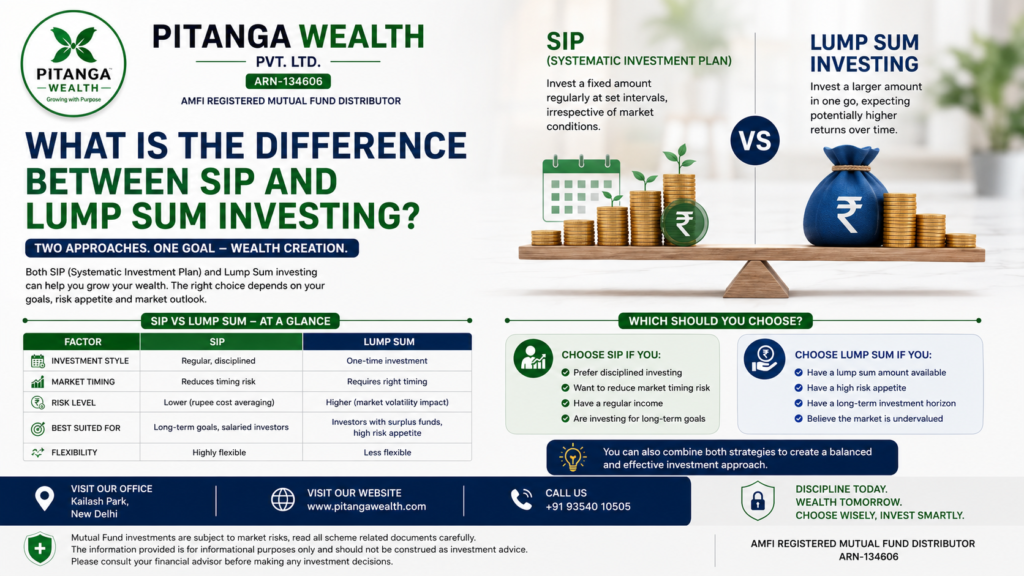
With a SIP, an investor invests a predetermined amount at regular intervals, such as monthly or quarterly. With a lump-sum investment, a larger amount is invested in a single transaction.
Neither method is automatically suitable for every investor. The choice can depend on factors such as the availability of funds, investment objective, time horizon, cash-flow pattern and ability to deal with market fluctuations.
SEBI’s investor-education material describes SIP as a staggered investment approach at specified intervals, while lump-sum investing involves investing a larger amount at one time.
What Is SIP Investing?
A Systematic Investment Plan (SIP) is a facility offered by mutual funds that allows an investor to invest a fixed amount at predetermined intervals.
For example, instead of investing ₹1,20,000 in a mutual fund in one transaction, an investor may choose to invest ₹10,000 each month for 12 months.
The amount, frequency and other terms depend on the particular mutual fund scheme and the SIP facility available.
SIP can be useful for investors who receive income periodically and want to invest a portion of that income at regular intervals.
AMFI describes SIP as a methodology through which investors can invest a fixed amount in a mutual fund scheme periodically rather than making a lump-sum investment.
How does a SIP work?
A simplified example:
Suppose an investor decides to invest ₹5,000 every month.
The amount is invested according to the applicable transaction terms and the prevailing NAV on the relevant transaction date. Since the NAV can differ from one instalment to another, the number of units purchased can also vary.
When the NAV is relatively lower, the same ₹5,000 may purchase more units. When the NAV is relatively higher, it may purchase fewer units.
This is commonly associated with rupee-cost averaging.
However, this should not be interpreted as a guarantee that SIPs will generate profits or eliminate market risk.
What Is Lump-Sum Investing?
A lump-sum investment involves investing a larger amount of money in a single transaction rather than spreading the investment over multiple instalments.
For example, an investor who has ₹1,20,000 available for investment could invest the amount in one transaction, subject to the applicable scheme terms.
The investment is then exposed to the market from the time the units are purchased.
SEBI’s investor-education material notes that with lump-sum investing, an investor typically puts a larger amount into the market at one time and therefore faces the risk of market volatility.
SIP vs Lump Sum: What Is the Difference?
The easiest way to understand the difference is to look at the timing and source of the money being invested.
| Factor | SIP | Lump Sum |
|---|---|---|
| Investment method | Regular instalments | One-time investment |
| Amount invested | Usually a fixed amount at each interval | Larger amount invested at once |
| Cash-flow pattern | Suitable for periodic income | Requires funds to be available upfront |
| Market exposure | Money enters the market over time | Most of the investment enters the market at once |
| Effect of market timing | Purchases occur across different dates | Initial investment is exposed to the market at the investment date |
| Investment discipline | Can encourage regular investing | Requires a larger investment decision at one time |
| Main consideration | Regularity and affordability | Timing, available capital and risk tolerance |
The table describes the general mechanics. It should not be interpreted as a recommendation that one method is superior to the other.
SIP vs Lump Sum: Which Is Better?
There is no universal answer to whether SIP or lump-sum investing is better.
The two approaches solve somewhat different practical situations.
Consider an investor who receives a salary every month and wants to invest a portion of that income. A SIP may provide a convenient way to invest regularly without needing a large amount of money upfront.
Now consider an investor who already has a sizeable amount available for investment, perhaps because of a bonus, maturity proceeds or accumulated savings. That investor may be considering how to deploy the available capital.
The important point is that the availability of money and the timing of investment are different questions.
An investor should consider their financial circumstances and risk profile rather than assuming that one investment method is universally better.
SIP and Market Volatility
One commonly discussed feature of SIP investing is that investments are spread across multiple dates.
Because market prices can fluctuate, each instalment may purchase a different number of units.
For example:
- If the NAV is ₹20, a ₹5,000 instalment would correspond to 250 units, before considering applicable factors.
- If the NAV falls to ₹16, the same ₹5,000 would correspond to 312.5 units.
- If the NAV rises to ₹25, the same ₹5,000 would correspond to 200 units.
This illustrates how the number of units purchased can change as the NAV changes.
It does not mean that a lower NAV automatically makes a fund a better investment, nor does it guarantee a positive return.
Market risk remains present in mutual fund investments.
SEBI investor material also emphasises that mutual fund investments carry risks and that investors should consider the risk-return characteristics of investments before making decisions.
Does SIP Eliminate Market Risk?
No.
This is an important distinction.
A SIP changes the way money is invested. It does not remove the underlying risks of the mutual fund scheme.
If the underlying securities decline in value, the value of the investor’s mutual fund units can also decline.
The risk level can also vary significantly between different types of mutual fund schemes. SEBI’s investor education material explains that mutual fund schemes are labelled according to their level of risk through the risk-o-meter.
Therefore, investors should evaluate the scheme and its risks, not simply assume that investing through a SIP makes an investment safe.
Does Lump-Sum Investing Give Higher Returns?
Not necessarily.
A lump-sum investment may benefit when the market subsequently rises because more of the investor’s money is exposed to the market from the beginning.
However, the opposite can also happen.
If the market falls after the investment is made, the investor may experience a decline in the value of a larger amount of money at once.
Therefore, the outcome of a lump-sum investment depends on factors including the investment itself, the entry point, subsequent market movements, holding period and other circumstances.
It would be misleading to claim that lump-sum investing will always produce higher returns than SIP investing.
Likewise, it would be misleading to claim that SIP will always outperform lump-sum investing.
An Important Difference: Timing of Market Exposure
One of the most important distinctions between the two approaches is when the money becomes exposed to the market.
With a lump-sum investment, the intended investment amount is generally deployed at one point in time.
With a SIP, the money is deployed progressively according to the selected schedule.
This creates a trade-off.
If markets rise consistently after the investment begins, having more money invested earlier could potentially benefit from that growth.
If markets decline soon after a large investment, spreading investments over time could result in some subsequent instalments being made at lower prices.
These are possibilities, not guaranteed outcomes.
The future direction of financial markets cannot be predicted with certainty.
When Can SIP Be Considered?
From an educational perspective, SIP may be relevant for investors who:
- Have a regular source of income
- Prefer investing smaller amounts periodically
- Want to establish a regular investment habit
- Do not currently have a large amount available to invest
- Prefer to spread their market entry over multiple dates
This does not mean SIP is automatically appropriate for every investor.
The mutual fund scheme itself, its risk level, investment objective, costs and other characteristics also matter.
When Can Lump-Sum Investing Be Considered?
A lump-sum approach may be relevant when an investor has a larger amount of money available for investment and is considering investing it at one time.
For example, someone may have accumulated savings or received a legitimate inflow of funds and may need to decide how to deploy that capital.
Before doing so, the investor should consider:
- Their investment objective
- Investment horizon
- Risk appetite and risk capacity
- Need for liquidity
- Existing portfolio exposure
- The risks associated with the chosen investment
- Applicable costs and taxes
Having a large amount available does not automatically mean that investing it immediately is the right decision.
What If You Have a Lump Sum but Prefer Staggered Investing?
Investors sometimes consider a structured approach to deploying a large amount over time rather than investing the entire amount immediately.
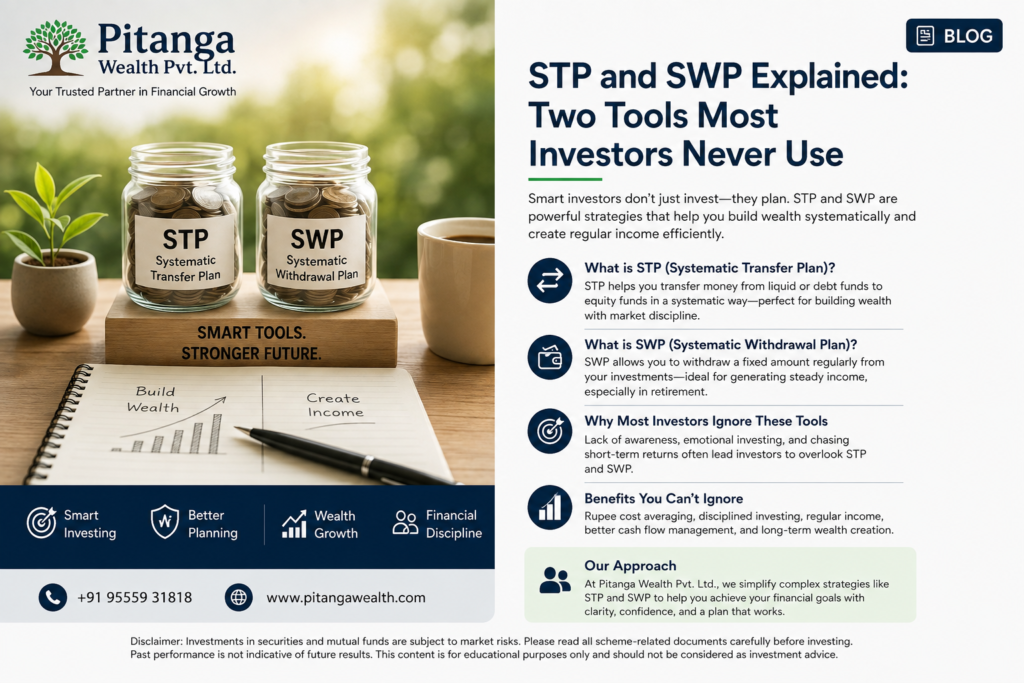
One mechanism available in mutual funds is a Systematic Transfer Plan (STP), where an investor can provide instructions to transfer amounts periodically from one mutual fund scheme to another scheme of the same mutual fund, subject to the applicable scheme terms.
SEBI documents describe STP as a facility under which investors can transfer sums periodically between schemes.
However, an STP is not the same as a SIP.
A SIP generally involves investing fresh money into a mutual fund scheme at regular intervals, whereas an STP involves transferring money that is already invested from one scheme to another.
Investors should understand the specific terms, risks, tax implications and applicable charges before using either facility.
Common Mistakes to Avoid
1. Assuming SIP means “safe investment”
A SIP is an investment method, not a guarantee against losses.
The risk depends substantially on the underlying investment.
2. Assuming lump-sum investing is always better
Investing a large amount at once can provide greater immediate market exposure, but it can also expose the entire amount to market movements from the investment date.
3. Choosing an investment method based only on past returns
Historical performance does not guarantee future performance.
4. Ignoring the risk profile of the mutual fund
Two mutual fund schemes can have very different investment objectives and risk levels.
Investors should look beyond whether the investment is made through SIP or lump sum.
5. Trying to predict the perfect market entry point
Markets are influenced by numerous factors and cannot be predicted reliably simply by looking at short-term movements.
A decision to invest should not be based solely on a claim that the market is about to rise or fall.
6. Following unsolicited investment tips
Investment decisions should not be based solely on social-media posts, messages, rumours or promises of quick profits.
SEBI’s investor guidance encourages investors to conduct appropriate research and cautions against blindly following tips.
SIP vs Lump Sum: Questions to Ask Yourself
Before deciding how to invest, an investor can consider:
Do I have a regular income?
If your investible surplus becomes available periodically, regular investing may fit naturally with your cash flow.
Do I already have a significant amount available?
If you have a lump sum, the decision becomes more about how and when to deploy existing capital.
How long can I stay invested?
The investment horizon can affect how an investor experiences market volatility.
How would I react if the investment declined soon after investing?
Understanding your ability and willingness to tolerate losses is an important part of assessing risk.
Have I evaluated the investment itself?
The choice between SIP and lump sum should not replace analysis of the underlying mutual fund scheme.
SIP vs Lump Sum: The Bottom Line
The difference between SIP and lump-sum investing is fundamentally about how money enters an investment.
A SIP spreads investments across regular instalments, while lump-sum investing puts a larger amount into the market at one time.
SIP can be convenient for investors who have regular cash flows and prefer a disciplined investment schedule. Lump-sum investing may be relevant for investors who already have a sizeable amount available and are comfortable considering the implications of investing it at one time.
Neither approach guarantees profits, eliminates market risk or is universally suitable for every investor.
The more important question is not simply “SIP or lump sum?”
It is:
“Which investment approach is consistent with my financial objective, available capital, investment horizon and ability to handle risk?”
Understanding that distinction can help investors make more informed decisions rather than choosing an investment method based on market trends, social-media claims or promises of returns.
Important Disclaimer
This article is intended solely for educational and informational purposes and should not be construed as investment advice, a recommendation, solicitation or an offer to buy or sell any securities, mutual fund schemes or other financial products. The information provided is general in nature and does not take into account any individual’s financial circumstances, investment objectives, risk profile or suitability requirements. Mutual fund investments are subject to market risks. Investors should carefully read all scheme-related documents and consider the applicable risks, costs, taxes and other terms before investing. Past performance is not indicative of future results. Where appropriate, investors may seek advice from a SEBI-registered Investment Adviser for personalised investment advice.