


A familiar logo, a professional-looking app and an impressive registration number can make a financial service appear legitimate. None of them, individually, proves that the person approaching you is entitled to handle your investments. A genuine stockbroker may have a real regulatory registration while a fraudster uses its name, copied website or forged customer-service account. Learning how to verify a stockbroker in India requires checking the legal entity, the activity it is authorised to undertake, the person contacting you, the platform and the destination of your money.
If you want to verify a stockbroker in India before opening an account, this is practical due diligence, not an administrative inconvenience. The same caution applies when someone calls themselves an authorised person, investment adviser, research analyst, portfolio manager, depository participant or mutual fund distributor. These labels refer to different roles, permissions and investor protections. This guide explains how to perform independent checks using official Indian resources, what the results do and do not establish, and what to do when information does not match.
Quick Answer: How Do You Check Whether a Stockbroker Is Genuine?
To verify a stockbroker in India, first find its exact legal name and SEBI registration details on the SEBI Recognised Intermediaries directory. Cross-check the firm’s stock-exchange trading membership, relevant market segment, authorised persons and official contact information through NSE, BSE or the relevant exchange. Obtain the trading-app link independently from an exchange-maintained authorised-app list. Before depositing funds, verify the official beneficiary bank account or UPI identifier using the applicable intermediary and SEBI Check resources. Do not rely only on a registration number, a screenshot, an advertisement or a caller’s claimed affiliation. [1][2][3]
Know What Kind of Intermediary You Are Dealing With
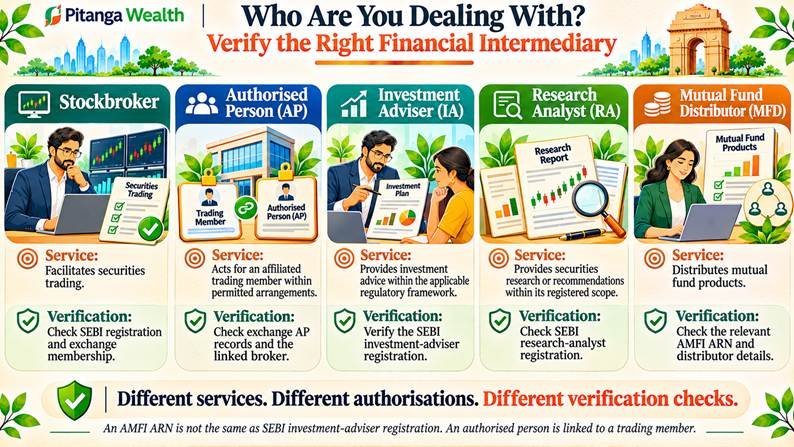
The term “financial adviser” is used loosely in everyday conversation, but Indian securities-market roles have different legal meanings. A broker executes permitted securities transactions on an exchange; an authorised person acts on behalf of a specified trading member under the relevant exchange framework; a registered investment adviser provides investment advice within the applicable regulations; and a research analyst publishes research and recommendations under a different framework. A mutual fund distributor facilitates distribution under an AMFI registration arrangement, which should not be mistaken for a SEBI investment-adviser registration.
Which register should you check?
| Claimed role | Main verification route | What you are checking |
| Stockbroker / trading member | SEBI directory plus NSE, BSE or relevant exchange | Registration, trading membership and segment |
| Broker’s authorised person (AP) | Exchange broker/AP locator and member confirmation | Name, affiliation and permitted relationship |
| Investment adviser (IA) | SEBI recognised intermediary list; applicable BSE IA resources | IA registration and entity identity |
| Research analyst (RA) | SEBI recognised intermediary list; applicable BSE RA resources | RA registration and research-provider identity |
| Portfolio manager (PMS) | SEBI recognised intermediary list | Portfolio-manager registration; contract terms still matter |
| Depository participant (DP) | SEBI plus NSDL/CDSL DP directory | Identity of the DP supporting demat services |
| Mutual fund distributor (MFD) | AMFI distributor locator / ARN status | Distributor identity and ARN status; not IA status |
A directory match is evidence of registration for the specified category, not a guarantee of good investment performance or blanket permission to sell every financial product. A firm may legitimately operate through several legal entities or have different registrations. Confirm the precise entity named in your application and agreement rather than assuming every brand affiliate has the same licence. [1][4][5]
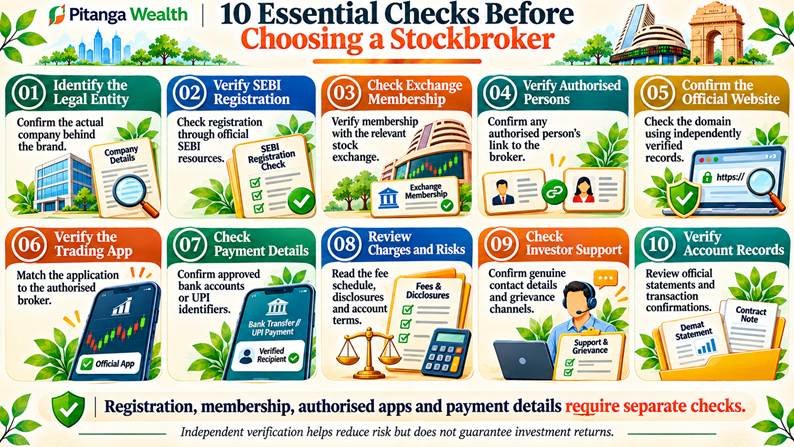
How to Verify a Stockbroker in India: A Ten-Step Process
The following order is designed to identify identity gaps before you share sensitive documents, approve transactions or send funds. If any step is unclear, ask the genuine firm to explain it using a phone number or website you obtained independently.
Step 1 — Get the full legal name and registration details
Ask the representative for the broker’s complete legal name, SEBI registration number, registered address and trading-member code for the exchange and segment relevant to your investment. Capture these details in writing. Marketing names, abbreviations and app names can differ from the legal entity, so ask the firm to explain the relationship if names are not identical. Look for an official compliance page with the full legal identity, grievance contact and applicable regulatory disclosures.
A number beginning with a familiar prefix can still be copied from an unrelated company. To verify a stockbroker in India, treat the claimed number as a search input, not proof by itself. A public directory should identify the actual registered entity; you must independently establish whether the person contacting you represents that entity.
Step 2 — Search SEBI’s Recognised Intermediaries directory
Visit the SEBI website yourself and open its Recognised Intermediaries search. Search by the full registered name or registration number, select or inspect the intermediary category, and compare the returned information with the documents supplied. Do not follow a look-alike link sent in a direct message. SEBI’s Investor Support page also points investors toward official registration checks. [1]
If no result appears, do not immediately conclude the firm is fraudulent. Search spelling variations, legacy names or the correct legal subsidiary, and ask SEBI or the exchange about an apparent mismatch. Some records and registration categories may be presented differently. But until the mismatch is resolved, avoid funding or handing over account control. A screenshot of a SEBI result is not equivalent to opening the live regulator source yourself.
Step 3 — Verify current stock-exchange membership and segment
A stockbroker generally needs membership of the relevant stock exchange to execute trades in that segment. Check the NSE, BSE or applicable commodity/other exchange directory for the legal entity and trading-member code. Confirm the precise segment—cash equities, derivatives, commodities or another relevant market—rather than assuming one membership covers every activity. [2][3]
An organisation’s registration for one regulated service cannot be used to justify an unrelated offering. A genuine equity broker identity, for example, does not automatically authenticate a message offering privately arranged offshore forex profits or an unverified institutional trading scheme. When in doubt, call the exchange’s official investor-support channel or the firm’s compliance team and describe the proposed transaction.
Step 4 — Check the authorised person and branch relationship
Many investors deal with a local representative instead of an exchange member’s head office. An authorised person (AP) may be an individual or entity affiliated with a specific trading member under exchange rules. The NSE Broker Locator includes member and AP-search functionality; BSE also maintains member and other-intermediary directories. Verify the representative’s name, the named trading member, branch and relevant business segment. [6]
An AP is not automatically an independent SEBI-registered broker. If someone claims to be an AP, request their affiliation details and independently contact the principal broker to confirm they are authorised to work with clients. Confirm which organisation accepts funds, issues trade confirmations and handles complaints. To verify a stockbroker in India through a local representative, check the principal firm and the person separately.
Step 5 — Confirm the real website, contact points and social handles
Fraudsters may use one altered character in a domain name, a cloned login page, paid-search advertising, a social-media profile with purchased followers or a messenger account using a real employee photograph. Find the website from official listings or a known verified corporate source. Compare the domain, phone and email address with the firm’s own regulatory and compliance disclosures. Contact the firm using a number you independently found, not one in the suspicious message.
SEBI Investor Support links to exchange-maintained lists of brokers’ social-media handles. Where a relevant exchange list is available, use it to cross-check the account that contacted you. A blue checkmark, professional biography or video appearance alone should not replace independent identity verification. [3]
Step 6 — Authenticate the trading app before downloading
SEBI’s Investor Support page points to official exchange lists of authorised mobile trading apps. NSE’s list includes trading-member names, app names, developer information and app-store links. Compare the app, developer and link before installing anything. An unexpected APK sent by a WhatsApp group or a direct-message link is not a safe substitute for the official app-distribution route. [3][7]
A legitimate broker may have more than one application and a genuine app may be developed by a technology vendor, so do not rely on a single superficial name match. Verify the mapping to the trading member and obtain confirmation through the firm. To verify a stockbroker in India digitally, treat the app’s registration relationship as a separate check from the firm’s SEBI entry. Even an app-store listing by itself is not a regulatory certificate.
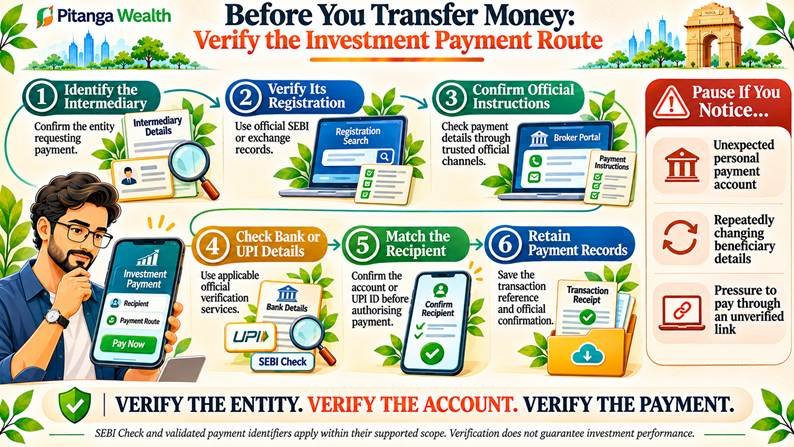
Step 7 — Verify where your funds are actually going
Before a transfer, compare the bank-account name, beneficiary details, UPI identifier and payment instructions with the firm’s genuine official disclosures. For relevant SEBI-registered investor-facing intermediaries, SEBI introduced validated UPI handles and the SEBI Check verification facility effective October 2025. SEBI Check can be used to verify registered intermediary bank-account details and supported UPI IDs; the available interface includes UPI and account-detail verification. [8][9]
Do not interpret the appearance of “@valid” or any payment name in isolation as permission to send money. Use an official verification route and examine the entire result. If the requested recipient is a private individual, an unrelated company or a constantly changing account, stop and ask the genuine intermediary to confirm in writing. Remember that different payment methods and transaction types can have different rules; use only the payment channels approved for your specific transaction.
Step 8 — Read the account-opening and service documents
A genuine securities relationship should be supported by identifiable contractual terms and relevant disclosures. Before completing online KYC or onboarding, review the account-opening material, schedule of charges, applicable risk disclosures, authorised services, privacy and grievance contact. For a trading and demat relationship, understand whether trading and depository services involve one legal entity or two distinct entities and how that is described in the documentation.
Reject demands to sign blank forms, reveal OTPs or hand over unrestricted remote device access. Check that the account is intended to be yours, that communication details are yours and that statements will reach you directly. To verify a stockbroker in India before onboarding, match the firm named in the legal documents to the firm shown in the registration and exchange records.
Step 9 — Verify transactions and independent account records
Once an account is opened, review official account confirmations and genuine contract notes for completed trades. Verify your registered mobile/email alerts and check demat holdings through the relevant depository or DP channels. A dashboard showing an attractive account balance is not evidence that actual securities were bought. A representative who refuses to provide genuine transaction records or redirects you to an unfamiliar website creates a serious verification gap.
Watch for unusual transactions, missing trade confirmations, unexplained charges or instructions to send personal credentials to a broker employee. Escalate discrepancies through the broker’s independently verified support or compliance channel. In addition to the broker’s records, use the official depository and exchange channels made available to investors where suitable.
Step 10 — Repeat the checks when something changes
The need to verify a stockbroker in India does not end after opening an account; verification is not a one-time tick box. Recheck if you receive a new funding instruction, an unexpected link, a request to move to a different app, a new authorised-person contact or a message claiming that your account has been shifted to a special trading scheme. Keep a record of the official sources you used and the date you checked them, recognising that memberships, authorised representatives and application lists can change.
A final check before each material change helps prevent the common error of allowing an impersonator to benefit from an earlier genuine relationship. If a contact says the usual payment channel is temporarily unavailable, pause and independently confirm the explanation.
SEBI Registration, Exchange Membership and App Listing: Why All Three Matter
These records answer different questions. A SEBI intermediary directory identifies a regulated entity and category. An exchange-member directory helps establish whether that entity may carry out the relevant exchange trading activity. An exchange-maintained app list helps link a particular application to an authorised trading member. Payment verification then checks where the money is being sent. None is a substitute for all the others.
| Verification layer | Question it helps answer | It does not prove |
| SEBI intermediary entry | Is this entity registered for this category? | The caller genuinely represents it |
| Exchange directory | Is the broker a member for this segment? | Every scheme promoted in its name is genuine |
| AP / branch locator | Is the named representative affiliated with a broker? | The representative may handle money personally |
| Authorised app list | Is this app linked to a recognised member? | Any link sent in a chat is genuine |
| SEBI Check / account details | Do payment credentials match verified records? | A proposed investment is suitable or risk-free |
For readers asking how to verify a stockbroker in India, the best answer is a chain of independent evidence, not a single badge. The intermediary can be properly registered and still face ordinary market, operational or service risks. Conversely, a fraudster may accurately quote a real firm’s registration number and ask for money through an unauthorised route.
Verifying Other Financial Intermediaries Without Mixing Up Their Roles
Investment advisers: personalised advice requires the right registration
A SEBI-registered investment adviser (IA) operates under a specific investment-adviser framework. If someone sells a personalised advisory package, ask for the exact registered IA identity, service agreement, fee information, disclosures and risk-profiling process. Verify the registration through SEBI’s recognised intermediary records. Depending on the relevant framework, BSE IA resources provide additional information. An individual’s claim to be “certified,” “experienced” or “associated with a broker” does not, by itself, prove IA authorisation. [1][10]
Do not assume that an IA can guarantee returns, trade without suitable authority or demand that you send investment capital to a private account. Registration identifies an authorised category; the contract and actual activity must still fit that category. Seek clarification where “advice,” product distribution, trade execution and account handling are bundled under unclear terms.
Research analysts: recommendations are not the same as account control
A registered research analyst (RA) may provide market research or securities recommendations under the relevant SEBI rules, but that does not by itself authorise the analyst to take custody of client funds or manage trading passwords. Verify the RA identity, registration, applicable disclosures and legitimate payment process before subscribing to a research service. The person behind a Telegram group may use the number of a real RA without being connected to that business. [1][11]
If a supposed analyst directs you to send capital to a new trading app, confirm that separate trading intermediary and app independently. One valid registration cannot authenticate every associated trading offer. This distinction is especially important for investors who discover a research seller through social media.
Mutual fund distributors: check AMFI ARN, not only SEBI records
An AMFI-registered mutual fund distributor (MFD) is not the same regulatory category as a SEBI-registered investment adviser. AMFI provides a distributor locator that allows searches using the distributor name or ARN. It also makes information available concerning suspended, terminated or invalid ARN cases. Ask the distributor about the product route, regular-plan remuneration, applicable disclosures and the AMC’s actual transaction process. [5]
An ARN match establishes a distributor-registration record, not an investment-advice licence or assurance of any mutual fund return. AMFI notes that a distributor must also be appropriately empanelled with the concerned AMC before doing business for that AMC. Investors should confirm the fund, plan, account ownership and official payment and redemption arrangements rather than allowing a third party to move money through an unrelated personal account.
Portfolio managers and depository participants
Portfolio-management services and depository services involve other kinds of regulated entities. Check a claimed PMS provider’s SEBI registration and agreements, including authority, risk, fees, reporting and custody arrangements. For demat services, check the relevant DP through SEBI and the NSDL or CDSL directory. A DP affiliation does not automatically grant someone permission to provide trading advice, and a broker’s app does not replace the depository’s official transaction or holdings information.
These distinctions matter because many suspicious offers blur the words broker, adviser, research analyst, wealth manager and distributor. The safest question is: “Which legal entity is authorised to provide this exact service, and where can I confirm it independently?”
What Are SEBI Check and Validated UPI Handles?
SEBI launched a standardised validated-UPI initiative and SEBI Check on 1 October 2025 for secure investor payments to registered investor-facing intermediaries. The framework includes approved “@valid” UPI identifiers for covered institutions and a mechanism to validate UPI IDs or specified bank-account details. Its objective is to help investors identify genuine payment recipients and reduce impersonation. [8][9]
A practical verification sequence
First, identify the actual regulated entity, not only the brand shown in a chat. Next, obtain its intended payment instructions from its official channels. Open SEBI Check through SEBI’s genuine website or linked authorised service and enter the requested information. Review whether the result supports the identity you expected. Finally, confirm the payment purpose and amount through the same institution’s genuine onboarding or transaction process.
A “no match” result requires clarification before a payment, but it should not automatically be interpreted as a legal verdict on the firm. Coverage, account classifications and technical access may differ; ask the relevant intermediary directly through independently sourced contact details. Likewise, a verified bank account does not make a risky or mis-sold product appropriate for you.
Example: A Real Broker Name, but an Unverified Payment Route
Imagine a Mumbai investor, Asha, who receives a WhatsApp message from someone calling himself a relationship executive of a recognised stockbroking company. The message has the company’s logo, a copied SEBI registration number and an invitation to a “priority IPO allocation.” Asha is told to download a trading app from a private link and transfer ₹50,000 to a third-party bank account before the day’s deadline.
Asha searches the official SEBI directory and confirms that the named stockbroker is real. This is a necessary first check, but it does not establish that the message is genuine. She then checks the broker’s exchange membership and exchange-listed apps. The private app is not among the confirmed links, and the person who contacted her cannot be verified as an authorised representative. The broker’s genuine compliance team, contacted using the number on its official site, does not recognise the proposed payment account or the “priority allocation” offer.
The example shows why people who verify a stockbroker in India should check the whole chain. A scammer can impersonate a real institution. Asha does not send the money, saves the message as evidence and uses the relevant official channels to report the attempted impersonation. This is a hypothetical illustration, not an allegation against any real intermediary.
Warning Signs That Should Stop an Investor From Proceeding
Even when some credentials look credible, stop and investigate if the person insists on a private investment group, an APK or unlisted download link, guaranteed market profits, a payment to an unrelated account, account access through screen-sharing software, or a secret institutional arrangement. A professional document with a registration number and a legitimate company logo can be fabricated.
Some legitimate financial services are complex, but complexity is not a reason to abandon verification. Genuine market professionals should be able to explain their legal entity, role, scope of service, charges, risk and grievance process. They should not need to prevent you from contacting the institution through its official channels. SEBI and exchange investor advisories warn specifically about app impersonation, social-media promotions and assured-return claims. [12]
If Your Checks Fail or You Have Already Sent Money
Before transferring anything
Stop the proposed payment and do not install unknown applications. Save the website address, screenshots, contact numbers, beneficiary information and correspondence. Use the regulator, exchange and registered entity’s official sources to identify the mismatch. If necessary, ask the broker’s compliance officer to confirm whether the communication is genuine. Avoid publicly accusing a named person or company without reliable evidence; report factual details through appropriate channels.
If you suspect cyber-enabled financial fraud
Contact your bank or payment provider immediately. Promptly call the national cybercrime helpline 1930 and submit the relevant complaint at cybercrime.gov.in. Keep payment reference numbers and messages, secure affected credentials from a trusted device and avoid sending extra fees for supposed recovery. Reporting quickly can support an investigation or possible intervention, but it does not guarantee recovery of money. [13]
If it is a dispute with a genuine SEBI-regulated entity
Use the entity’s official grievance or compliance channel first. Where eligible, an unresolved securities-market complaint against a SEBI-regulated entity can be brought through the current scores.sebi.gov.in platform. SCORES facilitates grievance redressal; it is not a general cybercrime hotline or a tribunal that guarantees compensation. Depending on the dispute, the market’s online-dispute-resolution process or other appropriate remedies may be relevant. [14]
For investors who needed to verify a stockbroker in India after encountering a suspicious offer, the correct response depends on whether the issue involves impersonation, unauthorised fraud, a regulated intermediary’s service failure or ordinary market loss. Preserve evidence and use the channel designed for the actual problem.
Practical Checklist: Before You Open an Account or Pay a Financial Intermediary
• Record the legal entity, SEBI registration number and claimed intermediary category.
• Independently check the live SEBI recognised-intermediary entry.
• Confirm trading membership and permitted segments through the relevant exchange.
• Check any authorised person and branch affiliation with the principal broker.
• Compare the website, email, phone and social profile with verified corporate sources.
• Obtain the trading app from a member-linked, exchange-maintained authorised list.
• Confirm official beneficiary bank details or UPI IDs, including SEBI Check where applicable.
• Read charges, risk documents, authority, grievance routes and account terms.
• Keep original transaction confirmations, contract notes and depository records.
• Recheck identities and payment instructions if anything changes or appears urgent.
You can use this checklist to verify a stockbroker in India without relying on a sales pitch. Its purpose is to make a potentially confusing market interaction easier to test. You do not have to judge an unfamiliar firm’s credibility from persuasive advertising or the confidence of a salesperson. Most checks can be started without sharing your password, banking PIN, portfolio data or original identity documents with a stranger.
Frequently Asked Questions
1. How can I verify whether a stockbroker is registered with SEBI?
Search the firm’s exact legal name or registration number in SEBI’s Recognised Intermediaries directory. Then cross-check its exchange membership, app and official contact details. A genuine record does not authenticate everyone who uses the firm’s name.
2. Is a SEBI registration number enough to prove a broker is genuine?
No. A registration number may belong to a genuine broker whose identity a scammer has copied. Verify the number and firm on an official site, then independently authenticate the caller, platform and payment instructions.
3. How do I check whether a broker is registered with NSE or BSE?
Use the relevant exchange’s trading-member directory. Compare the legal entity, code, membership and trading segment. If a local representative is involved, check the AP locator and ask the principal broker to confirm the affiliation.
4. Can I verify a broker’s authorised person or franchise office?
Yes, where the exchange provides a member/AP directory. Check the AP name and linked trading member, then contact the registered firm independently. A local office’s marketing materials alone do not prove the relationship.
5. How can I tell whether a trading app is authorised?
Use the mobile trading app lists linked from SEBI Investor Support and maintained by the relevant exchange. Compare the app name, developer, broker and official download link. Do not install an unexpected APK from a chat group.
6. Does an app-store verification badge guarantee safety?
No. An authentic or verified app label can be a helpful signal, but investors should still verify the registered entity, actual app link, scope of service and payment instructions. No badge guarantees investment performance or eliminates all fraud risks.
7. What is SEBI Check used for?
SEBI Check helps investors validate certain registered-intermediary payment details, including covered UPI IDs and bank-account information. Use the official service and confirm the final destination before paying. It is not a recommendation of the proposed investment.
8. What does an “@valid” UPI handle mean?
SEBI’s validated UPI framework introduced dedicated handles for covered investor-facing intermediaries. Check the whole identifier through official verification rather than assuming any text ending in “valid” is genuine. The payment must also be authorised for that transaction.
9. Is a research analyst the same as an investment adviser?
No. Their SEBI registration categories, scope of services and duties differ. Research recommendations do not automatically permit discretionary control of a client’s trading account, and an IA’s personalised advice requires compliance with the applicable advisory framework.
10. Is an AMFI ARN the same as SEBI investment-adviser registration?
No. An ARN is associated with mutual fund distribution and can be checked through AMFI’s distributor locator. It is not a substitute for verifying an IA registration when a person claims to offer SEBI-regulated investment-advisory services.
11. Can a genuine broker promise guaranteed stock market profits?
No guaranteed outcome should be inferred from the fact that a broker is registered. Equity and derivatives investments have market risks. Be especially cautious of assured-return marketing or exclusive account schemes that cannot be independently documented.
12. What if the broker’s legal name and app brand are different?
That can be legitimate. Identify the precise firm named in the app’s regulatory disclosures, verify its broker registration and exchange membership, and confirm the app’s developer and distribution link through official records. Stop if the relationship cannot be explained.
13. Where can I complain about an impersonated trading platform?
If it involves suspected cybercrime or stolen money, contact the bank and use 1930 and cybercrime.gov.in promptly. For issues with a genuine SEBI-regulated intermediary, begin with the entity’s grievance process and consider SCORES if eligible.
14. Does SEBI registration mean my investment is risk-free?
No. Registration concerns the legal status and obligations of the intermediary; investments retain market, liquidity, product and operational risks. Independent verification is necessary, but it does not replace risk assessment or appropriate advice.
Final Thoughts: Verify the Entity, the Person, the Platform and the Payment
The practical way to verify a stockbroker in India is to compare four independent facts: who the legal entity is, who may speak and act for it, which digital channel is genuinely authorised, and where the investor’s funds are supposed to go. Add the contractual terms and post-trade records, and you have a stronger basis for deciding whether to proceed.
A search result or genuine registration number can support one part of that decision without proving all the others. A trustworthy process welcomes questions, gives investors time to check, and provides records that can be traced through official infrastructure. If facts conflict, stop rather than guessing. The few minutes spent verifying a financial service may protect far more than the time it takes.
Disclaimer
This material is provided by Pitanga Wealth for general investor education, not as personalised investment, legal, banking or tax advice. References to registration, directories and payment frameworks describe publicly available official resources as researched on 12 November 2026. Verify the current information with the relevant regulator, exchange, depository, fund house or institution before acting. Registration does not guarantee returns, suitability, safety or complaint resolution. All illustrations are hypothetical, and no particular firm or individual is accused of misconduct. Financial products involve risks, and the permitted scope of any intermediary depends on applicable rules and authorisations.
Written by Pitanga Wealth Team.
Follow us on Instagram @pitangawealth for more educational insights.
This article is for educational and informational purposes only. It is not investment, tax, legal or insurance advice. Consider your circumstances and relevant documents before making a financial decision.