


A share price appears on a phone. A person says an investor can speculate on that price with less paperwork, flexible credit and lower charges than a conventional stockbroker. The trade seems ordinary because the price follows a real exchange. But what if the order never reaches that exchange? That is the central danger behind dabba trading in India: an apparent securities trade may be only a private arrangement recorded by an unauthorised operator.
India’s securities-market regulator, SEBI, describes dabba trading as illegal and unregulated dealing in securities in which the transaction is not executed on a recognised stock exchange. The operator maintains the deal and settles it internally. The distinction is not merely about the trading app or the size of brokerage: it changes the legal route, records, counterparty exposure and protections available to a customer. This article explains the mechanics, a simple numerical example, warning signs, legal context, verification methods and practical reporting options. [1]
Quick Answer: What Is Dabba Trading?
Dabba trading is an illegal off-exchange arrangement in which an operator records a customer’s securities-price bet or purported trade in a private system rather than executing it through a recognised stock exchange. A live NSE or BSE price may be used as a reference, but that reference does not make the transaction an exchange trade. SEBI warns that investors involved in dabba trading in India cannot use the stock exchange’s regular grievance-redressal arrangements for those off-exchange deals. A regulated broker and an exchange-confirmed trade are different from an operator’s private statement or screenshot. [1][2]

What Actually Happens in a Dabba Trading Arrangement?
The operator records a private deal
In a typical arrangement described in investor-awareness material, a customer tells the operator to take a position based on the price of a security or derivative. Instead of transmitting a genuine order through an authorised trading member to an exchange, the operator notes the supposed buy or sell position in its own ledger or application. The operator may show familiar symbols, market charts and prices, making the experience look similar to ordinary trading. Yet the customer’s transaction is not reflected as an exchange-executed deal. [1][3]
This is why dabba trading in India is sometimes described informally as a parallel market or bucket-shop system. The operator effectively becomes the person who owes the customer an amount if the recorded position moves favourably, or who claims money if it moves adversely. The customer’s ability to receive a payout depends on that private relationship, not on the normal clearing and settlement process of a recognised exchange.
A real market quotation is not proof of a real trade
An operator can display genuine market prices without placing actual exchange orders. A price feed answers what the market shows; it does not establish who accepted the order, whether it executed, whether a valid contract note exists, or whether the relevant trade appears in independent exchange and broker records. A branded website or a convincing dashboard is likewise not evidence of authorised execution.
The precise mechanisms of illegal operations differ. Anyone researching dabba trading in India should not assume that every operator uses the same funding method or software. Some arrangements may be offered face to face, others through messaging groups or apps. What matters is whether the securities transaction genuinely enters the recognised market mechanism through the appropriate authorised participant.
Internal settlement creates a different counterparty risk
In a lawful exchange-traded transaction, the relevant market infrastructure and regulated intermediaries operate under prescribed procedures, disclosures, margin rules, clearing and settlement requirements. Those systems cannot prevent ordinary market losses, but they create recognised records and channels for investor issues. In a dabba arrangement, the operator may control the ledger, change its terms, dispute the calculation or simply fail to pay. SEBI’s investor warning makes clear that the ordinary exchange-grievance route does not apply to such privately settled trades. [1][4]
A Simple Numerical Example: What a Dabba Deal May Look Like
Imagine a fictional individual called Rohan who is shown a quoted share price of ₹500. An unverified operator says he can take a position equivalent to 100 shares without using his own registered stockbroker. The operator records the reference price of ₹500 in a private account. For illustration only, ignore any fees or funding charges and assume the amount is calculated from a simple price difference.
If the reference price rises
Suppose the quoted price moves from ₹500 to ₹512. On paper, the change is ₹12 per share. For the notional 100 shares, the displayed gain would be ₹1,200 (₹12 × 100). The operator may show this number in an app or ledger. That figure is not a broker-issued contract note, is not evidence of a stock exchange execution, and does not prove that Rohan can withdraw ₹1,200.
If the reference price falls
If the price moves from ₹500 to ₹486, the recorded change is minus ₹14 per share, or a notional loss of ₹1,400 for 100 shares. The operator may demand settlement under whatever private rules it claims to use. The exposure can become more serious where the customer was encouraged to take a large notional position relative to the cash initially deposited.
For readers assessing dabba trading in India, the example explains the arithmetic of an unexecuted price-based bet; it is not a demonstration of a lawful stock or derivative transaction. Actual exchange trades have their own instrument, margin, transaction, settlement and risk requirements. The attraction of apparent convenience is not a substitute for legality, verification or counterparty protection.
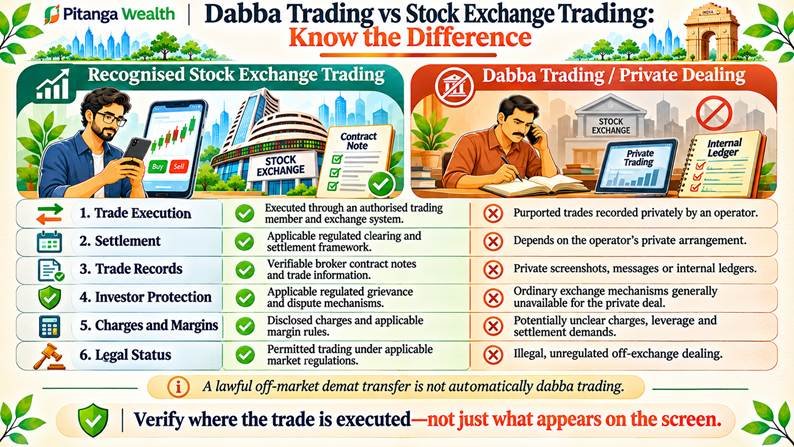
Dabba Trading vs Genuine Stock Exchange Trading
| Feature | Recognised exchange trading | Dabba or private off-exchange dealing |
| Trade execution | Order executed through authorised trading member and exchange system | Purported order recorded or settled privately by operator |
| Counterparty and settlement | Applicable exchange/clearing framework and member obligations | Operator’s private ability and willingness to settle |
| Evidence | Genuine broker contract notes and independently checkable trade information | Private ledger, message or app screen may be the only record |
| Investor safeguards | Applicable regulated grievance, dispute and protection mechanisms | Exchange mechanisms generally unavailable for the illegal deal |
| Charges and margins | Disclosed charges and regulatory margin/risk frameworks | Private fees, leverage or terms may be opaque or changeable |
| Legal character | Permitted transactions subject to relevant market rules | Dabba trading is prohibited and exposes parties to legal risk |
Comparing dabba trading in India with regulated exchange trading should not be read as a claim that exchange-traded securities are risk-free. Share prices can fall, derivatives can create substantial losses, and an investor can have a legitimate complaint with a registered broker. The central difference is that a regulated trade has a recognised execution and recordkeeping framework. A privately maintained bet that merely uses an exchange price does not. [1][2][4]
Is Dabba Trading Illegal in India?
Yes. SEBI explicitly identifies dabba trading in India as illegal and unregulated. NSE’s investor advisories likewise warn against off-exchange dabba and other prohibited schemes and state that organising, assisting or participating in such activity can attract legal consequences under applicable law. Trading through a private book should not be mistaken for an alternative licensed exchange venue. [1][2][5]
The securities-law context
NSE has cited relevant provisions of the Securities Contracts (Regulation) Act, 1956 (SCRA) in its warnings against illegal trading platforms, including Sections 13, 16, 17 and 19, with punishment provisions under Section 23 for applicable contraventions. A December 2024 NSE caution described potential penalties, on conviction, of imprisonment extending to ten years, a fine up to ₹25 crore, or both for the cited statutory violations. Actual liability depends on the conduct proved, the applicable provisions and legal process; the statement should not be interpreted as saying that every person contacted by an operator automatically commits the same offence. [6]
For anyone already involved, questions about criminal, regulatory, civil or tax consequences require fact-specific professional advice. A blog article cannot determine whether a particular individual acted knowingly, was deceived, or has a particular legal defence. Readers should avoid deleting records or making false explanations of transactions.
Not every legitimate off-market transfer is dabba trading
Indian investors may also hear the phrase “off-market transfer” in a lawful demat-account context, such as an otherwise permitted transfer of securities between beneficial owners subject to depository, tax and other rules. That is not automatically the same as running an illegal parallel trading book. The question is whether a purported securities transaction or speculation is routed through the authorised legal mechanism, rather than privately matched as a substitute for an exchange transaction.
Equally, an over-the-counter transaction may have a lawful framework for a different product and participant category. The word “off-exchange” alone should not be used to accuse every financial transaction of dabba trading. The evidence and applicable market rules are decisive.
Why Some People Are Attracted to Dabba Trading
The promise of lower visible transaction costs
An unverified operator may claim to avoid brokerage, statutory transaction charges or formal account-opening costs. It may even advertise cash settlement with no paperwork. SEBI’s own investing dos and don’ts warns that dabba trading remains illegal even if it appears to save costs. A headline saving is worthless if the customer has no reliable claim on an alleged gain or loses funds to an operator who cannot be held accountable through normal market channels. [4]
Large positions with little upfront money
Offers of unusually generous leverage may make losses look distant. A person contributing a small sum may be shown a much larger notional exposure, creating rapid gains on screen and equally rapid losses. Because an illegal operator is not providing exchange-regulated margin arrangements to the customer for the purported deal, its personal demand for additional collateral or settlement should not be mistaken for an official margin call.
Convenience, familiarity and social pressure
An acquaintance may describe the operator as a “trusted local dealer” or a Telegram administrator may show long lists of profitable trades. Familiarity, a physical office, occasional successful withdrawals and even a real market-price feed can build confidence without proving authorised trading. Dabba trading in India can be presented as a shortcut for people who feel the regulated process is complicated or slow. Simpler onboarding is never an exemption from securities law.
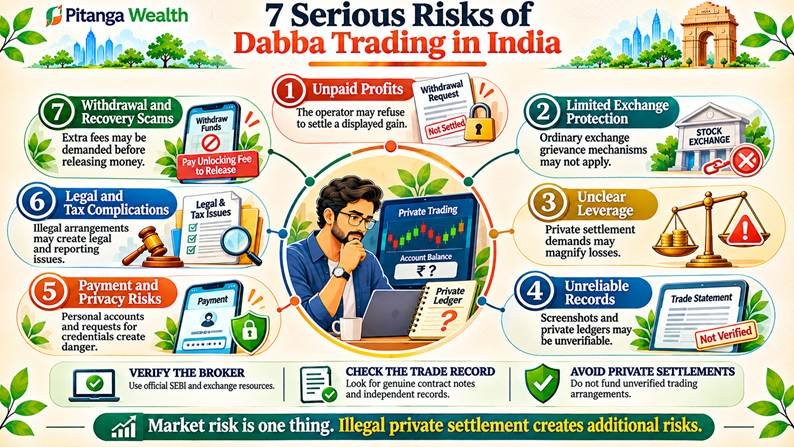
Seven Serious Risks for Indian Investors
1. The operator may not honour a claimed profit
A gain displayed on a screen is not the same as funds legally due under an exchange-executed transaction. The operator could refuse to settle, dispute a price, impose a new charge or disappear. The customer may be unable to establish the independent records normally associated with a genuine securities trade.
2. The exchange’s ordinary protection system may not help
SEBI says the grievance mechanism of stock exchanges is unavailable for dabba deals that were never executed there. NSE likewise warns that investors in prohibited schemes cannot expect its investor-protection jurisdiction, exchange dispute-resolution mechanism or exchange-administered grievance system to apply. For people considering dabba trading in India, this is a significant difference between market risk and the risk of dealing with an unauthorised private counterparty. [1][2]
3. Unclear leverage and settlement demands can magnify losses
A private ledger may show a modest deposit supporting an outsized position. The person accepting the deal could calculate additional debts under vague terms or threaten the customer for immediate payment. Independently verified records, suitable risk disclosures and authorised funding channels matter especially when a position moves quickly against the customer.
4. Records may be fabricated or inaccessible
Screenshots, spreadsheets and chat messages can be edited or lost. The operator may not issue a valid exchange-linked contract note. In genuine securities trading, investors should receive and preserve the required contract notes and check communications from brokers, exchanges and depositories. These records help identify discrepancies and support complaints through the appropriate regulated channels. [7][8]
5. Privacy and payment safety may be compromised
Some promoters request deposits to personal bank accounts, identity documents, trading passwords or remote-device access. An investor may then face separate fraud risks even if a proposed dabba trade never occurs. Do not send OTPs, UPI PINs or broker credentials to a messenger administrator, and independently confirm a payment destination before approving any transfer.
6. Legal, banking and tax complications may follow
Participation in an illegal securities arrangement can raise legal questions. Cash movements, undocumented settlements and unexplained transfers can create additional banking, tax or source-of-funds questions depending on the facts. There is no general rule that an investor can avoid tax or reporting obligations because an operator calls the activity “private trading.” Get individual advice rather than relying on a promoter’s assertion that the arrangement is invisible to authorities.
7. An apparent exit may become another scam
An operator may demand a new “withdrawal tax,” “unlock fee” or “audit charge” before releasing profits. A different person might then offer to recover lost money for an advance payment. These messages are warning signs, not official exchange procedures. If you suspect cyber-enabled fraud, preserve evidence and alert the bank and cybercrime authorities rather than sending more funds. [9]
How to Recognise a Possible Dabba Trading Offer
Signs of dabba trading in India cannot be reduced to one app colour, a particular language or the use of a chat platform. Instead, look for a combination of claimed securities exposure and an absence of genuine exchange execution. A credible verification process tests records against independent sources rather than treating persuasive messages as proof.
Warning sign 1: “We trade outside the exchange”
The person openly offers an alternative private book or says an exchange account is unnecessary. Another version uses words such as “internal settlement,” “paper trade with real payouts” or “private stock contract” while asking for actual money. Educational paper-trading simulators that use no real financial settlement should not be confused with an illegal paid arrangement; the critical facts are what is contracted and funded.
Warning sign 2: No verifiable trading member
A promoter supplies a vague firm name, a borrowed registration number or no identifiable NSE/BSE member at all. They may claim to represent a broker without any confirmed authorised-person relationship. Verify the legal entity and representative through official SEBI and exchange directories, then independently contact the genuine firm. [5][10]
Warning sign 3: Private funding and settlement instructions
The investor is asked to send deposits to a personal account, a changing UPI ID or an unrelated third party, with gains and losses settled in cash or by informal transfers. Payment instructions alone do not settle every legal question, but an unexplained beneficiary is a reason to stop and verify rather than proceeding with an alleged securities transaction.
Warning sign 4: No exchange-linked contract notes or alerts
For genuine exchange-executed securities trades, investors should review broker contract notes and applicable exchange/depository alerts. An operator who offers only a private screenshot cannot establish the same exchange execution. A missing individual alert alone is not conclusive because account settings and technical problems can affect delivery; investigate against actual independent records. [7][8]
Warning sign 5: Guaranteed gains or “risk-free” settlements
A person promises the operator will always pay or guarantees exceptional trading profits. Neither a legitimate market investment nor an illegal private bet becomes risk-free by contractual optimism. Ask who owes the amount, which rules apply and what reliable independent proof exists of the deal.
Warning sign 6: A secret app or administrator-only ledger
The customer receives an APK or login controlled only by a group administrator and cannot verify the app on the authorised exchange lists. Even a professional-looking interface with a live market chart can be a front end for an operator’s book rather than a genuine stock-exchange transaction. [5]
How to Check Whether a Proposed Trade Is Genuine
Step 1: Identify the registered broker and its market segment
Ask for the full legal name, SEBI registration number, exchange trading-member code and the precise market segment. Use the SEBI Investor Support page and the NSE broker locator or corresponding exchange directory. An entity’s registration in one segment does not establish authority for all products or privately arranged settlement schemes. [5][10]
Step 2: Confirm the platform independently
Open the broker’s real website using a source you found yourself, not a referral link in a chat. Cross-check any mobile app through the exchange-maintained authorised-app resources linked from SEBI Investor Support. Ask the genuine broker whether the alleged service and representative exist. [5]
Step 3: Confirm the trade record
For actual exchange trades, ask for an authentic broker contract note and examine its instrument, trade details, charges and timing. Compare available alerts and independent broker or exchange reporting features. For delivery-based equity holdings, verify appropriate depository records; remember that a genuine cash-settled derivative trade does not necessarily produce a shareholding in your demat account. Absence of a demat share alone is not proof of dabba trading. [7][8]
Step 4: Check the actual payment recipient
Confirm that funding instructions come from the legitimate registered intermediary through an approved channel. Do not assume a recipient is safe because the UPI name looks familiar. If the intermediary and payment route are covered by a specific official validation service, use it within its stated scope. Keep the verified details and transaction reference privately.
Step 5: Stop when the evidence conflicts
Do not place a small “test trade” to see whether the operator pays. An early payout can be manufactured to encourage bigger deposits, and making the transaction may itself expose the customer to legal and financial risk. Seek the relevant exchange’s investor-support guidance or qualified legal advice if you cannot determine what type of activity is being offered.
What If You Were Approached but Have Not Paid?
Decline the proposal without sharing financial credentials. Preserve the pitch, website address, names used, payment instructions and any claims about exchange affiliation. Avoid making public allegations about a named individual without evidence; the proper step is to submit factual information to a suitable official authority or the exchange’s investor-warning channel. NSE maintains investor advisories relating to prohibited schemes and a way to locate legitimate trading members. [2][10]
If the person claims to be attached to a genuine broker, contact that broker’s compliance team using details obtained from its verified website. The company may be able to confirm whether the proposed application, employee or bank account belongs to it. Warn family members not to reuse links or forward trading passwords in an effort to “check” the offer.
What If You Have Already Sent Money or Joined?
Stop the activity and preserve evidence
Do not send additional money for settlement, withdrawal, legal clearance or recovery promises. Save screenshots, messages, operator names, app download links, bank or UPI transaction references and any purported account statements. Avoid falsifying or destroying records. If a personal bank or trading account was compromised, secure it using the real institution’s support channel and change credentials from a trusted device.
Contact the bank and the appropriate authorities
If someone offering dabba trading in India obtained money through suspected cyber-enabled fraud, contact the bank or payment provider promptly, call 1930 and submit the relevant report through cybercrime.gov.in. The Ministry of Home Affairs confirms that these are the national cybercrime-reporting arrangements. Reporting promptly may support intervention, but it does not guarantee a refund or the outcome of an investigation. [9]
If the matter involves an illegal trading operator, the police or relevant law-enforcement authority may need to assess the offence. NSE’s official investor-advisory page gives exchange-related reporting and caution resources. Someone worried about their own participation should consider independent legal advice because the facts may raise both reporting and legal-exposure questions.
Do not confuse cybercrime reporting with SCORES
SEBI SCORES facilitates eligible grievances involving SEBI-regulated entities such as registered intermediaries, listed companies and market infrastructure institutions. It is not a general mechanism for obtaining an exchange settlement for transactions that never occurred on the exchange. If a registered broker itself is implicated in a separate genuine regulated-service complaint, use its grievance process and assess SCORES eligibility; the existence of a fake operator does not automatically make SCORES the correct first destination. [1][11]
| Situation | Practical first step | Important limitation |
| Invited to a suspected illegal dabba scheme | Preserve evidence and check NSE/SEBI official advisories | Do not join to gather proof |
| Paid into a suspected cyber-fraud account | Contact bank, call 1930 and file at cybercrime.gov.in promptly | Recovery is not assured |
| Threats or illegal operator dispute | Consider local police/law enforcement and legal advice | Exchange mechanisms may not cover deal |
| Separate grievance with a registered broker | Approach broker, then SCORES if eligible | SCORES is not an all-purpose fraud-recovery forum |
A Fictional Case: Why Independent Trade Records Matter
Meera follows market prices on her phone but has never placed a trade. A familiar acquaintance offers “special settlement trading” with no broker account and says that all profits and losses will be settled weekly. The app shows a chart using real stock prices. Meera is told a deposit of ₹20,000 will support a much larger notional position. The operator calls the arrangement an easier way to trade because “exchange paperwork is unnecessary.”
Before sending money, Meera looks up the alleged firm on the official broker locator. The person cannot identify a trading member responsible for exchange execution, and there is no credible path to a genuine broker contract note. She also notices that the proposed deposit would go to a private account unconnected to the firm. She declines, keeps the messages and checks official SEBI investor material. The example is fictional and does not accuse any real business; it shows why dabba trading in India must be identified from the transaction’s actual route rather than from familiar market terminology.
Frequently Asked Questions About Dabba Trading
1. What does the term dabba trading mean?
It refers to an illegal, privately recorded arrangement based on securities prices in which the purported customer trade is not executed on a recognised stock exchange. The operator settles the recorded position internally. This is different from trading through a registered broker and exchange mechanism. [1]
2. Is dabba trading legal in India in 2026?
No. SEBI’s current investor guidance expressly calls the activity illegal. NSE’s advisories also warn of potential statutory consequences under the applicable securities laws. Individual legal exposure depends on the person’s actual conduct and facts; do not rely on a promoter’s assurance that the scheme is lawful. [1][6]
3. Why is dabba trading dangerous even when prices look accurate?
The quote may follow a real market, but the person’s own deal may exist only in the operator’s ledger. The customer then depends on the operator to honour any claimed payout and may not have access to exchange-run grievance and dispute mechanisms for that arrangement.
4. Does dabba trading happen only in cash?
No single payment method defines it. An operator might seek cash, bank transfers or digital payments. The decisive question is whether the supposed securities trade was actually executed through a lawful authorised route rather than privately maintained outside it.
5. Is dabba trading the same as trading futures and options?
No. Futures and options can be traded lawfully on recognised exchanges through registered members subject to relevant rules and risks. A dabba operator may merely imitate the prices or terminology of such products without executing a valid exchange trade.
6. Can an app from an app store still be a dabba platform?
An app-store listing does not itself prove that the platform is linked to an authorised trading member. Check the exact app, developer and associated broker using official exchange-linked resources and the genuine firm’s support channels. [5]
7. What if an operator initially paid me a profit?
An initial payment is not proof that later profits are enforceable or that genuine trades occurred. Some deceptive arrangements use early payouts to build trust. Stop and independently confirm the legal entity, transaction and records rather than increasing deposits.
8. Can a dabba trading customer complain to the stock exchange?
SEBI explains that the normal stock-exchange grievance route is unavailable for deals not executed on a recognised exchange. The investor may still have other legal or law-enforcement avenues depending on the facts; exchange jurisdiction is not created by a screenshot using exchange prices. [1][2]
9. Are investors guaranteed repayment if they report an illegal operator?
No. Reporting may assist an investigation, but repayment depends on the circumstances, law, available assets and actions of authorities. Do not trust a person who guarantees recovery in exchange for another advance fee.
10. Is an off-market demat transfer always dabba trading?
No. A lawful off-market transfer of securities through a depository process is a different kind of transaction. Examine the legal nature of the activity and the recordkeeping arrangement rather than treating the words “off-market” and “dabba” as interchangeable.
11. How do I know if an executed trade is real?
Identify the authorised broker, verify the applicable exchange membership and examine authentic contract notes and independent market or account alerts. A trade confirmation from an unknown group administrator is not equivalent to a broker’s verifiable record. [7][8]
12. Does SEBI registration guarantee profits or prevent losses?
No. Registration does not eliminate market risk, derivatives risk or operational problems. It establishes a regulated identity and obligations for activities within the registration’s scope; investors still need product due diligence.
13. Where should I report money lost in a suspected online dabba scam?
Contact the bank promptly, call 1930 for suspected cyber-enabled financial fraud and report through cybercrime.gov.in. Preserve evidence and consider the relevant police or law-enforcement route. If a separate genuine regulated-entity dispute exists, check whether the intermediary’s grievance process and SCORES apply. [9][11]
14. Are lower brokerage charges a good reason to use dabba trading?
No. Saving apparent fees is not a justification for entering an illegal, privately settled arrangement. SEBI explicitly cautions against dabba trading in India even where it seems cheaper than ordinary stock-exchange transactions. [4]
Conclusion: Check the Trade, Not Just the Price
A genuine market price can appear on many screens, including an operator’s private ledger. It does not establish that a customer owns securities, that a derivative contract was executed, or that money is protected by an exchange framework. The most useful question is not whether an arrangement offers attractive fees or fast profits; it is whether the alleged trade has a legitimate, independently verifiable execution route.
The safest response to a dabba offer is to avoid participating, verify any claimed intermediary through official sources and preserve information if wrongdoing is suspected. People evaluating dabba trading in India should remember SEBI’s central warning: a privately recorded deal does not give the customer the ordinary protections of an exchange-executed transaction. This educational explanation cannot replace qualified advice when specific legal or financial circumstances are involved.
Disclaimer
This material is general investor awareness from Pitanga Wealth, not personalised investment, trading, legal, criminal, tax or recovery advice. All persons, amounts and transactions in examples are hypothetical. This article describes public SEBI/NSE guidance researched on 13 November 2026. Actual regulatory status, laws, procedures, bank or exchange services and reporting channels should be checked through live official sources before action. Legal exposure and remedies depend on specific facts. Stock-exchange trading does not guarantee investment returns; illegal trading does not gain legitimacy by using genuine market quotes. No recovery, prosecution or other outcome is promised.
Written by Pitanga Wealth Team.
Follow us on Instagram @pitangawealth for more educational insights.
This article is for educational and informational purposes only. It is not investment, tax, legal or insurance advice. Consider your circumstances and relevant documents before making a financial decision.