

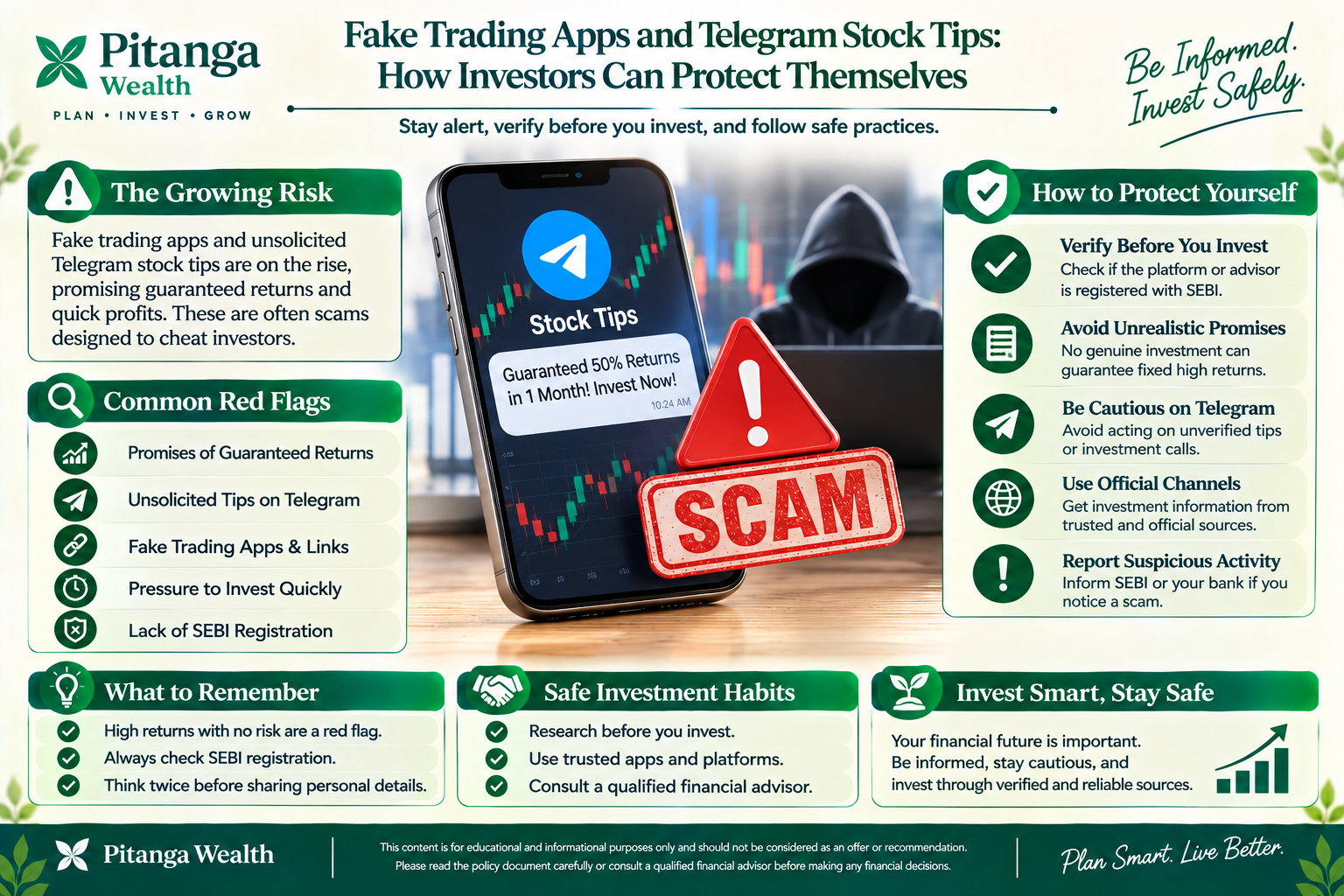
A trading app can show live-looking prices, a growing portfolio and an impressive withdrawal button without proving that any securities have been bought. At the same time, a Telegram group can display hundreds of enthusiastic comments without proving that the people, profits or research are genuine. These two digital environments increasingly appear together in investment-fraud warnings. Understanding how fake trading apps work—and how unverified stock-tip channels promote them—helps Indian investors check the transaction before putting money at risk.
This guide goes beyond the basic warning signs covered in Blog 47. It examines the stages of a typical digital trading scam, explains how to authenticate an app and broker, shows which records should exist in a genuine securities-market transaction, and separates cybercrime reporting from regulatory grievance routes. Not every online discussion, paid research service or poorly performing investment is fraudulent. The point is to verify the people, product, platform and payment path independently.
Quick Answer: How Can You Check a Trading App or Telegram Stock Tip?
Treat an investment invitation as unverified until you can independently identify the broker or adviser, check the relevant SEBI registration and exchange membership, match the app with the exchange’s authorised-app list, and confirm payment instructions through official channels. Do not rely on screenshots, celebrity videos, a group administrator’s identity card or a small initial payout. Fake trading apps can imitate professional interfaces, while Telegram stock tips may be accompanied by fabricated testimonials, urgency and pressure to pay into unrelated accounts. If funds have already been transferred under suspected fraud, stop additional payments, contact your bank immediately and use the appropriate official reporting channel.
Why Social-Media Tips and Fake Trading Platforms Work Together
An ordinary broker app is only one part of a regulated market infrastructure. The client has a relationship with an identifiable intermediary, executes permitted orders, receives records and can access established grievance channels. A scam promoter instead tries to move the entire relationship into a group chat and a controlled website. The person giving the ‘tip’, the apparent broker, the displayed holdings and the payment recipient may all be part of the same deception. This is why fake trading apps should be evaluated as part of a wider payment and identity chain.
A messaging group can manufacture social proof. An administrator announces a successful stock call; other accounts reply with screenshots of profit; a ‘mentor’ claims access to an institutional or VIP account. The target investor sees a stream of apparently independent people agreeing with the offer, but there is no reliable evidence that the messages represent genuine customers. The promoter then directs the investor to an unfamiliar trading app, often presenting this step as necessary for a special allocation or higher-return strategy.
SEBI’s investor-awareness material describes this progression, including social-media advertising, trust-building, app installation, displayed profits, pressure to deposit more money and blocked withdrawals. That is a pattern to recognise, not a claim that every Telegram finance group is criminal. The key issue is whether the provider and transaction can be authenticated outside the sales channel; fake trading apps exploit the absence of that independent check. (SEBI investor alert)
Why a convincing interface is weak evidence
Design, market charts, payment screens and account balances can be reproduced without a lawful brokerage relationship. A logo, a near-identical company name and a polished mobile app may simply copy a real firm’s branding. Even a listing in an app store is not a substitute for confirming the actual app and publisher against the broker’s authorised channels and the relevant exchange records. Conversely, a legitimate market loss or a temporary technical incident does not automatically establish fraud; the supporting facts matter.
Why the payment path matters more than the displayed profit
An investor who transfers funds to an unknown personal account may not have funded a brokerage account at all. The trading screen can later show an invented balance because the operator controls the display. Before a payment, identify the recipient, payment purpose, real legal entity and authorised funding process. SEBI has rolled out validated UPI handles and SEBI Check to help investors verify payment details of registered intermediaries, within the scope of those facilities. (SEBI secure-payments update)
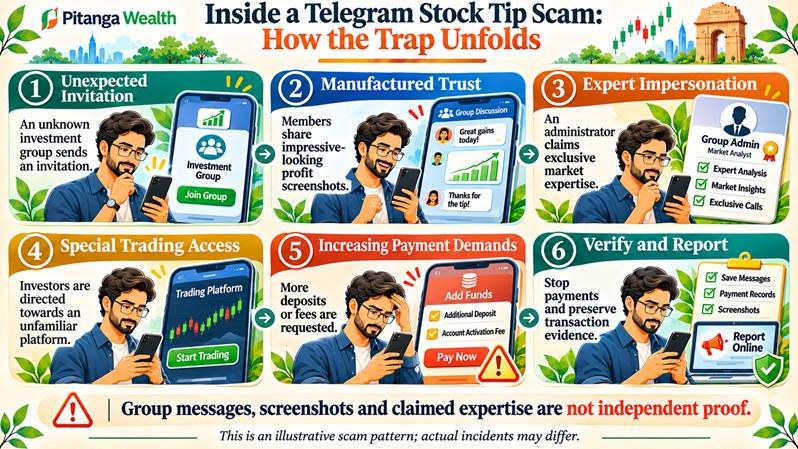
The Seven-Stage Anatomy of a Fake Trading App Scam
The following sequence is adapted from SEBI’s fake-trading-app investor alert and expanded into practical checks. Not every incident follows all seven steps or follows them in order. The purpose is to spot the point where the investor is being asked to trust a new entity without independent evidence.
Stage 1 — The unsolicited invitation
An online advertisement, message, livestream or Telegram invite promises stock-market insight, an exclusive allocation or unusually consistent profits. The message might refer to a respected brokerage, well-known analyst or foreign institution. Screenshots and names are easy to copy, so the invitation proves neither registration nor authorisation.
Protection step: Avoid clicking the payment or installation link. Search for the genuine entity using an independently obtained official source. If you did not request the conversation, treat the sender’s financial claims as unverified.
Stage 2 — Manufactured trust in a private group
A group administrator posts apparent testimonials, daily profit totals and trading successes. Different accounts reinforce the message and discourage questions. Some channels provide broadly plausible market commentary before a premium membership or ‘special account’ is offered, which makes the transition seem natural.
Protection step: Ask whether the claimed adviser or research analyst is registered for the service offered, and check the identity directly. Do not accept forwarded certificates, membership badges or a group admin’s promise as independent verification. A real registration number can also be misused by an impersonator.
Stage 3 — The switch to an unfamiliar app
The investor is told to install a new trading application or visit a nearly authentic-looking website. A direct APK file, shortened URL, unofficial QR code or private download link is especially concerning. The app may require broad permissions or offer no identifiable publisher. Fake trading apps are often introduced only after the group has built trust.
Protection step: Find the authorised mobile-app list through SEBI Investor and the relevant exchange. Match the intermediary, app name and publisher, then verify the broker’s official website, support number and app link independently. Do not install remote-control software at anyone’s request.
Stage 4 — The apparent account balance rises
Deposits appear as buying power, and the dashboard shows trades, allotments or profits. A fictional trading screen can produce the desired numbers even if no exchange order was placed. Some schemes allow an early withdrawal, which is used as evidence that larger deposits are safe. A successful small payout does not verify the entire platform.
Protection step: Check whether real trade confirmations, exchange records and account statements exist in the genuine intermediary’s system. Learn where the demat holdings or derivative positions would normally be reflected. A screenshot from the suspicious app is not equivalent to those records.
Stage 5 — Pressure to increase deposits
The promoter may announce a limited-time institutional deal, an IPO allotment, a margin requirement or an upgrade to a high-return club. The original payment is treated as too small to capture the claimed profit. The investor may also be asked to borrow money or route several separate payments to new beneficiaries. In fake trading apps, the changing beneficiary may be more revealing than the displayed trades.
Protection step: Refuse urgency-based funding requests until the underlying product and counterparty are verified. Ask for written risk disclosures, genuine transaction records and payment instructions. Do not send additional funds merely to protect money already transferred.
Stage 6 — A withdrawal becomes conditional
When a withdrawal is requested, the operator may cite an unlocking charge, advance tax, verification deposit, compliance fee or additional margin. New conditions may follow each payment, and the account balance keeps appearing large. The claimed fees may have no legal basis and could be a way to extract more money.
Protection step: Stop payment, preserve the messages and transaction records, contact the paying bank or provider and promptly report suspected cyber-enabled fraud. Do not provide a UPI PIN or OTP to ‘receive’ a refund. A real tax obligation is not established by an unknown chat administrator’s demand.
Stage 7 — The platform disappears or a recovery agent appears
The app may stop loading, the administrator may leave the group, or the website may be replaced. Another contact may then offer to recover the loss for a new fee. This second approach can target the same people because their personal details are already available to the fraud operator.
Protection step: Do not pay an unverified recovery intermediary. Keep a chronological record of interactions and use authentic police, bank and regulatory channels. Recovery is not guaranteed, even when the initial report is prompt.
Telegram Stock Tips: Education, Research and Suspicious Solicitation
Telegram is a communication platform, not a regulatory certificate. Some groups discuss publicly available business news or investment concepts. Others may provide securities recommendations as a service, and the applicable registration and conduct obligations depend on what is actually offered. A group is not legitimate merely because it says ‘educational purposes only’, and not every opinion shared online automatically amounts to a registered investment advisory service. The risk becomes acute when these channels funnel users towards fake trading apps or unverified payment recipients.
When a stock tip starts to resemble a sales funnel
Watch for a progression from free commentary to paid trade calls, private portfolio access, account handling, exclusive IPO funding or deposits into an unfamiliar application. A recommendation that does not disclose who wrote it, the basis of the recommendation, the conflicts of interest, relevant risks or the legal service provider deserves particular scrutiny. Be careful with any claim that past profitable calls eliminate future risk.
How impersonation changes the risk
A genuine broker or analyst may maintain an official social-media presence, but a scammer can create a similar name and reuse photographs. An apparent SEBI registration number is not enough; the number must correspond to the right entity, category and person providing the service. Verify the contact route through the registered entity’s own known website and exchange-provided social-handle information where available. Ask whether the exact group and representative are authorised. (SEBI Investor Support)
Why coordinated screenshots are not independent proof
A busy channel is not a randomly selected sample of investor outcomes. Administrators can remove negative replies, use controlled accounts and selectively publish gains while hiding losses. Screenshots may omit deposits, transaction charges and time periods. A claim of ten successful calls in a row is not a performance audit. Investors should evaluate the product and risks from independent records, not a collection of messages.
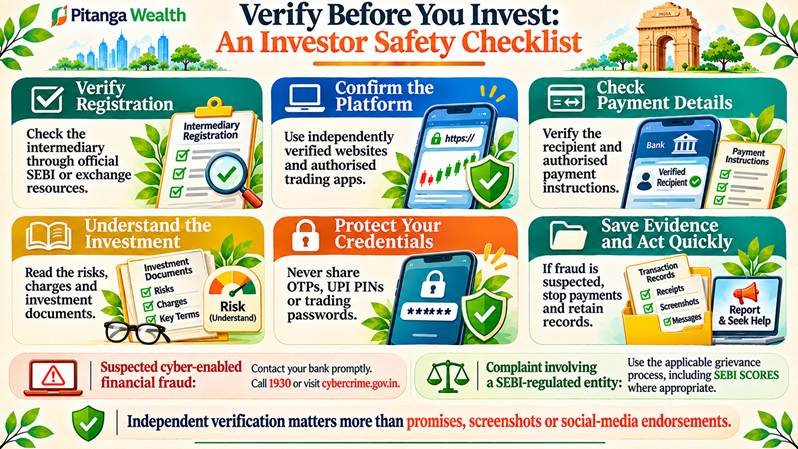
How to Verify a Trading App in India: Eight Checks
Before installing software, sharing documents or paying, use the following repeatable verification procedure. It is designed to test the chain from legal entity to app to money recipient. Fake trading apps are hardest to detect when the investor checks only one link in that chain.
1. Identify the exact legal entity
Write down the complete company or intermediary name, the SEBI registration number claimed, the service category and the official website. A display name such as ‘India Global Securities VIP’ is not a substitute for a legal entity. Verify the registration against SEBI records and, for brokers, relevant exchange membership information.
2. Match the app with authorised exchange listings
SEBI Investor’s Investor Support page links to the authorised mobile trading app lists of NSE, BSE and other exchanges. Use those links to identify the actual application and relevant broker. Do not rely solely on a forwarded store link. If a listed name differs from the app in a group, contact the broker’s official support channel before continuing. (SEBI Investor Support)
3. Verify the real domain and app publisher
Check spelling, domain history where appropriate, secure connection and the app developer or publisher. A padlock in the browser confirms encryption to a site, not that the site belongs to a regulated broker. A logo and a five-star rating do not prove market authorisation. Use the website and installation link obtained independently from the broker’s verified source.
4. Confirm the actual representative or social handle
Search the exchange-linked social handle listings where available, then contact the firm’s official service centre to ask whether the specific Telegram channel, analyst and offer are associated with it. Do not call a number provided only inside the questionable chat or a lookalike website. Preserve the profile address in case it is needed for reporting.
5. Confirm the account-opening and KYC route
A genuine trading relationship follows the intermediary’s authorised onboarding process, including applicable identity and risk documentation. Sending Aadhaar, PAN, selfies or a bank statement to a random chat contact exposes personal data. If a promoter promises a special ‘institutional client code’ without regular account records, seek independent confirmation before sharing anything.
6. Verify where the money is going
Confirm the bank or UPI beneficiary using the actual intermediary’s published instructions. For supported transactions, explore SEBI Check and validated UPI handles to independently verify the receiving details. These are safeguards for their intended scope, not evidence that a social-media tip or investment will make money. Repeated switches to individuals or unrelated beneficiaries are a strong reason to stop. (SEBI secure-payments update)
7. Confirm where genuine trades and holdings will appear
Ask how to access the broker’s authorised trading account, trade records, ledger and contract notes without using the suspicious app. For demat securities, check appropriate depository records; for exchange trades, review the broker’s confirmations and applicable exchange verification facilities. Not every derivative position will appear as a demat holding, so distinguish the account and instrument involved.
8. Read risk, fee and complaint information
Understand brokerage, product risk, margin obligations, authorised service contacts and applicable complaint routes. A provider who discourages reading the terms or says the trading strategy is too confidential to describe is asking for trust without evidence. Avoid payments until the full chain has been verified.
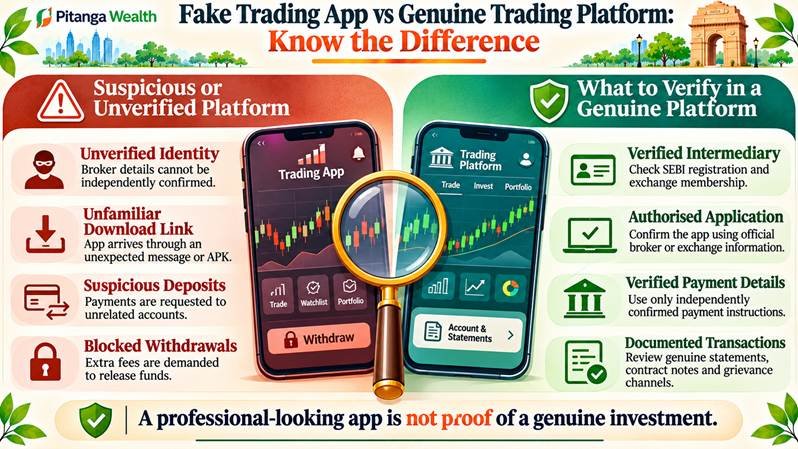
A Quick Comparison: Authentic Records and Suspicious Claims
| What you check | Genuine account evidence to seek | Suspicious pattern to investigate |
| Broker identity | Verifiable SEBI status and exchange details | A copied registration number and unknown contact |
| Trading application | Authorised app matched to the actual broker | Private APK link or lookalike app with no matching listing |
| Money destination | Official, independently confirmed payment route | Personal or repeatedly changing beneficiaries |
| Trade execution | Broker contract notes and appropriate transaction records | Only in-app profit screenshots or chat messages |
| Securities held | Relevant demat/DP or other account records | A dashboard balance with no independent audit trail |
| Withdrawals | Published procedures, charges and complaint contacts | New ‘unlocking’ payments demanded by a group admin |
A minor mismatch may have an innocent explanation, such as an old app name or a temporary system change. The response should still be verification, not assumption. Never assume that fake trading apps can be conclusively identified by appearance alone, or that a familiar-looking app is safe without matching the institution behind it.
Device Security: Protecting More Than Your Trading Balance
Fake trading apps can expose both the money transferred and sensitive data through unverified installations, intrusive permissions or credential harvesting. A sideloaded app or a remote-access tool may request extensive device privileges. Even a site that never executes a real trade could harvest identification documents, login credentials, payment details or contacts.
Use the official app distribution channel linked from the genuine institution; keep the operating system updated; decline unnecessary permissions; and enable account alerts. Don’t share trading passwords, UPI PINs, bank OTPs or screen-control access. If a suspicious app was already installed, disconnect from the session, use a different trusted device to change affected passwords, inform the bank and broker, and seek appropriate device-security assistance. Preserve relevant evidence first where safe; do not allow a stranger to ‘fix’ the device remotely.
When the messages appear to come from a well-known person
Videos, voice notes and images can be edited or impersonated. A recognisable face in a promotional clip is not confirmation that the person endorses the offer. Verify any alleged endorsement or partnership from the named institution’s own published channels. SEBI has cautioned investors about market scams promoted through social media. (SEBI social-media warning)
Illustrative Example: A Profit Screen Without a Real Trade
Consider a fictional investor, Meera, who joins a Telegram group after seeing an advertisement. A moderator provides market commentary and then asks her to install a ‘priority trading’ app. She deposits ₹25,000 through one beneficiary and later another ₹75,000 into a different recipient account. The app displays ₹1,47,000 as the total portfolio value, including apparent gains. When Meera requests a withdrawal, a representative asks for a separate ₹18,000 ‘release charge’.
The dashboard number is not evidence of an exchange transaction. Meera’s confirmed outward payments total ₹1,00,000; the ₹47,000 apparent gain has not been independently established, and the extra ₹18,000 demand may compound the loss. Her next step should be to stop further payments, retain the transactions and contact official reporting channels, not to pay in anticipation of unlocking funds. This is a common danger in fake trading apps where the displayed profit cannot be independently confirmed. This example is hypothetical and does not imply that any particular app, institution or named channel is fraudulent.
The lesson is not that every delayed withdrawal is a scam. A legitimate service may have documented processing times, verification requirements and product-specific settlement rules. The concern is an unverifiable provider demanding unrelated additional transfers without trustworthy records or a genuine complaint mechanism.
If You Already Clicked, Installed or Paid: What to Do Next
A response depends on what happened. Someone who merely saw an unsolicited message needs a different set of steps from someone who transferred money or surrendered credentials. The following approach focuses on reducing additional risk, preserving proof and using the appropriate channels.
If you only received the message
Do not click unknown investment links, send documents or transfer money. Capture the account handle, channel name, original URL and relevant claims. Report the content using the messaging platform’s abuse tools if appropriate, and use NSE’s unsolicited stock-tip reporting channel for relevant tip messages. Reporting a tip does not itself create a refund claim. (NSE reporting information)
If you installed an unverified app or shared credentials
Stop interacting with the operator. Contact the genuine bank and broker through independently obtained channels, secure accounts from a trusted device, review transaction alerts and ask about any suspicious activity. If device access was shared, consider professional technical assistance and appropriate reporting. Never provide another OTP to a purported security agent.
If money was transferred under suspected cyber-enabled fraud
Immediately contact the bank or payment provider and request available protective action. Call the national financial cyber-fraud helpline 1930 or report at cybercrime.gov.in, supplying transaction IDs, dates, amounts, beneficiary details and supporting screenshots. Complete any required portal steps and cooperate with the appropriate police or cybercrime authority. Speed can matter, but fund recovery cannot be promised. (National Cyber Crime Reporting Portal)
If the problem concerns a genuine SEBI-regulated intermediary
Raise the issue with the intermediary’s own official grievance function first. Where the issue falls within SEBI SCORES eligibility and remains unresolved, use scores.sebi.gov.in to pursue the complaint. SCORES is a facilitative system for eligible grievances against regulated entities; it is not a substitute for a criminal cyber-fraud report against an unknown impersonator. Information suggesting regulatory misconduct may require a different reporting route. (SEBI SCORES)
If someone offers to recover your money for a fee
Treat a new recovery approach as unverified, especially if it promises guaranteed results or demands an upfront transfer. Do not share new bank details, passwords or payment authorisations. Contact the original bank, police or regulated intermediary through their verified contact details and preserve the second approach as evidence.
Reporting Routes at a Glance
| Situation | First action | Appropriate official route |
| Money sent to a suspected fake platform | Contact bank/payment provider immediately | 1930 and cybercrime.gov.in; cooperate with police |
| Unsolicited securities tip in a Telegram or WhatsApp message | Preserve full message and sender details | NSE unsolicited stock-tip reporting channel when relevant |
| Grievance with a known SEBI-regulated broker or intermediary | Contact that entity’s official grievance desk | SCORES if eligible and unresolved |
| Possible misrepresentation or a suspicious registration claim | Verify entity and retain details | SEBI/exchange investor resources; relevant regulator or authority |
| Passwords or remote access compromised | Secure accounts through trusted channels | Affected bank, broker, police/cybercrime channel as appropriate |
Be accurate about who received the payment and what service was actually involved. A complaint about a stranger impersonating a regulated broker is not the same as a service complaint against that broker. Both can affect investors, but they may require different handling.
A Twelve-Point Routine Before Taking Any Stock Tip
1. Pause before clicking a group invitation, app link or payment request.
2. Record the exact person, legal entity and financial service being offered.
3. Check SEBI registration where relevant and confirm the service category.
4. Verify broker exchange membership and authorised mobile app listings.
5. Verify the claimed social handle or representative through the real firm.
6. Read the actual product terms, risks, fees and conflicts of interest.
7. Reject guaranteed trading profits, special secret allocations and unreasonable urgency.
8. Confirm the beneficiary account and purpose through official payment channels.
9. Use SEBI Check or validated UPI facilities where applicable and available.
10. Look for independent trading records rather than only displayed returns.
11. Protect OTPs, trading passwords, UPI PINs, device access and KYC documents.
12. Keep statements and transaction IDs, and know how to contact the actual grievance channel.
Using the same checks every time reduces dependence on the appearance or confidence of a sales pitch. The routine is valuable even when no scam is ultimately present, because it clarifies who is responsible for the investment and where the money will be held. It is especially useful when fake trading apps borrow genuine market terminology.
Frequently Asked Questions
1. Are all Telegram stock-tip groups illegal?
No. General market discussion is not automatically illegal. The activity, commercial arrangement, representations, conflicts, registration requirements and applicable securities rules determine what obligations may arise. An unverified tip should not be acted on simply because it appears in a large group.
2. Can a fake app display real stock market prices?
Yes. Displaying real or plausible market data does not prove that user orders were sent to an exchange. The important question is whether the investor has an authenticated account and appropriate independent transaction records.
3. Is an app safe if it is in Google Play or Apple’s App Store?
Not necessarily. Official distribution is preferable to random files or links, but store availability alone does not establish SEBI registration, exchange authorisation or the identity of a supposed broker. Cross-check the authorised-app list and genuine provider.
4. How do I check whether a trading app is authorised in India?
Use SEBI Investor’s Investor Support page to reach exchange-maintained lists of authorised mobile trading applications. Match the broker, app and relevant publisher, then confirm through the broker’s independently verified contact channel.
5. Does a SEBI registration number in a Telegram profile prove the person is genuine?
No. A genuine number might be copied or misused. Check that the registration matches the exact entity and category, and ask the real firm whether the social handle and representative are authorised.
6. Can a scam app let me withdraw a small amount first?
It may. An early payout is not reliable proof that subsequent deposits are protected or that displayed returns come from real trading. Independent records and verified intermediary details matter more than one payment.
7. Is an ‘institutional IPO allotment’ offered in a private group reliable?
Do not assume so. Demand details of the lawful offer, investor eligibility and intermediary, and confirm them through official sources. Claims of secret allocations or FPI-linked access for retail investors require particular caution.
8. What if the app asks for tax or an unlocking fee before withdrawal?
Stop and independently verify the legal basis and actual provider. A demand from an unknown administrator for a fresh payment to release fictional profits is a major warning sign. Do not pay simply because a dashboard displays a large balance.
9. Should I enter my UPI PIN to receive a refund?
No. A UPI PIN authorises a payment, and it should not be shared with someone promising an incoming refund. Verify instructions directly through the real bank or payment app and never disclose OTPs.
10. What is SEBI Check used for?
SEBI Check is an investor-protection facility intended to support verification of payment details of SEBI-registered intermediaries, alongside validated UPI handles. It does not certify the profitability of a trade, a Telegram recommendation or an unrelated payment receiver.
11. Can I report unsolicited Telegram stock tips to NSE?
NSE maintains a page explaining how to report unsolicited stock tips and recommendations. Refer to the current official instructions, preserve the original messages, and provide the requested reporting details. A tip report is not the same as a financial loss complaint.
12. Where should I report money lost to a suspected fake trading platform?
Promptly notify the paying bank or provider, call 1930, and use the National Cyber Crime Reporting Portal at cybercrime.gov.in for suspected cyber-enabled financial fraud. Keep payment references and communications. Recovery is not guaranteed.
13. Should I file every fake-app incident on SEBI SCORES?
No. SCORES is intended for eligible securities-market grievances involving SEBI-regulated entities, ordinarily after contacting the entity. A fraud by an unknown impersonator may need a police or cybercrime report; check which entity actually received the money.
14. What if I am only learning and have not paid anything?
That is the best point to verify. Do not share personal records or install an unfamiliar app. Use the official broker, exchange and SEBI resources to learn how genuine market accounts work and to check a proposed intermediary before acting.
Final Thoughts: Trust the Independent Record, Not the Screen
The central risk with fake trading apps is not just a misleading graph. It is the possibility that the investor has been drawn away from a verifiable securities-market relationship into an environment where the promoter controls the advice, software, reported returns and payment destination. Telegram stock tips can accelerate that shift by surrounding an unfamiliar offer with apparently enthusiastic endorsements.
Indian investors can reduce that risk through a consistent habit: identify the entity, verify the authorised app and account, understand the transaction, confirm the real payee, and retain independent records. If a suspicious payment has already occurred, prompt bank contact and an appropriate report are more useful than sending another ‘unlocking’ fee. A strong investor decision begins with evidence that exists outside the promotional group.
Disclaimer
This article is published by Pitanga Wealth for general investor education and is not personalised investment, legal, tax, technology-security or crime-recovery advice. The examples are hypothetical. A suspicious warning sign does not by itself prove criminal conduct; ordinary investments may lose value and legitimate providers may encounter operational delays. Regulatory rules, intermediary lists, app availability and reporting procedures can change. Recheck official sources and consult the relevant regulated institution or qualified professional when needed. No investment outcome or recovery of funds is guaranteed. Official-source research reviewed on 11 November 2026.
Written by Pitanga Wealth Team.
Follow us on Instagram @pitangawealth for more educational insights.
This article is for educational and informational purposes only. It is not investment, tax, legal or insurance advice. Consider your circumstances and relevant documents before making a financial decision.