

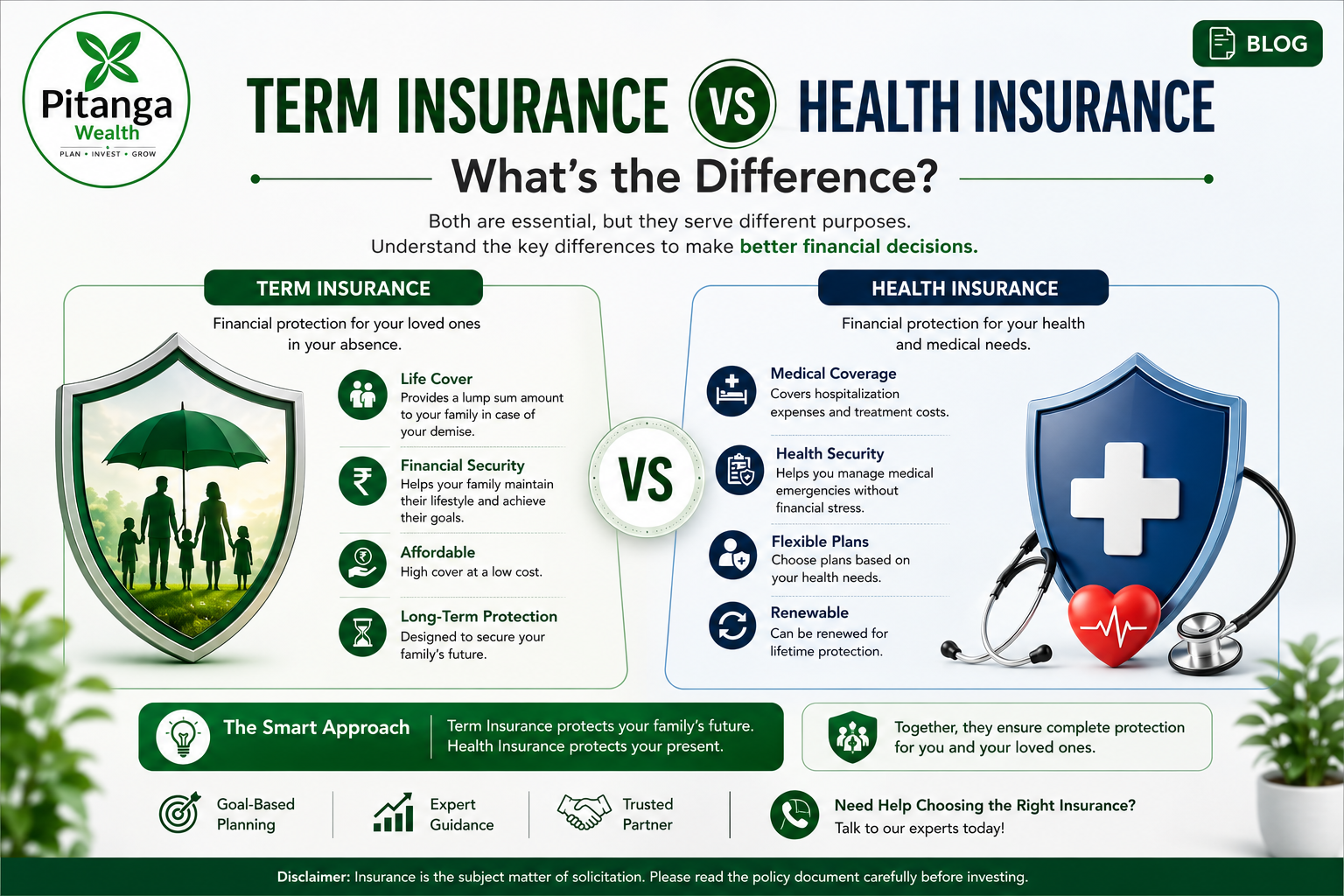
Term insurance vs health insurance is a mix-up that catches more people off guard than you’d expect — usually at the worst possible moment. A few years ago, a colleague mentioned she’d finally “sorted out her insurance” — she’d bought a term plan the year before and felt good about ticking that box. Then her father was hospitalised for a two-week stay, and she realised, mid-crisis, that a term plan pays out on death, not on a hospital bill. She ended up paying the bill out of pocket, then scrambling to buy a health policy while still stressed about her father’s recovery.
This mix-up is more common than you’d think. Both get lumped together under the general umbrella of “insurance,” and both are things people are told they should “just have.” But they protect against two completely different risks, and understanding that difference is the first step to actually being covered when something goes wrong — not just feeling covered.
What Is Term Insurance?
The first half of the term insurance vs health insurance comparison starts with what term insurance actually does. It’s a life insurance policy that pays a lump sum — called the sum assured — to your nominee if you pass away during the policy term. It’s built for one purpose: replacing your income for the people who depend on it, if you’re no longer around to earn it.
A few things that define how term insurance works:
- It’s pure protection, not an investment. Unlike some other life insurance products, a term plan usually has no maturity payout if you outlive the policy term — the premium you pay is the cost of the cover, similar to how a car insurance premium doesn’t come back to you if you never file a claim.
- It’s tied to a fixed term. You choose the duration — commonly until age 60, 65, or 70 — and the cover ends when the term ends, unless you’ve opted for a plan structured differently.
- The payout goes to your nominee, not to you. This is why term insurance is really a decision about the people who rely on your income, not about yourself.
What Is Health Insurance?
Health insurance, sometimes called mediclaim, is built to cover medical expenses — hospitalisation, surgery, and depending on the policy, pre- and post-hospitalisation costs, day-care procedures, and sometimes outpatient treatment.
The core mechanics:
- It pays out (or settles bills directly, via cashless treatment) when you’re treated, not when you die. You, or a family member on a family floater plan, can claim it multiple times during the policy year, subject to the sum insured.
- The sum insured resets or partially replenishes each year, depending on the policy — it isn’t a one-time payout like a term plan.
- It doesn’t care why you’re financially at risk the way term insurance does — it’s about the cost of treatment itself, regardless of whether you’re the sole earner in your family or not.
Term Insurance vs Health Insurance: The Core Difference
Laid out side by side, term insurance vs health insurance becomes much easier to keep straight:
| Term Insurance | Health Insurance | |
| What it covers | Loss of life during the policy term | Medical treatment and hospitalisation costs |
| Who receives the payout | Your nominee | You, or the hospital directly (cashless) |
| When it pays out | On death | On illness, injury, or hospitalisation |
| How often it can be used | Once (it’s a life cover, not renewable in the same sense) | Multiple times per year, up to the sum insured |
| What problem it solves | Income replacement for dependents | Protecting savings from medical costs |
The simplest way to remember the difference: term insurance protects your family’s financial future if you’re not there to earn; health insurance protects your family’s savings if you (or a family member) need expensive medical treatment while you’re very much still around.
Why “I Have One, So I’m Covered” Is a Risky Assumption
This is where the confusion actually costs people money. Having term insurance does nothing for a medical bill — as my colleague found out. And having health insurance does nothing to replace a family’s income if the primary earner passes away; it only covers what the hospital billed for during the treatment itself, not years of lost income afterward.
There’s also a specific version of this mistake that’s worth calling out directly: relying only on employer-provided health insurance. Group health cover from your employer is genuinely useful, but it typically ends the day you leave the job, gets restructured when you change employers, and often has lower sum insured limits than a growing family may need — especially as medical costs rise and as parents age into higher-risk years. It’s rarely enough as your only health cover once you factor in dependents and rising healthcare costs.
Do You Need Both?
Framed as term insurance vs health insurance, it can sound like an either-or choice — but for most people with financial dependents, the honest answer is yes, both serve a purpose that the other doesn’t cover:
Term insurance tends to matter most if:
- You have dependents who rely on your income (spouse, children, aging parents)
- You have outstanding loans (home loan, for instance) that your family shouldn’t have to repay alone
- You’re the sole or primary earner in your household
Health insurance tends to matter for almost everyone, because:
- Medical costs in India have been rising faster than general inflation for years, and a serious hospitalisation can derail years of savings in a single event
- It protects your investments and emergency fund from being liquidated for a medical emergency
- It’s relevant regardless of whether you have dependents — you can still face a large hospital bill even if you’re single
If you’re weighing which to prioritise first on a tight budget, it’s worth having a real conversation about your specific dependents, existing employer cover, and financial obligations — this article can explain the concepts, but the right amount and structure for your situation depends on your circumstances.
A Rough Way to Think About How Much Cover You Need
These are general rules of thumb used widely in financial planning — not a recommendation for your specific policy, since the right number depends on your income, debts, dependents, and existing savings.
For term insurance, a commonly used starting point is 10 to 15 times your annual income, adjusted for outstanding loans and the number of years your dependents would need support. Someone earning ₹12,00,000 a year with a home loan and two young children, for example, would typically need meaningfully more cover than someone the same age with no dependents and no debt.
For health insurance, thumb rules are less standardised because they depend heavily on city (metro hospital costs run higher), family size, and age of the oldest member on the policy — but a starting benchmark many planners use is a base sum insured of at least ₹5,00,000 to ₹10,00,000 per family, often layered with a separate super top-up policy for additional protection at a lower incremental cost, rather than buying one very large base policy.
These are illustrative starting points for a conversation, not fixed prescriptions — actual adequacy depends on your specific numbers.
In short, term insurance vs health insurance isn’t a competition between two products — they’re built to solve different problems, and most families end up needing both.
Frequently Asked Questions About Term Insurance vs Health Insurance
Can one policy cover both death and medical expenses? Some insurers offer combination or rider-based products, but a pure term plan and a pure health policy are structurally different products designed for different risks. It’s worth understanding what each specific product actually covers rather than assuming a bundled name means full protection on both fronts.
Is health insurance from my employer enough on its own? For many people, no — it’s a good starting layer, but it typically ends with the job, may have limits that don’t scale with a growing family, and doesn’t cover you during any gap between jobs. A personal health policy that stays with you independent of your employer is generally worth considering alongside employer cover.
Does term insurance cover critical illness? A standard term plan does not, though many insurers offer a critical illness rider that can be added for an additional premium. Critical illness cover typically pays a lump sum on diagnosis of specified conditions, which is different from both a death benefit and ongoing hospitalisation cover.
At what age should I buy term insurance and health insurance? Generally, earlier is more cost-efficient for both, since premiums are typically lower when you’re younger and healthier, and pre-existing condition waiting periods (common in health insurance) start earlier. That said, the right time also depends on when you actually take on dependents or financial obligations.
If I already have health insurance, do I still need an emergency fund? Yes. Health insurance typically doesn’t cover every expense (there can be sub-limits, co-payments, or non-covered items depending on the policy), and it doesn’t help with non-medical financial disruptions. An emergency fund and health insurance work together, not as substitutes for each other.
Can I buy term insurance and health insurance from the same provider? For the term insurance vs health insurance question specifically, you can buy both from one insurer, but you don’t have to — insurers vary in strengths across life and health products, and it’s worth comparing options for each separately rather than assuming one provider is automatically best for both.
If you’re trying to figure out how term insurance vs health insurance should fit together for your specific situation — your dependents, existing cover, and budget — our team at Pitanga Wealth can help you think through the right structure.
Insurance is the subject matter of solicitation. Please read the policy wordings, exclusions, and terms carefully before concluding a purchase. This article is for general educational purposes only and does not constitute insurance, investment, or financial advice; actual product features, premiums, and terms vary by insurer and are subject to underwriting. Pitanga Wealth is an AMFI-Registered Mutual Fund Distributor (ARN-134606); mutual fund investments are subject to market risks.
Written by the Pitanga Wealth team.
Enjoyed this breakdown? We post explainers like this regularly on Instagram — follow @pitangawealth to catch them as they drop.
This article is for educational and informational purposes only. It is not investment, tax, legal or insurance advice. Consider your circumstances and relevant documents before making a financial decision.