

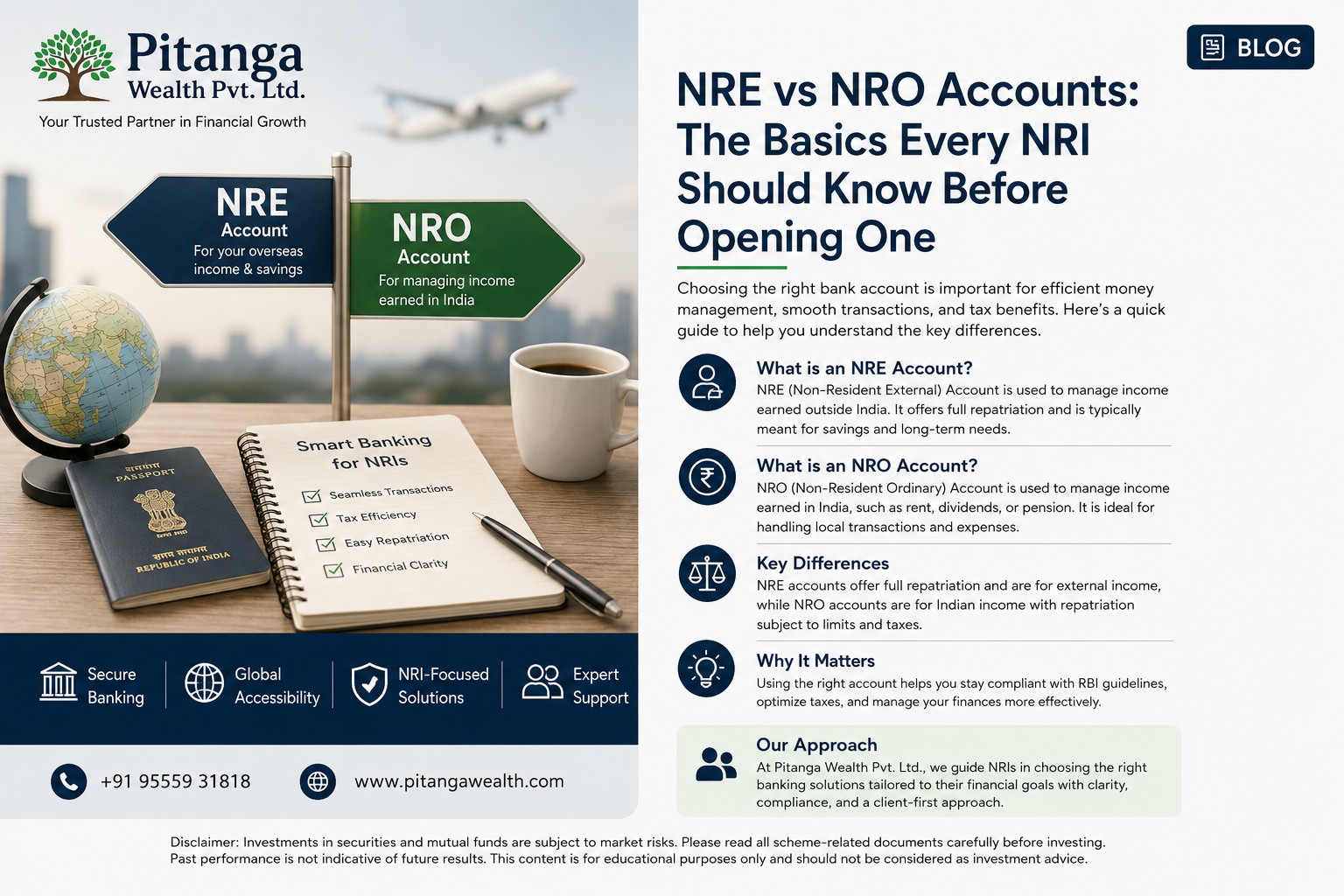
The NRE vs NRO account question is one of the first practical decisions many people face after becoming an NRI — and it trips up more people than you’d expect. If you’ve recently moved abroad, or you’ve been an NRI for a while and are only now getting around to sorting out your finances back home, there’s a good chance a bank has already asked you: “NRE or NRO?” — and there’s an equally good chance you weren’t quite sure how to answer.
It’s a fair question to be unsure about. Both are bank accounts meant for Non-Resident Indians, both are held in Indian rupees, and on the surface they look similar. But they’re built for two different kinds of money, and picking the wrong one can create avoidable complications later — especially around taxation and repatriation.
What Is an NRE Account?
An NRE (Non-Resident External) account is meant to hold money you’ve earned outside India and want to bring into the country — your foreign salary, savings, or other overseas income.
The two features that matter most:
- Interest earned is tax-free in India. This is one of the more attractive parts of an NRE account for many NRIs.
- Money is fully and freely repatriable. Both the principal and the interest can be transferred back abroad without restriction, since the funds originated outside India in the first place.
The account is typically held jointly only with another NRI, and any deposits should be genuinely foreign-sourced — this isn’t meant for income you earn within India.
What Is an NRO Account?
An NRO (Non-Resident Ordinary) account is built for the opposite situation: managing income you earn within India even after you’ve become a non-resident. Rent from a property you still own in India, dividends, pension, or any local income falls into this category.
The key differences from an NRE account:
- Interest earned is taxable in India, and tax is deducted at source (TDS) before it reaches you.
- Repatriation is limited. You can typically remit up to USD 1 million per financial year from an NRO account, subject to RBI rules and after submitting the required tax forms and documentation — it isn’t automatic or unrestricted the way NRE repatriation is.
An NRO account can be held jointly with a resident Indian relative, which makes it a practical choice if you still have financial ties — like a joint property or dependent family — back home.
Documents You’ll Typically Need to Open an NRE or NRO Account
The paperwork for both account types is broadly similar, though individual banks may ask for slightly different combinations. Commonly required documents include:
- Passport with a valid visa or residency permit for the country you’re living in
- Proof of overseas address, such as a utility bill, rental agreement, or bank statement from your country of residence
- PAN card, or Form 60 if you don’t yet have one
- Recent passport-sized photographs
- Proof of NRI status, such as your employment contract, work visa, or residency card, depending on the bank
- Overseas bank account details, needed for the initial funding of an NRE account in particular
Many Indian banks now allow NRIs to start this process online or through their overseas branches and correspondent banks, which can significantly cut down the back-and-forth compared to opening an account entirely from abroad through courier and physical signatures. It’s worth asking your bank directly whether they offer a digital or video-KYC route, since this varies by institution.
Common Mistakes NRIs Make With These Accounts
A few patterns come up often enough that they’re worth flagging directly:
Continuing to operate a resident savings account after becoming an NRI. This isn’t just a technicality — RBI/FEMA rules require the conversion once your residency status changes, and continuing to use a resident account can create compliance issues later, including at the time of repatriating funds or filing taxes.
Depositing India-sourced income into an NRE account. Since NRE accounts are meant only for foreign earnings, mixing in rental income or other India-sourced money can create discrepancies that surface later, particularly during a tax assessment or when trying to repatriate funds.
Assuming NRO funds are as freely transferable as NRE funds. The USD 1 million per financial year limit on NRO repatriation, along with the documentation it requires (including a chartered accountant’s certificate in Form 15CB and the online Form 15CA), catches people off guard if they haven’t planned for it in advance.
Not updating account status when returning to India permanently. NRE and NRO accounts need to be converted to resident accounts (or, for a transition period, to an RFC account in some cases) once you’re back in India for good — leaving them as-is isn’t compliant and can complicate things at tax time.
NRE vs NRO: Side by Side
| NRE Account | NRO Account | |
|---|---|---|
| Source of funds | Income earned outside India | Income earned within India |
| Tax on interest | Tax-free in India | Taxable, with TDS deducted |
| Repatriation | Fully repatriable | Limited, with documentation |
| Joint holding | Usually with another NRI | Can include a resident Indian |
Which One Do You Actually Need?
The NRE vs NRO account decision usually isn’t a matter of picking one and closing the door on the other. For most NRIs, the honest answer is: both, used for different purposes. If you’re sending foreign earnings to India to save or invest, an NRE account is generally the more natural fit because of the tax-free interest and unrestricted repatriation. If you still have income sources within India — rent, a pension, dividends from Indian holdings — an NRO account is where that money should be routed and managed.
Trying to force all your money through a single account type, or using a regular resident savings account after your NRI status changes (which isn’t compliant with FEMA regulations), tends to cause more paperwork down the line, not less. This is also where the account type matters for anything you plan to do next, including investing — the account you use can affect how straightforward it is to invest in Indian mutual funds or repatriate returns later.
What Happens to These Accounts If You Move Back to India?
NRE and NRO accounts are specifically meant for non-residents, so your residency status change works in the other direction too. Once you return to India with the intention of staying — not just a visit — you’re required to inform your bank and convert these accounts, typically into resident accounts or, for a transition period, into a Resident Foreign Currency (RFC) account if you want to continue holding foreign currency assets.
This matters for tax purposes as well. Your residential status under Indian tax law (resident, non-resident, or “resident but not ordinarily resident” — RNOR) is assessed separately from your bank account type, and getting this wrong can affect how your global income is taxed in India during the transition period. This is a good example of where it’s worth having a tax advisor look at your specific timeline rather than assuming the account conversion alone takes care of everything.
Frequently Asked Questions
Can I convert my existing resident savings account into an NRE or NRO account? Once your residency status changes, RBI/FEMA rules require you to convert your regular resident account — typically into an NRO account, since it can hold India-sourced income and existing balances. A fresh NRE account can be opened separately for new foreign remittances.
Do I need both an NRE and an NRO account? Not necessarily, but many NRIs end up with both — an NRE account for foreign income they want to save or invest, and an NRO account for any income that continues to arise in India.
Is interest from an NRO account really taxable even though I live abroad? Yes. NRO interest is taxed in India regardless of your residency status abroad, because the account is meant for India-sourced income. You may also be able to claim relief under a Double Taxation Avoidance Agreement (DTAA), depending on the country you reside in — this is worth checking with a tax professional for your specific situation.
Can I invest in Indian mutual funds using an NRE or NRO account? Both account types can generally be linked to mutual fund investments, and the choice affects how gains are eventually repatriated. This is a separate topic worth its own detailed explanation, which we’ll cover soon.
How long does it take to open an NRE or NRO account? This varies by bank and depends on documentation (passport, visa/residency proof, overseas address proof, PAN, and photographs are commonly required). Some banks now offer online account opening for NRIs, which can shorten the process considerably.
Can I hold an NRE or NRO account jointly with a family member who lives in India? An NRO account can generally be held jointly with a resident Indian, such as a parent or sibling, which is one reason it’s often used for managing property or dependent-related expenses in India. An NRE account is typically restricted to joint holding with another NRI, since it’s meant to hold foreign-sourced funds.
Is TDS on NRO account interest deducted at a flat rate? TDS on NRO interest is deducted at rates set under Indian tax law, which can vary based on applicable provisions and any DTAA benefit you’re eligible to claim. Because these rates and rules are subject to change, it’s best to confirm the current applicable rate with your bank or a tax advisor rather than relying on a fixed figure.
Figuring out the right account structure is often the first step before any real NRI investment planning can begin. If you’re an NRI trying to set up your finances in India the right way — from account structure to how that flows into investments — our team at Pitanga Wealth can walk you through the process.
This article is for general educational purposes only and does not constitute tax, legal, or investment advice. Banking rules, RBI/FEMA regulations, and tax provisions for NRIs can change and may vary based on individual circumstances — please consult your bank and a qualified tax advisor before making a decision. Pitanga Wealth is an AMFI-Registered Mutual Fund Distributor (ARN-134606); mutual fund investments are subject to market risks.
Written by the Pitanga Wealth team.
Enjoyed this breakdown? We post explainers like this regularly on Instagram — follow @pitangawealth to catch them as they drop.
This article is for educational and informational purposes only. It is not investment, tax, legal or insurance advice. Consider your circumstances and relevant documents before making a financial decision.