

Every January, something predictable happens in offices across India: someone in HR sends out a reminder about “investment proofs,” and a slightly panicked round of tax-saving decisions begins. ELSS vs PPF is one of the first comparisons that comes up in that scramble, because both qualify for deduction under Section 80C, and both are genuinely popular — but they work in almost completely different ways, and picking one without understanding that difference can leave you either short on liquidity or short on growth potential.
This isn’t about which one is “better” in the abstract. It’s about two different tools built for two different kinds of investors, and figuring out which one — or what mix of both — actually fits your situation.
A Quick Note on the 80C Deduction Itself
Before comparing ELSS and PPF, it’s worth being clear about one thing: the Section 80C deduction (up to ₹1,50,000 combined across eligible instruments, as per current tax law) is only available if you’re filing under the old tax regime. If you’ve opted for the new tax regime, most 80C deductions — including for ELSS and PPF — don’t apply. This matters because the entire “which 80C option is better” conversation is only relevant to you if you’re actually using, or planning to use, the old regime. Tax rules and regime choices can change, so it’s worth confirming your specific situation with a tax advisor or CA before assuming either applies.
What Is ELSS?
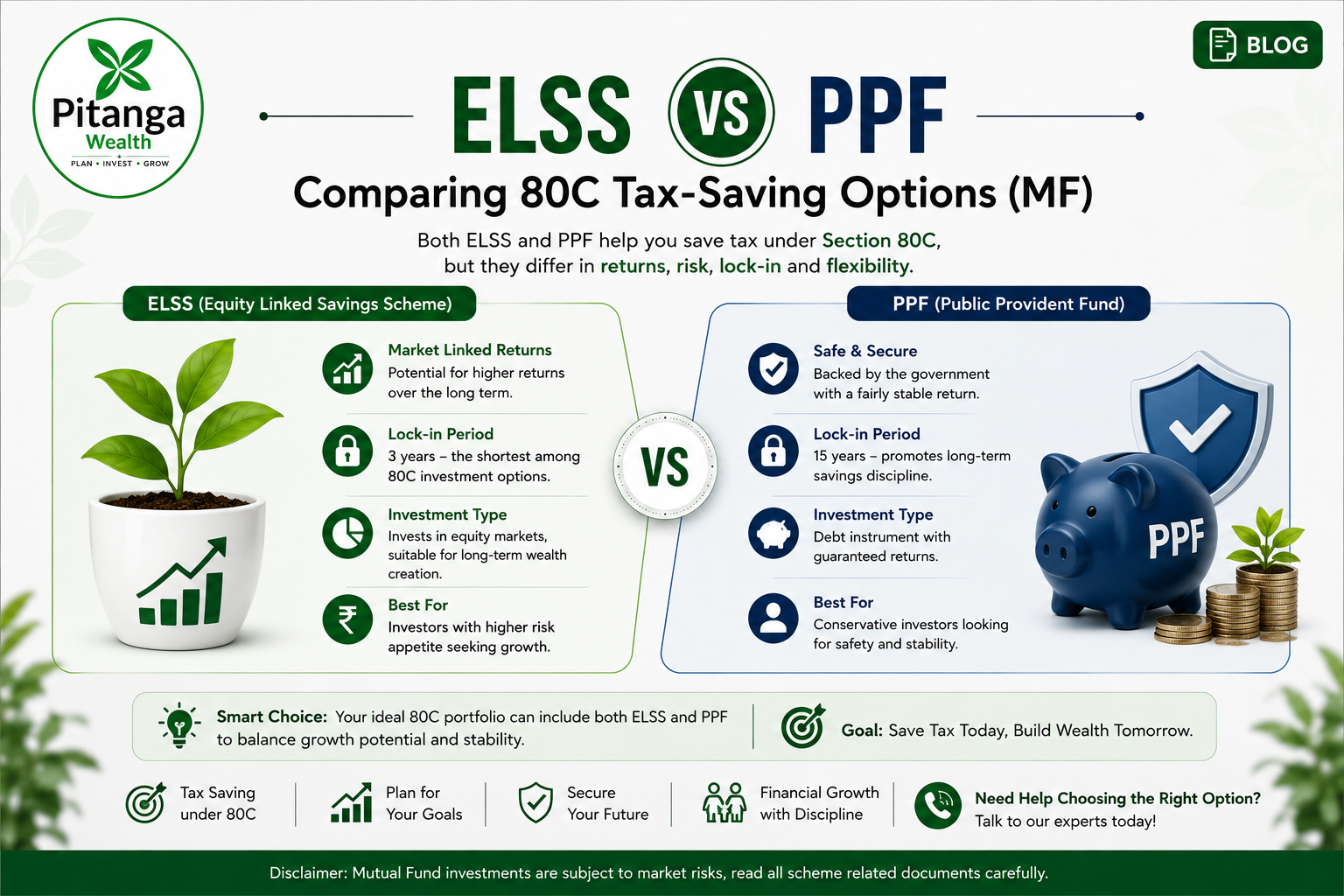
Understanding ELSS vs PPF starts with knowing what each one actually is on its own. ELSS, or Equity Linked Savings Scheme, is a category of mutual fund that invests primarily in equities and qualifies for Section 80C deduction. It’s the only mutual fund category with this tax benefit, which is part of why it comes up so often in this comparison.
What defines ELSS as a product:
- It’s market-linked. Because it invests in equities, the value of your investment moves with the stock market — it can go up or down, and returns are never guaranteed.
- It has the shortest lock-in among 80C options — 3 years. Compare that to PPF’s much longer horizon, and this is often the single biggest reason people lean toward ELSS.
- You can invest via SIP or lump sum, the same way you would with any other equity mutual fund, and each SIP instalment carries its own individual 3-year lock-in.
What Is PPF?
PPF, or Public Provident Fund, is a government-backed long-term savings scheme, also eligible for Section 80C deduction. It’s one of the older, more familiar tax-saving instruments for Indian households, often the first one people learn about from parents or grandparents.
What defines PPF as a product:
- The interest rate is government-declared and reviewed quarterly. It isn’t market-linked, so it doesn’t fluctuate the way equity does, though the rate itself can change from one quarter to the next based on government notification.
- The lock-in is 15 years, with partial withdrawals permitted from the 7th year onward under specific conditions, and the option to extend the account in blocks of 5 years after maturity.
- The entire structure is what’s often called EEE — Exempt, Exempt, Exempt under current tax rules: the contribution is deductible, the interest earned is tax-free, and the maturity amount is also tax-free, subject to prevailing tax provisions.
ELSS vs PPF: The Core Difference
| ELSS | PPF | |
| Underlying asset | Equity (market-linked) | Government-backed, fixed by notification |
| Lock-in period | 3 years (shortest among 80C options) | 15 years (with partial withdrawal from year 7) |
| Return nature | Not guaranteed, market-linked | Declared quarterly by the government |
| Risk | Subject to market volatility | Capital protected, backed by the government |
| Taxation on maturity/gains | Taxed under equity capital gains rules, as per current provisions | Tax-free (EEE structure), as per current provisions |
| Investment mode | SIP or lump sum | Yearly contributions, minimum and maximum limits apply |
Which One Grows Faster?
This is usually the real question underneath ELSS vs PPF, so it’s worth addressing directly, with an important caveat: past patterns don’t guarantee future outcomes, and neither instrument’s future returns can be predicted.
PPF’s return is set by the government and doesn’t fluctuate with markets — what you see is largely what you get, within the quarter it’s declared for. ELSS, because it’s equity-linked, doesn’t work that way. Over short periods, equity markets can be volatile and even produce negative returns. Over longer periods — which is exactly why ELSS has a lock-in in the first place — equity has historically had the potential to compound at a materially different pace than fixed-income instruments like PPF, though this is a general, illustrative pattern and not a promise about what will happen going forward, and it comes with real short-term volatility that PPF simply doesn’t expose you to.
In other words: PPF offers predictability, ELSS offers growth potential paired with market risk. Neither statement is a recommendation — it’s the fundamental trade-off between a fixed-income instrument and an equity instrument, and it’s the same trade-off you’d weigh in almost any other debt-versus-equity decision.
Which One Actually Suits You?
ELSS tends to make more sense if:
- You have a reasonably long investment horizon (ideally well beyond the 3-year lock-in) and can stay invested through market ups and downs
- You’re comfortable with your investment value fluctuating in the short term
- You want your tax-saving investment to also work toward a longer-term goal like wealth building, not just tax deduction
PPF tends to make more sense if:
- You want capital protection and predictable, government-backed growth
- You’re building a long-term, low-risk component of your portfolio — for example, as part of retirement savings
- You’re not counting on that money for at least 15 years, or you’re comfortable with partial withdrawal rules after year 7
Many people don’t actually need to choose one exclusively. A common approach is to hold both — PPF as the stable, long-horizon anchor, and ELSS for the equity exposure and shorter lock-in, splitting the ₹1,50,000 80C limit between them based on how much risk you’re comfortable taking on.
Liquidity: The Part People Underestimate
It’s easy to focus on returns and forget liquidity, but this is often where people get caught out. ELSS has a firm 3-year lock-in — no exceptions, no partial withdrawal, regardless of market conditions. PPF’s 15-year horizon sounds intimidating, but it does allow partial withdrawals from year 7, and loans against the balance from year 3 in certain conditions, which gives it more flexibility than its long headline term might suggest.
If there’s a real chance you’ll need this money back within 3–7 years for something specific, that constraint should weigh heavily in the decision, arguably more than the return potential of either option.
Weighed purely on liquidity, ELSS vs PPF isn’t close — but liquidity is only one piece of the decision, alongside risk comfort and your broader financial goals.
Frequently Asked Questions About ELSS vs PPF
Can I invest in both ELSS and PPF in the same year? Yes, and many investors do. The ₹1,50,000 Section 80C limit is combined across all eligible instruments (ELSS, PPF, and others like life insurance premiums, EPF contributions, and certain other options), so you can split your investment across ELSS and PPF as long as the total stays within the limit.
Is ELSS riskier than PPF? Yes, in the sense that ELSS is market-linked and its value can go down as well as up, while PPF’s declared rate doesn’t fluctuate with markets in the same way. This is the fundamental trade-off between an equity and a government-backed fixed-income instrument, not a flaw in either product.
What happens if I need my ELSS money before 3 years? You generally can’t withdraw it — the 3-year lock-in applies to each SIP instalment or lump sum investment individually, and there’s no provision for early exit in normal circumstances.
Does PPF have a maximum investment limit? Yes, current rules cap PPF contributions at ₹1,50,000 per financial year (with a minimum yearly contribution required to keep the account active), which happens to align with the overall 80C limit — worth confirming the current limit before investing, since rules can be revised.
Which one should a beginner choose? There’s no universal answer — it depends on your goals, risk comfort, and how soon you might need the money. Some beginners start with PPF for its simplicity and safety, others start with ELSS for the shorter lock-in and equity exposure. This is exactly the kind of decision worth discussing with an advisor who understands your full financial picture.
Can NRIs invest in PPF or ELSS? NRIs generally cannot open a new PPF account (existing accounts opened before NRI status may continue on specific terms), while ELSS mutual funds are typically open to NRI investment, subject to the fund house’s specific NRI policies and applicable FEMA regulations. This is worth verifying directly with the specific institution given how rules can vary and change.
If you’re trying to decide how to split your 80C investments between ELSS and PPF — or weighing ELSS vs PPF for your own goals — our team at Pitanga Wealth can help you think through it as part of your broader financial plan.
Mutual Fund investments are subject to market risks. Read all scheme-related documents carefully before investing. Tax benefits are subject to prevailing tax laws, which are subject to change, and depend on the tax regime you have opted for. This article is for educational purposes only and should not be construed as investment, tax, or financial advice. Pitanga Wealth is an AMFI-Registered Mutual Fund Distributor (ARN-134606).
Written by the Pitanga Wealth team.
Enjoyed this breakdown? We post explainers like this regularly on Instagram — follow @pitangawealth to catch them as they drop
This article is for educational and informational purposes only. It is not investment, tax, legal or insurance advice. Consider your circumstances and relevant documents before making a financial decision.