

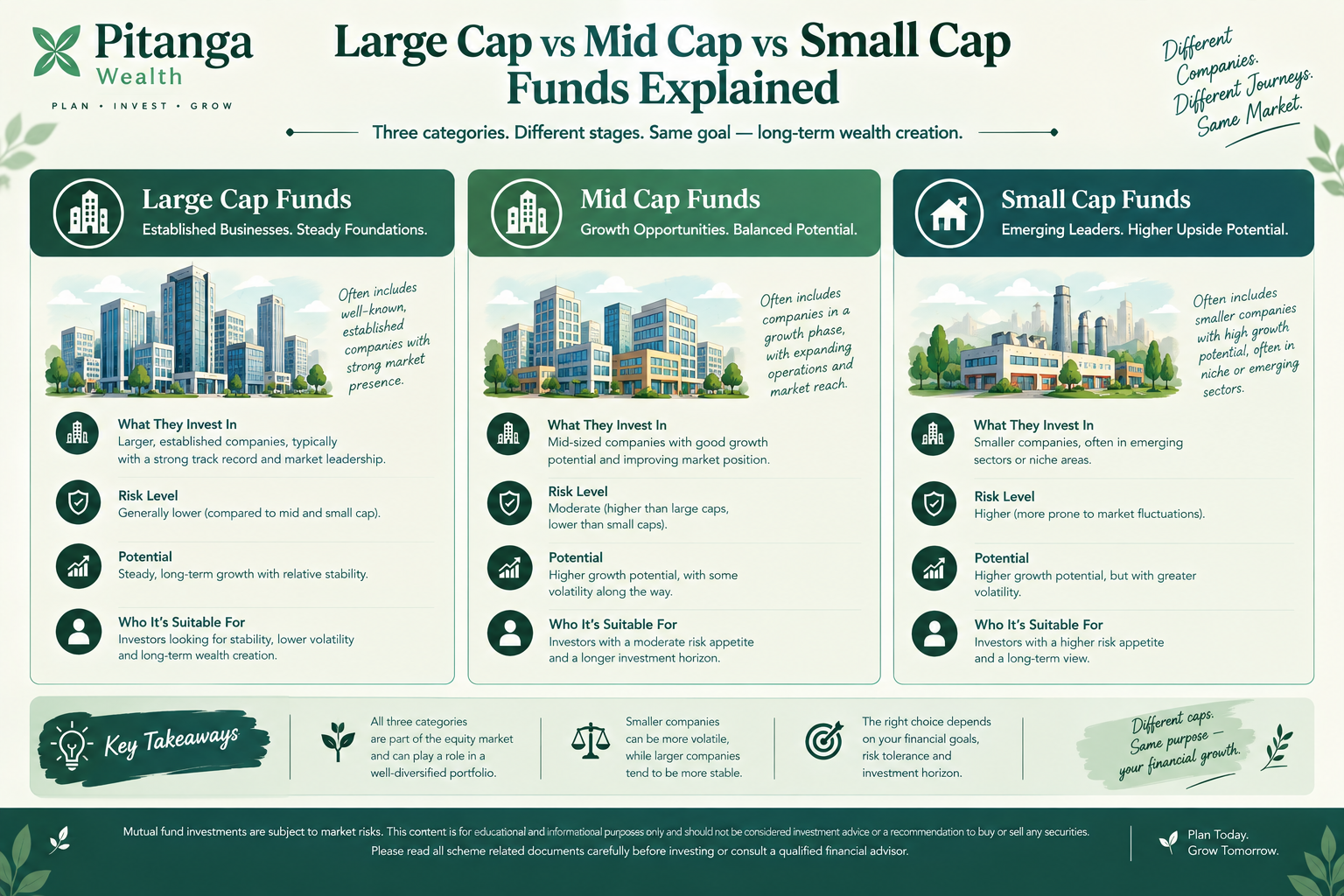
Large cap vs mid cap vs small cap funds are three important categories of equity mutual funds in India. Each category invests primarily in companies of different market capitalisations, which can influence their investment characteristics, volatility, and risks.
But what exactly separates these categories? And does investing in smaller companies automatically mean earning higher returns?
Not necessarily.
Understanding large cap vs mid cap vs small cap funds can help investors evaluate equity mutual funds based on their financial goals, investment horizon, and ability to tolerate market fluctuations.
Let’s understand how large-cap, mid-cap, and small-cap mutual funds work in India, how they differ, and what investors should consider before choosing among them.

What Is Market Capitalisation?
Before comparing these mutual funds, it helps to understand market capitalisation, commonly called market cap.
Market capitalisation represents the total market value of a company’s outstanding equity shares.
It is calculated by multiplying the company’s share price by the total number of outstanding shares.
A company’s market capitalisation changes as its share price changes. It is not the same as the company’s annual revenue, profits, or the amount of cash it holds.
In India, the Securities and Exchange Board of India (SEBI) uses a market-capitalisation ranking framework to classify listed companies for mutual fund purposes.
Under this framework:
| Company category | Market-capitalisation ranking |
| Large cap | First to 100th company |
| Mid cap | 101st to 250th company |
| Small cap | 251st company onwards |
The Association of Mutual Funds in India (AMFI) publishes the relevant stock classification list periodically, generally every six months, based on the prescribed methodology.
This means a company can move from one category to another as market values and rankings change.
Importantly, the categories are based on relative rankings, not permanent rupee-value cutoffs.
What Are Large-Cap Mutual Funds?
Large-cap mutual funds primarily invest in companies that rank among India’s largest listed businesses by market capitalisation.
These businesses are often established enterprises with substantial operations, recognised products or services, and a history of operating through different economic conditions.
Under SEBI’s mutual fund categorisation framework, a large-cap fund must invest at least 80% of its total assets in equity and equity-related instruments of large-cap companies.
Why Do Investors Consider Large-Cap Funds?
Large-cap companies often have relatively established business models, broader access to financing, and more actively traded shares.
These characteristics may help them withstand certain business or market challenges better than some smaller companies.
However, being a large company does not eliminate risk.
Large-cap funds can experience substantial declines during market corrections, economic slowdowns, or periods when their underlying sectors perform poorly.
The important distinction: Large-cap funds may generally experience lower volatility than mid-cap or small-cap funds, but they are still equity investments and do not offer capital protection.
What Are Mid-Cap Mutual Funds?
Mid-cap mutual funds primarily invest in companies ranked between the 101st and 250th positions by market capitalisation.
These businesses occupy the middle segment of the listed-company universe.
Some may be established companies expanding into new markets, increasing production capacity, introducing products, or strengthening their competitive positions.
Under SEBI’s categorisation framework, a mid-cap fund must invest at least 65% of its total assets in equity and equity-related instruments of mid-cap companies.
What Makes Mid-Cap Funds Different?
Mid-cap companies may have opportunities to expand their businesses, but their growth plans can also face challenges.
For example, a company expanding into new markets may benefit if demand develops as expected. But if costs rise, competition increases, or expansion is delayed, its financial performance may suffer.
Mid-cap shares can also experience sharper price movements and lower trading liquidity than shares of many large companies.
As a result, mid-cap funds may experience greater fluctuations in value, particularly during difficult market conditions.
Mid-cap funds should not be viewed as a guaranteed middle ground between safety and growth. Their actual risk depends on the underlying portfolio, valuations, sector exposure, and market conditions.
What Are Small-Cap Mutual Funds?
Small-cap mutual funds primarily invest in companies ranked 251st onwards by market capitalisation.
This category includes a wide range of listed businesses operating across different industries and stages of development.
Some small-cap companies may be growing businesses with opportunities to expand. Others may face significant competitive, operational, financial, or governance challenges.
Under SEBI’s categorisation framework, a small-cap fund must invest at least 65% of its total assets in equity and equity-related instruments of small-cap companies.
Why Are Small-Cap Funds Considered Riskier?
Smaller companies may have fewer financial resources, more concentrated operations, or greater dependence on particular customers, products, or markets.
Their shares may also be less liquid, meaning buying or selling substantial quantities can be more difficult without affecting market prices.
During periods of market stress, these factors can contribute to sharp price declines.
Small-cap funds may also face challenges when large numbers of investors seek to redeem their investments during unfavourable market conditions.
Although some smaller companies may grow significantly over time, many others may struggle or underperform.
Higher risk does not guarantee higher returns.
A small-cap fund can underperform a large-cap fund, even over extended periods.
Large Cap vs Mid Cap vs Small Cap Funds: Key Differences
When comparing large cap vs mid cap vs small cap funds, it is important to understand how their underlying company categories, portfolio characteristics, and market risks differ. The following table highlights these differences.
| Factor | Large-cap funds | Mid-cap funds | Small-cap funds |
| Main company universe | Top 100 | 101st–250th | 251st onwards |
| Minimum category exposure | 80% | 65% | 65% |
| Typical company profile | Larger, often established businesses | Medium-sized businesses | Smaller listed businesses |
| Relative volatility | Generally lower | Generally higher | Often higher |
| Liquidity of underlying shares | Typically greater | Can be more limited | Can be significantly more limited |
| Main considerations | Valuation, concentration, market risk | Business expansion, valuation, volatility | Liquidity, governance, business and valuation risks |
| Capital protection | None | None | None |
These are broad characteristics rather than fixed rules.
A particular large-cap fund can experience substantial losses, while an individual mid-cap or small-cap company may perform differently from its category.
Fund portfolios and market conditions matter more than labels alone.

Does a Smaller Company Mean Better Returns?
One common assumption is that small-cap companies have more room to grow, so small-cap funds must deliver better returns.
The reality is more complicated.
A company’s future share-price performance depends on several factors, including business earnings, competitive position, management decisions, financial strength, investor expectations, and the valuation at which its shares trade.
Even a successful business can be a disappointing investment if its shares were purchased at an excessively high valuation.
Similarly, a company with strong historical growth may not maintain that pace indefinitely.
This is why investors should be careful about choosing funds solely because a particular market-cap category has performed well recently.
Past performance does not guarantee future results.
How Does Risk Differ Across These Funds?
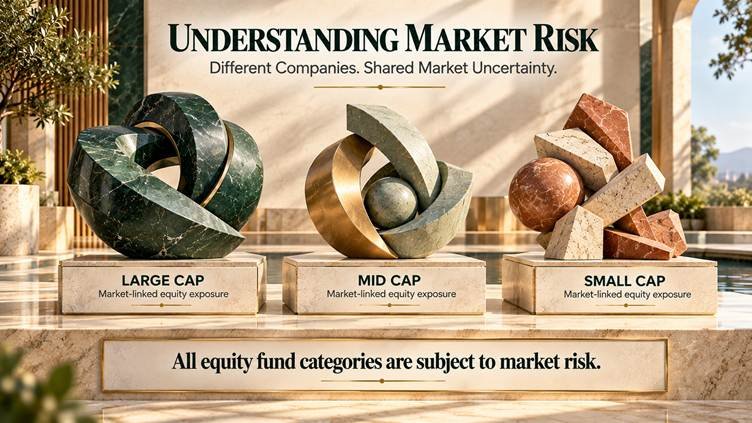
The risk characteristics of large cap vs mid cap vs small cap funds can differ because they invest primarily in companies of different market capitalisations. However, every equity mutual fund category remains exposed to market fluctuations and potential losses.
All three categories invest primarily in equities, which means their values can fluctuate with stock markets.
However, the sources and intensity of risk may differ.
Market Risk
A broad market decline can affect large-cap, mid-cap, and small-cap funds simultaneously.
No equity fund category is immune to market corrections.
Business Risk
Smaller companies may be more exposed to changes in demand, financing conditions, competition, or operational disruptions.
Large businesses also face business risks, including industry disruption, regulation, and changes in consumer behaviour.
Liquidity Risk
Shares of smaller companies may have fewer active buyers and sellers.
During periods of market stress, lower liquidity can make it more difficult for fund managers to adjust portfolios at favourable prices.
Valuation Risk
Strong investor enthusiasm can push share prices above levels supported by business fundamentals.
This risk can arise across all market-cap segments.
Concentration Risk
A fund’s exposure to particular companies or sectors can influence its performance.
Two funds within the same category may behave differently because their portfolios and investment strategies differ.
The key lesson is that risk cannot be assessed from market capitalisation alone.
Which Fund Category Is Suitable for Long-Term Investing?
There is no single category that is suitable for every long-term investor.
An investor’s financial goals, ability to tolerate losses, investment horizon, existing investments, and need for liquidity all influence the decision.
Large-cap funds may be considered by investors seeking equity exposure primarily through larger companies, while understanding that market losses remain possible.
Mid-cap funds involve exposure to medium-sized companies and may require greater comfort with volatility and periods of underperformance.
Small-cap funds generally demand an especially strong understanding of volatility, liquidity risk, and the possibility of prolonged or significant declines.
A longer investment horizon may provide more time to recover from market fluctuations, but it does not guarantee recovery or positive returns.
Money required for near-term essential expenses should not be exposed to equity-market risk merely because a particular fund category appears attractive.
Can You Invest in More Than One Category?
Yes.
Some investors use different equity fund categories within a broader investment portfolio.
The purpose of doing so should be to achieve an appropriate overall allocation, rather than simply owning more funds.
However, investing in several mutual funds does not automatically create effective diversification.
Different schemes can hold overlapping stocks, have similar sector exposures, or respond similarly to market conditions.
Investors may also consider categories such as flexi-cap, multi-cap, or large-and-mid-cap funds, which follow their own SEBI-defined investment mandates.
For example, a flexi-cap fund can invest across market-cap segments within its applicable equity allocation requirements, while a multi-cap fund follows prescribed minimum allocations to large-, mid-, and small-cap companies.
Understanding these differences is important before assuming that all diversified equity funds work in the same way.
SIP vs Lump Sum: Does the Investment Method Change the Risk?
A Systematic Investment Plan (SIP) allows investors to invest a chosen amount at regular intervals.
A lump-sum investment involves investing an amount at one time.
Both methods can be used in eligible mutual fund schemes, subject to scheme conditions.
A SIP spreads purchases across different market levels, which may reduce dependence on a single entry date.
However, a SIP does not remove equity-market risk, prevent losses, or guarantee better returns than a lump-sum investment.
The underlying fund category remains important regardless of the investment method.
An SIP in a small-cap fund is still exposed to the risks of that fund’s underlying investments.
What Should You Check Before Choosing a Fund?
Before choosing between large cap vs mid cap vs small cap funds, investors should evaluate their financial goals, risk tolerance, investment horizon, and existing portfolio. The fund category alone is not enough to determine suitability.
Before selecting a large-cap, mid-cap, or small-cap mutual fund, look beyond the category name.
Investment objective: Understand what the scheme is designed to achieve and whether it fits your financial goal.
Riskometer: Review the scheme’s current SEBI-prescribed Riskometer and understand what the indicated risk level means.
Portfolio holdings: Examine the companies, sectors, and market-cap segments in which the fund invests.
Investment strategy: Understand how the fund manager selects securities and manages the portfolio.
Expense ratio: Costs reduce the returns ultimately available to investors. Compare expenses alongside the fund’s strategy and other relevant characteristics.
Benchmark and performance: Evaluate performance across different market conditions, not just the most recent strong period. Historical results remain an imperfect guide to the future.
Exit load and taxation: Understand the scheme’s applicable exit-load terms and the tax implications of your transactions.
Overall portfolio allocation: Consider whether the fund adds useful exposure or simply duplicates investments you already hold.
Reading the scheme’s current documents, including the Scheme Information Document and relevant disclosures, is an important part of making an informed decision.
Common Mistakes Investors Make
Assuming Large-Cap Funds Are Risk-Free
Large companies can experience financial difficulties, falling earnings, or sharp declines in share prices.
Large-cap funds remain market-linked investments.
Chasing Recent Small-Cap Performance
Strong recent returns can attract attention, but they do not establish that similar results will continue.
Buying after a significant rise can expose investors to valuation risk.
Believing Higher Risk Guarantees Higher Returns
Higher risk means greater uncertainty, including the possibility of significant losses.
It is not a promise of higher rewards.
Choosing Funds Without Understanding Their Portfolios
Two funds within the same category can differ substantially in their holdings, sector exposures, and investment approaches.
Ignoring the Investment Horizon
An equity investment may be unsuitable for money needed soon, particularly if a market decline would force the investor to sell at an unfavourable time.
Owning Too Many Similar Funds
Adding multiple funds with overlapping holdings may increase complexity without meaningfully improving diversification.
Frequently Asked Questions
1. Which is better: large-cap, mid-cap, or small-cap funds?
No category is universally better. The appropriate choice depends on an investor’s financial objectives, risk tolerance, investment horizon, and existing portfolio.
2. Are large-cap funds safe?
Large-cap funds generally invest in larger listed companies, but they are not risk-free. Their values can decline, and invested capital is not guaranteed.
3. Can small-cap funds deliver higher returns than large-cap funds?
They can outperform during certain periods, but they can also underperform or experience significant losses. Higher potential growth does not guarantee higher investment returns.
4. Are mid-cap funds suitable for beginners?
Suitability depends on the investor’s understanding of equity-market risk, ability to tolerate fluctuations, financial goals, and overall asset allocation. Being a beginner does not, by itself, determine the right fund category.
5. Can I invest in all three categories through SIPs?
Eligible schemes may allow SIP investments across these categories. However, investing through SIPs does not eliminate market risk, and holding all three categories may not be necessary for every investor.
6. Do companies remain in the same market-cap category forever?
No. Companies can move between categories as their relative market capitalisations change. AMFI periodically updates the classification list used for mutual fund purposes.
7. Is a flexi-cap fund the same as a multi-cap fund?
No. Both can invest across market-cap segments, but they follow different regulatory allocation requirements. Investors should review the applicable scheme mandate before investing.
Final Thoughts
Understanding large cap vs mid cap vs small cap funds involves more than comparing potential returns. These categories represent exposure to different segments of the listed-company market, each with its own investment characteristics, uncertainties, and risks.
They represent exposure to different segments of the listed-company market, each with its own opportunities, uncertainties, and risks.
Large-cap funds primarily invest in larger companies. Mid-cap funds focus on medium-sized businesses. Small-cap funds provide exposure to smaller listed companies.
But the size of a company does not determine whether its shares will perform well.
Rather than asking which category will deliver the highest returns, a more useful question is:
Which type of equity exposure is appropriate for my financial goals and ability to handle market risk?
At Pitanga Wealth, we believe understanding what you invest in is an important part of making informed financial decisions.
Explore our educational resources to learn more about mutual funds, investment risks, and long-term financial planning.
Important Disclaimer
This article is intended solely for general financial education and information. It does not constitute investment advice, a recommendation to purchase or redeem any mutual fund scheme, or an assurance of investment performance.
Mutual Fund investments are subject to market risks. Read all scheme-related documents carefully before investing.
Past performance is not indicative of future returns. The suitability of any investment depends on individual circumstances, and investors should seek advice from an appropriately registered professional where required.
Distributor Disclosure: Pitanga Wealth is an AMFI-Registered Mutual Fund Distributor (ARN-134606). Mutual fund distributors may receive commissions from asset management companies for eligible distributions. Registration as a mutual fund distributor should not be interpreted as SEBI registration as an investment adviser.
Written by the Pitanga Wealth team.
Follow @Pitangawealth on Instagram for more accessible financial education.
This article is for educational and informational purposes only. It is not investment, tax, legal or insurance advice. Consider your circumstances and relevant documents before making a financial decision.