

Imagine investing in a mutual fund and deciding a few months later that you need your money back.
You check your investment value, place a redemption request, and notice that the amount payable is slightly lower than expected.
What happened?
One possible reason is an exit load.
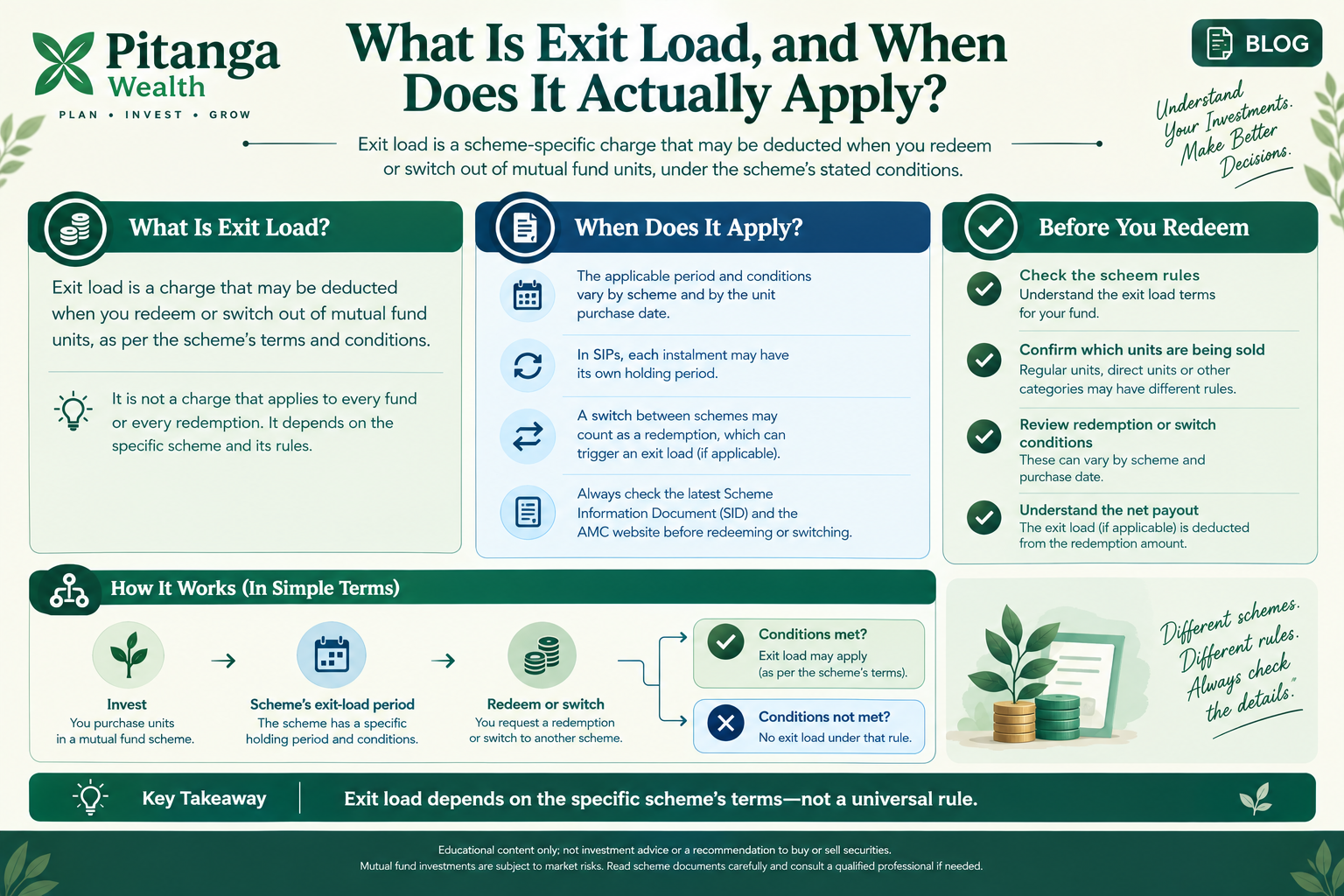
Exit load is a charge that may apply when you redeem mutual fund units within a specified period. But not every mutual fund charges it, and the rules can differ significantly between schemes.
Understanding what is exit load in mutual funds, how it works, and when it actually applies can help investors make more informed decisions and avoid unexpected redemption costs.
Let’s break it down.

What Is Exit Load in Mutual Funds?
To understand what is exit load in mutual funds, it helps to know that certain schemes impose a charge when investors redeem their units within a specified holding period.
The charge is generally calculated as a percentage of the applicable redemption value.
For example, a scheme might specify an exit load for units redeemed within a particular period after allotment.
If those units are redeemed after the specified period, that particular exit load may no longer apply.
However, the actual charge and holding-period conditions depend on the scheme’s published load structure.
The important point: Exit load is not a universal fee charged by every mutual fund. It is a scheme-specific condition that investors should understand before investing.
Why Do Mutual Funds Charge an Exit Load?
To understand what is exit load in mutual funds and why it is charged, consider how an exit load can discourage frequent or early redemptions, particularly in schemes designed around a longer investment approach.
Frequent redemptions may require fund managers to sell underlying investments or maintain additional liquidity.
Depending on the portfolio and market conditions, these activities can affect how a scheme is managed.
Exit loads can help address some of these concerns by discouraging short-term transactions.
However, not all schemes have the same investment objectives, liquidity needs, or exit-load policies.
Some impose an exit load for a limited period, while others may have no exit load under their applicable terms.
The existence of an exit load does not automatically make a scheme better or worse.
How Is Exit Load Calculated?
When learning what is exit load in mutual funds, it is also important to understand how the charge is calculated using the redemption value of the units to which it applies.
The basic calculation is:
Exit Load = Applicable Redemption Value × Exit Load Rate
Let’s consider a purely hypothetical example.
Suppose an investor redeems mutual fund units with an applicable redemption value of ₹50,000.
Assume the scheme specifies an exit load of 1% for those units at the time of redemption.
The calculation would be:
| Particulars | Illustrative amount |
| Redemption value before exit load | ₹50,000 |
| Assumed exit load | 1% |
| Exit load amount | ₹500 |
| Amount after exit load | ₹49,500 |
This illustration does not account for any other applicable deductions or tax obligations.
It is also not an example of a particular mutual fund scheme.
If the scheme’s conditions provide for no exit load on those units, the exit-load deduction would be zero.
Remember: The charge depends on the scheme’s actual terms, the relevant units, and their holding period—not simply the amount being withdrawn.

When Does Exit Load Actually Apply?
When exploring what is exit load in mutual funds, remember that the charge generally applies when units are redeemed within a period specified in the scheme’s applicable load structure.
The relevant conditions can include how long the units have been held, how many units are being redeemed, and whether the scheme provides any exemptions or allowances.
Redemption Before the Specified Period
If a scheme charges an exit load for early redemption, selling units before the applicable period ends may trigger that charge.
Redemption After the Specified Period
If the specified exit-load period has ended, the relevant units may be redeemed without that particular charge.
However, investors should verify the actual conditions rather than assume a standard holding period applies to every scheme.
Schemes With No Applicable Exit Load
Some schemes specify no exit load.
In such cases, redemptions may not attract an exit-load charge, although other considerations such as market movements, applicable taxes, and transaction conditions still matter.
Partial Redemptions
Redeeming only part of an investment does not necessarily avoid exit load.
If the redeemed units are subject to an applicable charge, exit load may still be deducted on those units.
Some schemes provide limited redemption allowances or different conditions for partial withdrawals. These provisions must be checked in the relevant scheme documents.
Does Exit Load Apply to SIP Investments?
An important part of understanding what is exit load in mutual funds is recognising that it can also apply to units purchased through a Systematic Investment Plan (SIP), depending on the scheme’s terms.
This is an important point because many investors assume that the holding period begins with their first SIP payment.
In reality, each SIP instalment generally results in a separate purchase and allotment of mutual fund units.
The exit-load holding period is ordinarily assessed with reference to the relevant units and their allotment dates.
Consider an investor who has been making monthly SIP investments in a scheme.
If that investor later redeems some units, older units may have completed the applicable exit-load period while more recently purchased units may not have.
The resulting charge depends on the scheme’s load structure and the units treated as redeemed.
Schemes commonly use a first-in, first-out method for identifying units redeemed from a particular holding, subject to applicable transaction rules.
The key takeaway: Completing a particular period since your first SIP does not automatically mean every unit in your investment is free from exit load.
Does Exit Load Apply When Switching Mutual Funds?
A mutual fund switch generally involves moving an investment from one scheme to another.
For transaction purposes, this commonly involves redeeming units from the existing scheme and purchasing units in the destination scheme.
As a result, an exit load may apply to the switch-out if the existing scheme’s terms provide for one.
However, not every switch is treated identically.
For example, some schemes specify exemptions for certain switches between plans or options within the same scheme.
The treatment depends on the relevant scheme documents and the nature of the transaction.
Before switching, investors should check both the applicable exit-load provisions and any tax consequences.
A switch can have tax implications even when no exit load is charged.
Does Exit Load Apply to SWP and STP Transactions?
A Systematic Withdrawal Plan (SWP) allows an investor to withdraw amounts from a mutual fund investment periodically.
A Systematic Transfer Plan (STP) generally facilitates periodic transfers from one mutual fund scheme to another.
Because these transactions can involve redemption or switch-out of units, exit-load conditions may apply.
For an SWP, each withdrawal should be evaluated against the applicable scheme conditions and the units being redeemed.
For an STP, the source scheme’s exit-load provisions may be relevant to each transfer.
The exact treatment can vary between schemes.
Investors should therefore avoid assuming that a systematic transaction is automatically exempt from exit load.

Exit Load vs Expense Ratio vs Taxation
These three concepts are often confused, but they represent different costs or obligations.
| Factor | Exit load | Expense ratio | Taxation |
| What it represents | Charge on certain redemptions or switch-outs | Scheme’s recurring operating expenses | Tax obligations under applicable law |
| When relevant | When units are redeemed or switched out under applicable conditions | While the scheme operates | When a taxable event or income arises |
| Is it the same for every scheme? | No | No | Depends on the transaction and applicable tax rules |
| Where to check | Scheme load structure and updates | Scheme disclosures and factsheets | Current tax law and relevant professional guidance |
An expense ratio is reflected in the scheme’s ongoing expenses and NAV calculation.
An exit load is linked to qualifying redemption or switch-out transactions.
Taxation is governed by applicable tax law and is not the same as a fee charged by the mutual fund.
Investors should consider these factors separately when evaluating the overall cost of an investment decision.
Is Exit Load the Same as a Lock-In Period?
No.
When explaining what is exit load in mutual funds, it is important to distinguish an exit load from a lock-in period because they are different concepts.
Exit load refers to a charge that may apply when units are redeemed within specified conditions.
Lock-in period refers to a restriction on redeeming units before a prescribed period ends.
For example, Equity Linked Savings Schemes (ELSS) have a statutory lock-in period under their applicable framework.
During that lock-in period, the relevant units generally cannot be redeemed merely by paying an exit load.
This distinction matters because investors sometimes assume that every early withdrawal restriction can be overcome by paying a fee.
That is not the case.
Can Exit Load Rules Change?
Mutual fund schemes may revise their exit-load structures in accordance with applicable regulations and disclosure requirements.
Changes are generally implemented prospectively rather than being imposed retrospectively on existing investments.
However, the terms applicable to a particular investment should be verified using the relevant scheme documents, transaction date, and subsequent official disclosures.
Investors should not rely exclusively on an old factsheet, an outdated online summary, or the exit-load conditions of another scheme.
The fund house’s current published documents and applicable addenda are important reference points.
Where Can You Check a Mutual Fund’s Exit Load?
Beyond understanding what is exit load in mutual funds, investors should review the scheme’s official information before investing or redeeming units.
Useful sources include:
Scheme Information Document (SID): Describes the scheme’s investment features, risks, expenses, and applicable load structure.
Key Information Memorandum (KIM): Provides a concise summary of important scheme information.
Fund house website: May publish the current load structure, scheme updates, and relevant addenda.
Scheme factsheet: Can provide a convenient summary, although the applicable legal documents and official updates should be checked when necessary.
Account or transaction records: Help identify when units were purchased or allotted.
If you are unsure how the rules apply to your holdings, seek clarification from the relevant fund house or an appropriately qualified professional before submitting a transaction.
Should You Wait Until the Exit-Load Period Ends?
Not necessarily.
Avoiding an exit load can be one consideration, but it should not be the only factor driving an investment decision.
Suppose an investor’s financial circumstances change or the investment no longer fits their objectives.
Waiting solely to avoid an exit load may not always be appropriate, especially if doing so exposes the investor to risks they cannot comfortably bear.
On the other hand, redeeming without checking the scheme’s conditions may create an avoidable cost.
The decision should consider the investment’s purpose, liquidity requirements, market risks, applicable charges, and potential tax consequences.
An exit-load period is not a recommendation to remain invested until that date, nor does its expiry mean an investment should automatically be redeemed.
Common Mistakes Investors Make
Assuming Every Mutual Fund Charges Exit Load
Understanding what is exit load in mutual funds also means recognising that exit-load structures vary between schemes, and some schemes have no applicable exit load.
Thinking Exit Load Is Charged on the Original Investment Amount
Exit load is generally calculated on the applicable redemption value of the units concerned, not automatically on the original amount invested.
Assuming All SIP Units Have the Same Holding Period
Each instalment generally creates a separate purchase of units. Their relevant holding periods may therefore differ.
Believing Partial Withdrawals Are Always Exempt
A partial redemption can still attract an exit load if the redeemed units meet the applicable conditions.
Assuming Switching Funds Avoids Exit Load
A switch-out can be treated as a redemption for exit-load purposes, subject to scheme-specific exemptions.
Confusing Exit Load With Tax
Even if no exit load applies, a redemption or switch may have tax consequences.
Staying Invested Only to Avoid a Charge
An investment’s suitability and risks should not be ignored merely to avoid a redemption cost.
Frequently Asked Questions
1. What is exit load in mutual funds?
Exit load is a charge that certain mutual fund schemes impose when units are redeemed or switched out under specified conditions, often within a particular holding period.
2. Is exit load compulsory for every mutual fund?
No. Exit-load conditions vary between schemes. Some schemes specify no exit load.
3. Is exit load charged on SIP investments?
It can be. Each SIP instalment generally creates separately allotted units, and the relevant holding period is assessed according to the scheme’s applicable rules.
4. Does exit load apply after one year?
There is no universal one-year rule for all mutual funds. Whether exit load applies depends on the particular scheme’s load structure and the units being redeemed.
5. Will I pay exit load if I withdraw only part of my investment?
Possibly. Partial redemptions may attract an exit load on the units redeemed, depending on the scheme’s terms and any applicable exemptions.
6. Does switching from one mutual fund to another attract exit load?
It may. A switch-out can attract exit load under the source scheme’s terms. Certain intra-scheme switches may be exempt, depending on the relevant provisions.
7. Is exit load the same as capital gains tax?
No. Exit load is a scheme-related redemption charge, while capital gains tax is governed by applicable tax law. They should be evaluated separately.
8. Can I avoid exit load by stopping my SIP?
Stopping future SIP instalments does not automatically remove the exit-load conditions attached to units already purchased. Those units remain subject to their applicable terms when redeemed.
Final Thoughts
Understanding what is exit load in mutual funds can help investors avoid confusion when redeeming or switching their investments.
The important thing to remember is that exit load is not a fixed charge that applies to every mutual fund or every withdrawal.
Its applicability depends on the scheme, the relevant units, the holding period, and the published load structure.
Whether you invest through a lump sum or SIP, checking these conditions beforehand can help you understand the possible costs of a transaction.
At Pitanga Wealth, we believe informed financial decisions begin with understanding both the opportunities and the conditions attached to an investment.
Explore our educational resources to learn more about mutual fund expenses, investment risks, and financial planning.
Important Disclaimer
This article is intended solely for general financial education and information. It does not constitute personalised investment advice, a recommendation to invest in or redeem any particular mutual fund scheme, or an assurance of investment outcomes.
Mutual Fund investments are subject to market risks. Read all scheme-related documents carefully before investing.
Exit-load structures, scheme conditions, regulations, and tax treatment may change. Investors should verify the applicable terms using official scheme documents and seek guidance from an appropriately qualified professional where necessary.
Distributor Disclosure: Pitanga Wealth is an AMFI-Registered Mutual Fund Distributor (ARN-134606). Mutual fund distributors may receive commissions from asset management companies for eligible distribution activities. AMFI registration as a mutual fund distributor does not constitute SEBI registration as an investment adviser.
Written by the Pitanga Wealth team.
Follow @Pitangawealth on Instagram for more accessible financial education.
This article is for educational and informational purposes only. It is not investment, tax, legal or insurance advice. Consider your circumstances and relevant documents before making a financial decision.