

Buying a property to earn rent sounds appealing until you start looking at what it actually involves. There’s the upfront cost, the paperwork, finding tenants, maintaining the property, and the possibility that it sits empty for months. Investing in infrastructure sounds even further out of reach. Most of us aren’t exactly in a position to own a toll road or a power transmission network.
But what if you could participate in the income generated by these kinds of assets without owning or managing them yourself?
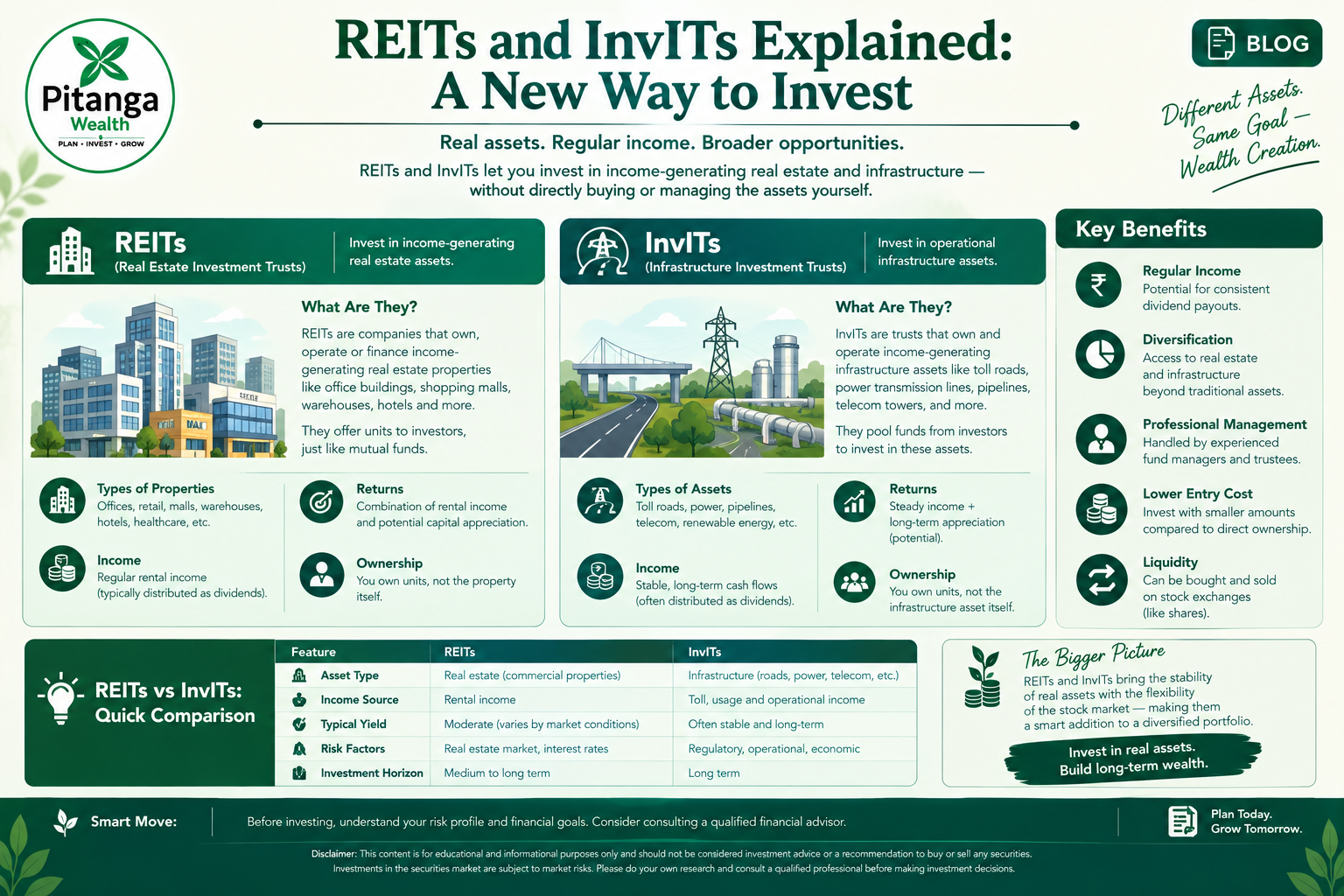
That’s the idea behind REITs and InvITs. These investment structures allow investors to gain exposure to income-generating real estate and infrastructure assets through units that can be bought and sold on stock exchanges.
They aren’t substitutes for every other investment, and they certainly aren’t guaranteed sources of income. But they’re worth understanding because they open up a part of the investment market that was traditionally difficult for individual investors to access.
What Are REITs?
REIT stands for Real Estate Investment Trust.
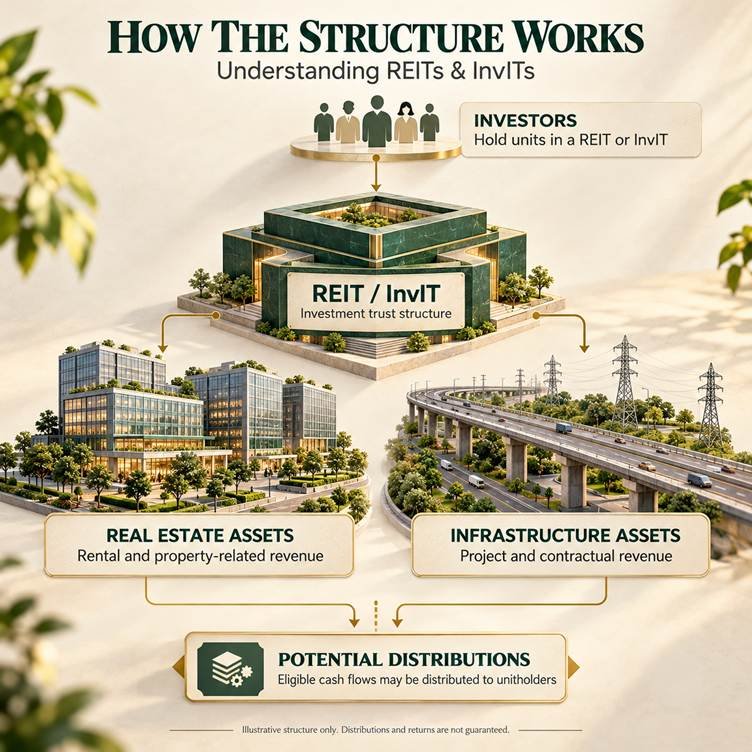
Think of a REIT as a way for many investors to collectively participate in a portfolio of real estate assets. Instead of buying an entire commercial building yourself, you purchase units in a trust that owns or invests in properties.
In India, REIT portfolios commonly include income-generating commercial real estate, such as office parks and business properties. The properties generate rental income, and eligible income is distributed to investors under the applicable regulatory framework.
A REIT typically involves three important participants:
Sponsor: Establishes the trust and contributes or helps assemble its initial asset portfolio.
Manager: Makes investment and operational decisions for the REIT.
Trustee: Oversees the trust’s activities and helps ensure compliance with its obligations.
As a unitholder, you don’t become the direct owner of a particular office or building. You own units representing an economic interest in the trust.
That distinction matters. You participate in the trust’s financial performance, but you don’t get to choose tenants, negotiate leases, or sell individual properties.
What Are InvITs?
InvIT stands for Infrastructure Investment Trust.
The broad idea is similar to a REIT, but the underlying assets are different.
An InvIT allows investors to participate in infrastructure projects that may generate income over extended periods. These can include toll roads, power transmission assets, pipelines, and other qualifying infrastructure investments.
For example, imagine a trust holding operational highway assets. The income available to investors may depend on toll collections, contractual payments, operating expenses, financing costs, and the terms of the underlying concessions.
Other InvITs may hold infrastructure assets whose revenues are based on long-term agreements rather than direct payments from individual users.
The key point is that an InvIT’s performance depends on the economics of its specific assets. Two InvITs can behave quite differently even though both belong to the same investment category.
Like REITs, InvITs operate through a regulated structure involving parties responsible for management and oversight.
REITs vs InvITs: What’s the Difference?
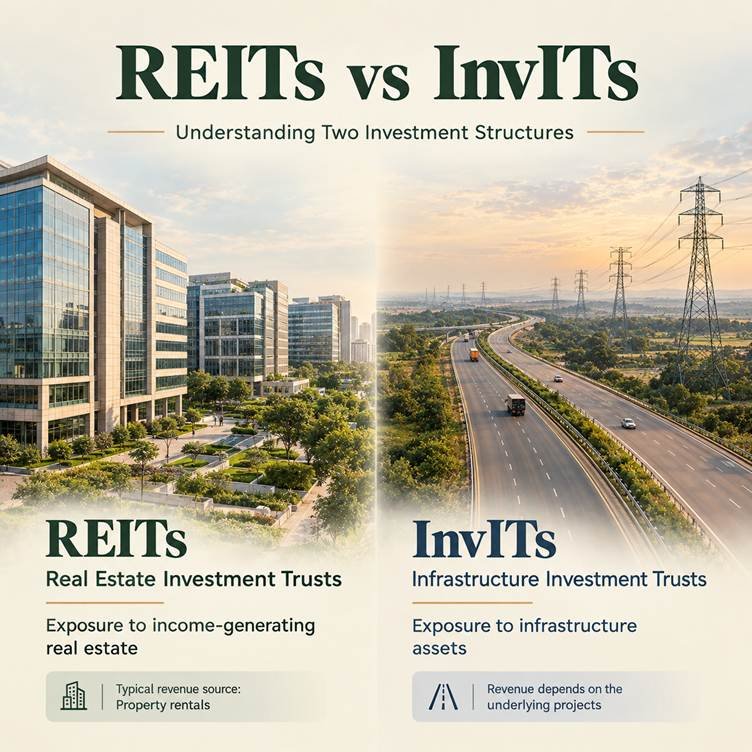
At first glance, REITs and InvITs look almost identical. Both pool investor capital, hold underlying assets, and may distribute income to unitholders.
The difference becomes clearer when you look at what generates that income.
| Feature | REITs | InvITs |
| Main investment exposure | Real estate | Infrastructure |
| Typical underlying assets | Office parks and commercial properties | Roads, transmission networks, pipelines and other infrastructure |
| Main income sources | Rent and related property income | Project revenue, contractual payments or usage-linked income |
| Important operating factors | Occupancy, tenant quality, lease renewals | Project utilization, contracts, concessions and operating costs |
| Key risks | Vacancies, property valuations, tenant concentration | Regulatory changes, project performance, contractual and operational risks |
| Trading | Listed units trade on exchanges | Listed units trade on exchanges; some InvITs are privately placed |
| Income distributions | Subject to applicable distribution requirements | Subject to applicable distribution requirements |
Neither structure is automatically safer or more profitable than the other.
A REIT with financially strong tenants and long leases may have relatively predictable rental receipts, but property valuations and financing costs can still change.
An InvIT with stable long-term contractual revenues may also offer visibility into cash flows, but that doesn’t remove operational, regulatory, or refinancing risks.
The quality of the assets and the financial structure matter more than the label.
How Do Investors Earn Returns?
When discussing REITs and InvITs, it’s useful to separate two sources of potential returns.
1. Income Distributions
REITs and InvITs are designed to pass a substantial portion of eligible cash flows to their investors.
Under the applicable SEBI framework, these trusts generally have to distribute at least 90% of their net distributable cash flows, subject to the relevant entity-level rules and prescribed distribution timelines.
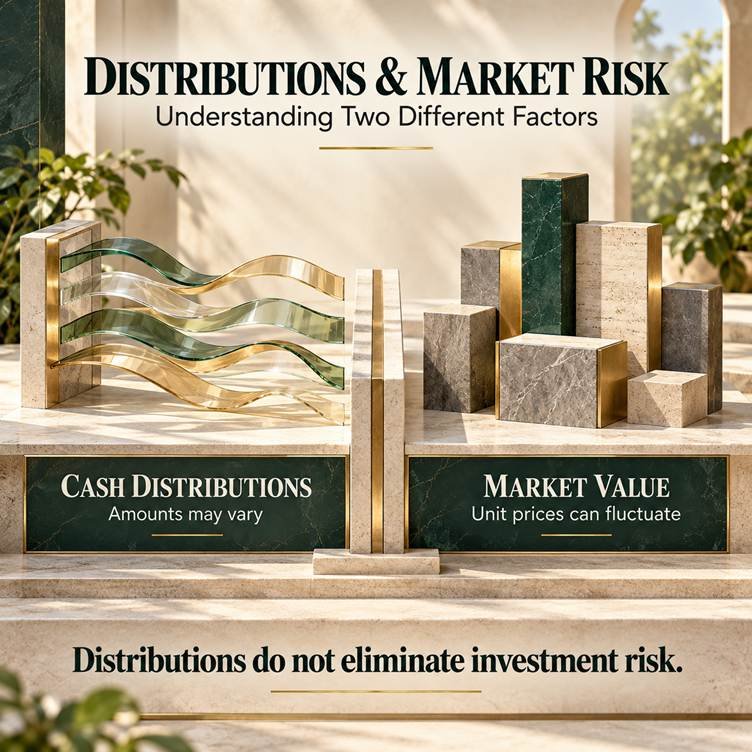
But here’s an important distinction: a requirement to distribute cash flow is not a promise that a particular amount of cash flow will always exist.
If rental collections fall, a project underperforms, or financing costs rise, the amount available for distribution may change.
Distributions can also contain different components, including interest, dividends, repayment of capital, or other amounts depending on the trust’s structure. Those components may receive different tax treatment.
2. Changes in Unit Price
Listed REIT and InvIT units trade on stock exchanges, so their market prices can rise or fall.
Suppose you buy 100 units at ₹300 each.
Your initial investment is ₹30,000.
Over a year, imagine the trust distributes ₹18 per unit, giving you ₹1,800 in cash distributions.
If the unit price rises to ₹315, your units would have a market value of ₹31,500.
In that hypothetical situation, your total pre-tax gain would be ₹3,300, consisting of ₹1,800 in distributions and ₹1,500 in unrealized price appreciation.
That’s an 11% total return before taxes and transaction costs.
But reverse the price movement and the picture changes. If the units fall to ₹260, their market value becomes ₹26,000. Even after receiving ₹1,800 in distributions, you would be ₹2,200 below your original investment value.
Income distributions do not protect you from capital losses.
This is why looking only at the distribution yield can give an incomplete picture.
How to Invest in REITs and InvITs in India
For a retail investor, buying units of a publicly listed REIT or InvIT is broadly similar to buying exchange-traded securities.
You generally need a demat account and access to a trading account through a registered intermediary.
The basic process involves identifying a listed trust, reviewing its public disclosures, checking its current trading price and liquidity, and placing an order through your trading platform.
Before investing, it helps to read the trust’s latest investor presentation, financial results, distribution disclosures, and risk information.
You should also distinguish publicly listed products from privately placed InvIT structures, which can have different eligibility, trading and investment requirements.
One attraction of exchange-listed units is that you don’t need the capital required to purchase an entire property or infrastructure asset.
However, being listed doesn’t mean you can always sell a large holding immediately at your preferred price. Trading volumes and bid-ask spreads still matter.
Are REITs and InvITs Safe Investments?
It’s tempting to think of these products as a middle ground between property ownership and fixed-income investments.
There are similarities, but that comparison can become misleading.
REITs and InvITs are market-linked investments. Their prices fluctuate, their distributions can vary, and neither principal nor returns are guaranteed.
Several risks deserve attention.
Interest Rate Risk
When market interest rates rise, financing can become more expensive for trusts carrying debt. Investors may also demand higher yields from income-generating assets, putting pressure on their market valuations.
Asset Concentration Risk
A trust holding only a limited number of major properties, tenants, or projects can be particularly exposed if one of them performs poorly.
Operational Risk
A commercial property may experience vacancies or unexpected maintenance expenses. An infrastructure asset may face technical disruptions, lower utilization, or project-specific problems.
Regulatory and Contractual Risk
Infrastructure projects may depend on government concessions, regulated tariffs, or long-term agreements. Changes in the relevant rules or contractual arrangements can affect future cash flows.
Liquidity Risk
Some listed units may trade less actively than widely held shares. That can make buying or selling at a desirable price more difficult.
The right question isn’t whether REITs or InvITs are safe in general. It’s whether a particular trust’s risks are understandable and suitable for your investment goals.
How Are REITs and InvITs Taxed in India?
Taxation is one area where investors should be especially careful about oversimplified explanations.
A distribution from a REIT or InvIT isn’t necessarily taxed in one uniform way. Its treatment depends on the nature of the amount received, the underlying structure, and the applicable provisions of Indian tax law.
For example, interest distributions, dividend distributions, certain other distributions, and qualifying repayments of capital may be subject to different rules.
Capital gains taxation when selling listed units is a separate consideration. The applicable treatment depends on factors including the type of unit, holding period, transaction conditions, and tax law in force.
Rather than assuming every distribution is tax-free or taxed at the same rate, check the component-wise distribution statement provided by the trust.
If you’re calculating your expected post-tax return, this distinction can materially change the outcome.
Tax provisions can change, so investors should verify the rules applicable to their own circumstances and the relevant financial year, ideally with a qualified tax professional.
Who Might Consider REITs and InvITs?
REITs and InvITs may interest investors who want exposure to real estate or infrastructure without directly purchasing and managing those assets.
They may also appeal to investors who value the possibility of periodic cash distributions and are comfortable with market-linked price movements.
But suitability depends on more than the desire for income.
If you need guaranteed capital protection, assured monthly payments, or money that must be available at a fixed value on a particular date, these products may not meet those needs.
They can be considered as part of a diversified portfolio, but they shouldn’t automatically replace emergency savings, appropriate insurance, or other investments serving different financial goals.
What Should You Check Before Investing?
Understand the assets. What does the trust actually own? Where are those assets located? How diversified are they?
Examine the revenue sources. For a REIT, look at occupancy, tenant concentration, rental agreements and lease expiries. For an InvIT, study contracts, concession periods, counterparties and project utilization.
Review debt and financing. Borrowing can help finance acquisitions, but excessive leverage can make distributions and valuations more vulnerable.
Study distribution sustainability. Are distributions supported by recurring operating cash flows, or have unusual transactions contributed to recent payouts?
Compare valuation with fundamentals. A high distribution yield may reflect a lower unit price caused by legitimate concerns about the trust’s future performance.
Check liquidity. Look at trading volumes and the difference between buying and selling prices.
These questions won’t eliminate investment risk, but they can help prevent a decision based entirely on a headline yield.
Common Mistakes Investors Make
Treating distributions like fixed-deposit interest. Cash distributions are variable and aren’t guaranteed contractual interest payments to unitholders.
Choosing the highest yield automatically. A high yield can sometimes indicate that the market expects weaker future performance.
Ignoring debt. Asset quality matters, but so does the financing used to hold those assets.
Assuming all REITs or InvITs are alike. Different portfolios can have very different risk profiles.
Forgetting taxes and transaction costs. What matters is the return you retain, not just the amount distributed.
Confusing access with diversification. Buying one trust gives you exposure to its portfolio, not necessarily to the entire Indian property or infrastructure market.
Frequently Asked Questions
Are REITs and InvITs better than mutual funds?
They serve different purposes. REITs and InvITs provide exposure to particular real estate or infrastructure assets, while mutual funds can invest across a much wider range of securities depending on the scheme. Neither is universally better.
Can I lose money in a REIT or InvIT?
Yes. Unit prices can decline, distributions can fall, and underlying assets may underperform. These are not capital-guaranteed investments.
Do REITs and InvITs pay monthly income?
Not necessarily. Distribution schedules depend on the trust and applicable regulatory requirements. Investors should review actual disclosures rather than assume a fixed monthly payment.
Is buying a REIT the same as owning property?
No. You own units in a trust, not direct legal ownership of a particular building. You also don’t control property-level decisions.
Can I sell REIT and InvIT units whenever I want?
Listed units can generally be offered for sale during exchange trading hours, but successful execution depends on market liquidity and available buyers. Private or unlisted structures have different restrictions.
Are REIT and InvIT distributions tax-free?
Not automatically. Different components of distributions may be taxed differently. Always review the distribution breakup and applicable tax rules.
The Pitanga Wealth Perspective
REITs and InvITs have made it easier for individual investors to access asset categories that once required substantial capital and specialist knowledge.
That accessibility is useful, but it doesn’t make every available investment suitable.
A REIT isn’t automatically attractive because it owns premium office buildings. An InvIT isn’t automatically dependable because its assets provide essential services. The quality of cash flows, financing, valuation, and investment structure still determines much of the risk.
At Pitanga Wealth, we believe the sensible starting point is to understand what an investment actually owns, how it generates returns, and what could go wrong before deciding whether it belongs in a portfolio.
If you’re exploring new asset classes alongside your existing investments, the Pitanga Wealth team can help you think through diversification, risk and long-term financial goals.
Important Disclaimer
REITs and InvITs are market-linked investments and are subject to price fluctuations, liquidity risk, operational risk and other risks associated with their underlying assets. Distributions and returns are not guaranteed. Tax treatment depends on prevailing law and individual circumstances. This article is for educational purposes only and should not be construed as investment advice, a solicitation, or a recommendation to buy or sell any security.
Pitanga Wealth is an AMFI-Registered Mutual Fund Distributor (ARN-134606). AMFI registration as a mutual fund distributor does not constitute authorization to provide regulated investment advisory services or to distribute every type of investment product.
Written by the Pitanga Wealth team. Follow us on Instagram: We explain investing and financial planning in plain language. Follow @pitangawealth for more educational insights.
This article is for educational and informational purposes only. It is not investment, tax, legal or insurance advice. Consider your circumstances and relevant documents before making a financial decision.