

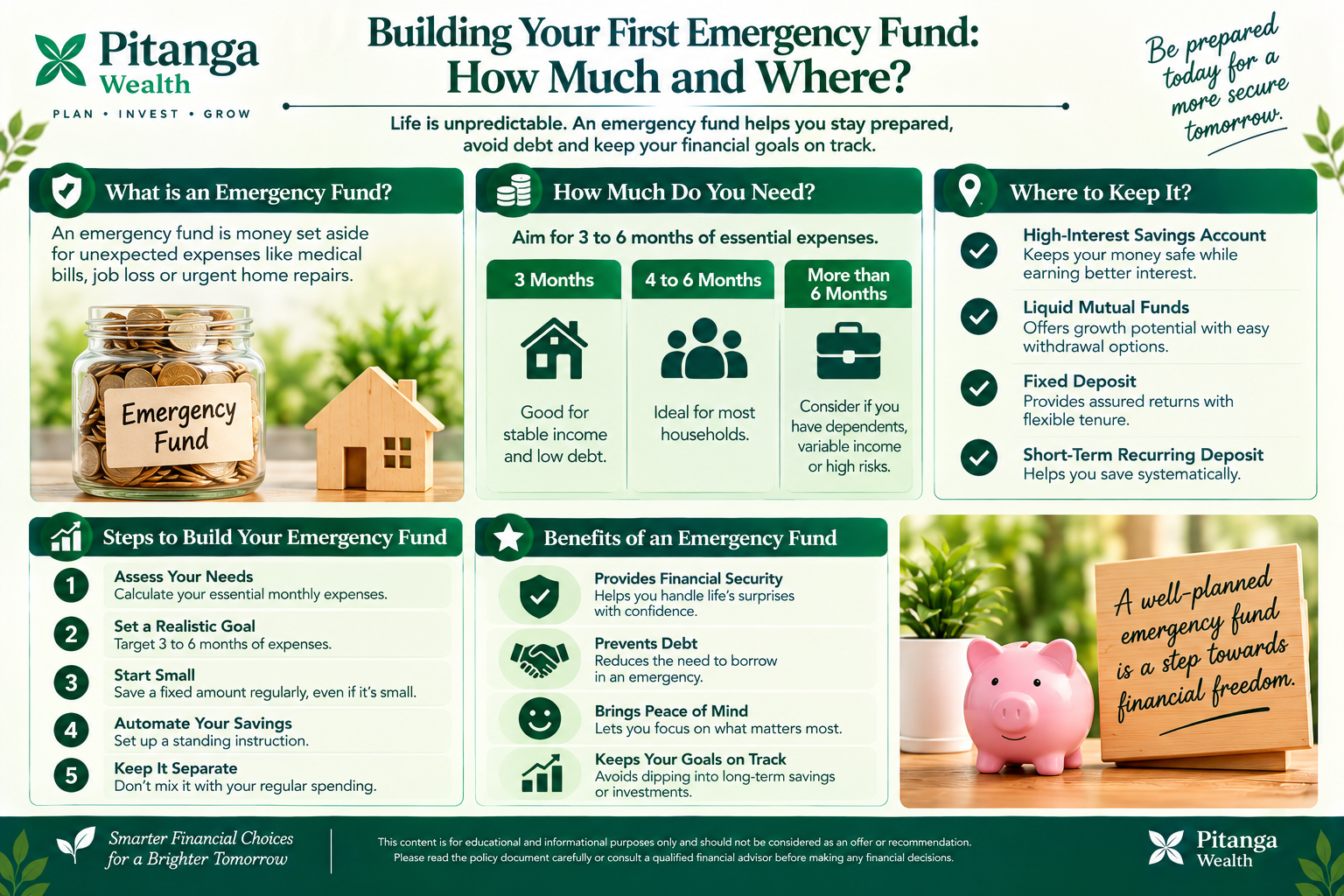
Life rarely follows a perfect financial plan. A sudden medical expense, unexpected job loss, urgent home repair, or temporary interruption in income can place considerable pressure on household finances.
When such situations arise, having money readily available can make a meaningful difference. Instead of immediately borrowing, selling investments, or using a credit card, you may be able to meet the expense using money specifically set aside for emergencies.
That is the purpose of an emergency fund. Building an emergency fund in India is one of the foundational steps in personal financial planning. Whether you are salaried, self-employed, a freelancer, or starting your first job, emergency savings can provide flexibility when circumstances change.
But how much should you save? Is three months enough, or should you aim for six or twelve months? And where should you keep it? This guide explains how to calculate your target, where to hold the money, and how to build it gradually.
What Is an Emergency Fund?
An emergency fund is money set aside specifically for unexpected, necessary expenses or temporary income disruptions. Unlike savings for a holiday, vehicle, wedding, or home down payment, it has no planned spending date.
Examples of Genuine Financial Emergencies
- Essential expenses during job loss
- Medical costs not fully covered by insurance
- Urgent repairs affecting home safety
- Necessary repairs to a vehicle used for work
- Unexpected family responsibilities
- Temporary income interruptions for freelancers or business owners
Routine shopping, planned holidays, and discretionary upgrades generally do not qualify. Using the reserve for predictable expenses can leave you exposed when a real emergency occurs.
Why Is an Emergency Fund Important in India?
An emergency fund in India can help households manage financial uncertainty without immediately disturbing long-term investments or relying on expensive borrowing.
Protection Against Income Disruption
Rent, EMIs, groceries and utilities continue even if salary stops. Emergency savings may cover essentials while you restore income.
Reduced Dependence on Borrowing
Without a reserve, urgent expenses may lead to credit card debt or personal loans with additional interest obligations.
Protection for Long-Term Investments
Unexpected redemptions may interrupt retirement or education planning and could force a sale during a market downturn.
Greater Financial Flexibility
Accessible savings give you time to evaluate options rather than make rushed decisions. They do not replace insurance.
How Much Emergency Fund Do You Need?
A common starting guideline is three to six months of essential living expenses, although some households may need more. This is a planning framework, not a universal rule.
How to Calculate Your Monthly Essential Expenses
- Rent or home loan EMI
- Groceries and basic supplies
- Electricity, water, gas and utilities
- School fees and necessary education costs
- Insurance premiums
- Essential transport
- Medicines and healthcare
- Minimum debt repayments and other unavoidable obligations
Discretionary entertainment, luxury shopping, and optional subscriptions can usually be reduced when calculating a survival budget.
Emergency Fund Formula
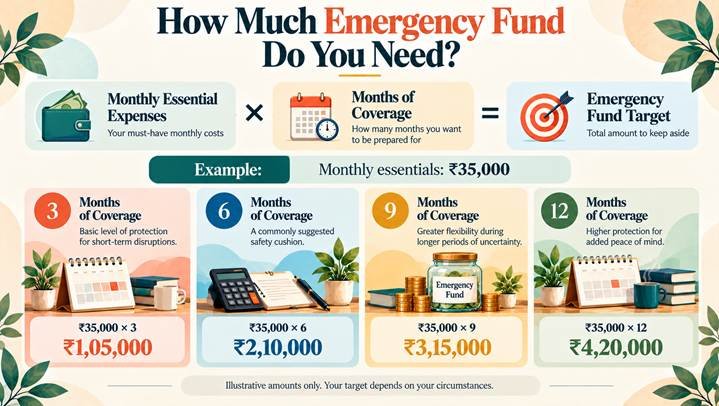
Emergency fund target = monthly essential expenses × months of coverage.
| Coverage period | Target if monthly essentials are ₹35,000 |
| 3 months | ₹1,05,000 |
| 6 months | ₹2,10,000 |
| 9 months | ₹3,15,000 |
| 12 months | ₹4,20,000 |
Figures are illustrative. Calculate your own target from your actual essential expenses.
Is Three Months or Six Months of Emergency Savings Enough?
When sizing an emergency fund in India, consider how quickly you could replace lost income and how many people rely on it.
Three Months of Expenses
A possible initial target for relatively stable income and limited obligations; also a useful first milestone.
Six Months of Expenses
May offer a larger cushion for families with dependants, fixed commitments or uncertainty around employment.
Nine to Twelve Months of Expenses
May be worth considering for freelancers, self-employed people and single-income households. The appropriate amount depends on individual risks.
Who May Need a Larger Emergency Fund?
Self-Employed Professionals and Freelancers
Irregular receipts can create long gaps between projects.
Single-Income Households
One income interruption may affect the entire household budget.
Families With Dependants
Children, elderly parents and ongoing care needs increase unavoidable expenses.
People With Significant EMIs
Loan payments continue even when earnings decline.
Individuals With Uncertain Employment
Contract or seasonal work may justify a longer buffer.
Where Should You Keep Your Emergency Fund in India?
Where you hold an emergency fund in India matters as much as its size. Prioritise accessibility, capital preservation, limited market exposure, and simple withdrawals. Potential returns are secondary.
Savings Bank Account
Often practical for money needed immediately. Check bank fees, access limits and interest terms. Separating the reserve from daily spending can help.
Bank Fixed Deposits
A callable FD may suit money not required immediately. Review premature-withdrawal rules, penalties and time to access proceeds. Non-callable deposits may be unsuitable.
Sweep-In Fixed Deposits
Some banks link savings accounts to deposits. Check minimum balances, sweep rules and withdrawal restrictions.
Liquid Mutual Funds
These debt funds hold short-term instruments, but are not bank deposits and do not guarantee returns. NAVs can fluctuate; redemption timing and holidays matter.
Overnight Mutual Funds
These invest in very short-maturity instruments, generally one day, but remain subject to fund risks, scheme terms and redemption processing.
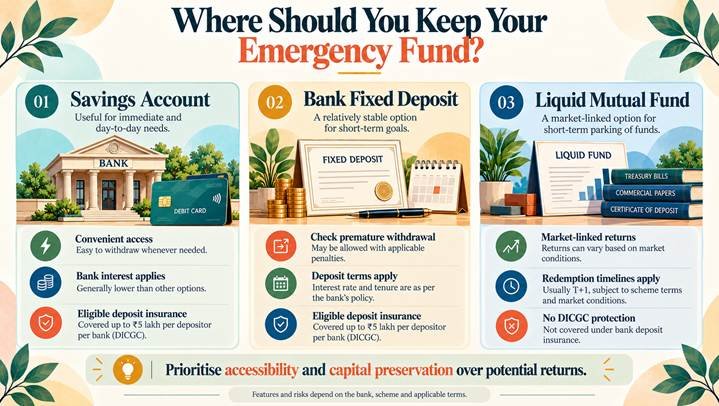
Emergency Fund: Savings Account vs FD vs Liquid Fund
| Factor | Savings account | Bank FD | Liquid mutual fund |
| Access | Usually convenient | Depends on FD terms | Redemption processing |
| Return | Bank-determined interest | Deposit terms | Market-linked |
| Risk | Bank risk | Bank risk | Investment and credit risks |
| DICGC cover | Eligible deposits | Eligible deposits | Not covered |
| Typical role | Immediate reserve | Accessible secondary reserve | Optional secondary reserve |
What Is DICGC Deposit Insurance?
Eligible deposits at insured banks are covered by DICGC up to ₹5 lakh per depositor per bank, including principal and interest, for deposits in the same right and capacity. Eligible deposits at branches of the same bank are aggregated. Mutual funds are not insured by DICGC. Official guide: https://www.dicgc.org.in/guide-to-deposit-insurance
How to Divide Your Emergency Savings Across Accounts
An emergency fund in India need not sit in one account. Some households use layers based on how quickly the money may be needed.
Layer 1: Immediate-Access Money
Hold money for urgent payments in a suitable accessible savings account.
Layer 2: Short-Notice Money
Consider an accessible deposit arrangement after checking withdrawal conditions.
Layer 3: Additional Reserve
Larger reserves may include other carefully evaluated short-duration options, where suitable.
For illustration, a household with ₹2,40,000 might keep ₹80,000 readily available and the balance in suitable bank deposits. This is not a recommended allocation for every family.
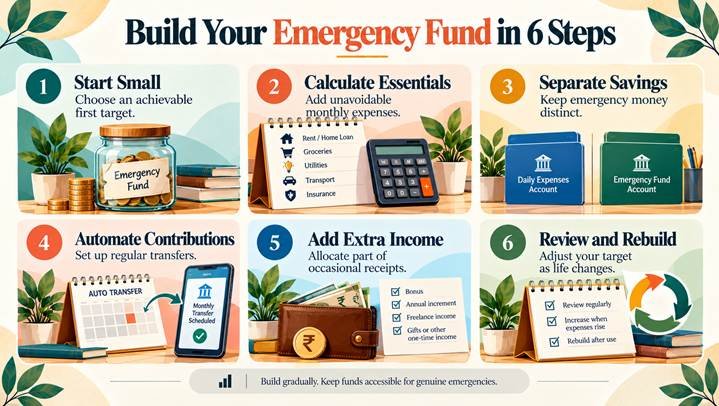
How to Build Your First Emergency Fund Step by Step
Building an emergency fund in India does not require a large lump sum. A consistent plan can be more practical.
Step 1: Start With a Small Initial Goal
Begin with an achievable milestone such as ₹10,000 or one month of essentials.
Step 2: Calculate Essential Monthly Expenses
Review bank statements, bills and necessary irregular expenses.
Step 3: Open or Designate a Separate Account
Keep emergency money distinct from daily spending.
Step 4: Automate Contributions
Consider a regular transfer after salary or business income arrives.
Step 5: Use Some Irregular Income
Bonuses or occasional receipts may accelerate progress, but do not depend on them.
Step 6: Review the Target Periodically
Reassess when income, dependants or major commitments change.
How Long Does It Take to Build an Emergency Fund?
For a target of ₹1,80,000 starting from zero, the time depends on regular savings:
| Monthly savings | Time to reach ₹1,80,000 |
| ₹3,000 | 60 months |
| ₹5,000 | 36 months |
| ₹7,500 | 24 months |
| ₹10,000 | 18 months |
| ₹15,000 | 12 months |
Illustrative calculations exclude interest, tax and withdrawals.
Should You Build an Emergency Fund Before Starting a SIP?
An emergency fund in India serves a different purpose from a systematic investment plan (SIP), which is a method of investing in mutual funds. Market-linked investments can fluctuate and may be unsuitable for urgent needs.
Why an Emergency Reserve Often Comes First
A basic reserve may reduce the chance of having to sell long-term investments during a market decline.
Can You Save and Invest at the Same Time?
Depending on circumstances, you may build a basic reserve and then split savings between enlarging it and long-term goals. Expensive debt or insurance needs may alter priorities.
Emergency Fund vs Savings vs Investments: What Is the Difference?
| Feature | Emergency fund | Goal savings | Long-term investments |
| Purpose | Unexpected essentials | Planned expense | Future goals |
| Horizon | Uncertain or immediate | Usually known | Generally longer |
| Liquidity | Very high | Goal-dependent | Product-dependent |
| Risk tolerance | Generally low | Varies | Depends on goal |
An emergency fund is defined by its purpose and accessibility, not by the product alone.
Should You Use Your Emergency Fund to Pay Off Debt?
This depends on debt costs and the remaining financial cushion. High-interest debt deserves attention, but using every rupee to repay it may leave you vulnerable to another emergency.
When Debt Repayment May Deserve Priority
Expensive revolving credit card debt can compound financial strain.
Why Keeping Some Emergency Savings Still Matters
A small reserve may prevent new borrowing when another unexpected expense occurs. Balance debt repayment with accessible savings.
When Should You Use Your Emergency Fund?
The purpose of an emergency fund in India is to help with genuine financial disruptions. Ask whether the expense is necessary, unexpected or hard to postpone, and difficult to meet from regular cash flow.
What If You Have Insurance?
Insurance may cover certain losses, but deductibles, exclusions and claim timelines can still require cash. Emergency savings complement rather than replace insurance.
How to Rebuild Your Emergency Fund After Using It
Using a reserve for a genuine emergency is not failure. Once finances stabilise, replenish it at a sustainable pace.
Recalculate the Remaining Reserve
Compare what remains with current monthly essentials.
Resume Regular Contributions
Restart automated savings when cash flow allows.
Review the Cause of the Withdrawal
For predictable annual bills, consider a separate sinking fund.
Common Emergency Fund Mistakes to Avoid
Even a well-intended emergency fund in India can become less useful through avoidable mistakes.
Saving Without Calculating Expenses
An arbitrary target may provide too little coverage.
Keeping Emergency Money in Volatile Assets
Equities, equity funds and cryptocurrencies may fall sharply when cash is needed.
Prioritising Returns Over Liquidity
Higher potential returns may involve restrictions or loss risk.
Mixing Emergency Money With Daily Spending
It becomes harder to track and protect the reserve.
Ignoring Inflation and Rising Expenses
An old target may no longer cover the intended months.
Treating Credit Cards as Emergency Savings
A credit limit is borrowing, not a funded reserve.
Forgetting to Replenish Withdrawals
Rebuilding should follow genuine emergency use.
Emergency Fund Planning for Different Life Stages
The suitable size of an emergency fund in India can change as responsibilities evolve.
First Job or Early Career
Start with a modest milestone and build gradually.
Married Couples
Consider joint expenses and whether one or both incomes are dependable.
Families With Children
Education, housing and healthcare may require more coverage.
Self-Employed Individuals
Keep personal emergency savings distinct from business working capital.
People Approaching Retirement
Consider pensions, healthcare and the availability of other liquid resources.
A Practical Emergency Fund Checklist
- Calculate essential monthly expenses.
- Choose a realistic coverage period.
- Separate the reserve from everyday spending.
- Keep some money promptly accessible.
- Understand deposit or investment withdrawal rules.
- Check eligible deposit insurance limits.
- Avoid relying entirely on volatile assets.
- Plan to replenish withdrawals.
- Review the target when circumstances change.
Frequently Asked Questions About Emergency Funds in India
How much emergency fund should I have in India?
Three to six months of essential expenses is a common starting guideline; some households may need more.
Is ₹1 lakh enough for an emergency fund?
It depends. At ₹25,000 in monthly essentials, it covers about four months; at ₹50,000, only two.
Where should I keep my emergency fund in India?
An accessible savings account is practical for immediate needs. Suitable callable deposits may hold another portion.
Can I keep my emergency fund in a liquid mutual fund?
Potentially for a portion, if you understand NAV, credit and redemption risks. It is not insured by DICGC.
Should I keep emergency money in cash at home?
A modest amount may help during payment disruptions, but large holdings face theft and loss risks.
Is an FD better than a savings account?
Neither is universally better; compare accessibility and premature withdrawal terms.
Can I use emergency savings for medical expenses?
Yes, for unexpected necessary costs not otherwise met.
Should I stop SIPs to build an emergency fund?
Not automatically. Consider your reserves, obligations, income stability and investment goals.
Is an emergency fund taxable in India?
There is generally no separate tax on holding a reserve; interest or investment income may be taxable.
Can I use emergency savings for a home loan EMI?
Yes, during a temporary income disruption, although persistent repayment difficulty needs a broader plan.
How often should I review the fund?
At least periodically, especially after major changes in expenses or household circumstances.
Should freelancers keep twelve months of expenses?
Some may benefit, but the right target depends on earnings variability and obligations.
Is a credit card a substitute for emergency savings?
No. It creates debt and potential interest obligations.
What should I do after using the fund?
Reassess remaining coverage and replenish it when affordable.
Final Thoughts
Building an emergency fund in India is not about predicting every setback. It is about preparing for unexpected expenses and income interruptions. Calculate essential expenses, choose a realistic coverage period, and prioritise accessible arrangements that preserve capital.
You do not need to reach the entire target immediately. Small regular contributions can build a useful buffer. Treat emergency savings as a distinct financial priority rather than an investment intended to maximise returns.
Important Disclaimer
This article is for general financial education and awareness only and is not personalised financial, banking, investment, tax or legal advice. The three-to-six-month guideline and all figures are illustrative. Suitable reserves and holding arrangements depend on individual circumstances. Rates, product terms, tax rules and regulatory requirements can change. Mutual funds are not bank deposits, do not guarantee returns and are not protected by DICGC deposit insurance.
Pitanga Wealth is an AMFI-registered mutual fund distributor (ARN-134606). Mutual fund investments are subject to market risks. Read all scheme-related documents carefully before investing.
Written by the Pitanga Wealth Team.
Follow us on Instagram @pitangawealth for more educational insights.
This article is for educational and informational purposes only. It is not investment, tax, legal or insurance advice. Consider your circumstances and relevant documents before making a financial decision.