

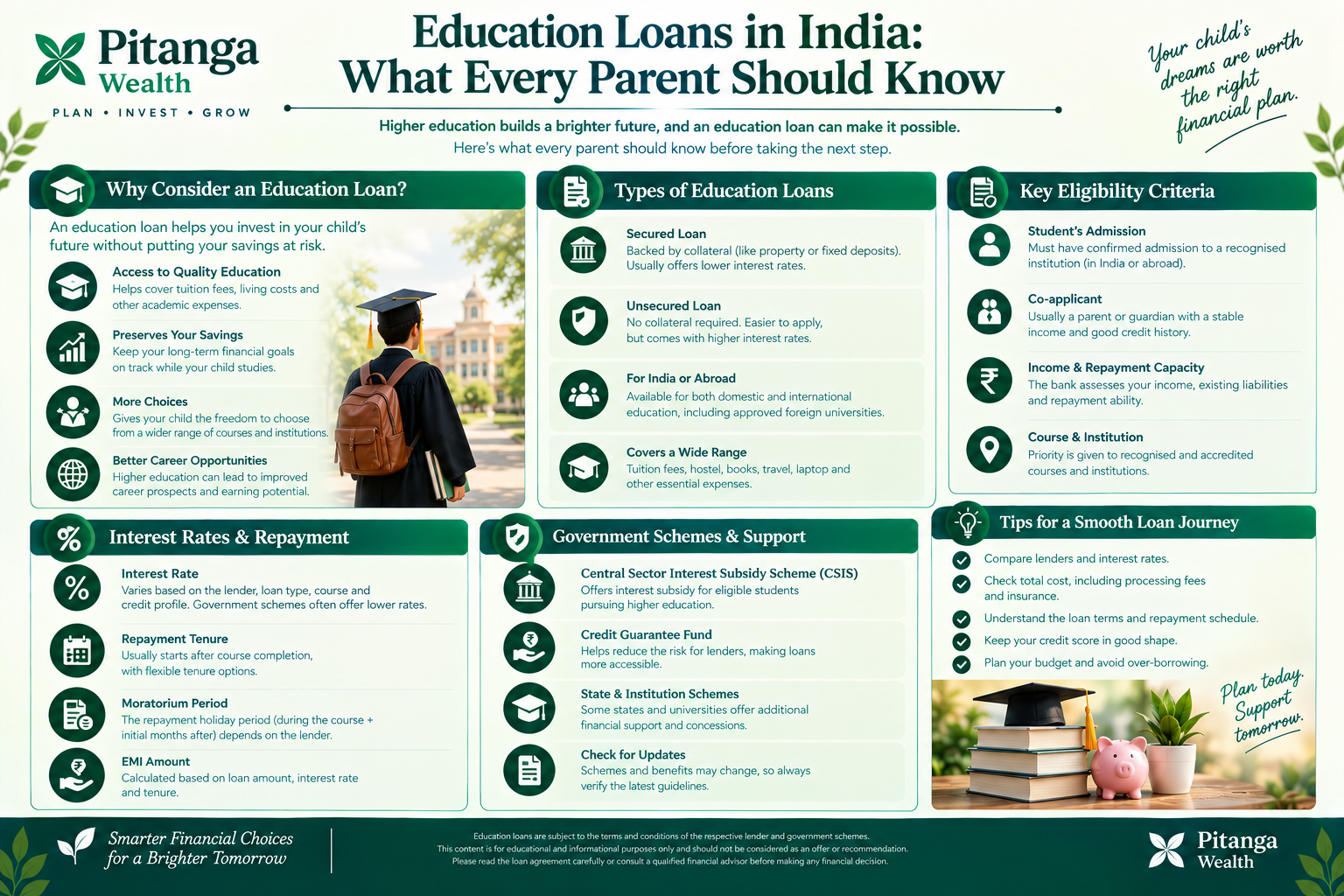
Higher education is one of the most important financial commitments a family may make. Whether a child plans to study engineering, medicine, management, law, or pursue a degree abroad, the cost of education can significantly affect household finances.
Tuition fees are only one part of the expense. Accommodation, food, books, equipment, travel, and other academic requirements can increase the overall budget. For many Indian families, an education loan can bridge the gap between savings and the cost of a chosen course.
Education loans in India help families manage the rising cost of higher education, but understanding the repayment responsibilities is essential.
Borrowing requires careful planning. Parents need to understand interest, moratorium, collateral, repayment and what happens if employment is delayed. This guide explains how education loans work in India, including government-supported assistance and important family financial considerations.
What Is an Education Loan?
An education loans in india finances eligible educational expenses, generally for higher studies in India or abroad. Depending on the lender and course, it may cover tuition, accommodation, examinations, books, equipment and other approved costs. The student is generally the primary borrower and a parent or eligible family member may join as co-borrower. Unlike many personal loans, an education loan may offer a study-related moratorium. It remains a financial liability governed by the sanction letter and loan agreement.
How Do Education Loans in India Work?
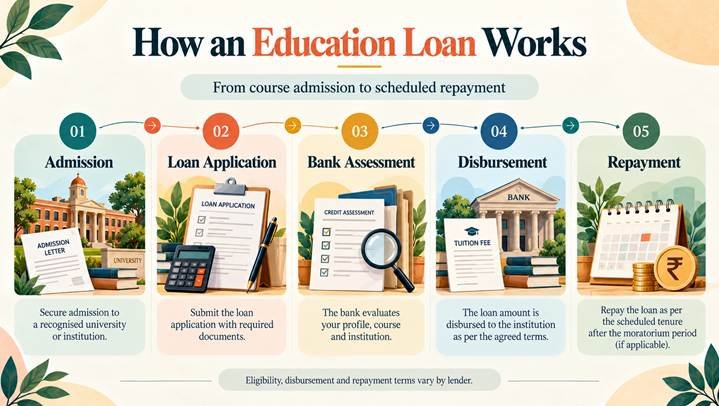
1. Admission and Course Eligibility
Banks review admission, course details, institution recognition and estimated expenses. Recognition alone does not guarantee approval.
2. Loan Application and Credit Assessment
The lender may evaluate academics, co-borrower income, existing obligations, credit history and any security offered.
3. Loan Sanction and Disbursement
The sanction letter sets out the amount, interest rate and terms. Disbursement may occur in stages, often directly to the institution.
4. Moratorium and Repayment
Many products defer regular EMIs during study and an additional period. Interest may still accrue. Repayment then follows the agreed schedule.
The RBI explains that the Indian Banks’ Association Model Education Loan Scheme provides broad guidance, while banks have discretion over their specific products and operational terms.
What Expenses Can an Education Loan Cover?
| Expense | Possible coverage |
| Tuition and academic fees | Usually a primary component |
| Examination and library fees | May be included |
| Hostel and accommodation | Subject to approved limits |
| Books and study materials | May be included |
| Laptop or essential equipment | Where reasonably required |
| Laboratory and course-related costs | Subject to lender assessment |
| Travel for overseas studies | May be considered |
| Other academic expenses | Depends on product |
Obtain a written total-course estimate and compare it against the lender’s eligible-expense list.
Who Is Eligible for an Education Loan in India?
Eligibility criteria for education loans in India vary depending on the lender, course, institution and borrower profile.
Student’s Admission and Academic Record
The student may need confirmed admission through an accepted process and academic records.
Institution and Course
Requirements vary for domestic, overseas, professional and postgraduate programmes.
Co-Borrower’s Financial Position
The lender may assess income stability, current EMIs and credit history.
Loan Amount and Security
Larger applications may require additional documents, security or family contribution, depending on the scheme.
No single eligibility checklist applies to all lenders. Confirm current requirements with the bank.
Education Loan Interest Rates in India: What Parents Should Understand
Interest rates on education loans in India depend on the lender’s policies, loan amount, collateral and other applicable conditions.
Fixed vs Floating Interest Rates
A fixed rate generally remains agreed for its specified period; a floating rate can change with the benchmark or spread under the contract. Ask how revisions work.
Why the Lowest Advertised Rate May Not Be the Cheapest Loan
Processing charges, insurance, moratorium interest and repayment tenure can change the total cost.
How Interest During the Study Period Affects the Loan
At an illustrative 10% annual simple interest rate, ₹10 lakh outstanding for a full year produces ₹1 lakh interest. Actual accrual depends on disbursement timing, rate and the bank’s calculation and capitalisation terms.
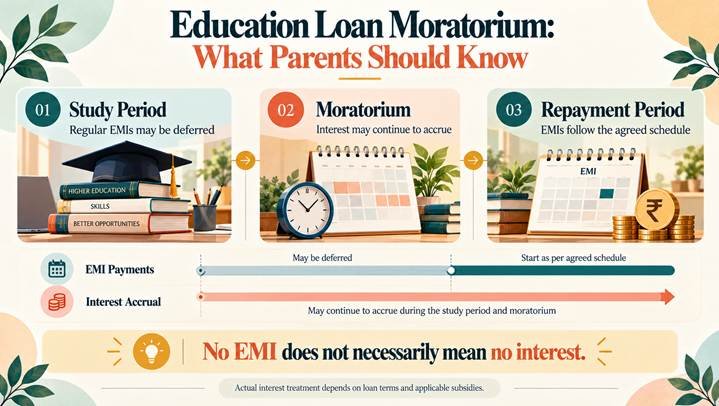
What Is the Moratorium Period in an Education Loan?
A moratorium defers scheduled regular EMI repayment for a period set by the loan agreement; it does not automatically make the borrowing interest-free.Many education loans in India offer a moratorium period, although interest may continue to accrue during this time.
Does Interest Accumulate During the Moratorium?
Often yes. Interest may accrue on disbursed balances and unpaid amounts may affect the repayment obligation under the contract.
Should Parents Pay Interest During the Study Period?
Servicing interest during study may reduce unpaid interest carried forward, provided doing so does not weaken emergency reserves or essential household finances. Request illustrations with and without interest servicing.
Education Loan EMI Example: How Much Could Repayment Cost?
| Illustrative assumption | Value |
| Principal at EMI commencement | ₹10,00,000 |
| Annual interest rate | 10% (constant) |
| Repayment period | 10 years / 120 months |
| Estimated monthly EMI | ₹13,215 |
| Approximate interest over EMIs | ₹5.86 lakh |
Assumes monthly reducing balance and no extra charges. The ₹10 lakh is the balance at the start of EMI repayment; moratorium interest has already been paid or is excluded. Figures are rounded. If unpaid interest increases the starting balance, repayment cost can be higher.
Is Collateral Required for Education Loans in India?
Collateral is an asset pledged as loan security. Not every education loan requires it. RBI education-loan guidance addresses loans up to ₹4 lakh without collateral; other thresholds and conditions depend on scheme and lender.
Collateral-Free Does Not Mean Repayment-Free
Even without pledged assets, the student and co-borrower remain responsible for repayment.
What Should Parents Check Before Pledging Property?
Understand enforcement risk, security-release conditions, available alternatives and the impact of possible repayment difficulty before pledging a family home.
What Is the PM-Vidyalaxmi Scheme?
PM-Vidyalaxmi is a Government of India initiative approved in November 2024 to improve financing access for eligible students admitted on merit to designated Quality Higher Education Institutions (QHEIs) in India. Its special loan product is collateral-free and guarantor-free, subject to guidelines and lender assessment.
Who Can Apply Under PM-Vidyalaxmi?
Eligible students admitted through qualifying merit-based processes to designated QHEIs. Management-quota and similar excluded admissions do not qualify. Check the current official institution list.
Is There a Maximum Loan Amount?
The scheme does not set one universal upper loan amount for the special product; sanction depends on eligible costs and bank assessment.
What Is the 3% Interest Subvention?
Eligible students from families with annual income up to ₹8 lakh may receive 3% interest subvention during the prescribed moratorium on eligible loan principal up to ₹10 lakh. This is not a promise of a 3% final borrowing rate; scheme conditions and allocation limits apply.
What About Families Earning Up to ₹4.5 Lakh?
The separate PM-USP Central Sector Interest Subsidy Scheme (CSIS) may provide full eligible interest subvention during the prescribed moratorium for qualifying students, courses and institutions.
PM-Vidyalaxmi vs PM-USP CSIS
The programmes differ in income ceilings, course/institution criteria and benefit rules. Benefits cannot simply be combined where scheme rules disallow overlap.
| Feature | PM-Vidyalaxmi subvention | PM-USP CSIS |
| Family income | Up to ₹8 lakh | Up to ₹4.5 lakh |
| Benefit | 3% eligible interest | Full eligible interest |
| Eligible principal | Up to ₹10 lakh | Up to ₹10 lakh |
| Period | Prescribed moratorium | Prescribed moratorium |
| Institution/course | Designated QHEIs | Specified eligible institutions/courses |
How Can Students Apply?
Use the official PM-Vidyalaxmi portal at https://pmvidyalaxmi.co.in/ to register, complete the application and select participating lenders. Check current subsidy claim procedures and deadlines.
Education Loan for Studying in India vs Abroad
Overseas study may involve foreign-currency tuition, travel, insurance, visas and higher living expenses. Compare the full programme cost, not tuition alone.
| Factor | Studies in India | Studies abroad |
| Tuition | Varies by institution | Varies by country/institution |
| Living expenses | Location-dependent | Country/city-dependent |
| Currency risk | Usually lower for rupee costs | Potentially significant |
| Travel | Usually domestic | International may apply |
| Eligibility | Lender/institution-specific | Additional country/course checks |
Why Currency Fluctuations Matter
A weaker rupee can increase the cost of foreign-currency fees and living expenses. Build a contingency for currency movements and unexpected expenses.
Should Parents Assume the Student Will Get a High-Paying Job Abroad?
No. Salaries, employment conditions, visas and living costs are uncertain. Repayment should be manageable under less favourable outcomes.
Education Loan Tax Benefits Under Section 80E
Section 80E of the Income-tax Act, 1961 provides an interest deduction for qualifying higher-education loans, subject to conditions and tax-regime eligibility. Tax benefits associated with education loans in India depend on the applicable tax regime and eligibility requirements.
Who Can Claim Section 80E?
An eligible individual paying interest on a qualifying loan for their own higher education or that of a spouse, child or student for whom they are legal guardian, from a qualifying institution.
Is There a Maximum Deduction Limit?
There is no fixed rupee ceiling for eligible interest; principal repayment is not deductible under Section 80E.
For How Many Years Is the Deduction Available?
The initial assessment year when interest payment begins and the next seven assessment years, or until eligible interest is fully paid, whichever occurs first.
Is Section 80E Available Under the New Tax Regime?
Generally no. Section 80E is typically available under the old tax regime, not the new regime under Section 115BAC. Compare total tax liability under both regimes.
What Documents Are Required for an Education Loan?
Student Documents
Identity/address proof; admission letter; academic records; course and fee details; entrance results where relevant; passport and overseas documents where applicable.
Parent or Co-Borrower Documents
Identity/address proof, income documents, salary slips or tax returns, bank statements and existing liability details.
Additional Documents
The lender may require collateral records, margin contribution proof, expense estimates and other documents.
How to Apply for an Education Loan in India
Step 1: Calculate the Total Cost of Education
Include all years of tuition, living costs, equipment, travel and contingencies.
Step 2: Identify Available Family Resources
Review dedicated education savings and confirmed scholarships.
Step 3: Check Government Scheme Eligibility
Verify PM-Vidyalaxmi, PM-USP CSIS and other applicable assistance on official portals.
Step 4: Compare Loan Offers
Compare written rates, charges, moratorium terms, security and repayment obligations.
Step 5: Review the Key Facts Statement
Check the KFS, Annual Percentage Rate (APR) and charges, as applicable under RBI rules.
Step 6: Understand the Sanction Letter
Confirm amount, rate type, disbursement conditions, concessions and borrower responsibilities.
Step 7: Plan for Repayment Before Disbursement
Stress-test the EMI if the student’s job or income is delayed.
How Much Education Loan Should Parents Take?
A lender’s sanction limit is not necessarily the right amount to borrow. Estimate total eligible costs and subtract dedicated savings and confirmed assistance.
| Illustrative budget | Amount |
| Tuition and academic fees | ₹12,00,000 |
| Accommodation and living | ₹4,00,000 |
| Books/equipment/other | ₹1,00,000 |
| Total estimated cost | ₹17,00,000 |
| Available education savings | ₹4,00,000 |
| Confirmed scholarship | ₹2,00,000 |
| Remaining funding requirement | ₹11,00,000 |
The illustration is not a lender quotation. Do not count hoped-for scholarships as confirmed resources.
Should Parents Use Savings or Take an Education Loan?
When Using Savings May Make Sense
Dedicated education savings may reduce borrowing cost if emergency and retirement reserves remain protected.
When an Education Loan May Be Useful
A loan may bridge a genuine funding gap when the course is eligible and repayment is manageable.
When a Combination May Be Preferable
Some families may use part of dedicated savings and finance the remainder to avoid exhausting liquidity.
Why Parents Should Protect Their Emergency Fund
Emergency savings help cover job loss, medical costs and urgent expenses. Do not automatically exhaust accessible reserves to reduce an education loan. Size the fund around essential expenses, income stability, dependants and existing obligations.
Should Parents Sacrifice Retirement Savings for Their Child’s Education?
Large withdrawals from retirement assets can create future financial insecurity. Education may have financing alternatives; retirement has a more limited time to rebuild capital. Assess the household trade-offs before withdrawing long-term savings.
Questions Parents Should Ask
Would the withdrawal materially reduce retirement security? How many working years remain? Would an EMI reduce retirement contributions? Could scholarships or a lower-cost programme reduce pressure?
What Happens If the Student Does Not Get a Job After Graduation?
Unemployment does not automatically cancel repayment obligations. Moratorium and repayment terms follow the contract and any applicable lender relief policy.
What Can Families Do?
Contact the lender promptly about potential difficulty. Ask about available rescheduling or restructuring without assuming approval; relief may affect costs or credit records.
Why a Conservative Repayment Plan Matters
Test whether the EMI remains manageable with a delayed start date or modest entry-level salary, rather than relying on the highest advertised placement package.
Can Education Loan Repayment Affect Credit Scores?
Yes. Repayment behaviour can affect the credit records of borrowers and co-borrowers. Missed payments may harm credit standing and borrowing capacity; timely repayment may support credit history.
Should Parents Consider Education Loan Insurance?
Review any offered or required insurance for coverage, exclusions, premiums, beneficiary arrangements and whether the cost is financed. Do not assume it covers unemployment or every repayment difficulty.
Common Mistakes Parents Make When Taking Education Loans
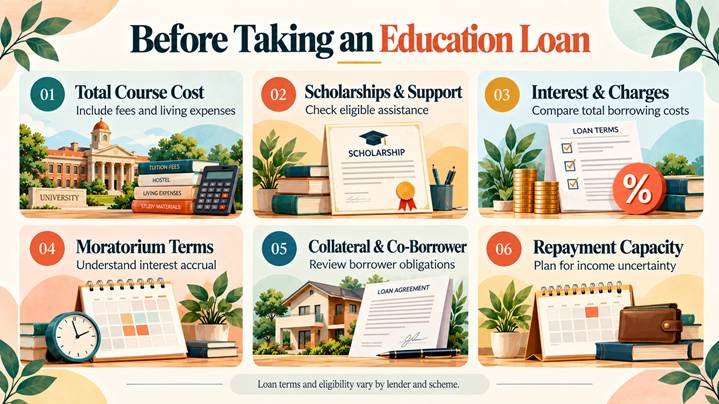
1. Looking Only at the Interest Rate
Compare total borrowing cost, fees and repayment terms.
2. Ignoring Interest During the Study Period
A deferred EMI does not necessarily mean zero interest.
3. Borrowing the Maximum Available Amount
Borrow against genuine needs and repayment capacity.
4. Assuming Employment Is Guaranteed
Job outcomes and salaries remain uncertain.
5. Overlooking Government Assistance
Check official scholarships and subsidy eligibility.
6. Pledging Property Without Understanding the Risk
Understand enforcement consequences and alternatives.
7. Using All Emergency Savings
Keep appropriate accessible reserves.
8. Neglecting Retirement Planning
Consider long-term family security.
9. Not Reading the Loan Agreement
Review benchmarks, fees, moratorium and repayment terms.
10. Delaying Communication With the Bank
Contact the lender early when repayment problems arise.
Education Loan Checklist for Parents
- Is the course and institution eligible?
- What is the full estimated cost?
- How much can the family contribute safely?
- Are scholarships or government schemes available?
- Is the interest rate fixed or floating?
- Does interest accrue during the moratorium?
- What is the estimated EMI?
- Is collateral or a co-borrower required?
- What fees and insurance costs apply?
- What happens if income is delayed?
Frequently Asked Questions About Education Loans in India
1. Can parents take an education loan for their child?
Yes. Commonly the student is the primary borrower and an eligible parent joins as co-borrower, depending on the product.
2. What is the minimum income required for an education loan?
There is no universal minimum. Lenders assess co-borrower finances, security and other factors.
3. Can a student get an education loan without collateral?
Yes, subject to the applicable RBI guidance, scheme and lender terms. Eligible PM-Vidyalaxmi loans offer a special collateral-free product.
4. Is education loan interest charged during the study period?
Often yes, on disbursed amounts. Check the agreement and applicable subsidies.
5. What is the maximum education loan amount in India?
No universal maximum applies across all products. The sanction depends on the lender and eligible costs.
6. What is the repayment period for an education loan?
It varies. PM-Vidyalaxmi may provide repayment up to 15 years excluding the applicable moratorium; other products differ.
7. Can parents claim tax benefits on education loan interest?
An eligible parent may claim Section 80E interest deduction under the old regime when all conditions are met.
8. Is an education loan tax deduction available under the new tax regime?
Section 80E is generally not available under the new regime.
9. What is the difference between an education loan and a personal loan?
Education loans are purpose-specific and may offer study-related moratoria or scheme benefits; personal loans have different terms.
10. Can an education loan be used for studying abroad?
Yes, for eligible overseas institutions and courses under lender-specific rules.
11. What happens if an education loan EMI is missed?
Charges, additional interest where applicable, credit reporting and recovery action may follow. Contact the lender promptly.
12. Is PM-Vidyalaxmi available to every student?
No. It requires qualifying admission to designated QHEIs; subsidies have further conditions.
13. Can parents repay an education loan before the scheduled end date?
Many products allow it, subject to current loan terms and any applicable charges.
14. Is it better to use savings or take an education loan?
It depends on savings, borrowing costs, liquidity, retirement needs and repayment capacity.
Final Thoughts
An education loan can help a student pursue higher education without requiring the family to meet every expense immediately. But financial responsibility may continue long after graduation. Parents should calculate the complete education budget, explore government assistance, compare written loan offers, understand moratorium interest and protect emergency and retirement savings.
The objective is to finance a child’s education responsibly while maintaining the family’s financial stability.
Choosing between education loans in India requires careful consideration of borrowing costs, repayment capacity and long-term family financial goals.
Important Disclaimer
This article is for general financial education and awareness only and does not constitute personalised financial, investment, tax, legal or loan advice. Eligibility, rates, fees, collateral, repayment and scheme benefits vary by lender and date. Numerical examples are hypothetical, not quotations or assurances. Verify current terms with lenders, authorities or qualified professionals.
Pitanga Wealth is an AMFI-registered mutual fund distributor (ARN-134606). Mutual fund investments are subject to market risks. Read all scheme-related documents carefully before investing.
Written by the Pitanga Wealth Team.
Follow us on Instagram @pitangawealth for more educational insights.
This article is for educational and informational purposes only. It is not investment, tax, legal or insurance advice. Consider your circumstances and relevant documents before making a financial decision.