


A practical, India-focused guide to setting goals, managing risk and making more informed investment decisions.
Opening a demat account or starting a mutual fund SIP can feel like a major milestone. Yet the first challenge is not finding the next popular stock or the scheme with the highest recent return. It is learning how to make decisions that fit your goals, finances and ability to handle uncertainty.
Many beginner investing mistakes arise from understandable habits: acting on a social media tip, investing money needed soon, or comparing every portfolio with a friend’s. These decisions can be costly even when the investment itself is legitimate. The good news is that most can be reduced through a simple, repeatable process.
This guide explains 15 common errors first-time Indian investors should recognise, how they affect a financial plan, and what practical checks to make before putting money at risk. It is educational information, not a recommendation to buy or sell a particular product.
Why First-Time Investors Make Avoidable Errors
Investing combines numbers, uncertainty and emotion. Markets publish prices every day, but a person’s financial goals may be years away. That mismatch can make a normal price movement feel like an urgent decision. Information is also uneven: an app can show a return figure in seconds while the fund’s risks, fees and conditions need much more reading.
A useful way to reduce beginner investing mistakes is to separate three questions: What is the money for? When might I need it? What loss or fluctuation can I realistically tolerate? SEBI’s investor education material identifies goals, time horizon, risk appetite, liquidity and diversification as core considerations before investing [1].
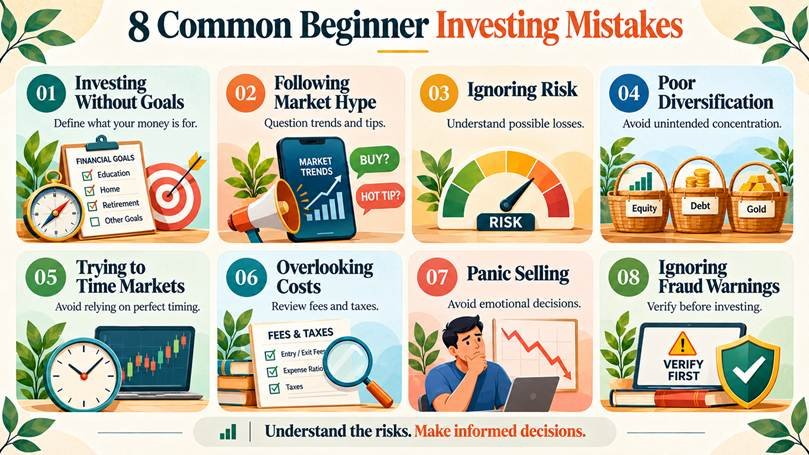
15 Common Mistakes First-Time Investors Make
1. Investing Without a Defined Financial Goal
“I want to earn good returns” is not a measurable financial goal. Saving for a laptop next year and building a retirement corpus over several decades are fundamentally different objectives. They require different liquidity, time horizons and approaches to risk.
To prevent beginner investing mistakes related to unclear priorities, write down each goal, its approximate future cost, target date and importance. For example, “higher education fees in four years” is more actionable than “grow my money.” Estimates may change, but the plan has a purpose.
- Separate short-term obligations from long-term ambitions.
- Do not assume that a product suitable for one goal suits another.
- Revisit the target when income, expenses or family responsibilities change.
2. Investing All Available Savings Before Building a Financial Buffer
A household may have investments on paper but little cash available for an unexpected medical bill or temporary loss of income. If that happens, it might need to sell volatile holdings during a market downturn or borrow at an unfavourable cost.
A common planning starting point is to assess roughly three to six months of essential expenses for an emergency reserve, with a larger amount considered where income is irregular or dependants are significant. This is a guideline, not a universal requirement. Insurance protection, immediate debt obligations and household cash flow also deserve attention.
Avoiding beginner investing mistakes sometimes means delaying a new investment while you establish a basic liquidity buffer or address expensive debt. Keep emergency money accessible and do not treat it as a guaranteed-return investment.
3. Following Tips, Finfluencers and Group Messages Without Verification
A widely forwarded message can make an opportunity seem credible simply because many people are discussing it. Screenshots of profits, testimonials and urgent “buy now” instructions do not establish that an investment is suitable or that claims are true.
Before acting, verify the intermediary’s regulatory status where relevant, understand the product, and read official disclosures. Never share OTPs, passwords, PINs or account credentials. SEBI warns investors about unsolicited offers, promises of quick profits and high-pressure tactics [2].
For a new investor, copying trades without independent research is especially difficult to evaluate afterward: you may know the entry price but not the promoter’s incentives, risk exposure or exit plan.
4. Expecting Guaranteed Returns From Market-Linked Investments
Stocks and mutual funds can rise or fall. They are not equivalent to a bank deposit with contractual interest terms. A calculator that projects one constant annual growth rate illustrates an assumption; it does not predict what will happen in any particular year.
As a simple example, ₹10,000 invested in an asset that falls 20% becomes ₹8,000. The asset then needs a 25% gain—not a 20% gain—to return to ₹10,000. Understanding loss arithmetic can help set realistic expectations.
AMFI states that mutual fund returns are not assured and that historical performance does not guarantee future performance [3]. A basic safeguard against beginner investing mistakes is to treat projected returns as scenarios rather than promises.
5. Ignoring Investment Horizon and Risk Capacity
Risk tolerance describes how comfortable you feel with fluctuations. Risk capacity is different: it reflects how much financial loss you can withstand without jeopardising your obligations. Someone may be comfortable with risk psychologically but still need their savings for a near-term expense.
Investment horizon matters because an asset with substantial short-term volatility may be inappropriate for money required on a fixed near-term date. Longer horizons may allow more time to ride out fluctuations, but they do not eliminate the possibility of loss.
One of the most consequential beginner investing mistakes is choosing an asset only because it has a high potential return, without asking what happens if its value declines just before the money is needed.
6. Putting Too Much Money Into One Stock, Sector or Theme
Owning one widely admired company or concentrating in a single industry can expose the portfolio to business, regulatory and sector-specific risks. If the company disappoints or the sector encounters difficulties, the impact may be disproportionate.
Diversification spreads exposure across appropriate holdings or asset classes. It cannot prevent an entire market from falling, and poorly chosen holdings can still move together, but it may reduce dependence on a single outcome. SEBI discusses diversification and asset allocation as risk-management tools [1].
To reduce beginner investing mistakes tied to concentration, review not just the number of holdings but what they actually own. Two different mutual fund schemes may still hold many of the same securities.
7. Buying Too Many Funds Without Understanding Overlap
The opposite problem also exists. Collecting numerous schemes can make a portfolio complex without adding meaningful diversification. Several similarly managed large-cap equity funds, for example, may share many underlying holdings.
Ask what role each investment plays and whether it contributes distinct exposure. Compare fund categories, underlying portfolios, risk, expense ratios and the intended time horizon. A larger number of schemes is not automatically a better plan.
Learning sound portfolio construction includes recognising that diversification is about the mix of underlying risks, not simply the length of an investment list.
8. Selecting Funds Solely From Last Year’s Return Rankings
A scheme at the top of a recent performance table may have benefited from a particular market cycle or style. Its position may reverse when conditions change. A short measurement period can also hide the extent of past declines or volatility.
Past performance can provide context, but it should be evaluated with benchmark comparison, time period, consistency, portfolio risk and fees. None of these measures can guarantee a future result.
Avoiding beginner investing mistakes here means replacing “Which fund won last year?” with “What does this scheme own, what risks does it take, and would it fit my goal?” Read the Scheme Information Document and other applicable disclosures before investing [3].
9. Assuming an SIP Removes Market Risk
A systematic investment plan (SIP) is a way to invest a chosen amount at regular intervals in a mutual fund scheme. It is a contribution method, not a separate investment asset or a promise of returns.
For a fixed SIP amount, fewer units are generally bought when the NAV is higher and more units when it is lower. This can change the average purchase cost over time, but it does not assure a profit or protect against losses in declining markets. AMFI explicitly makes that distinction [4].
A frequent source of beginner investing mistakes is treating the word “systematic” as if it means “risk-free.” The underlying fund category, portfolio and investment horizon remain essential.
10. Trying to Predict Every Market High and Low
After a market rise, some people wait for the “perfect correction.” After a decline, they wait until the news feels reassuring. Both reactions may delay a plan indefinitely. The exact bottom or top is not reliably identifiable in advance.
A written contribution and review schedule can reduce unnecessary decisions, although it cannot guarantee returns. Changes should reflect goals, risk, valuation considerations and financial circumstances—not every headline.
Better decisions do not require ignoring markets. It requires distinguishing relevant changes in your plan from ordinary market noise.
11. Overlooking Fees, Expense Ratios and Other Charges
Costs reduce the amount of investment performance that investors ultimately retain. Depending on the product and channel, relevant costs may include expense ratios, brokerage, transaction charges, account-related fees, exit loads and taxes.
In mutual funds, direct and regular plans of the same scheme generally share the underlying portfolio but have different expense ratios. Direct plans do not include distributor-related costs in the same way as regular plans; investors choosing between them should also consider their need for assistance and the service model. See AMFI’s explanation of direct and regular plans [5].
Ignoring recurring charges is easy because an apparently small percentage can affect outcomes over many years. Compare costs and services rather than selecting purely by the lowest fee or the most prominent advertisement.
12. Forgetting Inflation, Taxes and the Real Purpose of Returns
A portfolio’s nominal value can increase even as rising prices reduce purchasing power. Tax treatment can also affect what remains available for a financial goal. These are different concepts: a nominal return is not the same as an inflation-adjusted, after-tax outcome.
Taxation varies by investment type, transaction, holding period and individual circumstances; legislation and rates may change. Check the rules in force when making decisions and consult a qualified tax professional when needed.
One practical way to avoid beginner investing mistakes is to estimate goals using plausible future costs, not today’s prices alone. Keep projections as ranges and do not rely on a single optimistic growth assumption.
13. Entering Futures, Options or Leveraged Trading Without Understanding the Risks
Futures and options are derivatives whose value depends on another asset or underlying variable. They have legitimate uses, including hedging, but complexity, leverage and rapid price changes can magnify losses. In some strategies, losses can exceed an initial amount posted or paid.
The SEBI investor portal describes the risks of derivatives and cautions about magnified losses [6]. A first-time investor should be particularly careful with strategies that require margin, frequent trading or knowledge of expiry and contract mechanics.
Avoiding beginner investing mistakes means acknowledging that easy access through an app does not make a complex product easy to understand. Learning the risks should come before risking capital.
14. Skipping Documents, KYC Updates, Nomination and Account Security
Investing is more than selecting a product. Investors should understand basic documents and maintain accurate records, including PAN and other applicable KYC information, registered contact details and bank information. Keep account and transaction statements, and check them for discrepancies.
Review nomination options and applicable procedures; a nomination can assist claims administration but does not replace appropriate succession planning. Never share account credentials or authorise transactions that you do not understand. SEBI’s investor charter emphasises reading documents, knowing fees and risks, checking statements and protecting critical information [7].
One easily overlooked problem is that paperwork appears unimportant until an address changes, an account is compromised or a family member needs to locate investments.
15. Checking the Portfolio Constantly and Making Emotional Changes
Repeatedly checking prices can turn a long-term goal into a daily test of confidence. A sudden decline may trigger panic selling, while a short rally may encourage an impulsive purchase. Both can create unnecessary costs and tax consequences.
Set a reasonable review frequency appropriate to the product and goal. Review sooner when your financial circumstances change, an investment’s mandate changes, or there is a genuine reason to reassess suitability. Rebalancing should be thoughtful rather than automatic after every market move.
The aim is not to avoid every uncomfortable price fluctuation. It is to develop a plan you understand well enough to follow or revise for sound reasons.
Quick Reference: Mistake, Risk and Better Question
| Common mistake | Why it matters | Question to ask |
| No goal or time horizon | Product may not fit the purpose | When will I need this money? |
| No emergency buffer | May force a premature sale | What if my income stops? |
| Tips and guaranteed-return claims | Mis-selling and fraud risk | Can I verify the source and product? |
| Overconcentration or overlap | Unexpected portfolio exposure | What are the underlying holdings? |
| Chasing past performance | Recent winners may not persist | What risks produced these returns? |
| Ignoring costs | Reduces net outcomes | What will I pay, and for what service? |
| Unfamiliar leveraged products | Losses can escalate quickly | Do I understand every obligation? |
This checklist summarises common patterns; it does not rank them by severity. The most important risk varies across households and products.

A Simple Investing Framework for Beginners in India
A process is easier to follow than a collection of market predictions. The following six steps help turn the lessons from beginner investing mistakes into everyday decisions.
Step 1: Map Your Money Before Choosing Products
List household income, essential expenses, costly debt, existing savings, insurance and near-term obligations. Identify which money can genuinely remain invested for the intended period.
Step 2: Give Every Investment a Job
Write a purpose, target time horizon and broad risk tolerance beside each goal. Avoid combining an urgent obligation and a distant goal into the same undifferentiated pot of money.
Step 3: Understand the Product and Its Risks
Read the official terms and key disclosures. For mutual funds, examine the investment objective, category, current riskometer, benchmark, costs and exit conditions. A riskometer is a useful signal, not a substitute for assessing the full portfolio and your needs.
Step 4: Evaluate the Platform and the People Involved
Verify applicable registrations, keep records of instructions and payments, and understand whether you are receiving distribution, execution or regulated investment advice. An investment app’s popularity is not proof that every idea promoted on it is suitable.
Step 5: Choose a Contribution and Review Routine
A repeatable saving and investing routine may reduce impulsive decisions. Decide how regularly you will review progress and what events would justify changing course. Keep enough accessible money for foreseeable needs.
Step 6: Document Your Reasoning
For each investment, write two sentences: “I chose this because…” and “I would reconsider it if…”. This helps distinguish an evidence-based reassessment from an emotional reaction to price movements.
Illustrative Example: Two Approaches to a First Investment
Consider two hypothetical professionals, each with ₹5,000 per month available after essential bills. These examples are not portfolio recommendations and assume no particular investment return.
| Situation | Approach A: reacts to headlines | Approach B: uses a plan |
| Initial decision | Buys a trending product without reading its terms | Identifies a goal, time horizon and risk limits |
| Emergency savings | No reserve; may need to sell unexpectedly | Builds a suitable liquidity buffer alongside other priorities |
| Market decline | May sell because of short-term fear | Checks whether the original goal and suitability have changed |
| Ongoing review | Tracks daily rankings and tips | Reviews periodically and documents decisions |
Approach B is not guaranteed to earn more, and it can still suffer losses. Its advantage is a clearer decision-making process that is tied to circumstances rather than constant external signals.
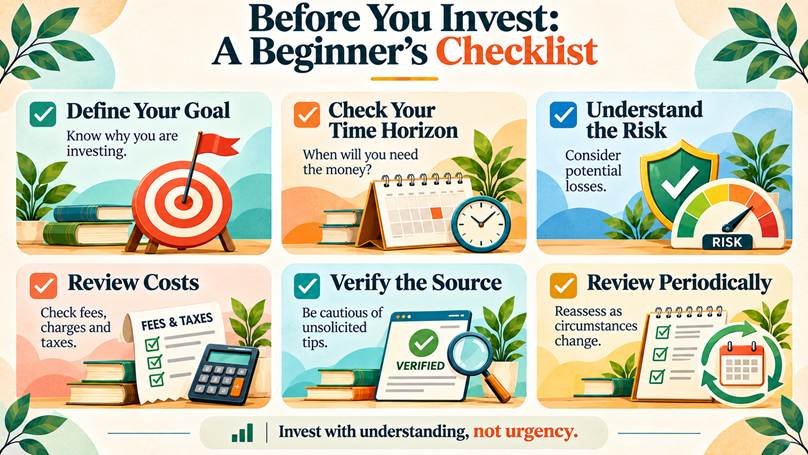
First-Time Investor Checklist Before You Commit Money
- I know the goal and approximate date for this money.
- I have considered emergency savings and high-cost debt.
- I understand the product, major risks and how it can lose value.
- I have checked the investment’s liquidity and exit conditions.
- I understand fees, taxation and other potential costs.
- I have considered concentration and overlap with existing holdings.
- I have read the relevant official disclosure documents.
- I have verified the provider or intermediary where applicable.
- My KYC, bank details, nomination choices and contact information are current.
- I can explain why I am investing without referring to a social media tip.
Frequently Asked Questions
1. What are the biggest mistakes new investors make?
The most material errors often involve starting without a goal, taking more risk than one can afford, investing emergency money, relying on unverified tips and choosing products based only on recent returns. The impact depends on the investor’s situation.
2. How can I avoid beginner investing mistakes with a small monthly amount?
Begin with a budget, a realistic goal and an understanding of liquidity needs. Learn the risks and charges of any product before investing. A small contribution does not remove market risk, but it can make learning and budgeting more manageable.
3. Is an SIP always safe for beginners?
No. An SIP is simply a method of investing periodically. The risk depends on the underlying mutual fund scheme, and neither rupee cost averaging nor the SIP format guarantees profits.
4. Should beginners choose stocks or mutual funds?
Neither is universally appropriate. Individual stocks require company-specific research and expose investors to company risk. Mutual funds provide pooled portfolios but have varying objectives, costs and risks. The decision should follow knowledge, goals and suitability.
5. Is it wrong to invest before building a six-month emergency fund?
Not automatically. A suitable emergency reserve depends on income stability, dependants, expenses and other resources. Some people may build a basic buffer while investing modestly; others may prioritise debt repayment or urgent cash needs.
6. Does diversification guarantee I will not lose money?
No. Diversification can reduce exposure to an individual holding or source of risk but cannot prevent losses when broad markets or multiple assets decline together.
7. How many mutual funds should a beginner hold?
There is no universally correct number. Focus first on goals, asset allocation, category suitability, costs and portfolio overlap. Multiple schemes are not inherently better than a carefully understood combination.
8. Are direct mutual fund plans always better than regular plans?
Direct and regular plans have different expenses and service channels. A direct plan generally has a lower expense ratio, while a regular plan involves a distributor. Investors should evaluate costs, available assistance and their ability to make informed decisions independently.
9. How often should I check my investment portfolio?
There is no fixed interval suitable for everyone. Periodic reviews and event-driven checks may be more useful than reacting to daily price changes, particularly for long-term goals.
10. What should I do if I already made an investment mistake?
First identify the product, current holdings, fees, taxes, liquidity restrictions and your original goal. Avoid making an urgent second decision solely to reverse the first. Consider appropriate regulated professional advice for complex situations.
11. How can I verify a suspicious investment offer?
Check the claimed entity’s registration with the relevant regulator, review official product disclosures, avoid unusual payment instructions and do not share credentials. SEBI’s investor education portal describes common scam warning signs [2].
12. Can I begin investing with ₹500 or ₹1,000 per month?
Some investment products and platforms permit relatively small contributions, subject to their current minimums and terms. Affordability, suitability and liquidity matter more than the symbolic amount. No starting amount guarantees a return.
Conclusion: Good Habits Matter More Than Perfect Predictions
Learning to invest is a process rather than a single decision. A first portfolio does not need to be complicated, and it certainly does not need to copy the latest market trend. Clarity about goals, liquidity, risk, diversification, costs and verification can make decisions more disciplined.
The most useful response to beginner investing mistakes is not an attempt to eliminate all uncertainty. It is to develop a framework that helps you recognise uncertainty, ask better questions and make choices consistent with your financial situation.
Begin with what you can understand, keep records, and review your approach as your needs change. No investment strategy removes market risk, but sound preparation can help you avoid preventable decisions.
Important Disclaimer
This material is for general financial education only and does not constitute personalised investment, financial, tax or legal advice. Examples are hypothetical and not forecasts or recommendations. Investment suitability depends on an individual’s goals, time horizon, liquidity needs, financial position and risk tolerance. Market-linked products can lose value; past performance does not guarantee future results.
Pitanga Wealth is an AMFI-registered mutual fund distributor (ARN-134606). Mutual fund investments are subject to market risks. Read all scheme-related documents carefully before investing. Where you require personalised investment advice, consider an appropriately registered investment adviser; seek a qualified tax or legal professional for those matters.
Written by the Pitanga Wealth Team.
Follow us on Instagram @pitangawealth for more educational insights.
This article is for educational and informational purposes only. It is not investment, tax, legal or insurance advice. Consider your circumstances and relevant documents before making a financial decision.