


A home loan is often one of the largest financial commitments an individual or family makes. While owning a home provides long-term security and stability, monthly equated monthly instalments (EMIs) can remain part of household expenses for many years.
When additional money becomes available through a salary increase, annual bonus, business income, or accumulated savings, an important financial question arises.
Should you prepay your home loan to reduce interest costs, or invest the surplus to build wealth over time?
Both options offer potential advantages.
Home loan prepayment reduces outstanding debt and can lower future interest expenses. Investing may help accumulate financial assets and support long-term goals, although returns depend on market conditions, investment risks, taxation, and the chosen products.
The decision is not simply about comparing a home loan interest rate with an expected investment return.
A borrower must also consider emergency savings, liquidity, remaining loan tenure, tax benefits, income stability, and personal financial priorities.
For some individuals, reducing debt may be more suitable. For others, maintaining investments while continuing regular EMI payments may offer greater flexibility.
In certain circumstances, a combination of prepayment and investing may be appropriate.
Understanding the financial implications of both approaches can help borrowers make a more informed decision.
Home Loan Prepayment vs Investing: Quick Answer
Home loan prepayment may deserve priority when borrowing costs are high, emergency savings are adequate, and reducing debt is an important goal. Investing may be more suitable when EMIs are manageable, long-term financial goals require funding, and the investor can tolerate risk. The decision depends on loan terms, taxes, liquidity, and personal financial circumstances.
What Is Home Loan Prepayment?
Home loan prepayment refers to repaying part or all of the outstanding loan principal before the scheduled repayment date.
A regular home loan EMI generally consists of two components:
- Principal: The portion that reduces the outstanding loan balance.
- Interest: The borrowing cost charged by the lender.
When a borrower makes an additional payment towards the principal, the outstanding balance decreases.
Because interest on a reducing-balance loan is calculated using the outstanding principal, prepayment can reduce future interest expenses.
How Does Home Loan Prepayment Work?
Suppose a borrower has an outstanding home loan of ₹35 lakh.
The borrower receives an annual bonus of ₹5 lakh and decides to use the entire amount for partial prepayment.
Assuming the lender applies the full payment towards principal, the outstanding loan would reduce to ₹30 lakh.
Depending on the lender’s terms, the borrower may then have the option to:
- Reduce the remaining loan tenure while maintaining approximately the same EMI.
- Reduce the monthly EMI while retaining approximately the same remaining tenure.
Both options may lower future interest expenses, but the total savings can differ.
The actual benefit depends on the outstanding balance, interest rate, repayment schedule, and timing of the prepayment.
What Does Investing Instead of Prepaying a Home Loan Mean?
Investing instead of prepaying means using available surplus money to purchase financial assets while continuing regular home loan repayments.
The surplus may be allocated to investments such as:
- Equity mutual funds
- Debt mutual funds
- Fixed deposits
- Government-backed savings instruments
- Other suitable financial products
Each investment carries different risks, potential returns, liquidity characteristics, and tax implications.
For example, equity mutual funds may provide opportunities for long-term capital appreciation but are exposed to market volatility and potential losses.
Fixed-income investments may offer more predictable income or maturity values, depending on their structure, although credit risk, interest-rate risk, and taxation can affect outcomes.
The central difference is that home loan prepayment reduces a financial liability, while investing creates or increases financial assets.
Neither approach automatically produces a better financial outcome.
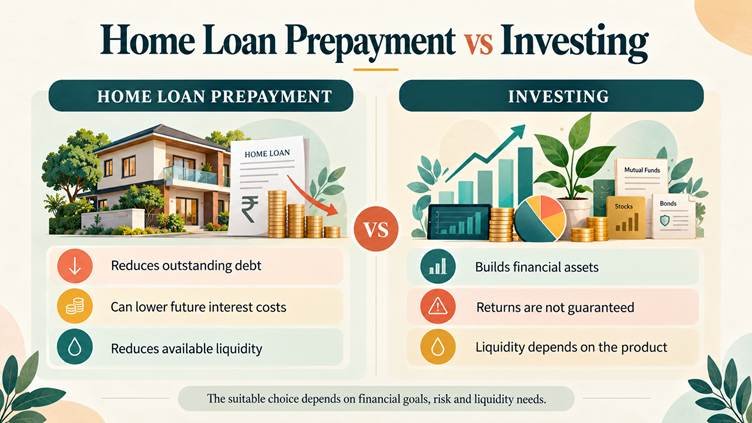
Home Loan Prepayment vs Investing: Key Differences
The following table highlights the general differences between the two approaches.
| Feature | Home Loan Prepayment | Investing |
| Primary objective | Reduce outstanding debt | Build financial assets |
| Main financial benefit | Savings on future loan interest | Potential investment returns |
| Risk | Relatively predictable savings under fixed assumptions | Depends on the investment product |
| Liquidity | Prepaid money is generally difficult to access | Varies by investment |
| Tax implications | May affect eligible home loan deductions | Depends on investment taxation |
| EMI impact | EMI or tenure may reduce | Existing EMI generally continues |
| Wealth creation | Improves net worth by reducing liabilities | May increase asset value |
| Financial flexibility | Can reduce future repayment obligations | May preserve accessible assets |
| Main limitation | Reduced liquidity | Uncertain returns or other investment risks |
The appropriate choice depends on the borrower’s financial position, goals, and ability to manage risk.
Why Should You Consider Home Loan Prepayment?
Prepaying a home loan can provide several financial advantages.
1. Reducing Total Interest Expenses
A home loan may continue for 15, 20, or even 30 years.
Over such periods, the total interest paid can become substantial.
Making additional principal repayments reduces the balance on which future interest is calculated.
When a meaningful amount of the loan remains outstanding, early prepayment may produce significant interest savings.
2. Becoming Debt-Free Earlier
Some borrowers prefer to complete their home loan repayment before retirement or another important financial milestone.
If the lender permits tenure reduction after partial prepayment, the borrower may finish repaying the loan earlier than originally scheduled.
3. Reducing Future Financial Obligations
Lower outstanding debt can improve financial flexibility.
For example, a borrower who reduces the EMI may have more money available each month for household expenses, savings, or other commitments.
4. Managing Floating Interest Rate Exposure
Floating-rate home loans can be affected by changes in benchmark interest rates.
A lower outstanding principal reduces the amount exposed to future interest charges.
However, the actual savings remain dependent on subsequent interest-rate movements and the repayment schedule.
5. Greater Financial Comfort
For some individuals, reducing debt provides peace of mind.
This may be particularly important for borrowers approaching retirement or managing uncertain income.
However, debt reduction should not come at the expense of essential emergency savings or other financial protection.
Why Might Investing Be Preferable to Home Loan Prepayment?
Investing can support financial objectives that may not be achieved through loan repayment alone.
1. Long-Term Wealth Creation
Certain financial assets provide opportunities for capital appreciation or income generation.
For example, diversified equity mutual funds can participate in the performance of underlying businesses.
However, market-linked investments do not provide guaranteed returns.
According to the Association of Mutual Funds in India (AMFI), mutual funds involve investment risks, including the possibility of losing principal.
Association of Mutual Funds in India
2. Maintaining Liquidity
Money used for home loan prepayment becomes part of the borrower’s reduced liability or increased home equity.
It generally cannot be withdrawn directly.
By comparison, some financial investments can be redeemed or accessed when required, subject to applicable restrictions, charges, market conditions, and settlement periods.
3. Supporting Other Financial Goals
A household may need to accumulate funds for:
- Retirement
- Children’s education
- Future healthcare expenses
- Major planned purchases
- Other long-term obligations
Using all available surplus for loan repayment could delay progress towards these objectives.
4. Diversifying Household Assets
A residential property may represent a significant portion of a family’s net worth.
Maintaining financial investments alongside property ownership can help avoid excessive concentration in a single asset.
5. Potential Benefits of Compounding
When investment earnings remain invested, they may generate additional earnings over time.
Compounding can contribute to long-term wealth accumulation.
However, investment values may also decline, and positive compounding outcomes are not assured.
Home Loan Prepayment vs Investing: How Does the Interest Rate Matter?
The home loan interest rate is an important factor in the comparison.
A higher borrowing rate generally increases the potential interest savings from prepayment.
A lower borrowing rate may make alternative investments worth examining more closely.
However, comparing the loan rate directly with an assumed investment return can be misleading.
Example: Home Loan at 8.5% vs Investment Return of 10%
Suppose an individual has:
| Particular | Assumption |
| Outstanding home loan | ₹40 lakh |
| Home loan interest rate | 8.5% annually |
| Available surplus | ₹5 lakh |
| Assumed investment return | 10% annually |
| Investment horizon | 10 years |
At first glance, the assumed investment return of 10% appears higher than the borrowing rate of 8.5%.
But this does not automatically mean investing is financially superior.
The 10% investment return is hypothetical and not guaranteed. Actual returns may be lower or negative.
Taxes, expenses, and market fluctuations may further affect the investment outcome.
Home loan prepayment, meanwhile, reduces future interest costs according to the loan’s applicable terms.
Any available tax deductions may also affect the economic cost of borrowing.
The meaningful comparison is between the actual benefit of prepayment and the potential after-tax, risk-adjusted outcome of investing over a comparable period.
How Much Interest Can You Save by Prepaying a Home Loan?
The interest savings from prepayment depend on the outstanding principal, interest rate, remaining tenure, and repayment method.
A borrower with a large outstanding balance and many years remaining may save more total interest than someone approaching the end of the loan.
Example: ₹5 Lakh Prepayment on a ₹40 Lakh Home Loan
Consider a hypothetical borrower with the following details:
| Loan Details | Amount |
| Outstanding principal | ₹40,00,000 |
| Annual interest rate | 8.5% |
| Remaining tenure | 15 years |
| Proposed prepayment | ₹5,00,000 |
| Principal after prepayment | ₹35,00,000 |
If the borrower makes the prepayment and continues paying the existing EMI, the remaining loan tenure may become shorter.
If the lender instead retains the original tenure and recalculates the EMI, the monthly repayment may decrease.
Both approaches can produce interest savings, but they affect cash flow differently.
The actual savings should be calculated using the lender’s updated amortisation schedule.
This example assumes that the full prepayment is applied to principal and excludes future interest-rate changes and any applicable charges.
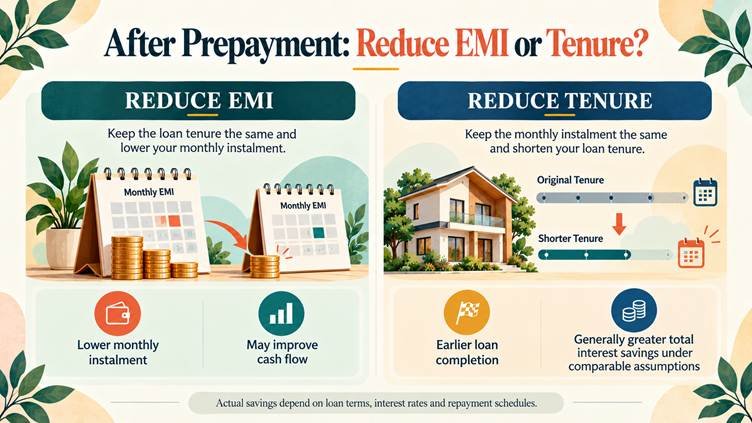
Should You Reduce EMI or Tenure After Home Loan Prepayment?
Borrowers may be able to choose between reducing the monthly EMI and reducing the remaining repayment tenure.
Option 1: Reduce EMI
Under this approach, the lender recalculates the monthly instalment based on the reduced principal and remaining tenure.
This may help borrowers who want to lower monthly financial commitments.
It can be useful when household expenses are increasing or income is uncertain.
Option 2: Reduce Loan Tenure
Under this approach, the borrower continues paying approximately the same EMI while the repayment period becomes shorter.
Under otherwise identical interest-rate and repayment assumptions, tenure reduction generally results in greater total interest savings than EMI reduction.
EMI Reduction vs Tenure Reduction
| Financial Goal | Option to Consider |
| Lower monthly expenses | EMI reduction |
| Become debt-free earlier | Tenure reduction |
| Greater total interest savings under comparable assumptions | Tenure reduction |
| Improve monthly cash flow | EMI reduction |
| Maintain an affordable EMI and shorten repayment | Tenure reduction |
The lender’s available options and the borrower’s financial circumstances should determine the choice.
Does the Remaining Home Loan Tenure Affect Prepayment Benefits?
Yes.
In a conventional reducing-balance home loan, interest is calculated on the outstanding principal.
During the earlier stages of repayment, a larger portion of the EMI generally goes towards interest.
As the principal decreases, the interest component generally becomes smaller, assuming the rate and EMI structure remain unchanged.
Prepayment During the Early Years
Prepayment made early in the loan tenure can reduce the principal on which interest would otherwise be charged for many future months.
Consequently, the total interest savings may be substantial.
Prepayment During the Later Years
When the loan is approaching completion, fewer interest payments remain.
A prepayment may therefore produce lower absolute interest savings.
However, it can still help borrowers eliminate debt sooner or reduce monthly obligations.
The actual benefit should be evaluated using the outstanding repayment schedule rather than relying solely on the age of the loan.
How Do Home Loan Tax Benefits Affect Prepayment vs Investing?
Tax treatment is an important part of the decision for borrowers in India.
Eligible deductions can affect the effective borrowing cost, but the benefit depends on the applicable tax regime, property type, and statutory conditions.
Home Loan Interest Deduction
Under the old tax regime, eligible interest on a loan for a self-occupied residential property may qualify for a deduction of up to ₹2 lakh, subject to prescribed conditions.
A lower limit may apply in certain circumstances.
The treatment of let-out property differs, and the deduction and loss set-off rules require separate consideration.
The Income Tax Department provides details in its guidance on self-occupied house property.
24+1
Home Loan Principal Repayment Deduction
Under the old tax regime, eligible principal repayments may qualify under Section 80C of the Income-tax Act, 1961, subject to applicable conditions.
The overall Section 80C limit is ₹1.5 lakh and is shared with other eligible contributions and payments.
For example, someone who already exhausts the limit through eligible provident fund contributions, insurance premiums, or other investments may not receive an additional deduction from home loan principal repayment.
The applicable provisions can be reviewed through the Income Tax Department’s Section 80C reference.
Income Tax Department+1
What Happens Under the New Tax Regime?
Under the new tax regime, the usual deduction for interest on a self-occupied home loan is not available.
The general deduction for eligible principal repayment under Section 80C is also unavailable.
Consequently, borrowers using the new tax regime may have a different effective borrowing cost from otherwise comparable borrowers using the old regime.
The Income Tax Department explains these distinctions in its New Tax vs Old Tax Regime FAQs.
Income Tax Department
Tax provisions and section references should be interpreted for the relevant tax year, including the transition to the Income-tax Act, 2025, where applicable.
Should You Keep a Home Loan Only for Tax Benefits?
Not necessarily.
A tax deduction generally reduces taxable income rather than reimbursing the full interest paid.
For example, paying ₹1 of eligible interest does not ordinarily create ₹1 of tax savings.
Continuing to pay interest solely to retain a deduction may therefore be financially inefficient.
The decision should consider the actual tax benefit alongside the borrowing cost and alternative uses of money.
Are Home Loan Prepayment Charges Applicable in India?
Prepayment charges depend on the type of loan, the lender, the borrower’s category, and applicable regulatory directions.
Under the Reserve Bank of India’s framework, floating-rate loans to individuals for non-business purposes are generally protected against prepayment penalties.
The RBI’s updated prepayment framework, applicable to covered loans sanctioned or renewed on or after January 1, 2026, addresses both partial and full prepayments without a minimum lock-in period.
The treatment of fixed-rate loans, dual-rate loans, and other lending arrangements may differ.
The applicable framework also depends on the lender category and loan circumstances.
Borrowers should check their sanction letter, loan agreement, Key Facts Statement, and the lender’s current terms before making a prepayment.
Should You Build an Emergency Fund Before Prepaying a Home Loan?
Emergency savings are an essential consideration when allocating surplus money.
A borrower may reduce outstanding debt by making a large prepayment, but that money is generally no longer available for unexpected expenses.
This can create financial pressure if an emergency arises.
An emergency fund is intended to support essential expenses during situations such as:
- Temporary income loss
- Medical emergencies
- Unexpected family obligations
- Essential repairs
- Other unavoidable expenses
How Much Emergency Savings Are Enough?
There is no universally correct amount.
Some households use three to six months of essential expenses as an initial planning reference.
Others may require larger reserves, particularly where income is variable or financial responsibilities are substantial.
Home loan EMIs should be considered when estimating essential monthly obligations.
A borrower with inadequate emergency savings may reasonably prioritise building liquidity before making aggressive prepayments or taking additional investment risk.
Home Loan Prepayment vs SIP: Which Is Better?
A systematic investment plan (SIP) allows investors to contribute a fixed amount periodically to a mutual fund scheme.
A SIP is an investment method, not a separate investment asset.
The underlying mutual fund determines the investment’s risk and return characteristics.
When Might Home Loan Prepayment Be More Suitable?
Prepayment may deserve consideration when:
- The home loan interest rate is relatively high.
- Adequate emergency savings are already available.
- Reducing debt is a major financial priority.
- The borrower is uncomfortable with market volatility.
- Retirement or another financial milestone is approaching.
When Might Continuing SIP Investments Be More Suitable?
Continuing SIP investments may be relevant when:
- The EMI remains comfortably affordable.
- The investor has long-term financial goals.
- The investment horizon is appropriate.
- The investor can tolerate potential market losses.
- Sufficient liquidity and financial protection are available.
SIPs can encourage disciplined investing, but they do not guarantee profits or protect investors against losses in declining markets.
Association of Mutual Funds in India
Therefore, stopping SIP investments solely to accelerate loan repayment should not be an automatic decision.
Can You Prepay Your Home Loan and Invest at the Same Time?
Yes.
Prepayment and investing are not necessarily mutually exclusive.
A household may choose to allocate surplus money between reducing liabilities and building financial assets.
Example: Allocating a Monthly Surplus
Suppose an individual has ₹20,000 available every month after meeting essential expenses and regular obligations.
A hypothetical allocation could be:
| Use of Surplus | Monthly Amount |
| Additional home loan repayment | ₹10,000 |
| Long-term investments | ₹10,000 |
| Total | ₹20,000 |
This is an illustration, not a recommended allocation.
The appropriate split may differ substantially between households.
Someone with a high borrowing cost may prefer to allocate more towards prepayment.
Another person with a manageable EMI, adequate savings, and long-term goals may place greater emphasis on investments.
A combined approach can help borrowers address multiple financial priorities without committing all surplus money to one strategy.
Home Loan Prepayment vs Investing for Salaried Individuals
Salaried individuals often balance home loan repayments with household expenses, retirement savings, and other financial commitments.
When deciding how to allocate additional income, several factors deserve consideration.
Income Stability
A stable salary may support regular EMI payments, but unexpected employment changes can still affect repayment capacity.
Existing Retirement Savings
Provident fund contributions, retirement investments, and other long-term savings should be reviewed before redirecting substantial money towards loan repayment.
Monthly Cash Flow
Prepayment should not create difficulty in meeting essential household expenses.
Financial Goals
Education expenses, retirement, and other future requirements may need ongoing investment contributions.
For salaried borrowers, the objective is to manage debt without neglecting other important financial responsibilities.
Home Loan Prepayment vs Investing for Self-Employed Individuals
Self-employed individuals may face different financial circumstances because business income can fluctuate.
A large prepayment could reduce future interest expenses but also limit money available for working capital, business operations, or unexpected requirements.
Important considerations include:
- Business income stability
- Working capital needs
- Existing business liabilities
- Emergency reserves
- Personal and business financial obligations
- Future expansion requirements
- Availability and cost of alternative financing
A business owner with uncertain cash flows may place greater importance on maintaining accessible funds.
Another individual with stable income and adequate reserves may reasonably prioritise reducing outstanding debt.
The decision should reflect both personal and business financial needs.
Should You Prepay Your Home Loan Before Retirement?
Borrowers approaching retirement may prefer to reduce financial liabilities before their regular employment income ends.
A continuing home loan EMI can affect retirement cash flow, particularly when income becomes dependent on pensions, investments, or accumulated savings.
However, using a substantial portion of retirement savings to close a home loan may create other financial risks.
Before making a decision, consider:
Remaining Loan Balance
Determine the outstanding principal and expected repayment period.
Expected Retirement Income
Evaluate whether future income can comfortably support any remaining EMIs.
Retirement Corpus
Assess whether prepayment would reduce funds required for long-term living expenses.
Healthcare and Emergency Reserves
Maintain appropriate liquidity for unexpected expenses.
Alternative Repayment Arrangements
Partial prepayment or EMI adjustments may provide flexibility without requiring complete loan closure.
Becoming debt-free before retirement can be a useful objective, but it should not compromise essential retirement financial security.
When Should Home Loan Prepayment Come First?
Home loan prepayment may deserve greater priority when reducing debt addresses an important financial risk.
This may be relevant when:
- The borrowing cost is relatively high.
- Adequate emergency savings are already available.
- Essential insurance and financial protection are in place.
- The borrower has limited willingness to accept investment volatility.
- The remaining loan balance creates significant future interest obligations.
- Becoming debt-free before retirement is an important objective.
- Prepayment will not compromise other essential financial goals.
However, borrowers should also review whether they have more expensive debts, such as outstanding credit card balances or high-interest personal loans, before directing additional money towards a home loan.
When Should Investing Come First?
Investing may deserve greater consideration when the borrower has manageable loan obligations and important long-term financial goals.
Relevant circumstances may include:
- The existing EMI is comfortably affordable.
- Emergency savings are sufficient.
- The investment horizon is appropriate for the selected product.
- The investor can tolerate potential losses.
- Retirement or other long-term savings require attention.
- Maintaining liquid financial assets is important.
- The expected investment outcome justifies the associated risks and costs.
Investing should not be preferred simply because historical returns appear higher than the home loan interest rate.
Actual investment outcomes can differ significantly from expectations.

What Should You Check Before Choosing Between Home Loan Prepayment and Investing?
Before making a substantial financial commitment, examine the following factors.
1. Outstanding Loan Principal
Review the amount still payable and how it affects future interest expenses.
2. Home Loan Interest Rate
Understand the current borrowing rate and whether it is fixed or floating.
3. Remaining Loan Tenure
Determine how many repayment years remain and how prepayment may change the schedule.
4. Actual Interest Savings
Request an updated amortisation schedule or calculate the effect of the proposed prepayment using accurate loan details.
5. Tax Implications
Consider eligible home loan deductions, the applicable tax regime, and the taxation of alternative investments.
6. Emergency Savings
Ensure that sufficient accessible funds remain for unexpected financial needs.
7. Investment Risk
Evaluate market volatility, credit risk, liquidity restrictions, and the possibility of capital loss.
8. Financial Goals
Consider retirement, education, healthcare, and other future commitments.
9. Existing Liabilities
Review whether other high-cost debts should receive priority.
10. Personal Financial Comfort
Choose an approach that remains sustainable under reasonably foreseeable changes in income and expenses.
The purpose of this evaluation is to understand which financial need should receive priority rather than relying on a universal rule.
Common Mistakes People Make When Choosing Between Home Loan Prepayment and Investing
Comparing Loan Interest With Historical Market Returns
A contractual borrowing rate and historical investment returns are not directly equivalent.
Investment returns are uncertain and can be affected by market conditions, costs, and taxation.
Using All Available Savings for Prepayment
Reducing debt without maintaining sufficient liquidity may create financial difficulties during emergencies.
Ignoring Tax Implications
Eligible deductions and investment taxation can influence the actual financial comparison.
Assuming Investments Will Always Outperform Borrowing Costs
Market-linked investments can generate losses or returns below expectations.
Ignoring the Remaining Loan Tenure
The potential interest savings from prepayment depend partly on how much of the repayment period remains.
Neglecting Other Financial Goals
Aggressive prepayment may delay retirement planning or other important savings objectives.
Choosing an Unaffordable Investment Strategy
Investing while maintaining a home loan requires the ability to meet EMIs even during periods of market volatility or financial uncertainty.
Following a Universal Rule
Statements such as “always prepay your home loan” or “always invest instead of prepaying” overlook individual circumstances.
A suitable decision requires evaluating the household’s complete financial position.
Is It Better to Be Debt-Free or Have Investments?
Being debt-free and holding financial investments are both potentially valuable outcomes.
A debt-free household may have fewer fixed repayment obligations and greater monthly cash-flow flexibility.
A household with a manageable home loan and financial investments may have more accessible assets and opportunities for long-term growth.
However, neither position automatically indicates greater financial security.
A more complete assessment considers:
- Total assets and liabilities
- Net worth
- Available liquidity
- Monthly repayment obligations
- Investment diversification
- Financial protection
- Future goals
- Ability to manage financial risk
The objective is to maintain a sustainable relationship between borrowing, saving, and investing.
Frequently Asked Questions
1. Is it better to prepay a home loan or invest in mutual funds?
There is no universally better option. Home loan prepayment reduces future borrowing costs, while mutual funds provide investment opportunities with varying levels of risk. The suitable choice depends on the interest rate, investment horizon, tax treatment, liquidity, and financial goals.
2. Should I prepay my home loan if the interest rate is high?
A higher interest rate can increase the financial benefit of prepayment. However, emergency savings, other liabilities, investment needs, and loan conditions should also be considered.
3. Is home loan prepayment better than SIP?
Not necessarily. Prepayment reduces outstanding debt, while an SIP is a method of investing in mutual funds. The appropriate choice depends on the underlying investment, borrowing cost, risk tolerance, and financial objectives.
4. Does home loan prepayment reduce interest?
Generally, yes. Reducing outstanding principal can lower future interest charges, subject to the applicable interest rate and repayment schedule.
5. Should I reduce EMI or tenure after prepayment?
Reducing EMI can improve monthly cash flow, while reducing tenure generally produces greater total interest savings under otherwise identical assumptions. The appropriate choice depends on repayment capacity and financial priorities.
6. Can I prepay my home loan every year?
Partial prepayments may be permitted according to the lender’s procedures and applicable loan conditions. Borrowers should verify processing requirements and whether any charges are legally applicable.
7. Does home loan prepayment affect tax benefits?
It may. Lower interest expenses can reduce the amount potentially eligible for an interest deduction. Actual tax consequences depend on the applicable tax regime, property type, and statutory conditions.
8. Should I stop my SIP to repay my home loan?
Stopping SIP investments should not be automatic. Consider the investment’s purpose, remaining horizon, borrowing cost, market risk, and impact on long-term goals before making changes.
9. Should I use my annual bonus to prepay my home loan?
An annual bonus may be allocated towards prepayment, investments, emergency savings, or other obligations. The suitable use depends on the borrower’s overall financial position.
10. Is home loan prepayment a guaranteed return?
Prepayment does not generate investment income. It reduces future borrowing costs. The savings may be relatively predictable under fixed assumptions, but interest-rate changes, tax implications, and loan terms can affect the outcome.
11. Should I prepay my home loan before retirement?
Prepayment may help reduce repayment obligations before retirement. However, borrowers should ensure that retirement income, healthcare reserves, and essential savings remain adequate.
12. Can I invest and prepay my home loan simultaneously?
Yes. Some borrowers may choose to divide surplus money between investments and additional loan repayments. The allocation should reflect financial goals, risk tolerance, liquidity, and borrowing costs.
Final Thoughts
Home loan prepayment vs investing is not simply a choice between saving interest and earning investment returns.
Home loan prepayment can reduce future borrowing costs, shorten the repayment period, and help borrowers manage long-term financial obligations.
Investing may support wealth accumulation, diversification, and important future financial goals.
However, investment returns are uncertain, while prepayment reduces the amount of money readily available for other needs.
The right priority depends on factors such as outstanding loan balance, borrowing rate, tax treatment, emergency savings, remaining tenure, investment risk, and household financial commitments.
For some borrowers, reducing home loan debt may be the more suitable priority. Others may benefit from continuing investments while maintaining regular EMI payments.
A combination of both approaches may also be appropriate.
Before making a decision, compare the financial benefit of prepayment with the potential risks, costs, and after-tax outcomes of investing.
At Pitanga Wealth, we believe that understanding the relationship between debt management, savings, and investing can help individuals and families make better-informed financial decisions.
Explore our educational resources to learn more about mutual funds, investment risk, financial planning, and long-term wealth management.
Important Disclaimer
This article is intended solely for general financial education and informational purposes. It does not constitute personalised financial, investment, tax, or legal advice, an investment recommendation, or a solicitation to purchase any financial product.
All examples, interest rates, amounts, allocations, and investment return assumptions are hypothetical. They do not represent guaranteed investment performance, interest savings, or tax benefits.
Mutual fund investments are subject to market risks. Read all scheme-related documents carefully before investing. Past performance does not guarantee future returns.
Actual home loan interest rates, repayment schedules, prepayment conditions, fees, and eligibility depend on the lender’s terms and applicable regulations.
Tax deductions and benefits depend on the law applicable to the relevant tax year and the taxpayer’s individual circumstances. Readers should refer to the latest official tax guidance and seek clarification from an appropriately qualified professional where necessary.
Distributor Disclosure: Pitanga Wealth is an AMFI-Registered Mutual Fund Distributor (ARN-134606). AMFI registration relates to mutual fund distribution and does not, by itself, constitute registration as a SEBI investment adviser or authorise the provision of personalised investment advice.
Written by the Pitanga Wealth Team.
Follow us on Instagram @pitangawealth for more educational insights.
This article is for educational and informational purposes only. It is not investment, tax, legal or insurance advice. Consider your circumstances and relevant documents before making a financial decision.