


Discovering that a promised investment may never have existed can be disorienting. A trading app shows a large balance, but every withdrawal request brings a new fee. A supposed stockbroker stops responding after a transfer. An investment group disappears overnight. At that moment, the most useful question is not whether the displayed profits were impressive; it is what can still be protected and which authority should receive the evidence. Responding to investment fraud in India requires prompt, organised action, not another payment to the person who made the promise.
This guide focuses on the period after someone suspects money has been lost. It explains nine practical steps, the distinction between a cybercrime report and a regulated financial-service complaint, what banks can and cannot do, why recovery is uncertain, and how to protect accounts and records. The guidance draws on the National Cyber Crime Reporting Portal, SEBI, RBI and other official resources current at the editorial review date. It does not suggest that all unsuccessful investments are fraudulent or that reporting guarantees reimbursement.
Quick Answer: What Should You Do After an Investment Scam?
Stop all further payments and contact your bank or payment provider immediately. If the incident involves suspected cyber-enabled financial fraud, call the national helpline 1930 and file the complaint through cybercrime.gov.in. Secure affected accounts, preserve messages and transaction references, and identify whether a real SEBI-regulated intermediary is involved. An eligible intermediary-service dispute may use the entity’s grievance process and SCORES, while a covered banking-service grievance may eventually fall under RBI’s 2026 Ombudsman scheme. These are different routes and may be needed for different parts of one incident. [1][2][3][4]
Start With the Right Distinction: Fraud, Market Loss or Service Dispute?
A share bought through a registered broker can lose value because a company performs badly or markets fall. That alone is not evidence of a scam. Similarly, an order delay, temporary payment failure or disagreement about charges may be a service issue that calls for records and a complaint to the genuine provider. By contrast, fabricated holdings, impersonated company identities, false profit displays, intentionally misleading representations or requests to send money to unrelated accounts may indicate possible deception.
Some situations contain more than one problem. Someone might send money willingly to a fake broker believing it is genuine; another person might suffer an unauthorised debit after credentials are stolen; a third might have a legitimate trade but dispute an intermediary’s failure to resolve an error. The bank, law enforcement and regulator may assess these situations differently. In responding to investment fraud in India, avoid choosing a complaint channel merely because the screen says ‘trading’. First establish who actually received the funds and which activity occurred.
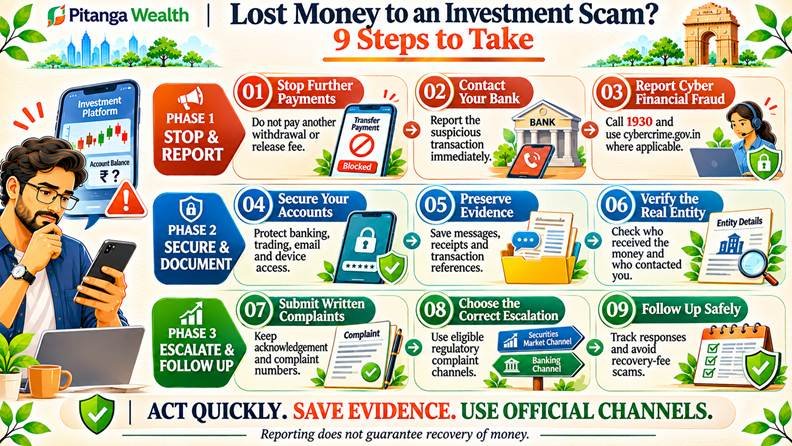
Nine Immediate Steps to Take After Suspected Investment Fraud
Step 1 — Stop Deposits, Fees and Contact With the Operator
Do not send an additional amount described as withdrawal tax, settlement margin, verification deposit, account-unlocking charge or a refund-processing fee merely because the operator says it will release the balance. A scammer can create a new condition after every payment. Decline requests to recruit family members, take an emergency loan or move money to a replacement app. Do not agree to keep the matter secret. [5]
You can preserve communication without engaging in a prolonged argument. Record the group name, usernames, URLs and instructions, then avoid responding to further funding demands. Do not attempt to recover your money by accessing someone else’s account, threatening a person, or conducting an illegal ‘test trade’. Evidence and appropriate authorities matter more than negotiating with an unverified operator.
Step 2 — Notify Your Bank or Payment Provider Immediately
Use the bank’s real official app, website, fraud-reporting channel or independently verified customer-care number. Explain that you suspect a fraudulent investment-related payment and provide the transaction reference, date, amount, beneficiary details and payment channel. Ask the institution to log a formal complaint, record your report’s time, examine any permissible recall or hold request and advise how to protect further transactions. Do not assume the first bank employee can reverse a completed transfer. [6]
When dealing with investment fraud in India involving several transfers through different banks, cards or UPI applications, notify every affected payment provider. Request the complaint or acknowledgement number and keep copies of follow-up messages. When a card, account or device might be compromised, ask the bank which blocks, access restrictions or card replacements are appropriate. The immediate objective is to reduce further exposure and create a timestamped record, not to obtain a verbal guarantee of recovery.
Step 3 — Report Suspected Cyber Financial Fraud Through 1930 and the National Portal
The Ministry of Home Affairs identifies the Citizen Financial Cyber Fraud Reporting and Management System as a mechanism for rapid reporting of financial cyber fraud. Call 1930 for assistance and submit the facts on https://cybercrime.gov.in/ through the applicable complaint flow. Keep the official acknowledgement number; complete any online follow-up required by the portal or helpline instructions. These are official reporting channels, not private recovery agents. [1][2]
Have your mobile number, bank or wallet name, UPI or account identifiers as permitted by the complaint form, transaction IDs, dates, amounts and screenshots ready. Report all known transfers accurately. If a payment is very recent, do not delay the bank notification while drafting a long narrative for the portal. The national mechanism supports coordination, but whether funds can be held, returned or investigated depends on the circumstances and legal process.
Step 4 — Secure Your Banking, Trading, Email and Device Access
From a trustworthy device, change passwords for any affected broker, email, banking or social-media accounts. Review active sessions, recovery details, linked devices and transaction alerts; turn on appropriate multifactor authentication. If a scammer received a PIN, OTP, access token or card detail, follow the real provider’s instructions for resetting or blocking access. A compromised email account may let an attacker intercept other account recovery messages.
If you installed a remote-control app or an unexpected APK, stop granting permissions and seek qualified device-security help. Preserve relevant evidence first where safely possible, but do not continue using a suspected compromised device for banking. Never share fresh OTPs or allow ‘support staff’ who contacted you through a scam chat to take remote control. These actions address possible ongoing exposure even when the original transfer cannot be cancelled.
Step 5 — Preserve a Clear Evidence Trail
Create a private incident folder containing the original offer, chat exports, email headers where available, screenshots, website URLs, app installation source, profile names, advertisements, payment requests, bank statements and complete transaction reference numbers. Note the date and time of each event and identify which person or account gave each instruction. Save copies in a secure place that scammers cannot access.
Preserve both the deposit confirmation and the app’s later withdrawal refusal. A screenshot of apparent profits does not prove that an investment existed; nevertheless it may help establish what the operator represented. Do not edit screenshots to make them appear more persuasive, delete messages impulsively, or publicly post account numbers and identity documents. For investment fraud in India, accurate chronological records can be more useful than a lengthy emotional description without transaction details.
Step 6 — Identify the Actual Recipient and the Claimed Financial Entity
Separate the company name shown in the advertisement from the legal name on bank transfers and any SEBI registration claimed in the pitch. Ask whether a genuine registered broker, investment adviser, research analyst, mutual fund distributor or other financial institution actually received or authorised the money. Verify identities using regulator and exchange directories rather than phone numbers supplied by the suspicious person. [5][7]
An impersonator can use the real name and registration number of a legitimate broker. An authentic regulator entry does not establish that the stranger contacting you represents that firm or controls an authorised payment account. Confirm the relevant app, representative and payment route separately. This assessment will help decide whether the matter is primarily a suspected cybercrime, a complaint against an eligible regulated entity, or both.
Step 7 — Make a Written Complaint and Ask for a Reasoned Response
After notifying the bank by its urgent channel, submit whatever formal written information the bank requests through an official route. State whether you personally initiated a payment because you were deceived, or whether an electronic transaction occurred without your authorisation; do not blur those facts. Ask for the complaint number, the applicable banking-policy provisions, investigation status and the procedure for escalation if the response is unsatisfactory.
A regulator’s customer-liability framework for unauthorised electronic banking transactions is not an automatic refund rule for every investment payment made after deception. The facts, applicable instructions and whether the transaction was genuinely unauthorised matter. Because investment fraud in India can involve both payment fraud and fabricated securities, preserve the bank’s written response even if you also file a cybercrime report. [6][8]
Step 8 — Use the Right Securities-Market or Banking Complaint Route
If a real SEBI-regulated intermediary provided a service and failed to resolve an eligible investor grievance, first approach that entity’s grievance officer. If unresolved, consider SCORES at https://scores.sebi.gov.in/, subject to its eligibility rules. SCORES is not designed for every forged-app, unregistered-operator or private-agreement matter. It also excludes categories listed in its FAQs, including many unregulated activities. [3]
If your concern is a deficiency in service by a bank or another RBI-regulated entity covered by the Reserve Bank – Integrated Ombudsman Scheme, 2026, complain to that institution first. For eligible unresolved or unsatisfactory complaints, RBI operates https://cms.rbi.org.in/. RBI’s 2026 scheme replaced the 2021 scheme from 1 July 2026 and has its own timing and maintainability requirements. [4]
Step 9 — Follow Up Carefully and Watch for a Second Scam
Keep an incident log with each report number, date, institution, response and next action. Reply to legitimate requests for supporting documents through verified channels. If investigators or a bank contact you, confirm their identity independently; fraudsters may impersonate police, cybercrime personnel or bank officials after learning that a complaint has been filed.
Avoid paid ‘asset tracing’, ‘wallet unlocking’, ‘recovery tax’ or ‘guaranteed refund’ offers received through messages or search advertisements. A claim that someone can recover funds for an upfront payment deserves independent scrutiny. The safest way to continue a case of investment fraud in India is to cooperate with official institutions, protect confidential records and seek qualified legal advice when the loss or legal circumstances warrant it.
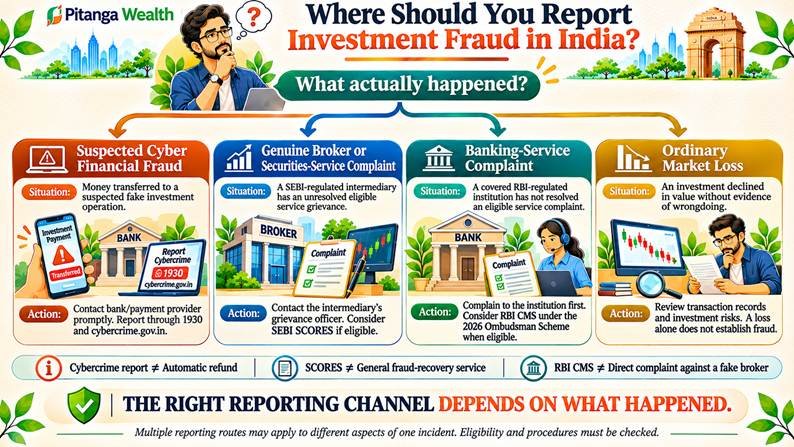
Which Complaint Channel Should You Use? A Practical Comparison
| Situation | First relevant action | Important limitation |
| Suspected online investment scam and money transferred | Notify bank/payment provider; report to 1930 and cybercrime.gov.in | Filing does not automatically freeze or refund funds |
| Stolen credentials or unauthorised electronic debit | Report immediately to bank as unauthorised; use applicable cybercrime route | Liability depends on facts and current RBI directions |
| Genuine broker’s unresolved service failure | Contact broker’s grievance officer; SCORES if eligible | SCORES does not cover every fake/unregulated operator |
| Covered bank’s unresolved service deficiency | Complain to bank; consider RBI CMS under 2026 scheme | Must satisfy scheme eligibility and time limits |
| Illegal off-exchange or dabba arrangement | Preserve evidence; contact police/appropriate authorities and relevant exchange resources | Normal exchange grievance mechanisms may not apply |
| Ordinary loss on a legitimate market trade | Review trade records and investment risks | Market loss alone does not establish fraud |
The distinction is central to investment fraud in India: the fact that an incident involves a stock price does not automatically turn it into a valid exchange complaint, and a bank complaint does not replace a crime report where deception or theft is suspected. Multiple reports can be appropriate when they address genuinely different concerns; avoid duplicating claims inaccurately or promising yourself that one portal will resolve every issue.
How the 1930 and Cybercrime Reporting Process Works
What the national system is designed to do
The Ministry of Home Affairs says the Citizen Financial Cyber Fraud Reporting and Management System was established to facilitate immediate reporting and help prevent the movement of fraudulently transferred funds. The 1930 helpline supports online complaint lodging through the National Cyber Crime Reporting Portal. Police and other law-enforcement agencies handle investigations, while financial institutions may assist under established procedures. [1]
In July 2026, the Ministry reported national figures for amounts saved, marked under lien and actually refunded. These are different categories. A temporary hold on suspected funds is not the same as a legally completed return to the victim. The presence of an acknowledgement number or a frozen account is likewise not proof that reimbursement has been approved. [1]
What information should you submit?
Prepare a concise sequence: how the offer reached you; the names, phone numbers or handles used; the claim made; the dates and amounts of every transfer; the beneficiary information visible to you; what happened when withdrawal or clarification was requested; and the documentary evidence. The official helpline or portal may require specific additional details and follow-up action. If your report was first made by phone, follow the current portal instructions to complete the written case. [2]
Is a portal complaint the same as a police FIR?
No. A report submitted to the cybercrime portal is not automatically proof that an FIR has been registered or that a named person has been charged. The relevant State or Union Territory law-enforcement authority handles legal processing and investigation. Keep the acknowledgement and follow official instructions about any separate statement, police visit or document submission. A lawyer can assist when the facts are complex or the person is uncertain about legal obligations. [1]
Can You Recover Money Lost to an Investment Scam?
There is no honest universal percentage or guaranteed period for recovering money after an online investment fraud. Prospects can depend on how recently a transfer occurred, the number of accounts involved, whether funds remain traceable or can be lawfully held, the payment method, evidence quality, investigation progress and decisions by relevant authorities. A person who has recovered a small amount should not assume the remainder will follow automatically.
For victims of investment fraud in India, a completed bank transfer is not equivalent to a reversible shopping order. Some payment channels have specific dispute processes, and a bank may investigate or pursue a permissible recall, but it generally cannot promise to retrieve funds after they have moved through unrelated accounts. Contacting a bank promptly may assist, while claims about bank liability must be assessed under the regulations actually applicable to the transaction. Never pay a private agent who promises to ‘speed up’ an official refund.
Why reporting quickly still matters
Earlier notification can provide authorities and financial institutions with more timely transaction information. Where permitted, that may support attempts to prevent further movement or investigate linked accounts. It also records the chronology relevant to a bank’s response. However, timing alone cannot guarantee recovery. The person may discover a scam days or weeks later, and that should not become a reason to avoid reporting it at all.
What does ‘amount put on hold’ mean?
It may indicate that a financial institution or authority has restricted access to an identified sum under an applicable process. The sum is not necessarily owned by the complainant for immediate withdrawal. Release can require verification, investigative steps or legal orders. Keep communicating with the responsible official channel rather than paying anyone who claims they can release a held amount through a private ‘clearance fee’.
Banking Rules: An Important 2026 Update
Unauthorised debits are different from transfers made after deception
The RBI instructions relevant to an unauthorised electronic banking transaction address the roles of bank fault, third-party breaches, customer conduct and the time of reporting. Whether the consumer actually authorised a transaction is material. If someone entered a payment PIN and voluntarily sent money after being deceived about an investment, the bank may assess it differently from a debit executed without the customer’s permission. The correct approach is to describe events accurately and request a written liability assessment, not to claim that every scam must be refunded within three days. [6]
Rules in force versus rules announced for 2027
As of this article’s November 2026 review, the RBI’s 2025 Commercial Banks Responsible Business Conduct directions, as updated through October 2026, provide the current consolidated framework for relevant commercial-bank cases. RBI also issued a Third Amendment on 24 June 2026 revising the customer-protection regime for fraudulent electronic banking transactions. That amendment is scheduled to apply to transactions on or after 1 January 2027, not retroactively to every loss that occurred in 2026. Readers should verify the rules effective on their own transaction date and bank category. [6][8]
The RBI Ombudsman route is a complaint about regulated service
The Reserve Bank – Integrated Ombudsman Scheme, 2026 came into force on 1 July 2026 and replaced the 2021 scheme for new covered matters. A complainant ordinarily approaches the regulated entity first. An eligible complaint can be taken to RBI where the institution has not replied within 30 days or the longer period specified by relevant RBI, NPCI or card-network rules, or when the complainant is dissatisfied with its reply. RBI’s current FAQ also identifies time limits for filing before the Ombudsman, which should be checked carefully. The scheme concerns deficiency in service by a covered entity and is not a free-standing verdict on whether a fake investment scheme was fraudulent. [4]
What If the Fraud Involved a Regulated Stockbroker or Mutual Fund Platform?
A real securities-market intermediary should have an identifiable legal entity, registration status, official client communication route and applicable records. Check the full identity of the entity, not just a logo or a copied registration number. If the issue is that the genuine entity failed to perform a regulated service, the normal escalation begins with its grievance officer. The SCORES platform may then be available for eligible securities-market complaints. [3][7]
An impersonator who creates a fake version of a genuine firm’s app is a different problem. The genuine firm may be able to confirm that the account, representative or payment instructions do not belong to it, but that does not mean the firm automatically received the funds or is liable to refund them. In cases of investment fraud in India involving fake brands, keep the genuine entity’s independent verification response alongside the payment evidence and report the suspected criminal conduct appropriately.
If a dispute concerns a mutual fund purchase or redemption that genuinely reached an AMC, RTA or distributor-supported process, check the folio, official transaction confirmation and registered payment route. In contrast, a promised ‘fund investment’ made to a stranger’s account with no matching official folio may require a fraud report rather than an assumption that an AMC has the money.
Special Situations: Fake Apps, Dabba Operators and Overseas Investors
A fake trading app shows profits but refuses withdrawal
First check whether the balance or trade can be independently confirmed by a genuine broker, depository or exchange record where the product should generate one. Avoid new ‘tax’ or ‘unlocking’ payments. SEBI’s investor-warning material describes fake apps that use screenshots, artificial gains and blocked withdrawals to draw in larger deposits. Save the app screen, payment references, chat messages and URL, then use the appropriate bank and cybercrime channels. [5]
An operator ran an illegal off-exchange ledger
A dabba operator may record a private position that never reaches a recognised exchange. SEBI and NSE warn that such off-exchange activity is illegal and ordinary exchange investor-protection systems do not automatically cover those private deals. Reporting suspected fraud or unlawful conduct through the proper authorities is distinct from filing a regulated broker-service complaint. Someone who participated and is concerned about legal exposure should seek individual legal advice instead of hiding transactions or destroying records. [9]
An NRI sent money from an overseas bank
Identify the actual sending country, bank and remittance provider, as well as the Indian beneficiary account and purpose of transfer. Contact both sending and receiving financial institutions through official channels and obtain the international transaction reference. A payment involving foreign institutions may have different recall arrangements and jurisdictional rules. An Indian cybercrime report may be relevant when the fraud has an Indian connection, but it should not be represented as a worldwide remittance reversal service. Seek legal or banking advice across the relevant jurisdictions where necessary.
A Hypothetical Case: Three Payments to a Fake Broker
Consider Meera, an illustrative investor who is added to a messaging group claiming to represent a licensed trading firm. She first sends ₹25,000 to a UPI account, then ₹45,000 to a different beneficiary after the app shows a profit. When she asks to withdraw, the operator demands another ₹30,000 as ‘tax’. She has transferred ₹70,000 in total; the additional ₹30,000 has not yet been paid.
The first practical decision is to stop the proposed third payment. Meera contacts both payment channels to report the two completed transfers and obtain formal complaint references. She calls 1930, files the suspected cyber-fraud details through cybercrime.gov.in and keeps the acknowledgements. She then exports the group messages and saves the two receipts, beneficiary names, links, app screens and the withdrawal demand. [1][2]
Meera verifies the genuine brokerage’s details through independent sources. The firm confirms that the group and payment recipients are not its authorised channels. That response supports her description of apparent impersonation, but it does not guarantee that the brokerage can reimburse the loss. She maintains a single factual timeline and follows official requests for evidence. This hypothetical illustrates a careful response to investment fraud in India; it does not predict whether any amount is recovered.
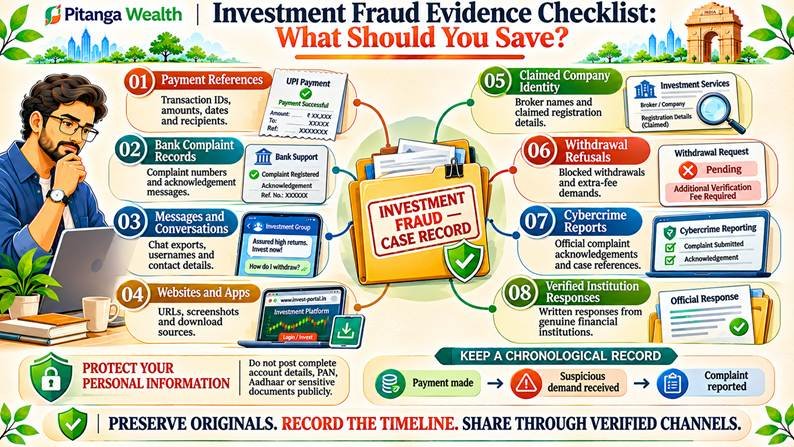
The Evidence Checklist: What to Keep and Why
| Evidence | Why it may matter |
| Bank or UPI transaction references | Helps identify payment dates, amounts and recipient routes |
| Official bank complaint acknowledgements | Shows when and how the issue was reported |
| Messaging-group details and chat exports | Preserves the offer, representations and demands |
| Website URLs, app source and screenshots | Helps establish the platform and what was displayed |
| Claimed company or SEBI registration details | Supports identity and impersonation checks |
| Withdrawal refusal or extra-fee messages | Documents the alleged escalation after funds were sent |
| Cybercrime portal acknowledgement | Links follow-up evidence to the official complaint |
| Any response from a genuine regulated entity | Helps distinguish impersonation from a service dispute |
Protect originals and avoid sharing complete bank statements, PAN, Aadhaar or other sensitive details in public forums. Disclose sensitive documents only through relevant verified official channels when requested. If you need help organising many transactions, create a simple chronological spreadsheet with one row per payment. A clean timeline is often more useful than an unstructured folder containing duplicate screenshots.
Mistakes That Can Make an Already Difficult Situation Worse
Paying for a withdrawal, refund or special investigation
A person who already paid an operator may be especially vulnerable to a second message promising that funds can be released after a small administrative payment. Do not rely on the sender’s badge, photograph or claimed government affiliation. Independently verify every demand with the relevant official agency. A claim to be a ‘recovery lawyer’ does not eliminate the need to verify credentials and a written engagement.
Assuming an app statement is a contract note
A fabricated trading dashboard can display profits without any executed transaction. Genuine exchange trading has relevant broker and market records; appropriate investment products have their own confirmation systems. Match the claimed investment with an independent source rather than treating a screenshot as proof of asset ownership. [5][7]
Applying to the wrong grievance portal and stopping there
A SCORES submission may be ineligible where the complaint concerns an unregistered operator or fake trading platform. An RBI Ombudsman case may be ineligible if it contains no covered bank-service deficiency. A cybercrime portal acknowledgement is not a guarantee of restitution. Match the report to the underlying issue, and preserve consistent facts across any applicable processes. [3][4]
Deleting data, changing stories or sharing private credentials
Do not destroy transaction evidence or invent a different payment description in an attempt to obtain a refund. Preserve records, correct genuine mistakes transparently and communicate through authorised institutions. Avoid posting sensitive details online, handing your phone to a self-appointed investigator or sharing new OTPs ‘for complaint verification’.
Protecting Your Finances After a Suspected Scam
Review the accounts and cards that may have been exposed. Confirm that account alerts reach you, remove unknown logins, check whether loan or credit facilities have been activated without permission and monitor statements for unusual activity. If identity documents were disclosed, ask the relevant institution what additional monitoring or protective steps are available. Keep any genuine loan repayments and essential household expenses under review, but do not make impulsive risky trades in an attempt to replace the lost money quickly.
The personal response to investment fraud in India may also require support from a trusted person, especially when the affected individual is receiving repeated threats or is being pressured to conceal the loss. Choose someone who can help organise documentation without asking for financial credentials. If the amount is significant, the case involves multiple jurisdictions or there are legal concerns, qualified legal advice may be appropriate. This article cannot determine the merits of an individual claim or the appropriate legal representation.
Frequently Asked Questions
1. I sent money to a fake investment app. What should I do first?
Stop further payments, contact the bank or payment provider immediately and, for suspected cyber-enabled fraud, use 1930 and cybercrime.gov.in. Secure relevant accounts and preserve transfer references. Do not pay another ‘release’ fee. [1][2]
2. Can I recover money lost to investment fraud in India?
Recovery may be possible in some situations, but it is not guaranteed. The result depends on payment movement, available evidence, applicable legal processes, investigation and financial-institution actions. Avoid anyone who guarantees a refund.
3. Is 1930 the correct helpline for an online investment scam?
1930 is the national helpline to assist with reporting financial cyber fraud. It is appropriate where the incident involves suspected cyber-enabled fraudulent transfers. Ordinary market losses or securities-service disputes require different handling. [1]
4. Can I file a complaint online without visiting a police station?
The National Cyber Crime Reporting Portal supports online complaints. The relevant law-enforcement authority may later request statements, supporting evidence or other participation. A portal acknowledgement does not by itself prove an FIR was registered.
5. Does filing an online cybercrime complaint guarantee a refund?
No. Reporting can support investigation and possible intervention, but the eventual outcome depends on facts and applicable procedures. A held amount is not automatically a completed refund.
6. What if I paid through UPI?
Report the transaction promptly through your bank or the payment app’s official complaint process as appropriate. Record the UPI transaction reference and receiving identifier; also use 1930 and the national portal where the payment was part of suspected cyber-enabled fraud.
7. What if I shared an OTP, trading password or remote-access permission?
Contact the affected banks and providers, secure access from a trustworthy device and change credentials using official procedures. Report any unauthorised activity promptly. Never share replacement OTPs with an alleged recovery agent.
8. Is a bank required to refund every scam payment?
No. A payment intentionally authorised after deception and a transaction executed without the account holder’s permission can raise different liability questions. The applicable RBI directions, bank category, timing and specific circumstances matter. Ask for a written assessment and consider an eligible complaint route if necessary. [6][8]
9. Should I complain to SEBI SCORES about a fake trading app?
Only if your matter fits SCORES eligibility, such as an unresolved qualifying complaint involving a SEBI-regulated entity. Complaints about unregistered operators or many forged-app incidents fall outside SCORES; suspected cybercrime should be reported through the appropriate law-enforcement channels. [3]
10. When can I approach the RBI Ombudsman?
Under the 2026 scheme, complain to the relevant covered RBI-regulated institution first. You may approach RBI for an eligible unresolved complaint after the applicable response period, or if its reply is unsatisfactory, subject to the scheme’s rules and filing deadlines. Use cms.rbi.org.in. [4]
11. Can someone charge me to file a government cybercrime complaint?
Use the official portal and helpline rather than an unsolicited paid intermediary. Be suspicious of people who claim an upfront fee is required to ‘activate’ an FIR, release held funds or guarantee recovery. Confirm any legitimate professional fee arrangement independently.
12. What if the fraudster used a real stockbroker’s name?
Verify the genuine firm through independently located official contacts and seek written confirmation about the person, app and payment instructions. Report suspected impersonation and preserve the response. A copied company name does not prove the genuine firm received the funds.
13. Should I delete the fake app and all the scam messages?
Preserve relevant evidence before removing access where it is safe to do so. If the device may be compromised, protect financial accounts promptly and seek competent device-security assistance. Avoid retaining malware on an actively used banking device merely to keep a screenshot.
14. Is an ordinary stock-market loss a financial fraud?
Not by itself. Securities can lose value legitimately. Fraud concerns potentially deceptive or unauthorised conduct; a regulated intermediary’s unresolved service failure is another distinct category. Examine records and choose the complaint path that matches the facts.
Conclusion: Act Promptly, Preserve Evidence, Use Official Channels
For investment fraud in India, the central lesson is practical: stop further transfers, notify your bank, report cyber-enabled fraud through official channels where applicable, protect the accounts that may be exposed and keep a reliable record of what occurred. Then separate any regulated-service grievance from the suspected criminal conduct. A fake app’s displayed gains, a portal acknowledgement and a claimed recovery agent’s promise should never be confused with money actually returned.
In dealing with investment fraud in India, realistic expectations matter. Early reporting, accurate information and appropriate escalation can improve the quality of the response, but no public guide can promise reimbursement, a criminal outcome or a regulatory ruling. If the amount is large or the case raises legal, banking, tax or cross-border complications, seek qualified individual advice while continuing to use the verified institutional channels.
Disclaimer
This article is general investor awareness material from Pitanga Wealth, not personalised legal, financial, tax, banking, cybersecurity or recovery advice. It does not evaluate or accuse any named individual, firm or platform. Hypothetical examples are illustrative only. Laws, portal instructions and complaint eligibility can change. Official information was researched on 14 November 2026. The RBI’s June 2026 revised directions for fraudulent electronic banking transactions are scheduled for January 2027 applicability; consult the rules applicable to the actual transaction date and bank category. Reporting does not guarantee reimbursement, and neither SEBI nor RBI registration ensures investment performance.
Written by Pitanga Wealth Team.
Follow us on Instagram @pitangawealth for more educational insights.
This article is for educational and informational purposes only. It is not investment, tax, legal or insurance advice. Consider your circumstances and relevant documents before making a financial decision.