

Having health insurance is an important part of financial planning. A suitable health insurance policy can help manage eligible hospitalisation expenses and reduce the financial pressure associated with medical treatment.
However, a serious illness can affect more than hospital bills.
Someone diagnosed with a major medical condition may need to take time away from work, undergo extended treatment, travel for specialist consultations, or make adjustments to their household expenses.
In some situations, the financial consequences may continue long after hospitalisation ends.
This raises an important question: Is regular health insurance sufficient, or should you also consider critical illness insurance?
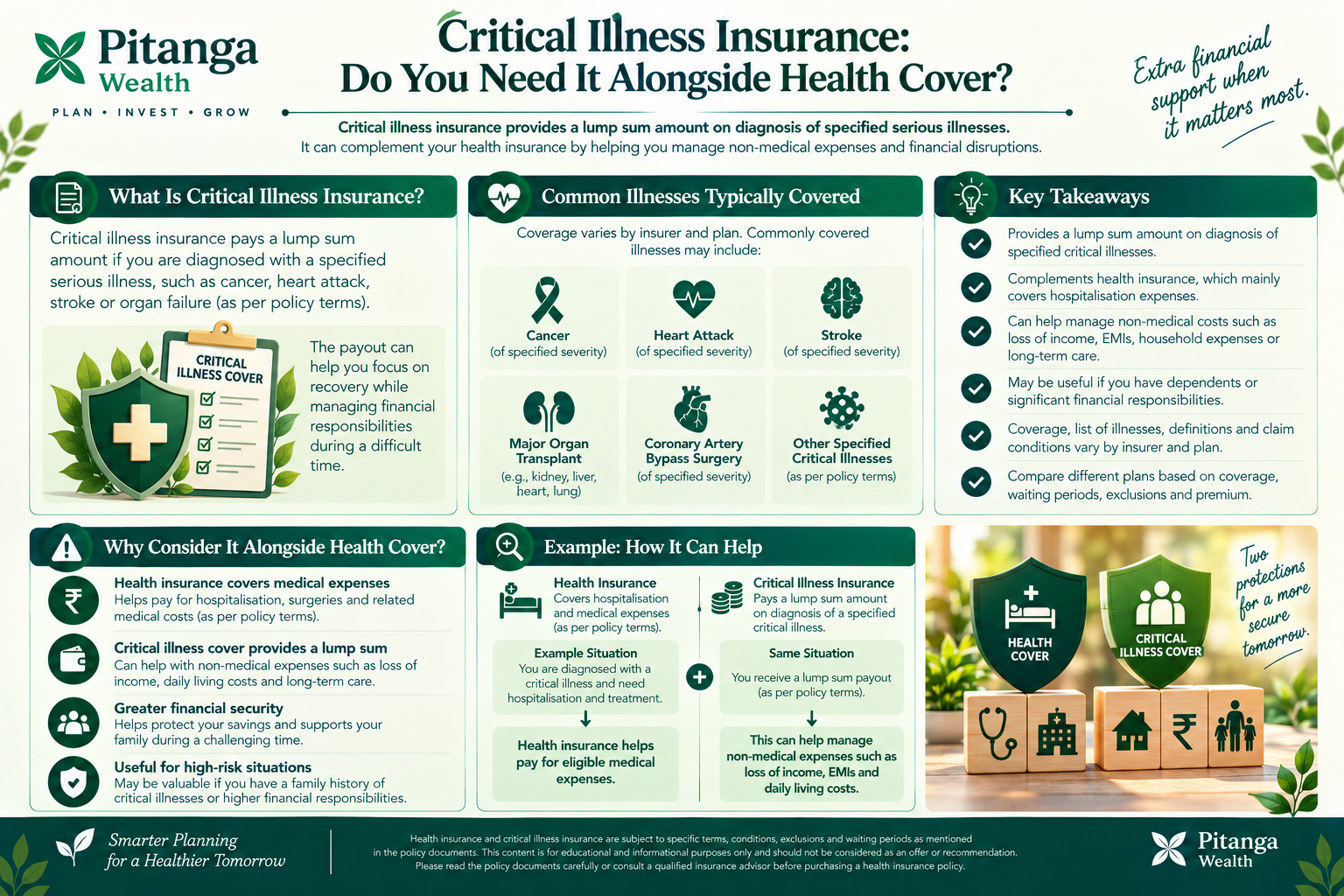
Critical illness insurance is designed to provide a defined financial benefit when an insured person is diagnosed with a specified serious illness and satisfies the policy’s conditions.
Unlike traditional hospitalisation-focused health insurance, critical illness coverage is generally structured around a fixed payout rather than reimbursement of eligible medical bills.
But it is not automatically necessary for everyone.
Understanding how critical illness insurance works, which conditions it covers, and how it fits alongside existing health insurance can help you make a more informed financial decision.
What Is Critical Illness Insurance?
Critical illness insurance is a type of insurance that provides a specified benefit when the insured person experiences a covered critical illness and meets the contractual claim requirements.
The policy generally identifies the illnesses or medical events eligible for coverage.
It also defines the medical criteria that must be satisfied before a claim becomes payable.
Depending on the product, the benefit may be provided as a standalone policy, a rider attached to another insurance product, or an additional feature.
How Is Critical Illness Insurance Different From Regular Health Insurance?
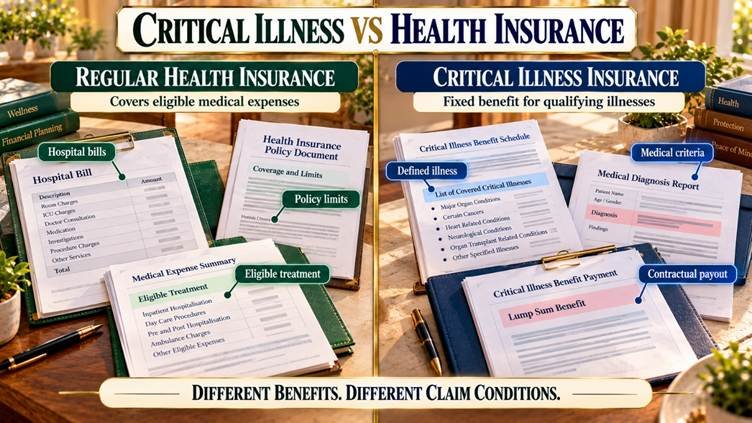
The main difference is how the benefits are structured.
Regular indemnity health insurance generally covers eligible medical expenses according to the policy’s terms, limits, and exclusions.
Critical illness insurance commonly pays a predefined amount when the covered medical event meets the relevant policy conditions.
For example, a qualifying diagnosis may trigger a fixed benefit even when the hospital bill is lower than the benefit amount.
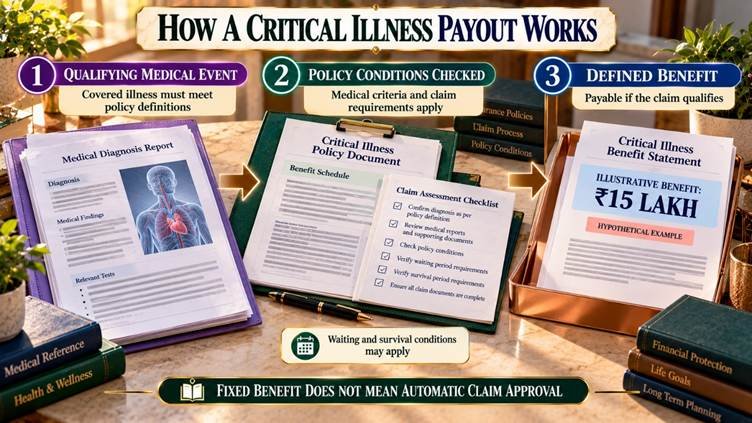
However, the policy must specifically cover the illness, and all contractual requirements must be satisfied.
A diagnosis alone does not necessarily guarantee payment.
Why Might Someone Consider Critical Illness Insurance?
A serious illness can create several financial challenges.
Hospitalisation expenses may be only one part of the overall impact.
Depending on the individual’s circumstances, additional financial pressures may include:
- Temporary or extended loss of employment income
- Household expenses during recovery
- Travel and accommodation for treatment
- Rehabilitation and recovery-related costs
- Ongoing loan repayments
- Caregiving arrangements
- Other financial obligations that continue during illness
A fixed critical illness payout may provide additional financial flexibility when a qualifying claim is payable.
However, whether the benefit is useful depends on the coverage amount, policy conditions, existing protection, and the person’s financial situation.
How Does Critical Illness Insurance Work?
Critical illness insurance generally follows a defined contractual process.
Step 1: Choose a Policy and Benefit Amount
The applicant selects an available insurance product and an eligible benefit amount, subject to the insurer’s underwriting and product rules.
Step 2: Complete the Application and Medical Disclosures
The insurer may ask questions about medical history, existing conditions, occupation, and other relevant information.
Medical tests may be required depending on the product and underwriting process.
Accurate disclosure is essential.
Step 3: Review the Covered Illnesses
The policy specifies which illnesses or medical events are covered.
It may also contain detailed medical definitions, exclusions, waiting periods, and survival requirements.
Step 4: A Qualifying Medical Event Occurs
If the insured person experiences a listed illness or medical event, the insurer assesses whether the relevant definition and conditions are satisfied.
Step 5: Submit the Required Claim Documents
The claim process may require medical reports, diagnostic evidence, treatment records, and other documentation.
Step 6: The Insurer Assesses the Claim
The insurer evaluates the claim against the policy’s conditions.
If the claim is admissible, the applicable benefit is paid according to the contract.
The exact process differs between insurers and products.
Critical Illness Insurance vs Health Insurance: Key Differences
The following table highlights the general differences between fixed-benefit critical illness coverage and indemnity health insurance.
| Feature | Critical Illness Insurance | Regular Health Insurance |
| Main purpose | Provides a defined benefit for qualifying serious illnesses | Covers eligible medical expenses |
| Payout structure | Usually fixed benefit | Generally reimbursement or cashless settlement of eligible expenses |
| Claim trigger | Covered illness meeting policy definitions | Eligible treatment or hospitalisation under policy terms |
| Hospital bill requirement | Payout is not necessarily based on actual hospital expenses | Medical expenses are central to claim assessment |
| Covered conditions | Specified illnesses or events | Treatments and conditions within policy coverage |
| Waiting periods | May apply | May apply |
| Exclusions | Policy-specific | Policy-specific |
| Income replacement | Payout may help manage income disruption | Generally not designed to replace lost income |
| Benefit amount | Defined contractual payout | Subject to sum insured and applicable limits |
This is a general comparison. Some products have additional features or different benefit structures.
Which Illnesses Are Commonly Covered Under Critical Illness Insurance?
Critical illness insurance policies cover only the illnesses or medical events specified in the contract.
The number and definitions of covered conditions can vary substantially.
Some products may include conditions such as:
1. Cancer of Specified Severity
Certain critical illness policies provide benefits for cancer that satisfies the defined medical criteria.
However, not every cancer diagnosis necessarily qualifies.
Early-stage conditions, specified tumour types, or other situations may be excluded or treated differently.
The policy’s exact cancer definition is essential.
2. Heart Attack of Specified Severity
Some policies cover a heart attack that meets specified clinical and diagnostic criteria.
Not every cardiac event necessarily satisfies the contractual definition.
3. Stroke Resulting in Specified Permanent Symptoms
Certain policies cover a stroke that results in neurological impairment meeting defined requirements.
The policy may specify medical evidence and the duration of symptoms or impairment.
4. Kidney Failure Requiring Regular Dialysis
Some products include kidney failure that satisfies defined medical criteria, potentially including requirements relating to regular dialysis.
5. Major Organ Transplant
Specified organ transplantation procedures may be covered when the policy’s definitions and conditions are met.
6. Other Listed Critical Illnesses
Depending on the product, additional covered conditions may include specified neurological disorders, major surgical procedures, or other defined illnesses.
Important: The examples above are not a universal list. A policy that advertises coverage for numerous illnesses may still contain narrow medical definitions and exclusions.
Always review the official list of covered conditions.
Does Critical Illness Insurance Cover Every Serious Disease?
No.
One of the most important limitations of critical illness insurance is that it generally covers only specified illnesses or medical events.
A condition may be medically serious without satisfying the policy’s definition of a covered critical illness.
For example, an illness could require substantial treatment but fall outside the listed conditions.
Similarly, an early-stage diagnosis may not qualify when the policy covers only a specified severity.
This is why the number of illnesses advertised should not be the only comparison factor.
The precise definitions matter more than promotional descriptions.
What Is a Lump-Sum Payout in Critical Illness Insurance?
A lump-sum payout is a fixed amount payable when the relevant claim conditions are satisfied.
Unlike an indemnity health insurance claim, the amount is generally not calculated by adding up eligible hospital invoices.
A Simple Example
Suppose an individual has:
- Regular health insurance with a ₹10 lakh sum insured
- A separate critical illness policy with a ₹15 lakh benefit amount
The person experiences a medical event that qualifies under the critical illness policy.
If the claim meets all applicable requirements, the critical illness policy may pay the contractual benefit of ₹15 lakh.
Separately, the health insurance policy may assess eligible medical expenses according to its own terms.
The two benefits operate under different contractual structures.
This is a hypothetical illustration, not a guarantee that a particular illness or claim would be covered.
Can Critical Illness Insurance and Health Insurance Pay for the Same Illness?
Potentially, yes.
A person may hold both types of coverage.
If a serious illness results in eligible hospitalisation expenses, the indemnity health insurance policy may cover those expenses according to its terms.
If the same medical event also satisfies the critical illness policy’s defined trigger and conditions, a separate fixed benefit may become payable.
However, the claims are assessed independently.
The existence of one policy does not guarantee a claim under the other.
This distinction is important when evaluating whether the two products provide complementary protection.
What Can a Critical Illness Insurance Payout Be Used For?
Where the product provides an unrestricted fixed benefit after a qualifying claim, the proceeds may provide flexibility for various financial needs.
Depending on the policy and the household’s circumstances, the amount might help with:
Household Living Expenses
A family may need to continue paying for groceries, utilities, rent, education, and other essential expenses while the insured person recovers.
Loan Repayments
Existing home loans, personal loans, or other financial obligations may continue even when income is disrupted.
Recovery-Related Expenses
Some expenses associated with recovery or caregiving may fall outside ordinary hospitalisation reimbursement.
Income Disruption
A lump-sum benefit may provide financial support during a period of reduced or interrupted earnings.
Financial Flexibility
The benefit may help reduce the need to immediately liquidate long-term savings during a difficult period.
However, the extent of permitted use depends on the product’s benefit structure, and receiving a payout should never be assumed before claim approval.
What Is the Waiting Period in Critical Illness Insurance?
Critical illness insurance may include a waiting period after coverage begins.
During this period, specified critical illness claims may not be payable.
The duration varies by insurer and product.
Example
Suppose a critical illness policy contains a defined initial waiting period.
If a covered medical condition is diagnosed during that period, the claim may not be eligible under the waiting-period clause.
The precise treatment depends on the policy.
Do not assume that all critical illness policies use the same waiting period.
What Is a Survival Period in Critical Illness Insurance?
A survival period is another important contractual condition found in some critical illness insurance products.
It may require the insured person to survive for a specified period after the diagnosis or medical event before the benefit becomes payable.
The exact requirement varies by policy.
Waiting Period vs Survival Period
| Feature | Waiting Period | Survival Period |
| When it applies | Generally after coverage commencement or another specified starting point | Generally after the qualifying diagnosis or event |
| Main purpose | Restricts claims during a defined initial period | Requires survival for a defined period after the covered event |
| Duration | Policy-specific | Policy-specific |
| Claim implications | A claim during the waiting period may not qualify | Failure to meet the survival requirement may affect benefit eligibility |
Not every product applies identical requirements.
Both clauses should be checked before purchasing coverage.
How Much Critical Illness Insurance Cover Do You Need?
There is no universally correct amount.
The appropriate benefit amount depends on financial circumstances, existing protection, and the impact that a serious illness could have on household finances.
Important considerations include:
Monthly Household Expenses
Estimate how much the household spends on essential expenses.
Income Dependence
Consider whether the family relies heavily on one person’s income.
Existing Emergency Savings
Review whether available savings could support the household during a prolonged interruption of earnings.
Outstanding Loans
Include financial commitments that would continue during illness.
Existing Insurance
Check whether critical illness benefits are already included in another policy or employer-sponsored coverage.
Affordability
The premium should be considered alongside other essential insurance and financial priorities.
A larger benefit amount may offer greater contractual protection but may also involve a higher premium.
The objective is to evaluate the potential financial impact rather than choosing a number solely because it appears attractive.
Is Critical Illness Insurance Necessary if You Already Have Health Insurance?
Not always.
Regular health insurance and critical illness insurance serve different purposes, but their usefulness depends on the individual’s circumstances.
For someone with substantial emergency savings, stable alternative household income, and adequate existing protection, an additional fixed-benefit policy may be less urgent.
For someone whose household finances depend heavily on continued employment income, the possibility of a serious illness disrupting earnings may deserve closer examination.
However, critical illness insurance is not a complete substitute for income protection, disability insurance, emergency savings, or regular health insurance.
The decision should be based on the specific financial risk being addressed.
Critical Illness Insurance for Salaried Individuals
Salaried individuals may receive employer-sponsored health insurance.
Such coverage can be valuable, but its terms may change with employment or employer benefit arrangements.
A serious illness may also affect the ability to work.
When assessing additional protection, consider:
- Existing employer-sponsored benefits
- Paid leave and other workplace benefits
- Personal health insurance
- Emergency savings
- Outstanding financial obligations
- Whether the proposed critical illness benefit addresses an uncovered risk
Do not assume employer health insurance automatically provides a separate critical illness lump-sum payout.
Critical Illness Insurance for Self-Employed Individuals
Self-employed individuals may face different financial challenges during an extended illness.
For example, business revenue may depend directly on the individual’s ability to work.
A prolonged interruption could affect both personal income and business operations.
A critical illness benefit may be one component of a broader financial protection strategy.
However, it does not necessarily replace business interruption coverage, disability protection, or adequate cash reserves.
The exact financial exposure should be assessed before selecting additional insurance.
Should Families Consider Critical Illness Insurance?
Families may consider how a serious illness affecting an earning member could influence household finances.
Important factors include the number of income earners, dependent family members, existing insurance, loans, and available savings.
For example, a household with a single primary income earner may face a different financial exposure from one with multiple stable sources of income.
However, the presence of dependants does not automatically mean every family needs the same critical illness policy.
Coverage decisions should reflect individual circumstances and contractual limitations.
Is Critical Illness Insurance Suitable for Senior Citizens?
Eligibility for critical illness insurance may depend on age, medical history, underwriting rules, and the insurer’s product conditions.
Some products may have entry-age restrictions or other eligibility requirements.
Premiums and available benefits can also differ.
A senior citizen should not assume that every advertised critical illness policy is available on the same terms.
Existing conditions, waiting periods, exclusions, and medical definitions deserve particular attention.
Standalone Critical Illness Policy vs Critical Illness Rider
Critical illness protection may be offered through a standalone insurance policy or as a rider attached to another product.
Standalone Critical Illness Policy
A standalone product provides critical illness coverage under its own contractual terms.
The benefit amount, covered illnesses, exclusions, renewal provisions, and claim requirements are defined by that policy.
Critical Illness Rider
A rider adds specified critical illness benefits to an eligible base insurance product.
The rider may have conditions linked to the underlying policy.
Which Is Better?
Neither structure is universally superior.
Compare the actual benefit definitions, covered illnesses, premiums, exclusions, policy duration, and how the coverage behaves if the underlying policy changes or ends.
A standalone policy may provide a different degree of independence from the base policy, but that does not automatically make it more suitable.
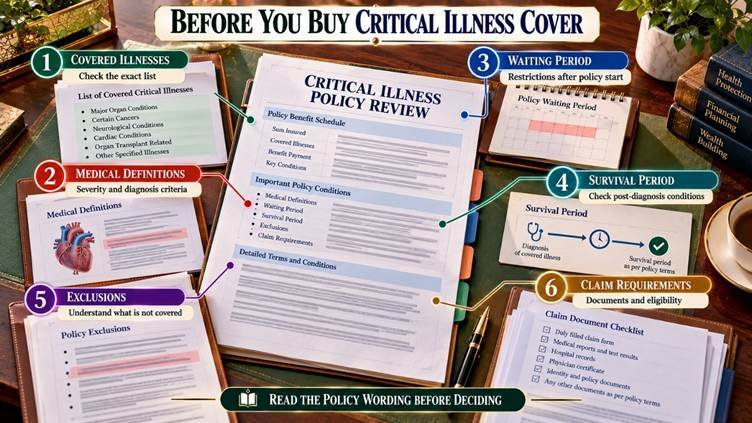
What Should You Check Before Buying Critical Illness Insurance?
Before purchasing a policy or rider, examine the following factors carefully.
1. Covered Illnesses
Read the full list of illnesses and medical events covered.
2. Medical Definitions
Check the precise diagnostic criteria, severity requirements, and exclusions.
3. Waiting Period
Identify any period during which specified claims are restricted.
4. Survival Period
Check whether the policy requires survival for a defined duration after the covered event.
5. Benefit Amount
Understand the amount payable and whether any conditions affect the payout.
6. Premium and Renewal Conditions
Review affordability, renewal provisions, and any applicable changes in premiums.
7. Existing Medical Conditions
Provide accurate medical disclosures and understand any underwriting conditions.
8. Multiple Claims and Policy Termination
Determine whether the policy pays once, permits multiple claims, provides partial benefits, or terminates after a qualifying payout.
9. Exclusions
Review conditions and events that are not covered.
10. Claim Documentation
Understand the medical evidence and administrative documents required.
Always refer to the official policy wording and Customer Information Sheet rather than relying solely on promotional summaries.
Common Mistakes People Make With Critical Illness Insurance
Assuming Every Serious Illness Is Covered
Coverage generally depends on a specified list of illnesses and contractual medical definitions.
Confusing Hospitalisation Cover With Lump-Sum Benefits
Regular health insurance and critical illness insurance may pay benefits in different ways.
Ignoring the Survival Period
A survival requirement can affect claim eligibility.
Comparing Policies Only by the Number of Illnesses
A longer list of covered illnesses does not automatically mean broader or more useful coverage.
Hiding Medical History
Incomplete disclosure can create complications under applicable policy conditions and law.
Choosing an Unaffordable Premium
Insurance protection should fit within a sustainable financial plan.
Assuming a Critical Illness Payout Is Guaranteed
Every claim remains subject to the contract and applicable rules.
Overlooking Existing Coverage
Purchasing overlapping benefits without examining current protection may lead to unnecessary expense.
Critical Illness Insurance vs Emergency Fund: Do You Need Both?
Critical illness insurance and emergency savings address different financial needs.
An emergency fund provides accessible money for a range of unexpected expenses, subject to the amount saved and where the money is held.
Critical illness insurance provides a contractual benefit only when a qualifying covered event occurs.
For example, emergency savings may be available during a temporary interruption of income even when no covered critical illness has occurred.
By contrast, a critical illness payout may provide additional financial support following a qualifying diagnosis, subject to the policy.
Neither should automatically be treated as a complete replacement for the other.
A balanced financial plan considers accessible savings, medical insurance, income-related risks, and existing financial obligations.
Frequently Asked Questions
1. What is critical illness insurance?
Critical illness insurance generally provides a defined benefit when the insured person experiences a listed serious illness or medical event and satisfies the policy’s conditions.
2. Is critical illness insurance different from health insurance?
Yes. Traditional indemnity health insurance generally covers eligible medical expenses, while critical illness insurance commonly provides a fixed benefit following a qualifying covered medical event.
3. Does critical illness insurance cover cancer?
Some policies cover cancer of specified severity. The actual coverage depends on the policy’s medical definitions, exclusions, and other conditions.
4. Can I claim both health insurance and critical illness insurance?
Potentially. Each policy assesses claims independently according to its terms. A qualifying event may result in benefits under both policies, but payment is not automatic.
5. Is critical illness insurance compulsory?
No. It is generally an optional form of protection.
6. What is a survival period?
It is a policy condition that may require the insured person to survive for a specified duration after a covered diagnosis or medical event.
7. Is critical illness insurance useful for self-employed people?
It may be relevant where a serious illness could interrupt income, but its suitability depends on existing protection, savings, financial obligations, and policy terms.
8. Does critical illness insurance cover pre-existing diseases?
Coverage depends on the insurer’s underwriting, disclosures, waiting periods, exclusions, and the applicable policy wording.
9. Can I purchase critical illness insurance as a rider?
Some insurers offer critical illness benefits as riders or add-ons, while others offer standalone policies.
10. How much critical illness cover should I buy?
There is no universal amount. Consider household expenses, income dependence, savings, loans, existing protection, affordability, and the policy’s actual coverage.
Final Thoughts
Critical illness insurance can provide additional financial protection against the consequences of certain serious medical conditions.
Regular health insurance generally focuses on eligible medical expenses, while critical illness coverage commonly provides a fixed contractual payout when specified medical criteria and other conditions are satisfied.
That distinction may be important for households concerned about income disruption, ongoing financial commitments, or expenses beyond hospital bills.
However, critical illness insurance is not automatically necessary for everyone, and it does not cover every serious disease.
Before choosing a policy, examine the covered illnesses, medical definitions, waiting periods, survival requirements, exclusions, premium, and existing protection.
At Pitanga Wealth, we believe that understanding financial risks and insurance terminology can help individuals and families make better-informed decisions.
Explore our educational resources to learn more about health insurance coverage, waiting periods, optional benefits, and broader financial planning concepts.
Important Disclaimer
This article is intended solely for general financial and insurance education. It is not personalised insurance advice, an insurance solicitation, a recommendation to purchase any particular insurance product, or an assurance of claim approval.
All examples and monetary amounts are hypothetical. Actual coverage, benefits, underwriting, waiting periods, survival periods, exclusions, premiums, renewals, and claims depend on the insurer’s policy wording and applicable regulations.
Readers should consult the latest official policy documents and Customer Information Sheet and seek clarification from an appropriately authorised insurance professional where necessary.
Distributor Disclosure: Pitanga Wealth is an AMFI-Registered Mutual Fund Distributor (ARN-134606). AMFI registration relates to mutual fund distribution and does not, by itself, authorise insurance distribution or constitute registration as a SEBI investment adviser.
Written by the Pitanga Wealth Team.
Follow us on Instagram @pitangawealth for more educational insights.
This article is for educational and informational purposes only. It is not investment, tax, legal or insurance advice. Consider your circumstances and relevant documents before making a financial decision.