

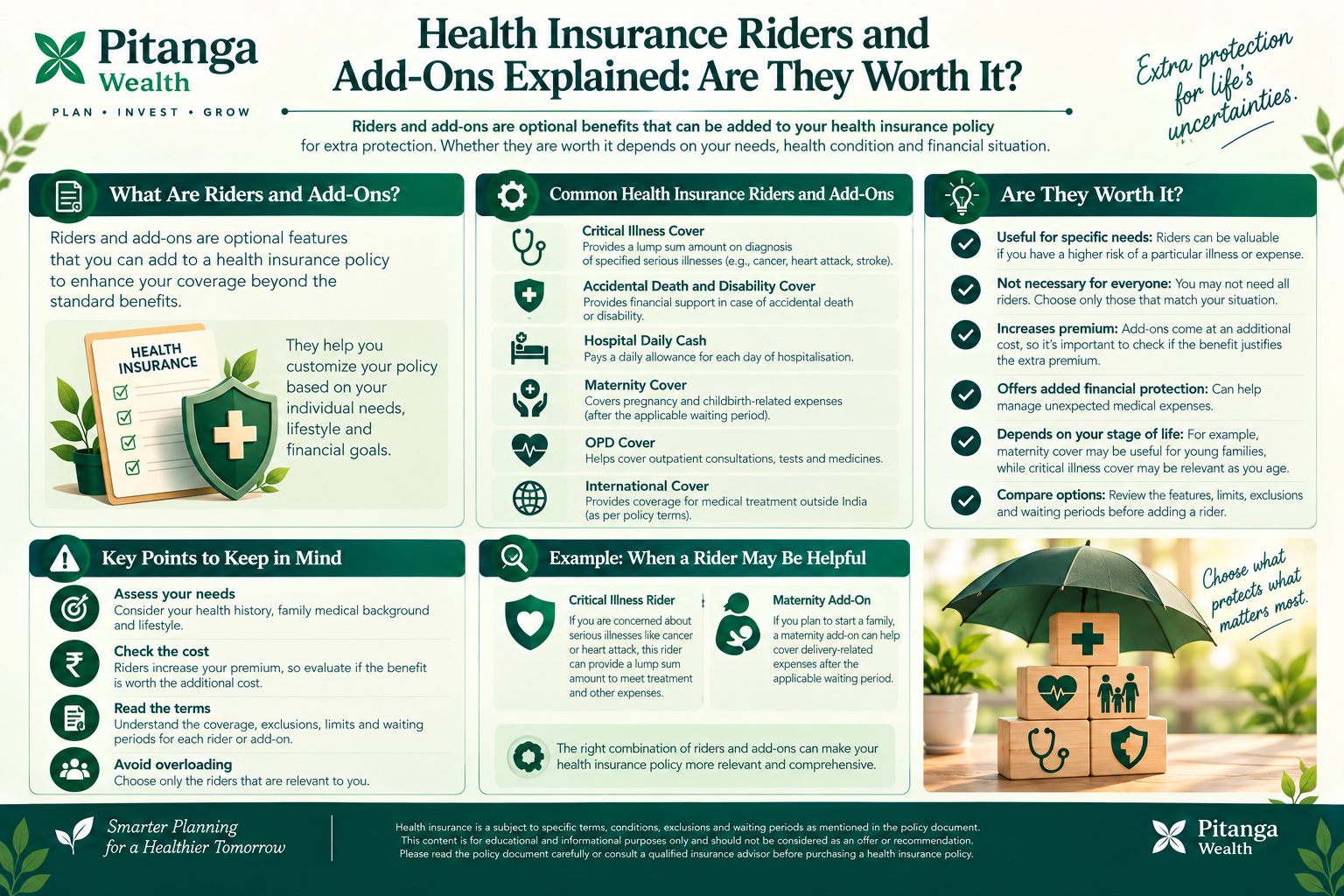
When purchasing health insurance, most people begin by comparing the sum insured, premium, hospital network, and basic policy benefits.
But while exploring different policies, you may encounter additional options such as room rent upgrades, consumables cover, reduced waiting periods, hospital cash benefits, and restoration-related features.
These are often presented as riders, add-ons, optional covers, or additional benefits.
Some can address important limitations in a standard health insurance policy. Others may provide benefits that are less relevant to your circumstances or overlap with coverage you already have.
The challenge is understanding what you are actually purchasing.
Health insurance riders and add-ons can improve certain aspects of coverage, but they do not automatically make a policy comprehensive or guarantee that every medical expense will be reimbursed.
Before paying an additional premium, it is important to understand what each benefit covers, how it works, and the conditions that may apply.
This guide explains the most common health insurance add-ons in India and provides a practical framework for evaluating them.
What Are Health Insurance Riders and Add-Ons?
Health insurance riders and add-ons are additional benefits or coverage options that may be available alongside a base health insurance policy.
Depending on the insurer and product, they may be offered for an additional premium or included as part of a particular policy variant.
Their purpose is generally to extend, modify, or supplement specific benefits provided by the base policy.
For example, a standard policy might have restrictions relating to room categories, non-payable hospital items, or certain waiting periods.
An optional benefit may change how one of those restrictions applies.
However, the actual coverage depends on the insurer’s policy wording.
Not every insurer offers the same optional benefits, and similarly named add-ons can operate differently.
Are Riders and Add-Ons the Same Thing?
In everyday insurance discussions, the terms rider and add-on are often used interchangeably.
However, their precise meaning can depend on the product and insurer.
A rider may refer to an additional contractual benefit attached to an insurance policy, while an add-on may describe an optional cover or enhancement.
For consumers, the more important questions are:
- What additional benefit is being provided?
- Is it optional or already included?
- Does it require an additional premium?
- What restrictions and exclusions apply?
- How is a claim made under that benefit?
The name alone does not determine the value of the coverage.
Why Do Health Insurance Companies Offer Add-Ons?
Health insurance needs can vary significantly between individuals and families.
A younger person with an existing employer-sponsored policy may have different priorities from someone purchasing individual coverage for aging parents.
Similarly, two policies with comparable base sums insured may differ in room rent conditions, consumables coverage, or restoration benefits.
Optional benefits allow insurers to offer different combinations of coverage features.
They may also allow policyholders to select certain enhancements without changing the entire base policy.
However, greater flexibility does not always mean greater value.
Every additional benefit should be evaluated against its cost and limitations.
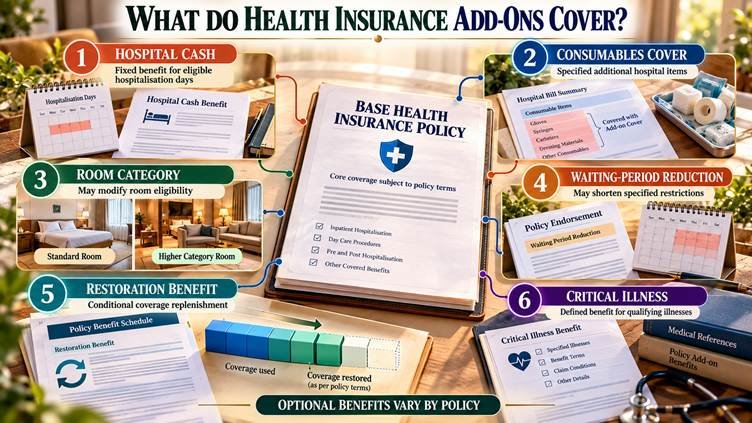
What Are the Common Types of Health Insurance Riders and Add-Ons?
Health insurance products in India may offer several optional benefits.
Some of the commonly discussed categories include:
- Hospital cash benefit
- Consumables or non-medical expenses cover
- Room rent modification or upgrade
- Waiting-period reduction
- Restoration or recharge benefit
- Personal accident-related benefits
- Critical illness benefit
- Outpatient consultation and diagnostic benefits
- Maternity and newborn-related benefits
- Other condition-specific or service-related benefits
These are examples of possible product features, not a universal list of benefits available under every policy.
Let’s understand them individually.
1. Hospital Cash Benefit
A hospital cash benefit generally provides a specified fixed amount for each eligible day of hospitalisation.
Unlike standard indemnity health insurance, which reimburses or directly settles eligible medical expenses up to applicable limits, a hospital cash benefit is usually structured as a fixed benefit.
How Does Hospital Cash Work?
Suppose a policy offers a hypothetical hospital cash benefit of ₹1,000 per eligible hospitalisation day.
If the insured person meets the benefit’s conditions for four days, the stated benefit could amount to ₹4,000.
This is only an illustration. Actual benefit amounts, qualifying hospitalisation periods, maximum payable days, exclusions, and claim requirements vary.
What Can Hospital Cash Be Useful For?
Hospitalisation may create expenses beyond the medical bill.
For example, a family might incur additional travel, meals, or other incidental costs.
A fixed hospital cash benefit may provide financial support without being calculated directly from each eligible hospital invoice item.
However, the insurer may impose minimum hospitalisation durations and other conditions.
Is Hospital Cash Necessary?
Not necessarily.
If you already have sufficient savings for incidental expenses, the additional premium may not offer significant value.
If such expenses could create financial pressure, it may be worth comparing the benefit with its cost.
2. Consumables and Non-Medical Expenses Cover
During hospitalisation, certain items may be excluded from reimbursement under the base policy.
Depending on the policy and applicable rules, these may include specified consumables or other items listed as non-payable.
An optional consumables benefit may cover some of these expenses.
What Expenses Might Be Included?
The covered items depend on the insurer’s approved benefit wording.
An add-on may address certain specified items that would otherwise remain outside the base policy’s payable expenses.
However, it should not be assumed that every item described as a consumable or non-medical expense becomes covered.
Example
Suppose a hospital bill contains eligible treatment charges and additional items that the base policy would not reimburse.
A consumables add-on might cover some of those specified items if they are included in its benefit schedule.
Any remaining exclusions or limits would continue to apply.
What Should You Check?
Read the actual list of covered items, exclusions, limits, and any conditions relating to admissible hospitalisation claims.
The term “consumables cover” alone is not enough to establish what will be paid.
3. Room Rent Upgrade or Room Category Modification
Some health insurance policies restrict the room category or room rent amount eligible for coverage.
An optional benefit may modify these restrictions.
Why Does Room Category Matter?
Certain policies link eligible hospital expenses to the permitted room category.
Depending on the contract, choosing a room above the allowed category may affect the amount payable for some associated charges.
However, the exact treatment of proportionate deductions and associated medical expenses depends on the policy wording and applicable requirements.
Example
Suppose a base policy allows a particular room category.
The policyholder chooses a more expensive room.
If the policy contains relevant restrictions, some expenses may not be fully payable.
An optional room category enhancement may change the permitted accommodation benefit.
It does not necessarily remove every limit on hospitalisation expenses.
When Might This Add-On Be Relevant?
It may deserve consideration when the base policy’s room restrictions are particularly limiting.
However, a policy that already offers suitable room eligibility may not require an additional upgrade.
4. Pre-Existing Disease Waiting-Period Reduction
Health insurance policies may impose waiting periods for eligible pre-existing diseases.
Some insurers offer optional benefits that reduce specified waiting periods.
How Does a Waiting-Period Reduction Work?
Suppose a policy has a defined waiting period for a particular pre-existing condition.
An optional benefit may reduce that period if the insured person meets the applicable eligibility and underwriting requirements.
The reduction may apply only to certain conditions or coverage categories.
Does It Cover Existing Diseases Immediately?
Not necessarily.
A waiting-period reduction is not automatically equivalent to coverage from the first day.
Other restrictions, medical underwriting decisions, and exclusions may still apply.
What Should You Compare?
Consider the additional premium, the actual reduction in waiting time, which conditions are covered, and any special underwriting requirements.
For a detailed explanation, read our guide on waiting periods in health insurance.
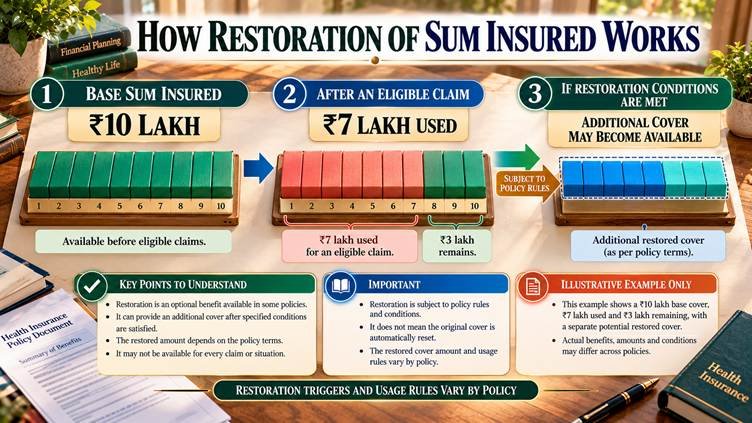
5. Restoration or Recharge of Sum Insured
Restoration-related benefits are designed to replenish an eligible amount of coverage after certain claim-related conditions are met.
Some health insurance policies include restoration as a built-in feature, while others may offer enhanced restoration options.
How Does Restoration Work?
Consider a hypothetical family floater with a ₹10 lakh base sum insured.
Suppose eligible claims use a substantial portion of that amount.
If the policy’s restoration conditions are satisfied, an additional amount of coverage may become available.
However, the benefit may depend on factors such as:
- Whether the original sum insured has been partially or fully exhausted
- Whether restoration can be used for the same illness
- Whether it applies to the same insured person
- Whether it can be triggered more than once
- Whether restored coverage can be carried forward
- Whether specific exclusions apply
Is Restoration the Same as Having a Higher Sum Insured?
No.
A restoration benefit may be conditional.
A higher base sum insured and a restoration benefit are not necessarily interchangeable.
For example, a large claim may be treated differently depending on whether the restoration benefit can be activated for that particular claim.
Always check the trigger and utilisation rules.
6. Personal Accident-Related Benefits
Some health insurance products offer optional accident-related benefits.
These may provide a fixed payment for certain covered accidental events, depending on the benefit structure.
Examples may include specified accidental injuries, disability-related benefits, or other events defined in the contract.
However, personal accident insurance is a distinct type of protection, and an optional accident benefit within a health insurance product should not be assumed to replace a comprehensive personal accident policy.
What Should You Check?
Review the covered events, benefit definitions, exclusions, payout conditions, and any overlap with existing accident coverage.
The presence of the word “accident” does not mean every accident-related loss is insured.
7. Critical Illness Benefit
A critical illness benefit generally provides a specified fixed payout when a covered critical illness meets the policy’s contractual definition and claim conditions.
It differs from ordinary hospitalisation reimbursement.
How Is Critical Illness Cover Different?
A standard indemnity health insurance policy generally pays eligible medical expenses according to its terms.
A critical illness benefit may pay a fixed amount when the insured person satisfies the defined illness and claim requirements.
Depending on the policy, the payout may not be linked directly to the actual hospital bill.
Example
Suppose a hypothetical critical illness benefit provides a fixed sum of ₹5 lakh for a qualifying covered illness.
If all contractual conditions are met, the defined benefit may become payable.
However, the illness must satisfy the policy’s precise definition.
Waiting periods, survival periods, exclusions, and other restrictions may apply.
Is Critical Illness Cover Automatically Included?
No.
It may be offered as a separate insurance product, an optional benefit, or a feature within a particular policy.
The terms can vary substantially.
We will examine this subject in greater detail in our upcoming article on critical illness insurance.
8. OPD and Diagnostic Benefits
OPD refers to outpatient department services.
Many standard hospitalisation-focused health insurance policies primarily cover eligible hospitalisation and certain related medical expenses.
Some products also offer outpatient benefits.
These may include specified consultations, diagnostic tests, or other eligible outpatient services.
What Should You Check?
Look for annual limits, eligible providers, network restrictions, reimbursement conditions, waiting periods, and exclusions.
An OPD benefit with a low annual limit may not justify a substantial additional premium for every policyholder.
The value depends on expected usage and the actual contract.
9. Maternity and Newborn-Related Benefits
Some health insurance products offer maternity-related coverage or optional enhancements.
These may include specified delivery expenses, pregnancy-related hospitalisation, or newborn-related benefits.
However, maternity coverage is not universal.
Important Conditions
Check the applicable waiting period, benefit limits, eligibility requirements, newborn enrolment rules, and exclusions.
Do not assume that adding maternity coverage shortly before an expected delivery makes all associated expenses eligible.
The timing of coverage and specific policy provisions matter.
10. Other Optional Health Insurance Benefits
Insurers may offer other optional features depending on the product.
These could include specified home-care benefits, additional service arrangements, certain disease-specific enhancements, or other benefits described in the policy.
The availability of these features changes across products.
Rather than relying on a promotional feature name, examine the actual benefit definition.
A feature is useful only when its coverage, eligibility, and cost are relevant to your circumstances.
Health Insurance Riders and Add-Ons: Comparison Table
The following table summarises common benefit categories and the questions to ask before purchasing them.
| Add-On or Benefit | What It May Provide | What to Verify |
| Hospital cash | Fixed benefit for eligible hospitalisation days | Daily amount, minimum stay, maximum days |
| Consumables cover | Coverage for specified otherwise non-payable items | Covered items, exclusions, limits |
| Room rent upgrade | Modification of room eligibility | Eligible category, deductions, conditions |
| Waiting-period reduction | Shorter specified waiting periods | Conditions covered, underwriting, additional premium |
| Restoration benefit | Conditional replenishment of eligible coverage | Trigger, reuse rules, limits |
| Accident benefit | Defined accident-related payout | Covered events, exclusions, overlap |
| Critical illness benefit | Fixed payout for qualifying listed illnesses | Illness definitions, waiting and survival periods |
| OPD cover | Specified outpatient expenses | Annual limits, network, reimbursement |
| Maternity benefit | Defined maternity-related coverage | Waiting period, eligibility, sub-limits |
This comparison is illustrative. It does not describe the terms of any particular insurance product.
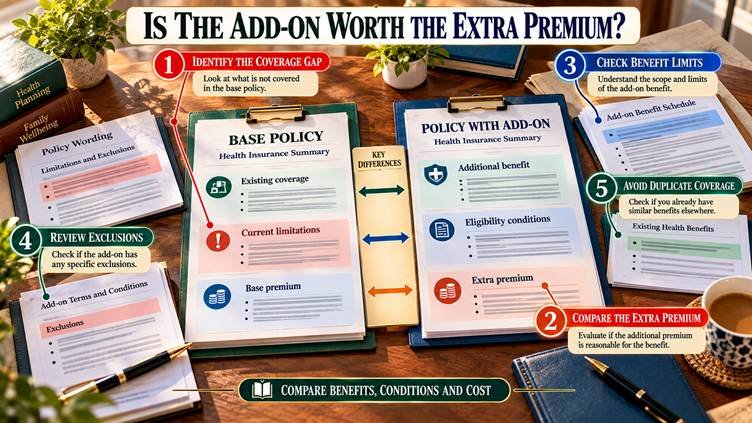
Are Health Insurance Riders and Add-Ons Worth the Extra Premium?
The answer depends on the value of the additional coverage relative to its cost.
A benefit that is useful for one person may be unnecessary for another.
Consider a few examples.
Example 1: A Policy With Restrictive Room Eligibility
If the base policy has a room restriction that could materially affect eligible hospital expenses, a suitable room category enhancement may deserve attention.
Example 2: A Family Concerned About Non-Payable Items
If an optional consumables benefit covers a meaningful range of specified items at a reasonable additional cost, it may be worth comparing.
Example 3: Someone With Existing Medical Conditions
A waiting-period reduction may be relevant if it applies to the person’s disclosed conditions and the underwriting terms are acceptable.
Example 4: Someone With Existing Critical Illness Cover
Purchasing another overlapping benefit without examining the existing protection may create unnecessary expense.
These examples are not recommendations to buy any particular add-on.
They demonstrate the importance of evaluating the actual benefit rather than choosing every available option.
How to Calculate Whether an Add-On Offers Value
There is no single calculation that determines whether every insurance add-on is worthwhile.
However, a practical comparison can help.
Step 1: Identify the Additional Premium
Determine how much more you will pay for the benefit and whether the additional cost can change at renewal.
Step 2: Understand the Maximum Available Benefit
Check the monetary limit, number of eligible claims, qualifying conditions, and any annual restrictions.
Step 3: Identify the Coverage Gap
Ask what expense or risk remains under the base policy without the add-on.
Step 4: Check Existing Protection
Review employer-sponsored insurance, other personal policies, and existing benefits.
Step 5: Examine the Conditions
A seemingly attractive benefit may have restrictions that significantly affect its usefulness.
A Hypothetical Example
Suppose an optional benefit costs ₹1,500 per year and provides up to ₹10,000 for certain eligible expenses.
It would be incorrect to conclude that the benefit automatically provides ₹8,500 of value.
The benefit may only pay when specific conditions are met, and the policyholder may never incur qualifying expenses.
Conversely, the benefit could be useful in an eligible claim situation.
The relevant comparison is not simply the maximum benefit minus the premium.
It is the coverage gap, the conditions, the financial impact of the risk, and the cost of transferring that risk to the insurer.
Can You Add Riders After Buying Health Insurance?
Some insurers may allow certain optional benefits to be added at renewal or under specified policy modification arrangements.
Others may require selection when the policy is first purchased.
Adding an optional benefit later may involve underwriting, eligibility conditions, fresh waiting periods, or other requirements.
It is important to obtain confirmation from the insurer before assuming that an add-on can be introduced at any time.
Do Add-Ons Have Separate Waiting Periods?
They can.
An optional benefit may have a waiting period that differs from the base policy’s general waiting-period provisions.
For example, certain maternity or critical illness benefits may have specific eligibility conditions.
Some enhancements may also have restrictions relating to when they can first be used.
Always check whether a separate waiting period applies to the optional benefit.
Do Health Insurance Add-Ons Guarantee Claim Approval?
No.
The presence of an add-on does not eliminate the requirement to satisfy the relevant claim conditions.
A claim may still be subject to:
- The benefit’s specific eligibility rules
- Medical necessity and treatment conditions
- Waiting periods
- Exclusions
- Sub-limits or deductibles
- Required documentation
- Other policy provisions
Even after purchasing an optional benefit, policyholders should retain the complete policy wording and endorsements.
What Should Families Check Before Choosing Add-Ons?
Families should consider the age, medical needs, and existing coverage of each insured member.
For a family floater, the shared sum insured and claim utilisation rules can be especially important.
However, some optional benefits may apply differently to individual insured members.
For example, an eligibility condition attached to one person’s medical history may not apply in the same way to another family member.
Families should also review whether a benefit applies to all covered members or only to those meeting specific conditions.
An add-on should not be selected solely because it is advertised as a family-friendly feature.
Common Mistakes When Buying Health Insurance Add-Ons
Choosing Every Available Add-On
More optional benefits do not necessarily mean better overall protection.
Ignoring the Base Policy
An add-on cannot compensate for every weakness in an unsuitable base policy.
Comparing Benefits by Name Alone
Two insurers may use similar labels for benefits with different conditions.
Assuming Restoration Means Unlimited Coverage
Restoration is governed by specific triggers and utilisation rules.
Confusing Critical Illness Cover With Hospitalisation Insurance
A fixed-benefit critical illness payout is not the same as reimbursement of eligible medical expenses.
Overlooking Separate Waiting Periods
Some optional benefits may have their own waiting periods.
Ignoring Sub-Limits
A benefit may have a much lower payable limit than the policy’s overall sum insured.
Failing to Check Existing Coverage
Some benefits may overlap with protection already available under another policy.
Assuming Add-Ons Can Always Be Added Later
Availability and eligibility can depend on the insurer and renewal conditions.
How to Choose Health Insurance Riders and Add-Ons: A Practical Checklist
Before purchasing an optional benefit, ask:
- What specific coverage gap does this benefit address?
- Is the benefit already included in the base policy?
- What additional premium is payable?
- What is the maximum benefit or applicable limit?
- Are there separate waiting periods?
- Are there exclusions or restrictions?
- Does the benefit apply to every insured family member?
- Is the benefit available immediately or only after specified conditions?
- Can it be removed or modified at renewal?
- Is there overlapping coverage under another policy?
The answers should come from the insurer’s official documents, not only from a promotional summary.
Frequently Asked Questions
1. What are health insurance riders and add-ons?
They are additional benefits or coverage options that supplement or modify specific aspects of a base health insurance policy, subject to the insurer’s terms.
2. Are health insurance add-ons compulsory?
Generally, optional add-ons are not compulsory. However, some benefits may be built into particular policy variants rather than offered separately.
3. Do add-ons increase health insurance premiums?
Optional benefits commonly involve an additional premium, although some features may already be included in a policy’s pricing.
4. Is consumables cover useful?
It may be useful when it covers relevant otherwise non-payable items. Its value depends on the covered list, exclusions, limits, and additional premium.
5. Is restoration of sum insured an add-on?
Restoration may be included in a base policy or offered through an optional enhancement, depending on the insurer and product.
6. Does a room rent upgrade remove all hospital bill deductions?
Not necessarily. It may modify room eligibility, but other policy limits, exclusions, and conditions can still apply.
7. Can an add-on reduce the pre-existing disease waiting period?
Some products may offer this feature, subject to underwriting, eligibility, and the specific conditions stated in the policy.
8. Is critical illness insurance the same as a health insurance add-on?
Critical illness protection may be offered as a separate product or an additional benefit. Its payout structure and conditions can differ from ordinary health insurance.
9. Can I remove an add-on at renewal?
This depends on the insurer and product. Changes may be permitted under specified conditions, so confirm the applicable rules.
10. Which health insurance add-on is best?
There is no universally best add-on. The appropriate choice depends on the base policy, existing protection, personal circumstances, cost, and the benefit’s terms.
Final Thoughts
Health insurance riders and add-ons can help address certain gaps in a base policy, but they should be evaluated carefully.
A hospital cash benefit may provide fixed financial support during eligible hospitalisation. A consumables benefit may cover certain specified expenses. A room rent upgrade may change accommodation eligibility, while a restoration feature may provide additional conditional coverage.
Other options, such as critical illness benefits or waiting-period reductions, may serve different purposes.
The key is to understand what each benefit actually changes.
Rather than selecting optional covers simply because they are available, compare the additional premium, coverage gap, eligibility rules, exclusions, and existing protection.
At Pitanga Wealth, we believe financial awareness begins with understanding the details behind important decisions.
Explore our educational resources to learn more about health insurance waiting periods, family floater coverage, and related financial protection concepts.
Important Disclaimer
This article is provided for general financial and insurance education only. It does not constitute personalised insurance advice, an insurance solicitation, or a recommendation to purchase any particular policy, rider, or add-on.
All examples and amounts are hypothetical and are not representations of actual insurance products.
Insurance benefits, premiums, underwriting, waiting periods, exclusions, claims, renewals, and eligibility conditions depend on the insurer, policy wording, endorsements, and applicable regulations.
Readers should review the latest official policy wording and Customer Information Sheet and seek clarification from an appropriately authorised insurance professional where required.
Distributor Disclosure: Pitanga Wealth is an AMFI-Registered Mutual Fund Distributor (ARN-134606). AMFI registration relates to mutual fund distribution and does not, by itself, authorise insurance distribution or constitute registration as a SEBI investment adviser.
Written by the Pitanga Wealth Team.
Follow us on Instagram @pitangawealth for more educational insights.
This article is for educational and informational purposes only. It is not investment, tax, legal or insurance advice. Consider your circumstances and relevant documents before making a financial decision.