

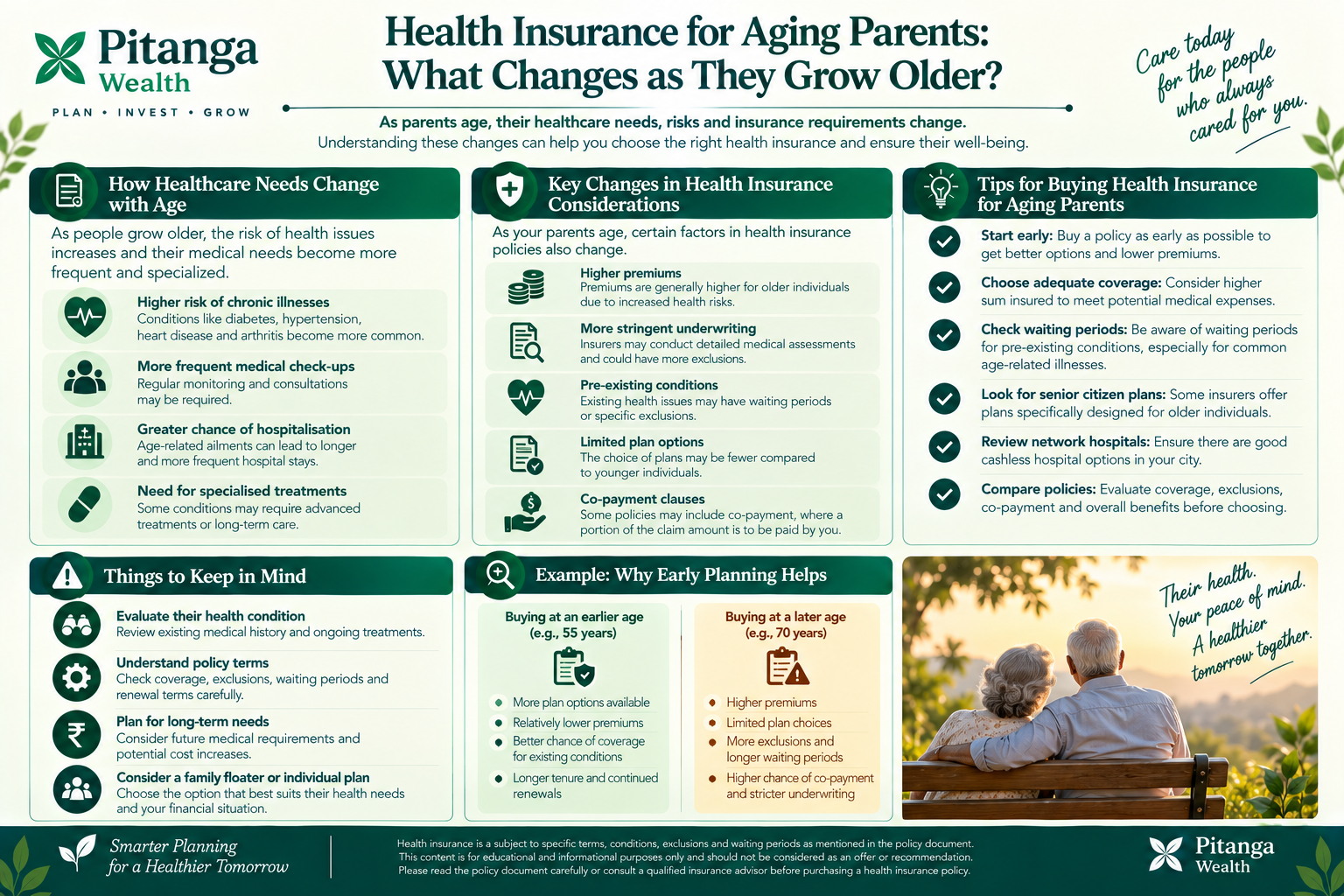
As parents grow older, their healthcare needs may change. Medical consultations can become more frequent, ongoing treatment may be required, and the possibility of hospitalisation may become a more important consideration for the family.
At the same time, choosing suitable health insurance can become more complicated.
A health insurance policy that seemed adequate several years ago may have limitations that deserve closer attention today, making regular reviews of health insurance for aging parents especially important.Premiums may change, existing medical conditions may affect underwriting, and certain policy features may become more important.
For adult children, this raises a practical question: How can you help your parents maintain suitable health insurance without overlooking important coverage restrictions?
Health insurance for aging parents is not simply about finding the highest sum insured or the lowest premium. It involves understanding the existing policy, the parents’ medical needs, the insurer’s contractual conditions, and the family’s ability to manage expenses that may remain uncovered.
This guide explains what changes as parents age, what to review before purchasing or renewing coverage, and how to avoid common insurance planning mistakes.
Why Does Health Insurance Become More Important as Parents Age?
Healthcare requirements can evolve with age, which is why health insurance for aging parents should be reviewed as medical and financial circumstances change.
Some older adults may need regular monitoring for chronic conditions, while others may require treatment for new medical problems or age-related complications.
However, age alone does not determine an individual’s health status or future medical expenses.
Health insurance can help manage eligible treatment costs, but the extent of protection depends on the policy.
Changing Medical Needs
Parents may require more frequent consultations, diagnostic investigations, medication reviews, or specialist care.
Not all such expenses are necessarily covered under a hospitalisation-focused health insurance policy.
Greater Financial Exposure
A significant hospitalisation can create substantial expenses.
Without adequate coverage or accessible savings, a family may need to use funds intended for retirement, household needs, or other financial goals.
Importance of Policy Continuity
Maintaining eligible continuous coverage may help preserve waiting-period credits and other continuity benefits, subject to applicable rules.
Allowing an existing policy to lapse can create avoidable complications.

What Changes in Health Insurance as Parents Grow Older?
Several factors may become more important when reviewing health insurance for aging parents.
These include:
- Premium affordability
- Existing medical conditions
- Underwriting and eligibility
- Waiting periods
- Co-payment requirements
- Room rent restrictions
- Coverage limits and exclusions
- Hospital network accessibility
- Renewal continuity
- Family financial responsibilities
Each factor should be evaluated individually rather than assuming that every senior citizen health insurance policy operates in the same way.
1. Health Insurance Premiums May Increase With Age
Age is one of several factors insurers may use when pricing health insurance products, subject to the product’s approved pricing structure and applicable rules.
Depending on the policy, premiums may change as the insured person moves into a different age band or because of other permitted pricing factors.
Why Does Premium Affordability Matter?
A policy should ideally remain affordable over the long term.
Choosing a plan solely because its initial premium is attractive may create difficulties if future premiums become harder to manage.
What Should Families Compare?
Review the current premium, product pricing structure, renewal conditions, coverage benefits, and the family’s ability to sustain the cost.
Do not assume that every insurer increases premiums at the same rate or that a particular increase will occur every year.
2. Pre-Existing Medical Conditions Need Careful Attention
Pre-existing medical conditions are an important consideration when purchasing health insurance.
Examples may include diabetes, hypertension, cardiovascular conditions, or other illnesses that fall within the applicable policy and regulatory definitions.
Having an existing condition does not automatically mean that health insurance is unavailable.
However, underwriting decisions, coverage terms, waiting periods, and exclusions can vary.
Why Is Medical Disclosure Important?
Insurers may ask about medical history, previous diagnoses, treatment, medication, and hospitalisation.
Answers should be accurate and complete.
Incomplete or incorrect disclosure can create claim-related disputes or other consequences under applicable law and policy terms.
Does Health Insurance Cover Pre-Existing Diseases Immediately?
Not necessarily.
A policy may impose an applicable waiting period or other conditions.
Under the IRDAI’s 2024 health insurance regulatory framework, the maximum pre-existing disease waiting period was reduced to 36 months for applicable products. Families should verify the latest applicable rules and the exact policy wording before relying on a particular duration.
A condition’s coverage can also depend on underwriting and other contractual provisions.
3. Co-Payment Clauses Can Affect Out-of-Pocket Expenses
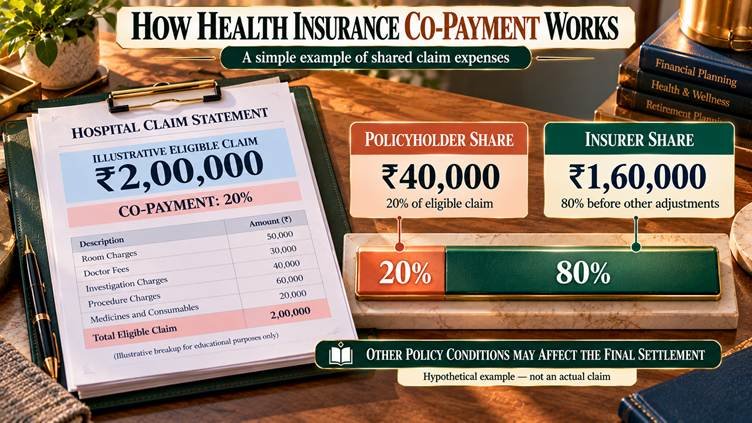
A co-payment is a contractual arrangement under which the policyholder bears a specified share of an eligible claim.
Some health insurance products, including certain plans designed for older adults, may contain co-payment requirements.
How Does Co-Payment Work?
Consider a hypothetical eligible claim amount of ₹2 lakh.
If the policy applies a 20% co-payment to that amount:
| Particulars | Amount |
| Eligible claim amount | ₹2,00,000 |
| Policyholder’s 20% share | ₹40,000 |
| Insurer’s share before other applicable adjustments | ₹1,60,000 |
This example assumes the co-payment applies to the entire eligible amount and ignores other deductions or policy conditions.
Actual claim settlement can differ.
Why Should Families Check Co-Payment Carefully?
A policy with a lower premium may require the family to pay a meaningful portion of eligible claims.
However, a co-payment does not automatically make a policy unsuitable.
The important question is whether the family understands and can manage its potential share of expenses.
4. Room Rent Limits May Affect Hospitalisation Costs
Some policies restrict the eligible room category or room rent.
These restrictions may influence the amount payable under the policy.
What Is a Room Rent Limit?
A policy may specify an eligible room category or a monetary restriction.
If a more expensive room is selected, the treatment of additional charges depends on the policy’s terms.
Why Is This Important for Older Parents?
Families may prefer a particular hospital or room category based on medical needs, availability, or comfort.
A restrictive room entitlement can complicate the financial decision.
What Should You Check?
Review the permitted room category, any associated deductions, and whether an alternative policy provides more suitable terms.
Do not assume that a policy advertising a large sum insured automatically permits every room category.
5. Waiting Periods Can Become Especially Important
Waiting periods restrict coverage for specified conditions, treatments, or benefits during defined periods.
They can be particularly relevant when parents already have medical conditions or are considering a new policy later in life.
Types of Waiting Periods to Review
Depending on the product, these may include:
- Initial waiting periods
- Pre-existing disease waiting periods
- Specified disease or procedure waiting periods
- Benefit-specific waiting periods
What Happens When Parents Switch Policies?
A new policy may have different conditions.
Eligible continuity credits may be available through portability or migration, subject to applicable regulatory and product rules.
However, families should not assume that every benefit, waiting-period credit, or coverage feature transfers without conditions.
For a detailed explanation, read our guide on waiting periods in health insurance.
6. Sum Insured Should Reflect Coverage Needs
The sum insured represents the maximum coverage amount available under the relevant policy provisions, subject to limits and conditions.
A higher sum insured may provide greater potential financial protection, but it does not automatically remove exclusions, co-payments, deductibles, or sub-limits.
Is ₹5 Lakh or ₹10 Lakh Enough for Aging Parents?
There is no universal answer.
The appropriate amount depends on factors such as:
- Existing medical needs
- Local treatment costs
- Preferred hospital access
- Available family savings
- Other insurance coverage
- Premium affordability
- Policy restrictions
Families should avoid choosing a sum insured solely because a particular amount is commonly advertised.
Should You Increase an Existing Policy’s Sum Insured?
Increasing coverage may be worth evaluating when the existing amount appears insufficient.
However, an increase may involve underwriting and additional conditions.
Waiting-period provisions may apply to the enhanced portion of coverage, depending on the product and applicable rules.
7. Individual Health Insurance vs Family Floater for Parents
Families sometimes consider including parents under a shared family floater.
Others prefer separate individual coverage.
Neither arrangement is universally better.
How Does a Family Floater Work?
A family floater generally provides a shared sum insured for the insured family members.
Eligible claims by one member reduce the amount available to others, subject to restoration and other policy provisions.
How Does Individual Coverage Work?
Individual health insurance generally provides a separate sum insured for each insured person.
The precise structure depends on the product.
Which Arrangement May Be More Suitable?
Consider the ages and medical needs of the insured members, the available sum insured, premium structure, and claim-sharing implications.
Including older parents in a family floater may affect pricing or eligibility depending on the insurer’s rules.
A separate policy may provide clearer individual coverage, but it may also involve different premiums and restrictions.
Read our detailed comparison of family floater vs individual health insurance for a broader explanation.
8. Hospital Network Accessibility Matters
The size of an insurer’s hospital network is useful information, but the total number of hospitals should not be the only consideration.
Families should examine whether suitable hospitals are accessible from the parents’ home.
What Should You Verify?
Check whether preferred hospitals are currently part of the insurer’s network.
Also review the availability of relevant specialties and the insurer’s cashless treatment process.
Does a Network Hospital Guarantee Cashless Approval?
No.
Cashless treatment is subject to policy eligibility, claim assessment, hospital arrangements, and applicable procedures.
Network participation can also change.
Verify the current status directly with the insurer or its authorised claims administrator and the hospital.
9. Sub-Limits and Exclusions Can Change the Value of Coverage
A policy may advertise a substantial sum insured while imposing specific restrictions on certain treatments, procedures, or expenses.
These restrictions may include sub-limits, exclusions, deductibles, or other conditions.
What Is a Sub-Limit?
A sub-limit restricts the amount payable for a specified benefit or expense category.
For example, a policy may contain a defined limit for a particular procedure.
What Is an Exclusion?
An exclusion identifies a condition, treatment, expense, or circumstance that the policy does not cover under its terms.
Why Should Parents Review These Clauses?
An important medical expense may be subject to a specific restriction even when the overall sum insured appears adequate.
Families should compare the actual policy wording rather than relying only on the coverage amount displayed in advertisements.
10. Renewal Continuity Becomes More Valuable
Maintaining eligible continuous health insurance coverage can be important for preserving accumulated benefits and waiting-period credits.
Can Health Insurance Be Renewed as Parents Grow Older?
Applicable Indian health insurance rules provide protections concerning renewability, but the exact rights, exceptions, and conditions should be checked against current regulations and the policy.
Under the IRDAI’s 2024 framework, insurers were directed to make health insurance products available across age groups rather than imposing a universal maximum entry age of 65.
This does not mean every specific product must accept every applicant or that underwriting and eligibility conditions disappear.
Why Should Families Avoid Unnecessary Coverage Gaps?
A lapse can affect continuity benefits and create complications when seeking fresh coverage.
Renewal dates, premium payment arrangements, and applicable grace-period provisions should be monitored carefully.
11. Should Parents Rely Only on Employer Health Insurance?
Some adult children receive employer-sponsored health insurance that may allow parents to be included.
Such coverage can be useful.
However, its availability and benefits depend on the employer’s arrangements.
What Could Change?
Employer-sponsored coverage may change when:
- The employee changes jobs
- The employer revises benefits
- Parent coverage is discontinued
- The employee retires or leaves employment
- Eligibility or premium-sharing rules change
A separate personal policy may provide a different form of continuity, subject to its own conditions.
Families should assess whether employer coverage alone adequately addresses their parents’ long-term needs.
12. What if Parents Already Have an Old Health Insurance Policy?
An existing policy should not automatically be replaced merely because a newer product offers additional features.
An older policy may have valuable continuity benefits.
Review Before Replacing
Check the existing sum insured, renewal terms, accumulated waiting-period credits, exclusions, co-payment, and other benefits.
Compare these with the proposed replacement.
Should You Port the Existing Policy?
Portability may allow eligible continuity benefits to be recognised when moving between insurers, subject to applicable rules and underwriting.
However, the new policy may have different coverage features, premiums, and exclusions.
Do not cancel an existing policy before understanding whether replacement coverage has been accepted and when it becomes effective.
13. Are Senior Citizen Health Insurance Plans Always Better?
No.
A policy marketed specifically for senior citizens is not automatically better than a suitable regular health insurance product.
Some senior-focused products may have features designed for older applicants.
Others may contain co-payment requirements, specific limits, or different coverage conditions.
Compare the Actual Benefits
The evaluation should include:
- Eligibility and underwriting
- Premium affordability
- Sum insured
- Co-payment and deductibles
- Waiting periods
- Room eligibility
- Sub-limits
- Hospital network
- Renewal provisions
- Claims-related conditions
The label “senior citizen plan” should not replace a detailed policy comparison.
14. Should You Consider a Super Top-Up Policy for Parents?
A super top-up policy may provide additional eligible coverage after the applicable aggregate deductible threshold is met, subject to the product’s terms.
It can be one way to evaluate additional protection.
However, it is important to understand how the deductible operates and which expenses qualify.
A Hypothetical Example
Suppose a super top-up policy has an aggregate deductible of ₹5 lakh.
The policy may begin responding to eligible expenses above that threshold during the defined policy period, subject to its conditions.
This does not mean every expense above ₹5 lakh will automatically be covered.
The deductible, exclusions, waiting periods, and covered benefits must be examined.
Is a Super Top-Up a Substitute for Base Health Insurance?
Not necessarily.
The two products can serve different functions.
Families should understand how the policies interact before relying on a super top-up for additional protection.
15. What if Your Parents Cannot Get New Health Insurance?
Some applicants may face underwriting restrictions, exclusions, premium challenges, or other eligibility issues.
The availability of coverage depends on the insurer and product.
If suitable new coverage is unavailable, families may need to focus more heavily on other financial preparations.
Build Accessible Medical Savings
A dedicated reserve may help manage expenses that insurance does not cover.
Review Existing Coverage
Check whether any existing policy can be maintained or appropriately enhanced.
Understand Employer or Group Benefits
Determine whether eligible group arrangements provide relevant coverage.
Avoid Assuming Future Approval
Do not rely on the expectation that a new policy will necessarily be available later.
Financial planning becomes particularly important when insurance options are limited.
16. How Can Adult Children Help Parents Manage Health Insurance?
Helping parents with health insurance involves more than paying premiums.
Administrative support can make a meaningful difference.
Keep Policy Documents Organised
Maintain accessible copies of the policy schedule, Customer Information Sheet, and complete policy wording.
Track Renewal Dates
Use reminders so premiums are paid within the applicable timeframes.
Review Medical Disclosures
Ensure information supplied during applications or policy changes is accurate.
Maintain Emergency Contacts
Keep insurer contact details, claims information, and relevant hospital information accessible.
Understand the Claim Process
Know how to request cashless treatment, what documents may be required, and how reimbursement claims are submitted.
Discuss Financial Responsibilities
Families should understand who will manage premium payments, non-covered expenses, and emergency funds.
Health Insurance for Aging Parents: Practical Comparison Checklist
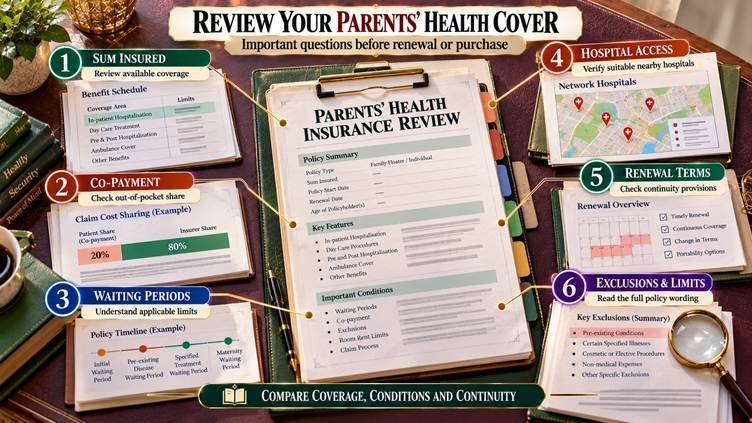
Before selecting or renewing a policy, compare the following factors.
| Factor | Questions to Ask |
| Premium | Is it affordable now and sustainable over time? |
| Sum insured | Is the coverage amount suitable for likely financial exposure? |
| Pre-existing diseases | What conditions, waiting periods, or underwriting restrictions apply? |
| Co-payment | What share of eligible claims must the family pay? |
| Room rent | Which room categories are permitted? |
| Sub-limits | Are particular treatments subject to separate limits? |
| Exclusions | Which conditions or expenses are not covered? |
| Hospital network | Are suitable nearby hospitals accessible? |
| Continuity | What waiting-period credits or renewal benefits are available? |
| Claims process | What are the cashless and reimbursement procedures? |
| Existing policies | Would changing policies sacrifice valuable benefits? |
| Additional cover | Would an appropriate top-up or super top-up address a meaningful gap? |
Use the insurer’s current official documents to confirm the answers.
Common Mistakes When Buying Health Insurance for Aging Parents
Waiting Until a Medical Emergency
Trying to arrange new coverage only after a serious diagnosis can create eligibility and waiting-period complications.
Choosing the Lowest Premium
A lower premium may be accompanied by restrictions that create larger out-of-pocket expenses.
Ignoring Co-Payment
Families may underestimate their share of eligible claims.
Replacing an Old Policy Without Comparing Continuity Benefits
A replacement may not preserve every feature of the existing policy.
Assuming Every Disease Is Covered
Waiting periods, exclusions, and specific medical definitions may apply.
Selecting Coverage Based Only on Sum Insured
A large sum insured does not automatically eliminate room rent limits, deductibles, or sub-limits.
Relying Entirely on Employer Coverage
Employer benefits may change with employment arrangements.
Failing to Check Nearby Hospitals
A large network does not guarantee that suitable facilities are conveniently accessible.
Forgetting Renewals
A missed renewal can affect coverage and continuity.
Ignoring Non-Covered Expenses
Insurance may not reimburse every consultation, medication, caregiving expense, or incidental cost.
Frequently Asked Questions
1. What is the best health insurance for aging parents in India?
There is no universally best policy. The suitable option depends on age, medical history, existing coverage, affordability, hospital access, and the insurer’s terms.
2. Can parents above 60 get health insurance?
Health insurance products may be available to people above 60, subject to product eligibility and underwriting. Availability and terms vary by insurer.
3. Does health insurance cover pre-existing diseases in senior citizens?
Coverage may be available subject to applicable waiting periods, underwriting decisions, exclusions, and policy conditions.
4. What is co-payment in senior citizen health insurance?
Co-payment is the specified share of an eligible claim that the policyholder must bear under the contract.
5. Should I buy separate health insurance for my parents?
Separate coverage may be worth comparing with a family floater or other existing arrangements. The choice depends on coverage structure, premium, and individual needs.
6. Can an old health insurance policy be renewed after age 65?
Renewability depends on applicable regulations and the policy’s terms. Families should check the current policy and insurer’s renewal provisions rather than assume coverage ends at a particular age.
7. Is a super top-up useful for senior citizens?
It may provide additional eligible coverage above a defined aggregate deductible, but waiting periods, exclusions, and other conditions still apply.
8. Can parents use cashless treatment at any hospital?
Cashless arrangements depend on the insurer, hospital, applicable procedures, and policy eligibility. They should not be assumed to be available at every hospital.
9. Can I increase my parents’ existing health insurance sum insured?
An increase may be possible subject to insurer approval, underwriting, pricing, and conditions applicable to the enhanced coverage.
10. What if my parents already have employer-sponsored health insurance?
Review the coverage, limitations, and continuity arrangements. Employer-sponsored benefits may change with employment or the employer’s insurance programme.
Final Thoughts
Health insurance for aging parents requires careful attention to more than the premium and sum insured.
As parents grow older, factors such as existing medical conditions, co-payments, waiting periods, room rent restrictions, policy continuity, and hospital accessibility may become increasingly relevant.
An existing policy may offer valuable continuity benefits, while a new policy may provide different coverage features. Neither should be selected or replaced without comparing the actual terms.
Families should also recognise that insurance may not cover every medical or household expense.
Accessible savings, organised policy records, timely renewals, and a clear understanding of claims procedures can all contribute to better financial preparedness.
At Pitanga Wealth, we believe that informed financial decisions begin with understanding both the benefits and limitations of available options.
Explore our educational resources to learn more about health insurance, family coverage, waiting periods, critical illness protection, and broader financial planning.
Important Disclaimer
This article is intended for general financial and insurance education only. It is not personalised insurance advice, an insurance solicitation, or a recommendation to purchase any particular insurance product.
All monetary examples are hypothetical. Insurance eligibility, underwriting, premiums, co-payments, deductibles, waiting periods, renewals, exclusions, claims, and benefits depend on the insurer’s policy wording and applicable regulations.
Regulatory references are based on the IRDAI framework introduced in 2024 and should be checked against the latest applicable rules before publication or reliance.
Readers should review official policy documents and the Customer Information Sheet and seek clarification from an appropriately authorised insurance professional where necessary.
Distributor Disclosure: Pitanga Wealth is an AMFI-Registered Mutual Fund Distributor (ARN-134606). AMFI registration relates to mutual fund distribution and does not, by itself, authorise insurance distribution or constitute registration as a SEBI investment adviser.
Written by the Pitanga Wealth Team.
Follow us on Instagram @pitangawealth for more educational insights.
This article is for educational and informational purposes only. It is not investment, tax, legal or insurance advice. Consider your circumstances and relevant documents before making a financial decision.