

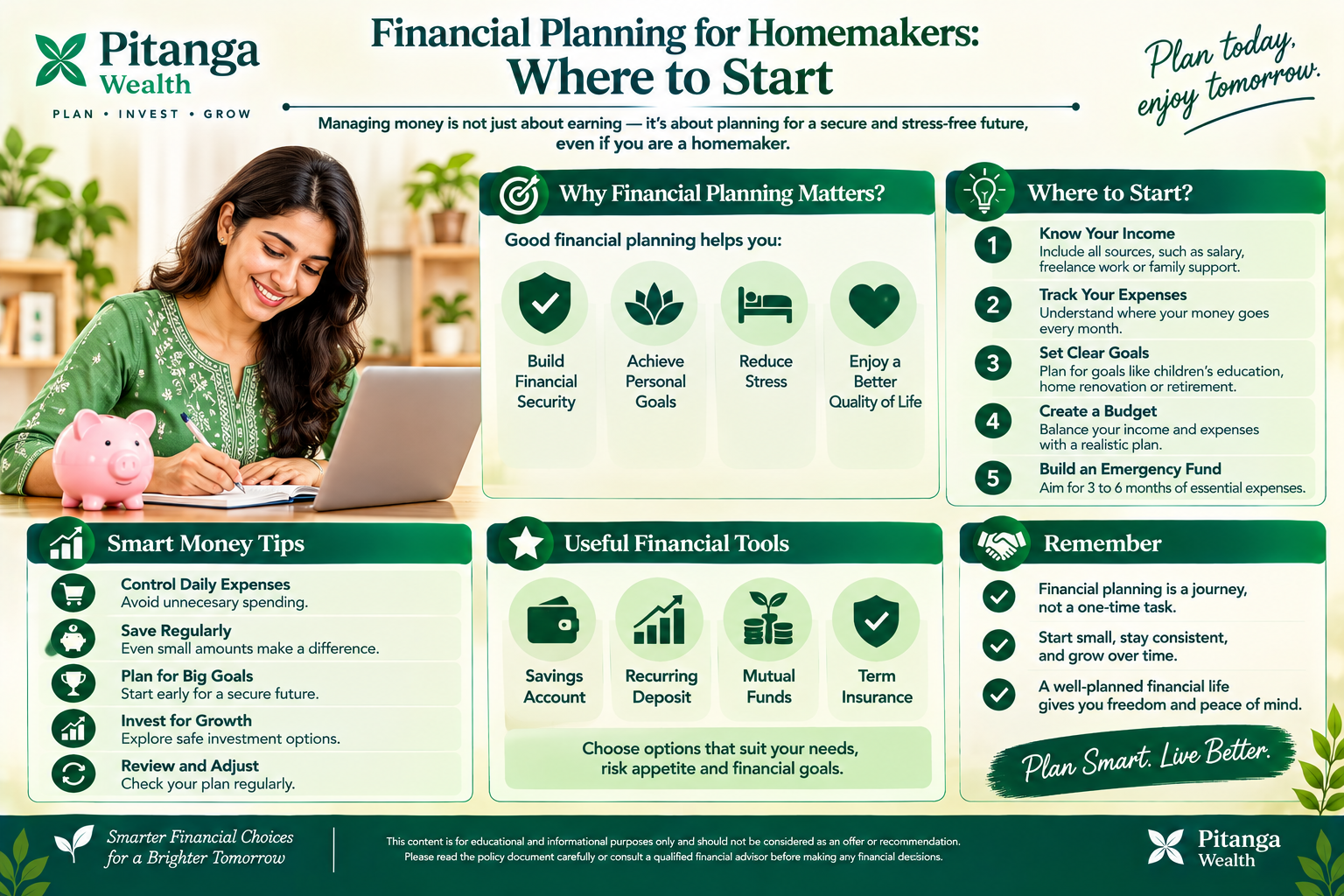
Managing a home involves daily decisions about food, bills, children’s needs, healthcare, and family priorities. Yet the person coordinating these decisions may not always have a salary in their own name, a separate bank account, or a clear picture of household assets. That gap can become important when circumstances change.
Financial planning for homemakers is not simply about deciding where to invest money. It begins with understanding household cash flow, having reliable access to essential funds, knowing which protections are in place, and identifying long-term needs that belong to the homemaker as an individual. These foundations matter whether a household has one income, two incomes, irregular business earnings, or support from other family members.
A homemaker’s unpaid work has real economic value: it makes other work and everyday family life possible. Financial decisions should therefore be discussed with respect and shared access to relevant information, rather than assuming that only a person who receives a salary needs a financial plan. This guide explains where to begin in India, what to review before investing, and how to make a practical plan without relying on unrealistic returns or one-size-fits-all rules.
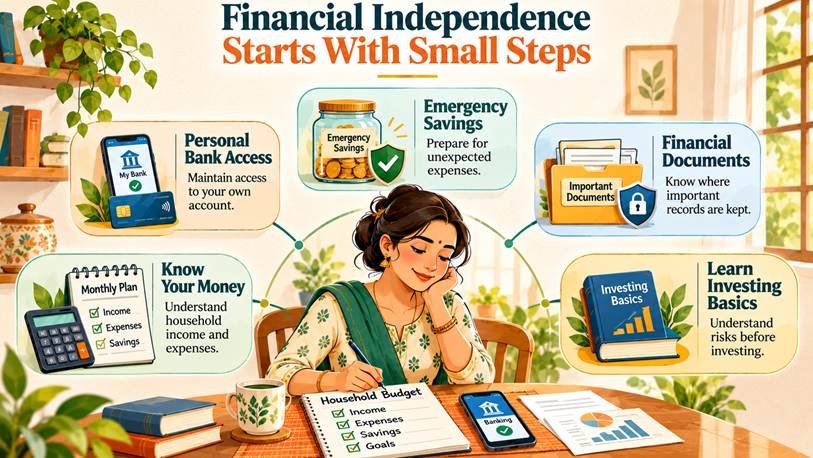
Why Financial Planning for Homemakers Matters
There is a difference between managing everyday spending and having financial security. Someone may expertly run a household while knowing very little about the bank accounts, debts, insurance cover, or retirement resources available to the family.
Household contribution and personal financial needs
Budgeting, caregiving, household administration, and financial coordination are valuable forms of work even when they do not produce a payslip. A household plan should recognise these responsibilities alongside the earning member’s income. Personal needs may include accessible savings, healthcare, skills development, retirement provision, and a clear understanding of legal ownership.
Independence does not require separate family goals
A couple may work toward shared goals while each person maintains financial awareness and appropriate access. Discussing emergency arrangements, account operating instructions, and who can retrieve important documents is part of good planning. It need not mean keeping secrets or duplicating every account.
Planning for changes in circumstances
Illness, disability, separation, bereavement, a career break, or an unexpected need to care for a relative can change the household’s income and expenses. Financial planning for homemakers helps identify which resources would be available in those circumstances and where a practical gap remains.
Step 1: Map the Household’s Money Before Choosing Products
The starting point is a simple written map of what comes in, what must go out, and what the family already owns or owes. Do not begin by selecting an investment product or guessing a monthly SIP amount.
Record every source of household income
Include take-home salary, self-employment receipts, recurring pension income, rent received, or other dependable inflows. Keep irregular bonuses and gifts separate because they may not repeat each month. If income varies significantly, consider a conservative monthly figure rather than treating the best month as normal.
Separate essential, flexible, and irregular expenses
Essential expenses might include rent, groceries, utilities, medicines, minimum loan repayments, transport required for work, school expenses, and insurance premiums. Flexible expenses might include eating out, subscriptions, and leisure purchases. Irregular expenses include annual school payments, appliance replacement, festivals, and periodic repairs.
For beginners, the process becomes easier when every expense has a category and predictable annual bills are divided into monthly amounts. This prevents a single expensive month from looking like a financial failure.
Illustrative household budget
Suppose a household has a take-home income of ₹80,000 per month. The example below is hypothetical and is not a recommended budget for every family.
| Monthly item | Illustrative amount |
| Housing | ₹18,000 |
| Groceries and household supplies | ₹12,000 |
| Utilities and connectivity | ₹4,000 |
| Education-related essentials | ₹7,000 |
| Necessary transport | ₹5,000 |
| Routine healthcare | ₹3,000 |
| Insurance premiums | ₹4,000 |
| Minimum loan repayments | ₹10,000 |
| Other essential and irregular-expense provision | ₹5,000 |
| Total planned outgoings | ₹68,000 |
| Amount available for other priorities | ₹12,000 |
The remaining ₹12,000 might be divided among emergency savings, a personal reserve, upcoming planned purchases, and long-term goals. If the household is already in debt distress or has no basic protection, those priorities could require a different order.
Step 2: Know Your Accounts, Access, and Financial Documents
Knowing that money exists is not the same as being able to access it. Set aside time to record the bank names, account types, investment statements, loan providers, insurance policies, and key contact details relevant to the household.
Can a homemaker open a bank account without a salary?
A regular salary is not generally a prerequisite for an individual to open a savings account, subject to the bank’s eligibility rules and applicable Know Your Customer (KYC) requirements. The Reserve Bank of India also describes Basic Savings Bank Deposit Accounts with no minimum-balance requirement, subject to applicable conditions. Check the bank’s latest features, service limits, and documentation before applying.
A separate account can be useful for managing personal savings and expenses, even when the money comes from household contributions or gifts. It should have operating arrangements the account holder understands. Do not confuse a joint account’s operating permissions with the legal ownership of every asset in the family.
Build a one-page household financial inventory
Record institution name, broad product type, policy or account reference, account holder or owner, nominee where relevant, maturity or renewal dates, monthly obligations, and where the original papers are stored. Keep sensitive credentials out of an ordinary shared spreadsheet. Use a secure password manager or another appropriately protected method for access arrangements.
Practical household planning includes knowing which payments are due, whom to contact if an account is blocked, and how to obtain records without depending entirely on one family member’s memory.
Protect banking and digital access
Do not share OTPs, UPI PINs, card PINs, or passwords with callers, even if they claim to represent a bank. A PIN is not needed to receive a UPI payment. Verify unusual payment requests independently, activate transaction alerts, and report suspected fraud promptly through the bank’s official channels.
Step 3: Build an Accessible Emergency Reserve
An emergency fund is money intended for unexpected essential needs or income disruption, not a general-purpose investment pool. Its size depends on the family’s spending requirements, stability of income, dependants, and existing financial obligations.
Calculate an initial target
A commonly used starting guideline is around three to six months of essential household expenses. Families relying on one income or facing highly variable income may consider a larger cushion. This is an educational framework rather than a mandatory target.
Emergency fund target = monthly essential expenses × months of coverage.
For a household with ₹60,000 of monthly essential expenses, three months equals ₹1,80,000 and six months equals ₹3,60,000. A family can work toward the target gradually, beginning with a smaller first milestone.
An essential part of financial planning for homemakers is agreeing which emergency expenses the reserve covers, who can access the money, and what will happen if the primary earner is temporarily unavailable. A household emergency fund and a modest personal-access reserve may serve overlapping but not identical purposes.
Where should emergency savings be kept?
Prioritise accessibility and capital preservation. A suitable bank savings account is commonly used for immediately needed money; a callable bank fixed deposit may suit a second layer after reviewing premature-withdrawal terms. Market-linked products can fluctuate, and redemption processes may cause delays, so they should not automatically replace cash required at short notice.
Eligible deposits in insured Indian banks are covered by DICGC up to ₹5 lakh per depositor per bank, including principal and interest, when held in the same right and capacity; applicable terms and exclusions matter. Mutual fund units are not DICGC-insured.
Step 4: Review Insurance Before Investing Aggressively
Savings can absorb smaller unexpected costs, but certain medical or financial disruptions can be much larger. Insurance may provide protection for specifically covered events; coverage, exclusions, deductibles, waiting periods, and claims processes must be reviewed rather than assumed.
Health cover for a homemaker
Check whether the homemaker is included in an individual or family-floater health policy, and read the actual schedule and wording. Important questions include sum insured, nearby hospital network, co-payment conditions, room-related limitations where applicable, waiting periods, exclusions, and the effect of renewal or changing insurers.
For many families, financial planning for homemakers also means ensuring that the person who usually handles appointments and claims knows where the policy documents, health cards, helpline numbers, and insurer’s claim instructions are located.
Life cover and the value of unpaid work
A family’s dependence on a wage earner can create a need to assess appropriate life insurance for that earner. Separately, the loss of a homemaker’s caregiving and household work may create substantial replacement expenses, such as childcare, eldercare, or paid domestic support. Whether and how such risks can be insured depends on eligibility, underwriting, and policy terms.
Do not buy an insurance policy solely because of a tax deduction or because a seller describes it as an investment. First identify the financial risk, then review coverage suitability and costs.
Keep insurance and emergency savings distinct
Health insurance may not pay every bill, and claims may take time; emergency money can help bridge those gaps. Conversely, relying on emergency savings alone for a potentially large insured risk may leave the household exposed.
Step 5: Create Personal and Shared Long-Term Goals
The next step is to write goals in plain language. Examples include funds for education, replacing essential equipment, caring for an elderly parent, retirement, or resuming paid work after a career break.
Put dates beside goals
A goal needed within one or two years usually calls for a different risk and liquidity approach from one expected in ten or twenty years. The date is as important as the amount. For a planned expense, allow for possible price increases instead of assuming today’s cost will remain unchanged.
Include the homemaker’s retirement needs
Retirement planning should not assume that one spouse’s employment-based benefits automatically provide unlimited financial security for both. Review the household’s pension sources, retirement investments, medical costs, survivor benefits, and ownership arrangements. Long-term financial planning for homemakers should account for longevity and the possibility that spouses may not live for the same number of years.
Consider education and career re-entry as goals
Courses, digital skills, professional certifications, or basic business tools may be valuable future options for someone who wants to return to paid work. The decision to pursue paid employment is personal; financial planning should support choice rather than imply that a homemaker must earn money to deserve independence.
Step 6: Understand Investing Before Starting a SIP
A systematic investment plan (SIP) is a way to invest periodically in a mutual fund scheme; it does not by itself make a scheme safe or guarantee returns. The appropriate investment depends on the goal, time horizon, risks, costs, and the investor’s own understanding.
Start with financial knowledge, not an advertised return
Learn the differences between bank deposits, mutual funds, shares, pension products, and insurance. Ask whether capital can fall in value, whether the money can be withdrawn when needed, whether there are charges or lock-ins, and how the product is taxed under currently applicable rules.
In financial planning for homemakers, investment decisions should be made by the actual investor with informed consent. Ownership and account access matter as much as choosing a scheme. A family member can explain options, but should not make an unexplained investment in someone else’s name.
Diversify without assuming that diversification eliminates losses
Holding everything in a single company or narrowly focused product can create concentration risk. Diversification can help manage certain risks, but it cannot ensure profits or prevent losses across all market conditions. An investment mix should reflect the person’s goals, horizon, and capacity for loss.
Compare costs and scheme documents
Mutual fund investors should review scheme documents, riskometer, relevant expense information, liquidity terms, and applicable exit loads. Be cautious of social media tips, promises of fixed high returns, and pressure to make quick decisions. Official SEBI and AMFI investor-education resources are preferable to unsolicited messages.
Step 7: Understand Ownership, Gifts, and Taxes
A homemaker may receive money from a spouse or relatives, hold savings independently, or invest from personal income or inherited assets. It is important to distinguish who owns the asset, where the money originated, and whose taxable income arises from it.
Money given by a spouse is not automatically tax-free investment income
Transfers between spouses can have different tax consequences from income generated by assets funded through those transfers. Under applicable Indian income-tax clubbing provisions, income arising from assets transferred to a spouse without adequate consideration may, in specified circumstances, be included in the transferor’s taxable income. Exceptions and the tax treatment of subsequent income can be fact-specific.
Tax-aware financial planning for homemakers therefore requires more than asking whether a gift was received. Keep records of the source of funds, consult a qualified tax professional for material transactions, and avoid assuming that an investment in a homemaker’s name will always be taxed only in that person’s hands.
Document who owns what
Check property deeds, deposit account holders, mutual fund folios, demat accounts, pension statements, and loan documents. A nominee, joint holder, contributor, and legal owner can have different roles and rights depending on the asset and applicable law. Do not infer ownership from who pays a bill or who happens to possess a document.
Step 8: Update Nominations and Plan for Unexpected Events
Nomination can simplify claims or transmission procedures in many financial products, but its legal effect depends on the type of asset and the law governing it. Nomination should not be treated as a universal substitute for a valid Will or broader estate planning.
Make a basic records and nominations review
Check nominations in eligible bank deposits, insurance policies, demat accounts, and mutual fund folios. Ensure names and contact information are accurate, and understand the product’s rules for updates. Keep a list of important documents and where to locate them without distributing sensitive login details.
Sound financial planning for homemakers also means understanding what would happen after illness, incapacity, or death. For important assets or complex family circumstances, obtain appropriate legal guidance on Wills, succession, and any power-of-attorney arrangements.
Have a calm family conversation
A useful conversation asks: Who can pay essential bills if the usual account operator is unavailable? Where are insurance details stored? Who should be contacted? Are there undisclosed loans or financial commitments? What documents would family members need to locate? These discussions can prevent administrative confusion at a difficult time.
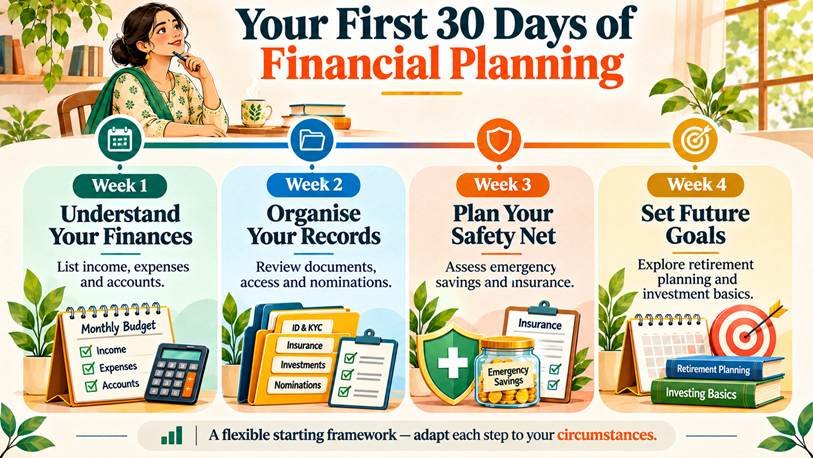
A 30-Day Starting Plan for Homemakers
A manageable first month can turn broad intentions into action. This is not a fixed programme; move at a pace that fits family responsibilities and access to information.
Week 1: Understand the numbers
Collect recent household bills and bank statements. List predictable income, essential monthly costs, irregular expenses, and outstanding loans. Identify which accounts and policies already exist.
Week 2: Check access and protection
Review account access, KYC status where relevant, transaction alerts, family health coverage, emergency contacts, and the location of essential documents. Resolve obvious gaps before selecting new financial products.
Week 3: Select two realistic goals
Choose an initial emergency saving milestone and one longer-term personal or shared goal. Write down the target, expected date, and affordable monthly contribution. Avoid borrowing or promising contributions that strain essential expenses.
Week 4: Put one routine in place
Consider an appropriate regular transfer or a calendar reminder to review progress. A 30-day approach to financial planning for homemakers works best when the routine is simple enough to continue, rather than demanding a complete financial overhaul immediately.
Example: How a Homemaker Can Begin With Limited Monthly Savings
Consider a fictional household in which the homemaker and earning partner agree that ₹4,000 a month is available for a new savings routine after covering essential commitments. The household is still building its emergency reserve, and no product selection has been made.
| Illustrative priority | Monthly amount |
| Family emergency reserve | ₹2,500 |
| Personal-access savings | ₹1,000 |
| Planned annual-expense fund | ₹500 |
| Total | ₹4,000 |
After twelve months, contributions alone would total ₹48,000 if made consistently, excluding any interest, taxes, or withdrawals. This is not a return projection. The split could be unsuitable for a different household, especially one carrying high-interest debt, lacking health coverage, or managing unstable income.
A plan need not begin with a large portfolio. First build clarity, access, and a habit of reviewing decisions together.
Common Mistakes Homemakers Should Avoid
Leaving every financial decision to one person
Delegating day-to-day execution is different from having no visibility. At a minimum, relevant household members should know the general financial position and how to find essential information.
Treating all leftover money as investable money
Money needed for annual bills, school payments, medical expenses, or near-term goals should not automatically be exposed to market risk.
Buying products based only on tax benefits
Tax treatment can change and may depend on the investor’s circumstances. Assess purpose, cost, liquidity, and risk before considering a possible tax advantage.
Assuming a nominee automatically becomes the ultimate owner
Nomination rules differ by asset and applicable law. Check the relevant product and obtain legal advice for succession questions.
Ignoring digital security and documentation
A secure records system and independent verification of payment requests can be just as important as selecting a savings product.
Waiting until income is earned personally
An earned salary is not a prerequisite for learning about money, participating in household decisions, or planning for essential personal needs.
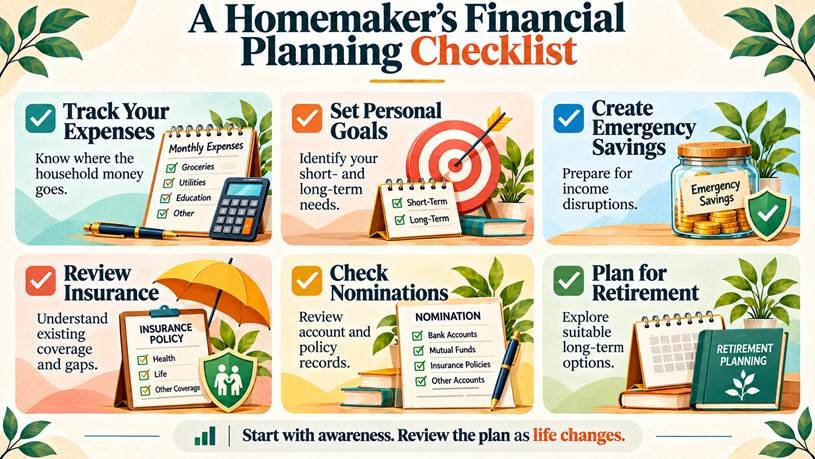
Homemaker Financial Planning Checklist
- List household income, essential expenses, and irregular bills.
- Know which financial accounts, loans, and policies exist.
- Understand personal access to a bank account and emergency money.
- Check available health cover and insurance claim information.
- Identify urgent debts and establish an emergency saving target.
- Record at least one individual and one household financial goal.
- Learn about risk, charges, liquidity, and investment documents before investing.
- Review ownership records, nominations, and estate-planning needs.
- Check possible tax implications of gifts and income from transferred assets.
- Set a realistic routine for saving and reviewing the plan.
Frequently Asked Questions About Financial Planning for Homemakers
1. Can a homemaker begin financial planning without a salary?
Yes. Household budgeting, access to banking, emergency preparedness, understanding insurance, and setting long-term goals do not require salary income. A person may also have funds from savings, gifts, inheritance, or other lawful sources, with relevant ownership and tax considerations.
2. What should be the first financial goal for a homemaker?
Start by understanding the household’s finances and making sure necessary money and information can be accessed. After that, an initial emergency reserve may be an appropriate early milestone, depending on existing debt and protection gaps.
3. Is financial planning for homemakers different from planning for salaried investors?
The basic principles—budgeting, risk management, adequate liquidity, and goal setting—are similar. The distinctive issues can include limited personal income, reliance on another person’s banking access, gaps in retirement provision, and the tax consequences of transferred assets.
4. Can a homemaker open a savings account in India?
Generally, yes, subject to the bank’s current account eligibility and KYC requirements. Some basic savings accounts have no minimum-balance requirement, though operating limits and other conditions may apply.
5. How much emergency fund should a single-income household keep?
Three to six months of essential expenses is a common starting point, but households with unstable income, dependants, large fixed commitments, or difficult-to-replace earnings may consider a larger reserve.
6. Can a homemaker invest in mutual funds?
A homemaker may be eligible to invest subject to applicable KYC, financial-product rules, and documentation. Investment suitability depends on goals, risk tolerance, time horizon, liquidity needs, and source-of-funds and tax considerations. Returns are not guaranteed.
7. Can a spouse transfer money for the homemaker’s investments?
Transfers may be legally possible, but the tax treatment of investment income arising from assets transferred without adequate consideration can be affected by clubbing provisions. A tax professional can help assess the specific transaction.
8. Is an SIP the same as a savings account?
No. An SIP is a method of investing regularly in a mutual fund; the underlying fund can fluctuate in value. A bank savings account has different characteristics, risks, access arrangements, and eligible deposit-insurance treatment.
9. Should a homemaker have personal savings as well as a family emergency fund?
That can be useful where feasible. The key is a transparent arrangement that meets household obligations while giving the individual appropriate access for personal needs. The suitable amount depends on financial circumstances.
10. Does a homemaker need health insurance if a spouse has a policy?
Check the actual policy schedule and wording. Being related to the policyholder does not by itself confirm that someone is covered; confirm names, sums insured, exclusions, waiting periods, renewal conditions, and claim procedures.
11. Does adding a nominee settle all inheritance questions?
Not necessarily. The role of a nominee varies across products and legal circumstances. Nominations and estate-planning documents should be considered together, with legal guidance where necessary.
12. What if the family cannot save every month?
Start with better visibility of cash flow, reduce avoidable costs if possible, address urgent debt, and choose smaller milestones. A realistic plan that can adapt to irregular income is more useful than an inflexible savings target.
13. How frequently should the household review the plan?
A brief monthly cash-flow review and a more thorough review after major events—such as changes in income, the birth of a child, illness, or a large loan—can help keep the plan relevant. There is no compulsory review frequency for every household.
14. Can homemakers plan for retirement even without an EPF account?
Yes. Retirement planning can include understanding household pensions, personal savings, other eligible long-term products, medical needs, and the implications of ownership and succession. Specific products have their own eligibility, restrictions, and tax rules.
Final Thoughts
Good financial planning for homemakers begins with information and access, not with a complicated investment portfolio. Understand the household’s income and commitments, protect money needed for emergencies, review insurance and ownership, and identify goals that reflect the homemaker’s needs as well as the family’s.
Small actions can be meaningful: organising account information, opening an appropriate personal account, checking a policy’s coverage, setting aside a modest amount, or agreeing on a quarterly financial conversation. The best starting point is the next practical step that improves clarity and resilience without promising returns or adding unnecessary risk.
Important Disclaimer
This article is for general financial education and awareness only. It is not personalised investment, financial, banking, insurance, tax, or legal advice. All numerical examples and timelines are illustrative. Product features, eligibility, deposit insurance conditions, taxation, nomination effects, and regulatory requirements may change. Evaluate individual circumstances and seek appropriately qualified advice where needed. Mutual fund investments are subject to market risks; read all scheme-related documents carefully before investing.
Pitanga Wealth is an AMFI-registered mutual fund distributor (ARN-134606). Distribution and investor education should not be confused with a guarantee of returns or personalised investment advice.
Written by the Pitanga Wealth Team.
Follow us on Instagram @pitangawealth for more educational insights.
This article is for educational and informational purposes only. It is not investment, tax, legal or insurance advice. Consider your circumstances and relevant documents before making a financial decision.