


A mutual fund redemption appears delayed. A broker’s contract note contains a charge you do not recognise. Demat holdings do not match the records you expected. Or a company has not provided a satisfactory response about an eligible securities-related entitlement. Each problem can be frustrating, but filing on the first government-looking website found in a search is not necessarily the solution. The practical challenge with investment complaints in India is identifying which institution owes a response, gathering independent transaction records, and using the correct escalation system before important review windows expire.
India does not have one universal grievance portal for every financial product. Securities-market complaints may involve the service provider, the stock exchange or depository, SEBI’s SCORES 2.0 and, for eligible disputes, SMART ODR. Bank, insurance and pension complaints follow different regulatory systems. Suspected cyber-enabled investment fraud may require urgent reporting to a bank and law enforcement rather than waiting for a routine service complaint. This guide explains the routes, timelines and evidence that can help investors act methodically. It is general education, not a guarantee of redress or compensation.
Quick Answer: How Do You Resolve an Investment Complaint?
First identify the institution responsible for the transaction: stockbroker, depository participant, asset management company, registrar, listed company or another financial provider. Submit a specific written complaint to that entity’s official grievance contact and preserve the acknowledgement. For eligible unresolved securities-market investment complaints in India, use the current SEBI SCORES 2.0 portal at https://scores.sebi.gov.in/; the investor must watch the Action Taken Report and any review deadlines. SMART ODR at https://smartodr.in/ provides an eligible dispute-resolution route involving conciliation and possibly arbitration. Banking, insurance, pensions and suspected cyber-fraud may need different authorities. [1][2][3]
First Identify the Type of Problem, Not Just the Product Name
A genuine service grievance is different from an investment loss
A share declining in market value or a mutual fund posting a negative return is not, by itself, evidence that a broker or fund house failed in its duties. A valid grievance may instead concern an unexplained charge, inaccurate transaction record, unprocessed instruction, delayed proceeds beyond applicable processes, unauthorised activity, incorrect account information, or failure to respond to a properly submitted request. The exact obligation depends on the provider, product, facts and applicable rules.
An alleged contractual breach between two private parties, an unregistered scheme, or a fake trading application may be outside SCORES eligibility. Likewise, a bank may be the right entity to investigate a payment transaction while a stockbroker is responsible for a separate order-execution issue. When grievances involve multiple parties, record separate questions for each rather than assuming every institution has the same responsibility. [1]
A simple responsibility test
Ask four questions before filing: Who issued the account or folio? Who actually received or executed the instruction? Which institution was contractually or regulatorily responsible for the disputed action? What objective result do you want, such as a corrected statement, an explanation with evidence, an eligible reversal, a completed transfer or a formal decision? This approach makes the complaint factual instead of speculative.
Do not use a company’s advertising name as a substitute for its legal identity. For broker-related matters, identify the trading member and relevant exchange. For demat matters, identify the depository participant (DP) and whether the record sits with NSDL or CDSL. For mutual fund transactions, note the asset management company (AMC), scheme and registrar and transfer agent (RTA), if applicable.
Which Investor Grievance System Applies? The Practical Routing Table
| Problem type | Start with | Possible next route | Key boundary |
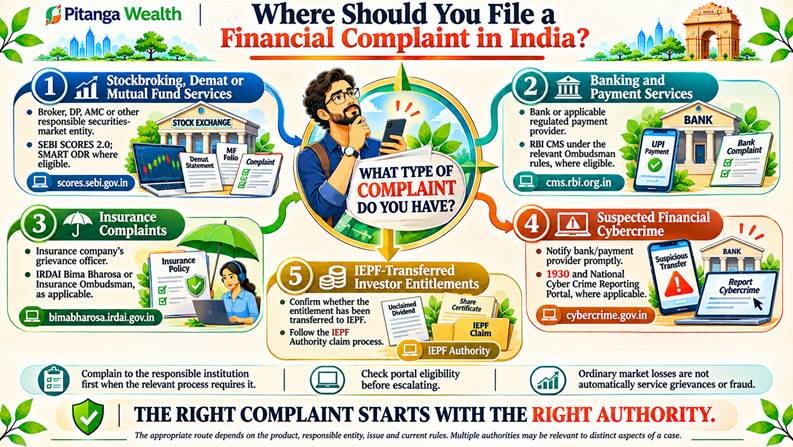
| Stockbroker trade, charge or account dispute | Broker’s official grievance/compliance channel | Exchange processes, eligible SCORES, SMART ODR | Verify the actual broker and trade records |
| Demat holding, DP service or securities transfer | Registered depository participant | Relevant depository, eligible SCORES or SMART ODR | Trading broker and DP may be different entities |
| Mutual fund folio, redemption or service issue | AMC or official investor service centre/RTA | Eligible SCORES or SMART ODR | A distributor may not control AMC records or payments |
| Eligible listed-company securities grievance | Listed company or its RTA | Applicable exchange or SCORES routes | IEPF-transferred entitlements follow a separate process |
| Bank account, card, UPI or remittance service | Bank/payment provider | RBI CMS for eligible covered service grievances | SCORES is not RBI’s complaint system |
| Insurance claim or policy service | Insurance company grievance officer | IRDAI Bima Bharosa; Insurance Ombudsman if eligible | Insurance has its own regulator |
| Suspected fake app or cyber financial fraud | Bank immediately, law enforcement reporting | 1930, cybercrime.gov.in, appropriate authorities | SCORES does not handle all unregistered scams |
The table is a navigation aid, not a finding that every example is eligible in every portal. Always check the current rules and the actual party responsible. Treating all investment complaints in India as SEBI matters is a frequent and avoidable mistake. [1][2][4][5][6]
Step One: How to File Investment Complaints in India With the Entity
Find the real grievance contact
Use the provider’s independently verified website, account document, statement, exchange listing or regulator-linked investor page. For a stockbroker, look for the designated grievance or compliance officer. For a mutual fund, the SID and AMC website provide investor-service contacts; an RTA may process correspondence on the AMC’s behalf. For a DP, confirm the DP’s registered identity and the relevant depository. Do not rely on a phone number delivered by an unknown messaging-group administrator. [6]
Start by sending the complaint through the authorised channel offered by the institution. Use a subject that states the issue, product or account reference and date. Ask for an acknowledgement or ticket number. If you speak to customer support by telephone, follow up in writing so the issue, dates and requested relief can later be verified.
Describe facts, evidence and relief separately
A useful complaint answers: What service was expected? What happened instead? On which date? What record supports your account? What response, if any, has already arrived? What specific correction or explanation are you requesting? Avoid accusations of fraud when the evidence shows only a possible processing error, and avoid presenting an estimated financial loss as a settled legal amount.
The first written complaint should be short enough for the grievance team to understand, with supporting documents attached or referenced. Include only necessary identifiers; never circulate passwords, full card numbers, OTPs or more identity information than a verified official process requires. A well-structured complaint increases the chance that the issue reaches the team able to investigate them.
Sample structure: a complaint that can be investigated
| Field | Illustrative entry |
| Subject | Request to investigate delayed mutual fund redemption confirmation |
| Account reference | Masked folio XXXX4721, scheme and AMC identified |
| Transaction date | 5 November 2026 |
| Disputed event | Submitted an instruction; status remains unclear after the stated processing window |
| Evidence | Official acknowledgement, request reference and statement |
| Remedy requested | Confirm acceptance and transaction status; explain delay and applicable rules |
| Follow-up | Reply through registered email and issue a complaint reference |
This is a fictional example. The permitted processing period can vary by scheme, timing, transaction channel and exceptional circumstances; do not label a transaction ‘late’ merely because it has not appeared immediately.
Seven-Step Roadmap: From Complaint to Possible Resolution
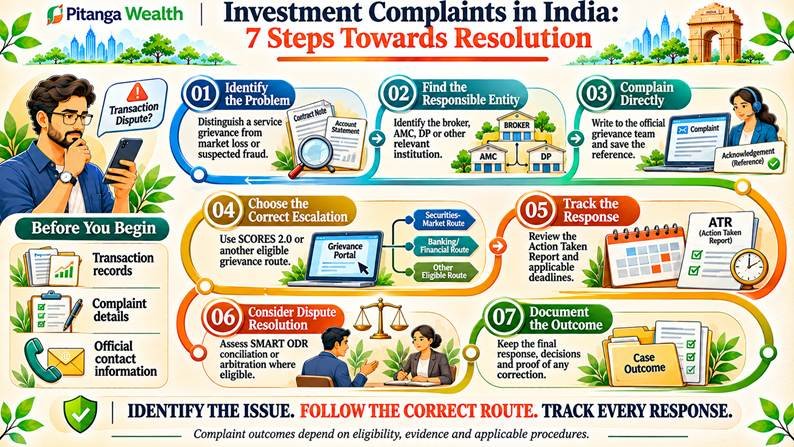
1. Classify the problem. Decide whether it concerns securities service, banking, insurance, pensions, possible cybercrime or ordinary investment risk.
2. Identify the accountable entity. Find the legal name on the account, contract note, AMC folio, DP statement or bank transaction.
3. Complain directly. Send a concise written account and supporting records to the genuine provider’s designated grievance channel; retain its reference.
4. Select an eligible escalation route. For unresolved covered securities-market grievances, use SCORES 2.0; other products and suspected crimes have distinct portals.
5. Read the response and deadlines. An Action Taken Report may call for further clarification or a timely first-level review rather than passive acceptance.
6. Consider the dispute-resolution route. Where eligible, evaluate SMART ODR’s conciliation and arbitration process, including procedural consequences and costs.
7. Record the final outcome. Keep decisions, correspondence and proof of any actual correction or payment. Seek qualified individual advice if unresolved legal rights are at stake.
This roadmap is practical editorial guidance, not a substitute for the eligibility rules of any institution. A bank, insurer or cybercrime authority will not use the identical SCORES process, and choosing SMART ODR can change the status of a pending SCORES complaint.
Step Two: Understand SEBI SCORES 2.0
What is SCORES and where is the current portal?
SCORES is SEBI’s online system for facilitating the redressal of eligible securities-market grievances against listed companies, SEBI-registered intermediaries and market infrastructure institutions. It allows the investor to lodge a complaint, monitor the entity’s Action Taken Report (ATR) and request specified reviews. It is a facilitation and monitoring mechanism, not a court issuing automatic compensation orders. The current website is https://scores.sebi.gov.in/. [1][2]
The older scores.gov.in site was closed to new complaints effective 28 March 2024. Some older search results and legacy SEBI educational pages still display the retired URL or a 30-day timeline. Follow the live SCORES 2.0 instructions and the current FAQs rather than copying obsolete steps. For investment complaints in India, this version distinction is important because missed filing or review deadlines can affect the process. [2]
What do you need to register?
SCORES registration uses identity and contact details specified by the platform, such as name, address, PAN, date of birth, email and mobile number, with registration information potentially drawn from a KYC Registration Agency. The complainant then selects an appropriate entity, category and complaint nature, provides a focused narrative, and uploads available supporting material. A reference number permits later status checks. Requirements and file limits should be read directly in the live portal rather than assumed from an older screenshot. [1]
Before registering, identify whether the party is in scope. If you paid an impersonator using a genuine broker’s stolen name, the real broker may not be the party that received the money. It may help confirm impersonation, but that does not automatically convert the incident into an eligible broker-service complaint.
Step Three: Know the SCORES 2.0 Timelines and Reviews
The initial Action Taken Report: 21 calendar days
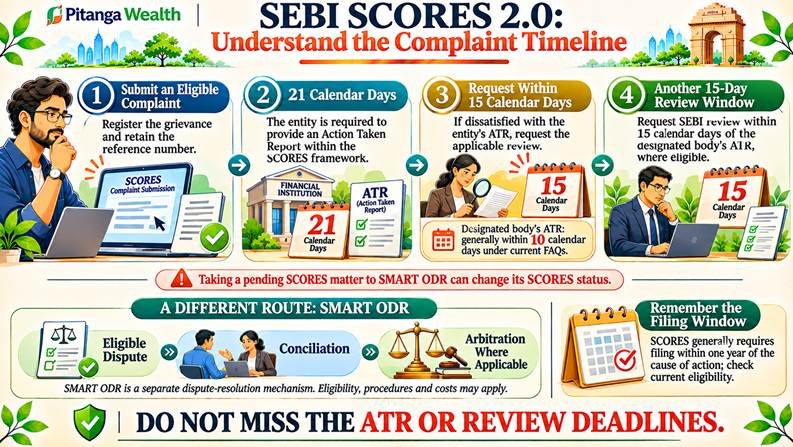
Under the SCORES 2.0 framework described in the current official FAQs, complaints are sent to the relevant entity, which is required to resolve the complaint and upload an ATR within 21 calendar days of receipt on SCORES. A designated body monitors this part of the process. Where the entity fails to submit the ATR in time, the complaint is automatically escalated to first-level review. ’21 days’ describes a response-and-redress framework; it is not a guarantee that every complex dispute will reach the investor’s preferred outcome in that period. [1]
First-level review: request within 15 calendar days
If the entity’s ATR does not address the concern, an investor can request first-level review within 15 calendar days from the ATR. The designated body takes up the matter and, under the current FAQs, has a 10-calendar-day window to submit its ATR in the specified review stage. An investor who does not request review within the permitted period may find the complaint disposed of within SCORES. Do not overlook a portal notification simply because the status initially looks ‘resolved’. [1]
Second-level review: another 15-day opportunity
If the first review still leaves an eligible concern unresolved, the investor may request second-level review by SEBI within 15 calendar days of the designated body’s ATR. The system also describes escalation when the designated body fails to act within its prescribed period. The SEBI review may seek further information or reach a disposition consistent with the system’s remit; it does not decide every contested civil right or guarantee restitution. [1]
The one-year filing window matters
The current SCORES FAQs say a complaint should be lodged within one year of the occurrence of the cause of action; a complaint beyond that limit may be rejected. The relevant ’cause of action’ date is not always the date the investor first noticed a problem. Record the original event, when the contractual or regulatory duty became due, and subsequent correspondence. Seek qualified advice for complex limitation questions instead of assuming continuing emails reset every deadline. [1]
For many investment complaints in India, the practical danger is not a complicated legal argument; it is losing the acknowledgement number, ignoring the first ATR or missing the 15-day review window. Maintain a calendar with the dates displayed by the portal.
Step Four: Learn What SMART ODR Does Differently
SCORES facilitates grievances; SMART ODR addresses eligible disputes
The Securities Market Approach for Resolution Through Online Dispute Resolution, known as SMART ODR, is an online dispute-resolution framework supported by securities-market infrastructure institutions. Its current portal is https://smartodr.in/. Investors first approach the relevant market participant. If the issue is not resolved, an eligible dispute may be routed for review, pre-conciliation, conciliation and, when necessary and permissible, arbitration. [3][4]
Unlike a routine grievance-status page, conciliation involves attempts to achieve a mutually acceptable solution; arbitration is a more formal process in which a decision may have binding legal consequences. SEBI’s investor resource lists regulated participants such as stockbrokers, DPs, AMCs, investment advisers, research analysts and other specified entities within the ODR ecosystem. The eligibility, documents, cost and timelines depend on current framework provisions and the dispute. [3]
What happens after you enter SMART ODR?
A typical user creates an account, identifies the market participant and dispute category, describes the matter and uploads relevant documents. The applicable market infrastructure institution reviews the dispute, and unresolved matters may move to a pre-conciliation or conciliation phase. If conciliation does not succeed, arbitration may be available subject to the rules. SEBI’s investor page identifies pre-conciliation as free; arbitration costs depend on the claim and applicable fee schedule. Do not tell investors that the entire ODR process is automatically free. [3][4]
SCORES and ODR are not simultaneous duplicate proceedings
NSE’s investor guidance explains that when a matter is taken to SMART ODR while it remains pending on SCORES, the SCORES complaint is treated as disposed of through that route. An investor should not present identical matters as independent parallel claims without disclosing the overlap. Save all prior communication, existing complaint IDs, ATRs and outcomes for submission in the appropriate process. [4]
In handling investment complaints in India, the choice between another SCORES review and ODR can affect procedure and costs. Consider the remedy sought, stage of the grievance, evidence and applicable rules. A lawyer or qualified adviser may be appropriate for high-value or legally complex disputes.
Complaints Against Stockbrokers and Trading Platforms
Separate execution disputes from market movements
For a disputed trade, gather the order number, time, instrument, segment, transaction statements, broker contract note, charges and any exchange-generated alerts. The market price moved against you is not ordinarily sufficient evidence of broker error; the grievance should identify the alleged service failure, such as an unauthorised transaction, incorrect charge or failure to follow a documented instruction. Reconcile device screenshots against records generated by the actual broker and exchange. [7]
The investor may begin with the trading member’s grievance team and examine the exchange’s investor-protection resources. The exchange may act as a designated body or relevant market infrastructure institution for an eligible matter, depending on the case. SCORES 2.0 and SMART ODR can be relevant next routes, but their functions are not interchangeable.
Watch for a false broker identity
Before entering account details into a portal or sending documents, confirm the broker and its registration using the official exchange and SEBI resources. A fake app with a copied broker logo is not automatically a dispute against that genuine firm. If a payment went to a fraudster’s account, promptly notify the bank and report suspected cyber financial fraud. Where the genuine broker separately failed in a duty, assess the distinct regulated complaint on its facts.
Demat and Depository Complaints: DP, NSDL and CDSL
A trading account and a demat account can involve different regulated entities. If holdings, pledges, transfers, nominee records or depository statements are disputed, check the DP’s records and identify whether the account sits within NSDL or CDSL. Compare dates, instruction references, depository alerts and the type of transaction involved. A missing delivery share and an open derivatives position are not equivalent account conditions.
Depository participants have established complaint and escalation obligations. NSDL provides investor grievance options through its official infrastructure, and CDSL publishes depository participant complaint information. Contact the DP first, then the appropriate depository support channel; use SCORES or SMART ODR where the matter is eligible. A depositorily confirmed record may help separate a documentation error from an unauthorised transfer. [8][9]
Protect beneficiary owner IDs and documents. Do not send a complete demat statement to an unknown ‘recovery’ account on social media. If unauthorised access or identity theft is involved, secure the affected accounts immediately and consider the additional reporting channels appropriate to the suspected offence.
Mutual Fund Complaints: AMC, RTA and Distributor Responsibilities
Start with the AMC or official investor service centre
AMFI’s investor-service guidance says an investor should first approach the mutual fund or its investor service centre; the Scheme Information Document and AMC website identify relevant contacts. Common matters include an unresolved folio issue, a rejected transaction, bank-account updates, an incorrect unit record, distribution or dividend-related communication, or a redemption-status concern. An RTA may process the query, but the response should be traced to the responsible fund and its official service channels. [6]
For such investment complaints in India, record the scheme, folio number, mode of holding, AMC name, transaction reference, applicable NAV date and official service acknowledgement. Note whether you hold units directly in a folio or via demat: the operational parties and records may differ.
A distributor and AMC do not perform identical functions
A mutual fund distributor may help the investor understand process steps or raise a service query, but that does not mean the distributor executes AMC redemptions or controls the bank account receiving the proceeds. A distributor’s AMFI ARN is different from SEBI registration as an investment adviser. If an investor alleges unauthorised sales conduct, identify the actual person, registration or ARN, documents and alleged representation. If the grievance concerns the AMC’s records, do not send it only to an unrelated platform and assume the fund has received it.
Where the original mutual fund service provider has not resolved an eligible grievance, SCORES and SMART ODR may be available under their rules. Market-risk losses and dissatisfaction with a fund’s investment performance are not automatically service failures.
Listed-Company Complaints, RTAs and the IEPF Boundary
Investors may complain about corporate-action records, eligible unpaid entitlements, share transfer or transmission processing, and other securities-related services. Identify whether the responsible party is a listed company, its registrar and transfer agent, a depository participant or another institution. Preserve corporate-action communications, demat statement entries, folio information where relevant and dates of written requests.
A special boundary applies to certain unclaimed dividends and securities that have already been transferred to the Investor Education and Protection Fund. SCORES FAQs explicitly direct relevant IEPF claims to the IEPF Authority process rather than treating SCORES as a universal recovery portal. The investor may need to follow the Ministry of Corporate Affairs/IEPF procedures, not file an ordinary broker complaint. [1]
Other legally complex claims, disputed ownership and court matters may fall outside a portal’s summary process. A complaint reference is not a substitute for proper title documents or legal advice in transmission and inheritance disputes.
Banking, Insurance and Pension: Different Regulators, Different Portals
Bank and payment-service grievances: RBI CMS
For a deficiency in service by a covered RBI-regulated institution, begin with the bank or relevant entity. The Reserve Bank – Integrated Ombudsman Scheme, 2026 has applied from 1 July 2026, replacing the 2021 scheme for new covered matters. RBI’s current FAQ provides for escalation where no response arrives within 30 days or a longer applicable RBI, NPCI or card-network period, or where the response is unsatisfactory. Under the 2026 FAQ, filing before the RBI Ombudsman is generally subject to a 90-day window measured from the specified trigger; check the complete current rule and individual facts before filing. The online portal is https://cms.rbi.org.in/. [5]
An investment purchase made by bank transfer may involve separate issues: whether the bank carried out a payment instruction correctly, and whether the investment intermediary fulfilled securities-service obligations. RBI CMS does not decide whether every market purchase was prudent, just as SCORES is not a universal bank complaint portal.
Insurance and pension products are not SCORES categories
Insurance grievances ordinarily begin with the insurer’s grievance officer and can involve IRDAI’s Bima Bharosa portal at https://bimabharosa.irdai.gov.in/, with Insurance Ombudsman remedies where eligible. NPS or other pension disputes follow the applicable PFRDA and provider grievance mechanisms. Check the responsible regulator and current official process. The word ‘investment’ in a product’s marketing material does not shift every complaint into SEBI jurisdiction. [10]
Suspected Fraud and Crime: Do Not Wait for a Routine Grievance Cycle
If someone sent money to an impersonator, installed a fake trading app, lost control of banking credentials, or was induced to make suspicious payments, act promptly. Contact the bank or payment provider through official channels, preserve references and, for suspected cyber financial fraud, call 1930 and report at https://cybercrime.gov.in/. A fake operator or an illegal off-exchange scheme may fall outside ordinary exchange grievance and protection mechanisms. Reporting does not guarantee a hold, refund or criminal outcome. [11]
SCORES FAQs exclude a number of unregistered, unregulated and private-agreement matters. They also distinguish a securities regulatory tip or market intelligence from an investor’s individual grievance; suspected violations that fit market-intelligence reporting may belong on SEBI’s official MI portal. Treating all investment complaints in India as routine administrative tickets could delay action where money or devices remain at immediate risk. [1]
Do not pay an unsolicited ‘agent’ to file a complaint, expedite a case or release supposedly frozen funds. Government-looking letters and websites can be imitated. Open official portals independently, keep your complaint ID private and verify identity before sending additional sensitive documents.
What Evidence Should an Investor Preserve?
A complaint file should be factual, chronological and easy to follow. Keep the original account-opening documents or folio details, official statements, contract notes where applicable, emails, transaction confirmations, order references, complaint acknowledgements, complete replies, screenshots that show the actual problem and the precise relief requested. For a disputed payment, preserve the beneficiary details and bank or UPI reference. Avoid editing originals or exposing personal information in public posts.
| Evidence | Why it matters |
| Contract note, broker ledger or exchange alert | Helps test execution, charges and timing |
| AMC/RTA acknowledgement or folio statement | Shows the requested instruction and recorded holdings |
| DP/depository transaction statement | Helps trace securities movement or account issues |
| Written complaint and ticket number | Establishes initial submission and follow-up trail |
| Action Taken Report and review messages | Shows the entity’s response and review-window dates |
| Bank confirmation or transaction reference | Supports payment-route investigation |
| Applicable terms, scheme document or charge schedule | Identifies the obligation being disputed |
| A short chronology and remedy request | Makes the desired resolution clear to the reviewer |
When a complaint involves several transactions, prepare a private spreadsheet with one row per event, showing the date, reference, amount, source record, response and next deadline. That is often more useful than forwarding a long unstructured chain of messages. Store sensitive documents in a restricted location and share them only through verified official channels.
A Worked Example: An Unresolved Brokerage Charge
Consider a fictional investor, Aditi, who notices a ₹1,250 charge in a brokerage statement that she does not understand. The amount and all details are illustrative. She checks the broker’s disclosed charge schedule and contract notes but cannot reconcile the charge. She sends the broker’s official grievance team a short written request on 2 November 2026, quoting the statement entry and attaching the relevant records. She asks for the contractual basis and correction if the amount was wrong.
Suppose the broker answers with a generic message that does not address the entry. Aditi preserves that response and submits an eligible SCORES complaint using the official portal, after confirming the correct registered entity and relevant timeline. She records the SCORES number and checks for the entity’s ATR. If the ATR does not explain the amount, she requests first-level review within the allowed 15 calendar days rather than assuming the initial ATR has resolved everything. [1]
If she later chooses SMART ODR because the unresolved matter is an eligible dispute, she reviews the portal’s requirements, discloses the earlier SCORES case and understands that ODR changes the SCORES status. Her objective is a reasoned, documented outcome—not a promise that every disputed charge will be refunded. This example demonstrates how investment complaints in India can be pursued without treating each stage as a guaranteed victory.
Common Filing Mistakes and How to Avoid Them
Filing against the wrong legal entity
An app brand, introducing partner, distributor, trading member, depository participant and fund house can all appear in one customer journey. If the wrong entity is selected, the complaint may be delayed, transferred or found outside the chosen channel. Verify account documents and service ownership first.
Reusing old SCORES instructions
The current portal is scores.sebi.gov.in. Older guides may link to scores.gov.in or describe 30 days for the entity’s ATR. Follow the current SCORES 2.0 FAQ and observe the 21-day ATR and 15-day review provisions. Keep an independent record of your deadlines. [1][2]
Treating a polite acknowledgement as a substantive resolution
A ticket number means the complaint was logged; an ATR means the entity has reported its action. Neither proves that all allegations are accepted or that the requested relief has been provided. Read the answer against each disputed point and the supplied documents.
Asking for a guaranteed market result
Regulated grievance mechanisms can examine relevant conduct and service issues, not reverse ordinary market volatility simply because an outcome was disappointing. Quantify disputed charges or missing amounts from objective records rather than estimated peak portfolio values.
Missing the review or filing window
Many investment complaints in India become harder to pursue when investors delay or fail to read portal notices. Review SCORES within the permitted 15-day windows, and be mindful of the one-year cause-of-action guideline. Different ODR, RBI, legal and product-specific procedures have distinct deadlines. [1][5]
A Practical Checklist Before You Escalate
- Identify the legal entity and whether the matter concerns securities, banking, insurance, pensions or cybercrime.
- Collect official transactions, statements, correspondence, screenshots and a clean chronology.
- Make a precise written complaint to the provider and retain its acknowledgement.
- Specify an evidence-based remedy and avoid sharing unnecessary confidential credentials.
- For eligible SEBI matters, check the live SCORES 2.0 portal and its current filing window.
- Read the ATR carefully; calendar the 15-day first-review and second-review opportunities.
- Consider SMART ODR only after understanding scope, prior complaint status, conciliation and possible costs.
- Use RBI CMS, Bima Bharosa, PFRDA procedures or cybercrime reporting when those jurisdictions fit.
- Keep each portal’s reference numbers and disclosures accurate and consistent.
- Seek qualified professional advice for disputed ownership, legal liability, complex limitation or high-value claims.
A good complaint is neither the longest nor the angriest. It tells the correct institution what happened, identifies independent evidence and asks for an actionable response. For investment complaints in India, that discipline can reduce confusion even where the dispute remains difficult.
Frequently Asked Questions About Investor Grievance Systems
1. What is the first step in resolving an investment complaint in India?
Contact the genuine service provider through its official grievance channel, describe the issue in writing and keep the acknowledgement. Determine whether a bank, broker, DP, AMC, listed company or another entity owns the disputed service before escalating.
2. What is the correct SEBI SCORES website in 2026?
Use https://scores.sebi.gov.in/. The old scores.gov.in portal is closed to new complaint submissions. The live portal and current FAQs take precedence over outdated educational screenshots. [2]
3. What kinds of complaints can be filed on SCORES?
Eligible securities-market grievances against listed companies, registered intermediaries and market infrastructure institutions may be filed, subject to the official exclusions. Private agreements, unregistered schemes, many criminal matters and disputes belonging to another regulator may not qualify. [1]
4. Is it necessary to complain to the broker or fund house before SCORES?
SEBI’s stated procedure expects the investor to approach the concerned entity first. Keep evidence of that communication and the response before making an eligible SCORES submission. [2]
5. How many days does a company get to reply on SCORES 2.0?
The current FAQs require the entity to upload its Action Taken Report within 21 calendar days after receipt of the complaint through SCORES. The system provides escalation when a response is not submitted on time. A report is not a guaranteed refund. [1]
6. How long do I have to request SCORES review?
The investor normally has 15 calendar days to request first-level review after the entity’s ATR and 15 calendar days to request second-level review after the designated body’s ATR. Use the live portal’s notices and dates. [1]
7. Is there a deadline for filing a SCORES complaint?
The current SCORES FAQs say it should be lodged within one year from the cause of action, and a late filing may be rejected. Identifying the actual cause-of-action date can require case-specific advice. [1]
8. What is SMART ODR and is it the same as SCORES?
No. SMART ODR is the securities-market online dispute-resolution mechanism for eligible matters, involving pre-conciliation, conciliation and possibly arbitration. SCORES is the grievance facilitation and review system. The portals have different purposes and procedural consequences. [3][4]
9. Is SMART ODR completely free for investors?
Do not assume every stage is free. SEBI’s investor resource identifies pre-conciliation as free, while arbitration has a fee structure tied to the claim and current rules. Read the live terms before initiating a dispute. [3]
10. Where should I complain about a mutual fund redemption delay?
Contact the AMC or its official investor service centre, using the folio and transaction reference; the RTA may assist. If unresolved, assess SCORES or SMART ODR eligibility. Check the actual applicable redemption processing rules before alleging delay. [6]
11. Where can I report a wrong demat account entry?
Start with the registered depository participant and examine NSDL or CDSL records as applicable. Relevant depository grievance services and eligible SCORES/SMART ODR routes may be available. Preserve transaction instructions and alerts. [8][9]
12. Should I use SCORES for a bank or insurance complaint?
Generally no. Covered bank-service grievances may fall under RBI CMS after the institution’s process and eligibility requirements. Insurance complaints ordinarily start with the insurer and may use IRDAI Bima Bharosa and the Insurance Ombudsman where applicable. [5][10]
13. What if a fake trading app took my money?
Contact the bank promptly and, for suspected cyber financial fraud, use 1930 and cybercrime.gov.in. Preserve transaction evidence, secure affected accounts and do not assume a fake operator qualifies for SCORES. Additional regulated-service grievances depend on the facts. [1][11]
14. Does a SCORES or ODR complaint guarantee repayment?
No. Eligibility, evidence, applicable rules and the outcome of the grievance or dispute procedure determine what may follow. Acknowledgement, ATR, conciliation, arbitration and actual refund are different events. For significant disputes, seek appropriate qualified advice.
Conclusion: Choose the Right Forum and Protect Every Deadline
Understanding investment complaints in India means recognising that securities services, banking, insurance, pensions and suspected financial crimes have different complaint infrastructures. For eligible securities matters, begin with the provider, use the current SCORES 2.0 workflow when needed, and understand when SMART ODR may be appropriate. Keep the 21-day entity ATR requirement, 15-day review windows and one-year filing guideline in view, while checking the rules of every other applicable route. [1]
No grievance system can make a risky investment loss disappear or promise restitution in every dispute. But careful documentation, independent verification and timely follow-up can help the correct authority understand the issue. If the dispute involves fraud, legal liability, high-value claims or overlapping jurisdictions, act promptly and seek suitably qualified advice rather than relying on a generic online promise.
Disclaimer
This article is general financial and investor education from Pitanga Wealth and not personalised securities, investment, legal, tax, banking or dispute-resolution advice. Information reflects publicly available official sources reviewed on 16 November 2026. Registration, eligibility, timelines, costs and portal procedures may change; confirm the current terms on the official website before acting. Every example is hypothetical. A complaint does not guarantee a refund, award, compensation or successful resolution. An ordinary market loss is not by itself evidence of fraud. No real person or institution is accused of wrongdoing.
Written by Pitanga Wealth Team.
Follow us on Instagram @pitangawealth for more educational insights.
This article is for educational and informational purposes only. It is not investment, tax, legal or insurance advice. Consider your circumstances and relevant documents before making a financial decision.