


A bond often sounds simpler than a share: an investor lends money, receives interest, and expects the principal to be repaid on a specified date. Yet two securities that both promise an annual coupon can have very different levels of credit risk, market-price volatility, liquidity and contractual protection. A central-government security and a privately issued corporate debenture are not interchangeable merely because both appear under the label “fixed income.” Understanding bonds in India begins with the issuer, the terms of the instrument and the price actually paid.
This guide explains how government and corporate bonds work, where returns come from, why prices change, what a credit rating does and does not tell you, and how retail investors can verify a bond platform. It uses hypothetical numbers instead of current yield quotations, which change with market conditions. The article is educational; it neither recommends a specific security nor promises a particular income or redemption outcome. [1][2]
Quick Answer: Government Bonds vs Corporate Bonds
Government bonds are debt securities issued by the Central Government or State Governments to borrow funds, while corporate bonds are debt obligations issued by companies or other eligible corporate entities. Central Government dated securities in rupees are treated by RBI as carrying no domestic sovereign credit risk, but their market prices can fall before maturity. Corporate bonds introduce issuer-specific credit risk as well as interest-rate, liquidity and other contractual risks. When comparing bonds in India, check the issuer, maturity, coupon, purchase price, yield, credit rating where relevant, seniority, liquidity and the genuine transaction channel. [1][2][3]
What Is a Bond, and What Does the Investor Actually Own?
A lender’s claim rather than ownership of the business
A bond is a debt instrument: its issuer borrows money under stated terms, and the investor ordinarily has a contractual right to the specified payments. Buying an ordinary non-convertible bond does not make the holder a shareholder with ownership voting rights. The issuer’s obligation is usually defined by documents stating the face value, payment dates, maturity and rights on default. Different instruments, including perpetual or subordinated debt, can have substantially different terms. [1][4]
A bondholder’s economic result depends both on the issuer making the payments due and on the price the investor paid. Holding a bond through a demat account or an RBI gilt account is a method of recording ownership; it does not change the security’s underlying credit quality. The word “bond” is not itself a guarantee of principal, a bank deposit, or an assurance of easy withdrawal whenever cash is needed.
Face value, coupon rate and maturity date
Face value is the principal amount used in the bond’s contractual calculations; coupon describes the interest rate or amount payable under the issue terms; maturity is the scheduled date for redemption where the security has a stated maturity. A bond with face value ₹10,000 and an annual coupon of 7% would generate ₹700 over a full year if its terms provide that fixed rate and the issuer pays. Payment frequency depends on the instrument. Indian dated government securities commonly pay coupons half-yearly, while corporate issues have their own specified schedule. [2][3]
Not all bonds pay regular interest. Some are issued at a discount and redeemed at face value, or have floating-rate, step-up or other features. A short-term Treasury bill is a government security but does not operate like a conventional coupon-paying dated bond. This distinction is explored more fully in the next article on Treasury bills versus government bonds.
Primary issue versus secondary-market purchase
In a primary issue, the investor buys an allocated security under the issue or auction terms. In the secondary market, an existing security changes hands at a negotiated or quoted price that may be above or below face value. A quoted annual coupon does not reset just because the market price changes; however, the yield relevant to a new buyer changes with that price. Fees, accrued interest, settlement method and tax treatment can affect the final cash flow. [2][6]
For anyone researching bonds in India, it is therefore useful to ask two separate questions: “What does the issuer contractually promise?” and “What will I earn or lose based on the amount I actually pay, the dates and the eventual sale or redemption?”
Government Bonds in India: The Main Categories
Central Government dated securities (G-Secs)
A dated Government of India security is a marketable obligation issued by the Central Government with a specified maturity. Fixed-coupon securities typically make periodic coupon payments and repay face value on maturity under their terms. RBI describes rupee-denominated Central Government securities as free of domestic sovereign credit risk in the relevant market context. This narrow credit-risk statement should not be translated into a claim that selling the bond early is free of losses. [2][3]
Dated G-Secs can trade above or below face value as market yields, inflation expectations and demand change. The longer the remaining cash-flow period and the greater the instrument’s interest-rate sensitivity, the more its price may move for a change in yields. A nominal rupee repayment also does not guarantee that the same money will buy as much after years of inflation.
State Development Loans (SDLs)
State Governments issue dated securities generally called State Development Loans. They are government securities, but the issuer is a State rather than the Central Government; do not label every SDL a Central Government bond. Investors should read the specific issue terms and distinguish the credit, liquidity and market conventions relevant to it. RBI Retail Direct includes eligible SDLs among its government-security access routes. [2][3]
Treasury bills: part of the broader government-debt market
Treasury bills are short-term Central Government instruments, generally issued at a discount and redeemed at face value instead of paying an ordinary dated-security coupon. They are included here to avoid confusing “government securities” with “long-term bonds”; their pricing, time horizon and cash-flow pattern deserve a separate comparison. RBI’s market primer distinguishes Treasury bills from dated G-Secs and SDLs. [2]
Other products with government-related names
A security labelled “government-backed,” “public sector” or “tax-saving” should not automatically be treated as identical to a sovereign Government of India dated security. Public-sector companies, financial institutions, municipal authorities and special-purpose issuers may have different legal structures and guarantees. Sovereign Gold Bonds, where available, also have an exposure to gold prices and distinct terms. Always identify the actual issuer and any explicit guarantee instead of relying on the marketing category.
Corporate Bonds in India: Issuers and Legal Terms
Companies borrow through debt securities
Companies can raise debt capital by issuing corporate bonds or non-convertible debentures (NCDs) rather than issuing new shares. The holder is a creditor under the contractual structure, not an owner of the business. This diversity is why bonds in India cannot be compared reliably from issuer names or headlines alone. Corporate issues may be fixed-rate, floating-rate, secured, unsecured, callable, subordinated, amortising, perpetual or structured, depending on the documentation. Not every issuer or instrument is available to every retail investor. [1][4]
A high-quality company and a financially stressed company can both issue an instrument described as a bond. What matters is which entity owes the money, what resources support its repayment and how the particular bond ranks if the issuer faces financial difficulty. Corporate securities may offer a higher quoted coupon or yield than sovereign securities partly because investors demand compensation for additional risk; the difference is not a free bonus.
Secured, unsecured, senior and subordinated: important differences
A secured bond has security over specified assets or collateral under its issue documents; this is not the same as an assured full recovery. The quality, valuation, enforceability and priority of security matter. An unsecured bond does not have the same pledged collateral. Senior and subordinated describe relative priority; subordinate holders may stand behind other creditors in a recovery process. A bond can also have covenants, guarantees or an appointed debenture trustee without becoming risk-free.
Perpetual instruments and certain bank capital securities can absorb losses under special terms, and may have no ordinary fixed redemption date. A fixed coupon printed on an offer page is not enough to understand their risks. Read the information memorandum, debenture trust deed, security description and risk factors before treating them like an ordinary fixed-term deposit.
Credit ratings: helpful opinion, not a promise
SEBI explains that a credit rating expresses a credit rating agency’s opinion about the likelihood of timely payment of principal and interest. A rating is not a recommendation to buy, hold or sell. It does not adequately measure all market-price, liquidity, early-redemption or taxation risks. Credit ratings can change, and even higher-rated debt is not immune to default. Investors should read rating rationales, outlooks, watch notices and recent changes, not just a prominent three-letter symbol. [1][5]
Before selecting among bonds in India, a retail investor can examine the issuer’s operating cash flows, existing debt, interest coverage, refinancing schedule, contingent obligations, security and group support where legally documented. A company with a familiar consumer brand can still have a complex funding structure. Do not assume that the credit rating of its parent applies automatically to every subsidiary or security.
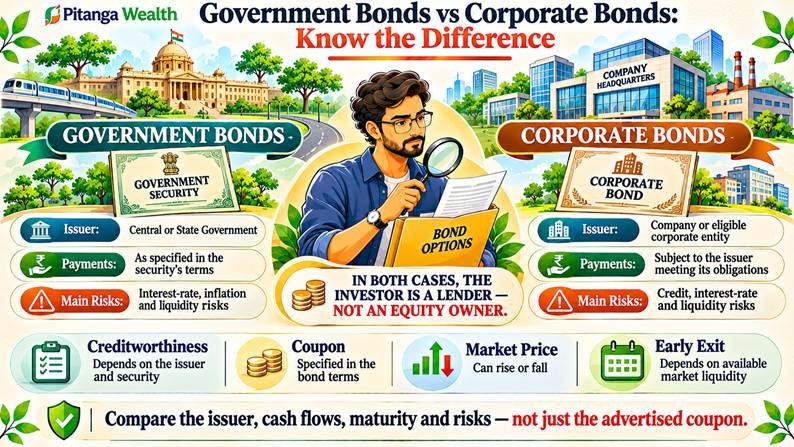
Government Bonds vs Corporate Bonds: Side-by-Side Comparison
| Feature | Central Government dated G-Sec | Typical corporate bond / NCD |
| Who borrows? | Government of India | Specific company or corporate issuer |
| Core credit exposure | Domestic sovereign credit risk treated as negligible by RBI | Issuer-specific capacity and willingness to pay |
| Coupon | As specified by individual security; fixed and other structures exist | Fixed, floating, zero-coupon or other issue terms |
| Market-price risk | Price may fall if yields rise, especially for longer maturity | Interest-rate moves plus changing credit spreads |
| Liquidity | Varies by security and market depth | May be limited, especially in small or infrequently traded issues |
| Credit-rating analysis | Sovereign issue context differs from corporate ratings | Read instrument-specific rating and rationale if rated |
| Early sale | May realise a capital loss even without default | May realise market loss or face few buyers |
| Where to verify | RBI issue information / Retail Direct and official market records | Offer documents, stock-exchange disclosure, rated instrument and issuer |
| Investor conclusion | Low domestic sovereign credit risk does not remove all risks | Higher quoted yield does not ensure a better result |
This table provides a conceptual comparison rather than a ranking of products. State-issued securities, sovereign gold-linked products, PSUs and complex corporate structures may not fit a simple two-column description. Both sides remain subject to the terms of the specific instrument. [1][2][4]
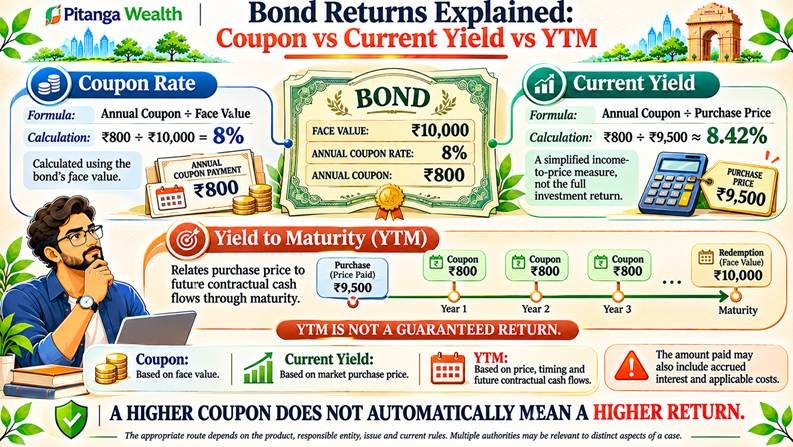
Bond Returns Explained: Coupon, Current Yield and Yield to Maturity
Coupon is calculated on face value
Suppose a bond has a face value of ₹10,000 and a fixed annual coupon of 8%. The coupon amounts to ₹800 for a full year, assuming contractual payment is made. If an investor buys that security at ₹10,000 and holds it under unchanged terms, the annual coupon equals 8% of the purchase price before tax and costs. But a secondary-market buyer might pay ₹9,500, ₹10,400 or another amount, so the coupon rate alone is not their investment yield.
Current yield is not yield to maturity
For a simple illustration, suppose the same ₹10,000-face bond with ₹800 annual coupon trades at a clean price of ₹9,500, excluding accrued interest and other charges. The simplified current yield is ₹800 ÷ ₹9,500, about 8.42%. This calculation ignores the eventual redemption difference, timing of payments, accrued interest and reinvestment. It is not a correct full yield-to-maturity calculation and does not forecast the amount a buyer will realise. [6]
Yield to maturity (YTM) is a discount rate that relates the current price to the bond’s future contractual cash flows through maturity. It generally incorporates coupon payments, time remaining and the redemption amount. On a plain bond bought at a discount, its indicated YTM may exceed the coupon rate; at a premium, the opposite may be true. The relationship depends on the actual terms and assumptions. [2][6]
YTM should never be presented as guaranteed earnings
The NSE and other market institutions have cautioned investors that YTM is not a guaranteed rate of return. The quotation may assume scheduled cash flows arrive, the instrument is held to maturity and any other applicable calculation assumptions. A corporate default, call, restructuring, sale before maturity, fees, reinvestment conditions or taxes can change the actual outcome. Comparing bonds in India by sorting a platform’s “highest YTM” column alone leaves out the central question: how dependable are those future cash flows? [6]
Clean price, accrued interest and what you actually pay
A bond may be quoted at a clean price, while the settlement amount reflects accrued coupon interest since the last payment and any applicable charges. The investor’s bank debit can therefore differ from the displayed bond price. Ask whether an online platform’s presentation is clean price or dirty (full) price, check the accrued-interest calculation and confirm the final consideration before approval. This is especially relevant when comparing bonds with different coupon dates. [2]
Two Illustrative ₹10,000 Bonds: What Is and Is Not Comparable?
| Hypothetical term | Bond A: Government of India dated security | Bond B: Corporate issuer debt |
| Face value | ₹10,000 | ₹10,000 |
| Fixed coupon illustration | 7% per year | 9% per year |
| Annual coupon amount | ₹700 | ₹900 |
| Coupon frequency | Assumed half-yearly | Assumed annually |
| Credit basis | Sovereign rupee obligation | Financial strength and terms of the company |
| Example difference | — | ₹200 more coupon per year before taxes and fees |
This is not a quotation of currently available issues. It deliberately holds face value constant but does not assert identical purchase prices, maturities, market yields, liquidity or investor suitability. A 9% contractual coupon is not proof of a 9% realised return, and it is not evidence that the second security is better. If Bond B experiences a payment delay, impairment or default, the extra ₹200 coupon becomes an inadequate description of the actual risk. [1][6]
Now imagine that an investor buys Bond A and must sell before maturity after market yields rise. Even without a sovereign credit event, the resale price could be below their purchase cost. If another investor buys Bond B at a high premium, their YTM could be lower than its printed coupon, assuming all payments are made. Both examples show why any comparison should use actual purchase price and cash-flow timing, not simply the coupon headline.
Why Bond Prices Rise and Fall
Interest-rate risk: prices and yields usually move inversely
When new market yields rise, the fixed payments on existing bonds often become less attractive, causing their market prices to decline; falling yields tend to have the opposite effect. Longer-duration bonds generally have greater price sensitivity to a given yield change than otherwise comparable shorter-duration bonds. RBI describes interest-rate risk as a core risk of government securities, not a corporate-only concern. [2][3]
Consider an investor who paid ₹9,500 for a bond and later sees an executable resale quote of ₹9,300. Ignoring coupons received, accrued interest, costs and taxes, that is a ₹200 change in price, or about 2.11% of the purchase cost. This is a simple arithmetic illustration, not a forecast. Holding to maturity can remove the need to realise an interim market price on a plain bond, but the issuer must still meet its obligations and the investor must be able to wait.
Credit-spread risk and company-specific events
Corporate prices can move when investors change their assessment of a company’s creditworthiness. A downgrade, covenant breach, deteriorating cash flow or refinancing difficulty can push required yields higher and market prices lower, even if benchmark government yields are unchanged. Wider credit spreads can therefore affect a corporate security while a comparable government security behaves differently. Credit rating reports, exchange announcements and financial filings are useful inputs, but they require interpretation.
Liquidity risk: a quoted value is not always an executable sale price
Some bonds trade infrequently. A platform may display an indicative valuation or last-traded price that differs from the amount an investor could actually receive for a given quantity. Wide bid–ask spreads, small market depth, odd lot constraints and settlement arrangements can reduce proceeds. For money that may be needed unexpectedly, an attractive coupon does not replace a realistic exit plan. Liquidity is especially uneven across bonds in India with small issues or infrequent trades. SEBI lists liquidity as a significant bond risk. [1]
Reinvestment, inflation and call risk
A coupon received today must be invested at whatever rates are available if the investor wants to compound it. Inflation can erode the purchasing power of future nominal payments. Callable bonds can be redeemed early when the issuer is permitted to exercise a call, potentially leaving the investor to reinvest at less attractive rates. Floating-rate and amortising structures change how interest and principal arrive. These features should be examined in the issue terms instead of being inferred from a product label. [1][4]
How Retail Investors Can Access Government Bonds
RBI Retail Direct: understand the account before placing a bid
The RBI Retail Direct scheme lets eligible individual investors open a Retail Direct Gilt (RDG) account and access government securities in primary auctions and the secondary market. RBI’s official FAQs explain account eligibility, KYC requirements, government-security categories and transaction services. The portal is https://rbiretaildirect.org.in/. It is an access route to eligible securities, not an investment-advice service or a promise that market prices cannot change. [3][7]
RBI’s FAQ has historically shown a ₹10,000 minimum for many Treasury bill, dated G-Sec and SDL auction investments, but issue terms, auction rules and platform requirements should be checked live rather than treated as fixed across every transaction. Retail Direct also has an official mobile app; use RBI’s own resources to verify the current app rather than installing a forwarded link. [3][7]
A practical government-security buying checklist
1. Identify the security. Record the issuer, ISIN, coupon, redemption date and whether the bid is in an eligible primary auction or the secondary market.
2. Confirm the account. Use the official RDG account procedure or a verified intermediary route and complete required KYC.
3. Check the price. Read the auction or market quotation, minimum amount, settlement method and any applicable accrued interest.
4. Match the time horizon. Decide whether a sale before maturity is a realistic possibility and understand the price risk that creates.
5. Retain confirmation. Check successful allotment or trade records and later coupon and redemption entries through the official account.
Some investors instead obtain indirect exposure through debt mutual funds or other products. Those are not equivalent to personally holding one government security; a fund has its own NAV, portfolio, fee and liquidity characteristics.
How Retail Investors Can Evaluate Corporate Bonds and Bond Platforms
Read the actual offer document—not only the app card
Corporate bonds may be accessed through eligible public issues, regulated secondary-market channels or permitted online bond platforms. Review the information memorandum or prospectus, listed status, ISIN, maturity, coupon, payment dates, issuer financial information, security, seniority, rating rationale, covenants, debenture trustee information and default history where available. A platform’s simplified product card cannot replace the instrument’s full terms. [4][5]
A bond described as “secured” may still offer poor liquidity. A “AAA” symbol may be an issue-specific rating rather than a blanket statement about all debts of a group. The label “monthly payout” may refer to coupon frequency without assuring the investor that the principal is liquid each month. Readers evaluating bonds in India should verify whether the promised investment is a genuine identified security and not a pooled private lending arrangement disguised as a listed bond.
Verify Online Bond Platform Providers (OBPPs)
SEBI maintains a regulatory framework for Online Bond Platform Providers, including registration and exchange oversight. In November 2025, SEBI cautioned investors about unregistered platforms and urged verification. SEBI publishes a page linking to NSE and BSE lists of registered OBPPs; consult the live lists because the membership can change. The framework was further modified by an August 2026 SEBI circular. Do not treat a flashy website or an investment advertisement as proof of OBPP status. [8][9][10]
Use the platform’s genuine website obtained independently, verify the legal entity and relevant registration, identify the exact listed instrument, and confirm the authorised payment and settlement arrangement. Never send investment money to an unexplained personal account or provide OTPs and trading passwords to a messaging-group administrator. If an offer promises a guaranteed high yield regardless of issuer performance, seek clarification rather than rushing to transfer funds.
What to check after buying a corporate bond
Retain the trade or allotment confirmation, demat entry or applicable account record, issuer correspondence and coupon credits. Monitor credit-rating changes, delayed payment disclosures, corporate actions and issuer filings. A bondholder’s rights can depend on notice periods, consent processes, trustee communications and debt-restructuring terms. If the entity does not perform a regulated service, use the relevant official grievance process and assess SEBI SCORES eligibility as appropriate; an ordinary market loss is not, by itself, proof of misconduct.
Taxation of Bond Interest and Gains: Avoid Simple Assumptions
Coupon interest, discount income, sale gains and redemption outcomes can be taxed differently under Indian tax law, depending on the instrument and the taxpayer. Listing status, acquisition and disposal dates, residence, the special rules for unlisted bonds or market-linked debentures, and applicable withholding or reporting provisions may affect treatment. An investor should not assume every government bond is tax-free or that the word “bond” gives every corporate security a concession. [11]
Official Income Tax material explains that gains on certain unlisted bonds and debentures, on transfer, redemption or maturity within the relevant statutory rules, receive short-term capital-gain treatment irrespective of the ordinary holding period. Listed bonds and government securities may fall under different rules; tax treatment can also change by legislation. Because the Income-tax Act, 2025 and subsequent Finance Act amendments interact with earlier transactions and transitional provisions, verify the applicable law for the specific tax year and trade rather than applying a social-media tax summary. [11]
For bonds in India, compare post-tax cash flow only after the price, yield assumptions and tax category are properly understood. This article provides no personalised calculation or tax-saving recommendation. Consult the latest official Income Tax guidance and a qualified professional for a transaction-specific assessment.

Eight Checks Before Choosing Any Bond
1. Identify the legal issuer and security. Check whether it is a Central Government issue, an SDL, corporate NCD or something else; retain the ISIN.
2. Read the cash-flow schedule. Separate face value, coupon rate, payment frequency, redemption amount and any amortisation or call terms.
3. Check the purchase price and yield assumptions. Don’t treat coupon, current yield and YTM as synonyms.
4. Assess credit and claim priority. For corporate debt, read the instrument rating, rationale, security, covenants and seniority.
5. Assess exit liquidity. Look at trade volumes, available bids, quoted spread and whether money might be needed before maturity.
6. Match maturity to a real goal. An investor needing funds in one year should not ignore the market risk of a distant maturity.
7. Use a legitimate transaction route. Check RBI Retail Direct or the appropriate registered intermediary/OBPP and authorised payment details.
8. Consider taxes and concentration. Review tax treatment and avoid placing all fixed-income money with one corporate borrower simply for a higher coupon.
This checklist is deliberately broader than a yield ranking. A low-coupon security bought at a discount may have a competitive yield; a high-coupon issue can still be a poor fit when default probability, poor liquidity, long duration or a weak contractual position are taken into account.
Frequent Mistakes First-Time Bond Investors Make
Mistaking a high coupon for the highest return
A 10% coupon on an expensive secondary-market bond is not automatically a 10% return on the price paid. A quoted YTM also does not eliminate issuer default, early redemption, trading costs or personal tax. Read the calculations and assumptions. [6]
Assuming government securities cannot show losses
Central Government rupee debt has a distinct sovereign credit profile, but a person who sells a long-dated G-Sec after market yields rise can incur a capital loss. “Safe from domestic sovereign default” and “price never falls” are not equivalent claims. [2][3]
Treating all corporate bonds as equal
Two debt instruments from related businesses may differ in guarantee, security, seniority, repayment schedule, maturity and bondholder rights. A rating is issue-specific and may be downgraded. High-yield advertisements should increase scrutiny, not reduce it. [5]
Confusing access with suitability
A regulated trading platform can provide a legitimate route to buy an unsuitable bond. Platform registration does not mean its securities will always pay on time, and a simple purchase interface does not make a complex perpetual or subordinated instrument simple. SEBI’s warning about unregistered bond platforms is a reason to verify the channel in addition to evaluating the bond. [8]
Frequently Asked Questions About Bonds in India
1. What is the basic difference between government and corporate bonds?
Government securities are debt obligations of the Central or State Government. Corporate bonds are debts issued by companies or eligible corporate entities. They differ in issuer credit exposure, structure, liquidity and available terms; neither category makes market-price changes impossible. [1][2]
2. Are Government of India bonds completely risk-free?
RBI treats domestic-rupee Central Government securities as carrying no domestic sovereign credit risk, but interest-rate movements can cause losses on sale before maturity. Inflation, liquidity and reinvestment considerations still matter. [2][3]
3. Is a corporate bond safer than a company share?
Ordinary corporate debt generally ranks differently from equity under the terms and applicable law, but that does not make every bond safer in every circumstance. A weak issuer or subordinated debt can produce substantial loss. Compare the actual instrument and risks, not just the broad asset label.
4. What is the coupon rate on a bond?
The coupon rate generally determines periodic contractual interest as a percentage of face value. Actual payment frequency and any changes depend on the bond terms. It is not necessarily equal to a secondary-market buyer’s yield. [1][6]
5. What does yield to maturity mean?
YTM is the discount rate linking a bond’s current price to its future contractual payments through maturity under specified assumptions. It is a valuation measure, not a guaranteed personal return. Defaults, calls, sale timing, charges and taxes can change the outcome. [2][6]
6. Why does a bond’s price fall when interest rates rise?
When newly available yields increase, the market generally discounts an existing fixed payment stream more heavily. The resulting price can fall, especially for securities with longer duration. Changes in credit perception and liquidity also affect corporate prices. [1][2]
7. Is a AAA-rated corporate bond guaranteed to repay me?
No. SEBI says ratings are opinions about credit risk, not guarantees or buy recommendations. Ratings can change and do not capture every liquidity, call or market risk. Examine the instrument and issuer independently. [5]
8. Can I sell a government bond before maturity?
Eligible government securities may be traded in the secondary market through available authorised routes, including RBI Retail Direct. The price and buyer availability at the time determine proceeds; an early sale may realise a gain or loss. [3]
9. What is the RBI Retail Direct scheme?
It lets eligible individuals open an RDG account and use the official RBI portal for primary and secondary government-security market access under applicable rules. It is not a recommendation of a particular bond. [3][7]
10. What is a State Development Loan?
An SDL is a dated State Government security. It is not the same legal issuer as a Central Government dated G-Sec, even though both are part of the broader government-securities market. RBI Retail Direct provides access to eligible SDLs. [2][3]
11. What should I verify before using an online bond platform?
Check the legal provider and its registration using SEBI’s official OBPP links to the relevant stock-exchange lists. Then verify the exact security, pricing, investor documents, fees and payment route. Avoid unregistered platforms. [8][9]
12. Are corporate bonds liquid like savings accounts?
Not necessarily. Some listed issues have limited secondary-market activity, and a quick sale may require accepting a discount. Buying a listed security does not guarantee a buyer whenever funds are needed. [1]
13. Are bond interest payments tax-free in India?
Do not assume so. Tax treatment depends on the security, investor category and current law. Coupon income and gains on sale or redemption may receive different treatment; check official guidance for the actual transaction and year. [11]
14. Can I invest only in government bonds and ignore diversification?
Sovereign government securities may reduce corporate credit exposure, but maturity concentration, duration, inflation and liquidity still matter. The appropriate mix depends on the investor’s goals, cash-flow needs and risk tolerance. Diversification does not guarantee against all losses.
Conclusion: Understand the Promise, the Price and the Risk
A bond is not evaluated merely by reading a coupon percentage. Start with the legal issuer and the security’s exact terms; then examine the purchase price, expected cash flows, payment risk, possibility of an early sale and tax treatment. Government of India securities and corporate debt can both play roles in financial markets, but they solve different needs and carry different risk profiles. Comparing bonds in India responsibly requires more than choosing the highest displayed yield.
For beginners, the most useful habit is to verify the instrument and the transaction channel, read the official documents, and match maturity to the date the money may be needed. A credible investment decision should remain understandable when the marketing headline is removed. Where a term, rating, market price or legal right is unclear, seek suitably qualified advice before committing funds.
Disclaimer
This article is general investor education from Pitanga Wealth, not personalised investment, credit, tax, legal or financial planning advice. All figures and security terms in the examples are hypothetical and are not live quotations. Public sources were reviewed on 17 November 2026; actual security terms, tax rules, registration status and secondary-market conditions can change. Central Government rupee securities have a different domestic sovereign credit-risk profile from corporate debt, but market losses, inflation effects and other risks remain possible. Credit ratings are opinions, not guarantees, and this article does not recommend any named issuer or promise returns.
Written by Pitanga Wealth Team.
Follow us on Instagram @pitangawealth for more educational insights.
This article is for educational and informational purposes only. It is not investment, tax, legal or insurance advice. Consider your circumstances and relevant documents before making a financial decision.