

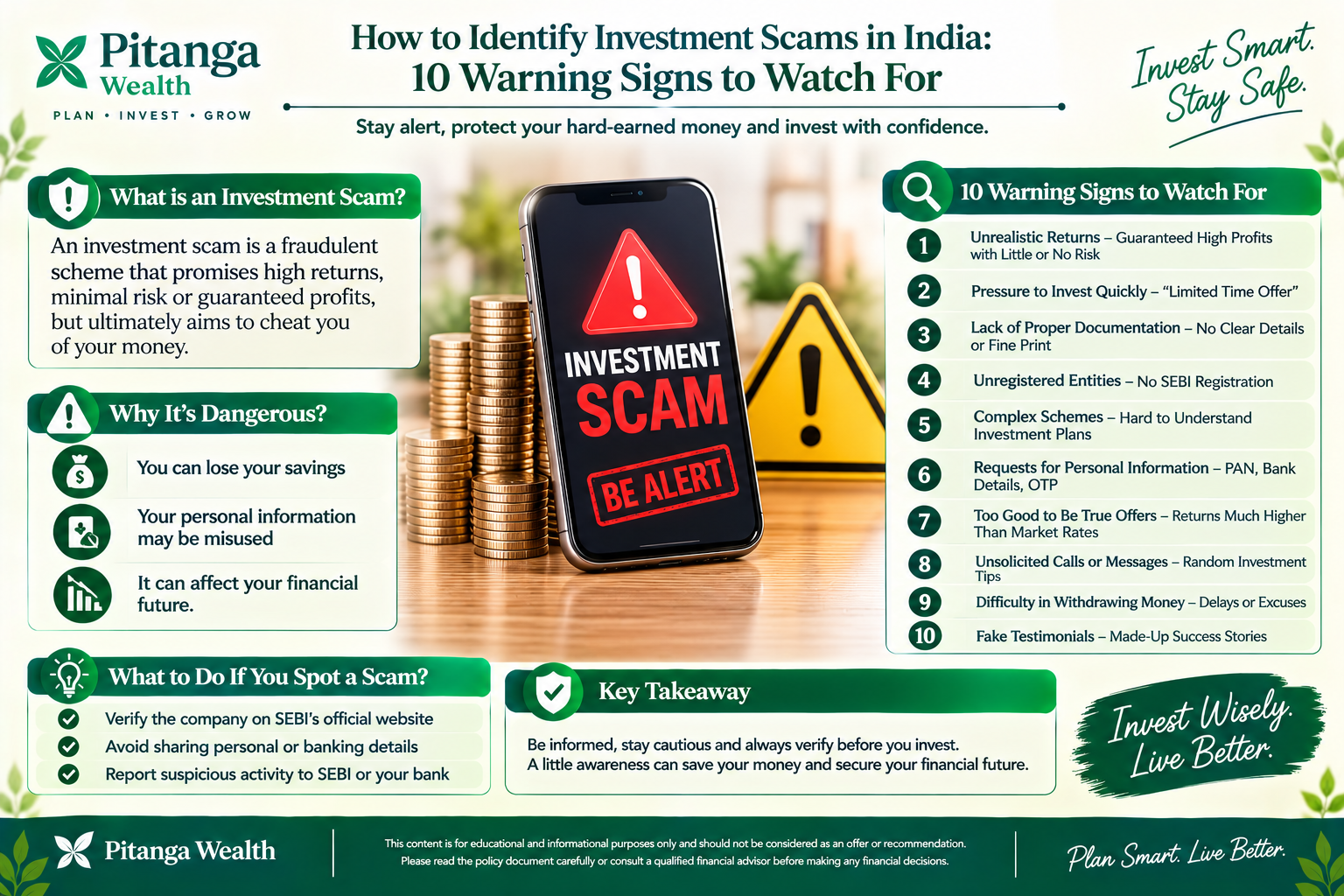
Investment offers increasingly reach people through a phone screen rather than a branch office. An advertisement promises unusually steady returns, a WhatsApp group appears to contain successful investors, and a trading application displays a fast-growing balance. Yet the attractive interface may not represent any genuine investment. Understanding investment scams in India begins with checking who is making the offer, where the money will go, and whether the underlying transaction can be independently verified.
A scam is not the same as an ordinary investment loss. Genuine market investments can fall in value without fraud. A suspected scam involves potentially deceptive claims, impersonation, fabricated transactions or other conduct designed to obtain money or sensitive information. The ten signs below are not a definitive legal test; they are practical reasons to stop, verify, and avoid acting under pressure. This article is educational and draws on SEBI investor alerts and official cybercrime resources.
Quick Answer: How Can You Recognise a Suspicious Investment Offer?
The strongest signals include promises of guaranteed high returns, unverified advisers, unsolicited Telegram or WhatsApp tips, an app that cannot be matched to a regulated intermediary, instructions to pay a personal account, requests for passwords or OTPs, and demands for more money before a withdrawal is released. One warning sign merits investigation; several together are a reason to stop the transaction and seek independent verification. Investment scams in India can imitate legitimate brands, so a polished website or professional-looking video is not proof of authenticity.
Why Investment Fraud Can Look Convincing
Investment fraud is not always a crude message filled with spelling errors. Criminals may copy the branding of genuine brokers, create realistic social-media profiles, use fabricated customer testimonials, or display plausible market charts. Some approaches start with small apparently successful transactions. A person may even receive an initial withdrawal designed to build confidence before larger deposits are requested.
Regulated products also have complicated language, which an imposter can exploit. Terms such as IPO allocation, block deal, institutional account, algorithmic strategy, or guaranteed daily profit may be used to suggest exclusive expertise. A technical phrase is not inherently suspicious; the warning comes when a promoter cannot explain the product, demonstrate valid authority, or document how client money is protected. SEBI has issued cautions on social-media scams and account-handling offers, and its investor material highlights fake trading application schemes.
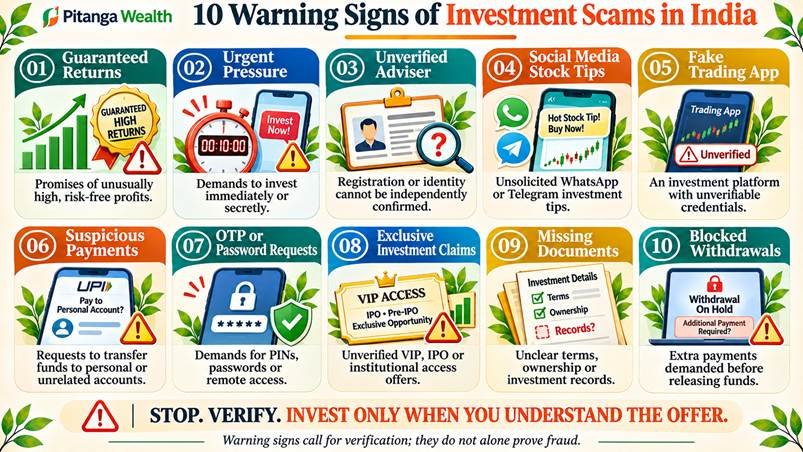
10 Warning Signs of Investment Scams in India
1. Guaranteed or Unusually High Returns With Little Risk
Claims such as “fixed daily profit,” “double your money in weeks,” or “zero-loss stock market strategy” should immediately trigger scrutiny. Market-linked securities do not deliver assured outcomes simply because a group administrator says so. A legitimate product may explain an indicative yield or contractual payment structure, but that is not equivalent to a blanket guarantee of stock-market profits. Risk, costs and conditions must be disclosed and understood.
What to do: Ask for the complete product description, risk disclosure, legal issuing entity and independently verifiable documentation. Treat claims of risk-free market trading as a serious warning. Avoid assuming that an early payout proves the whole arrangement is genuine.
2. Pressure to Pay Immediately or Keep the Offer Secret
Fraudsters often describe an opportunity as closing in minutes, a “VIP allocation,” or a special slot available only to group members. They may say a bank transfer must be completed before a market opening, discourage discussions with relatives, or make withdrawal of the opportunity conditional on immediate payment. The aim is to prevent careful research.
What to do: Pause. Verify through channels that you locate independently, not numbers supplied in the message. An unwillingness to allow basic due diligence is itself useful information. Missing a legitimate opportunity is preferable to handing money to an unknown recipient.
3. Unregistered or Impersonated Intermediaries
A promoter may claim to be a SEBI-registered investment adviser, research analyst or stockbroker but provide no registration details, supply a borrowed number, or use the name of a genuine firm. Even a valid registration number does not prove that the person contacting you represents that firm. An imposter might reproduce its logo and employee photographs without authorisation.
What to do: Check the firm’s registration and category using SEBI Investor’s intermediary support page. Verify broker membership and authorised apps through the relevant exchange. Then contact the genuine entity through a phone number or website independently found on its verified official channel, asking whether the named representative, app and payment instructions are authorised. This independent cross-check is particularly important in investment scams in India involving impersonation.
4. Unsolicited Stock Tips in WhatsApp, Telegram or Social Media
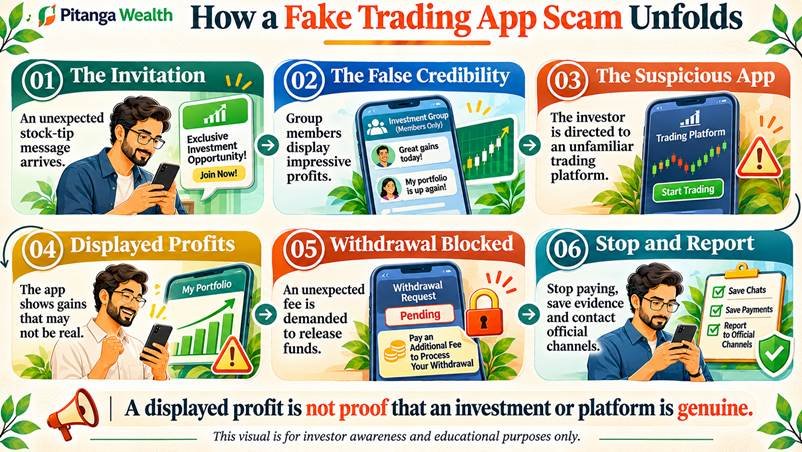
A stranger adds you to a trading group. Several members post screenshots of profits and thank a supposed analyst. Administrators give a few free tips before directing members to a special app or a paid trading account. These testimonials may be fabricated, and the group’s apparent size does not establish that independent investors are involved.
What to do: Do not trade or transfer funds merely because a group shows persuasive screenshots. Seek verifiable research disclosures and understand the conflicts of interest. NSE accepts reports of unsolicited stock tips, while SEBI has warned investors about stock market scams promoted through social platforms. Avoid forwarding unverified tips to others.
5. A Trading App or Website That Cannot Be Verified
A convincing app might display stock prices, account statements, IPO allotments or profits, yet those screens can be entirely controlled by the scam operator. Fake trading apps may arrive through a direct APK download, messaging link or imitation website rather than a verified broker’s official distribution channel. An app’s appearance in an app store is not, on its own, a regulatory licence.
What to do: Find the authorised mobile trading application from SEBI Investor’s links to exchange-maintained lists, and cross-check the developer, domain and intermediary. Access your legitimate account through the official broker’s known site or app, not an administrator’s hyperlink. Investment scams in India increasingly exploit attractive interfaces, so independent authentication matters more than screen design.
6. Requests to Pay a Personal, Third-Party or Unexpected Account
Someone claiming to operate a stockbroker or financial platform instructs you to transfer money to a changing beneficiary, a private individual, or a UPI ID unrelated to the stated organisation. Explanations may involve “temporary settlement,” “priority IPO funding,” or an urgent workaround. A recipient’s display name alone cannot establish that the transfer is authorised.
What to do: Confirm account and payment instructions using the genuine intermediary’s official portal or independently verified support team. Where applicable, SEBI Check offers verification of registered intermediaries’ payment identifiers or bank details. Do not treat a successful payment as proof of a genuine investment. Be especially alert if recipients are repeatedly changed or split across multiple accounts.
7. Requests for OTPs, Trading Passwords or Remote Device Access
A supposed adviser asks you to disclose your UPI PIN, OTP, broker password, screen-sharing access, or to install a remote-control application. Another person may claim they need these details to activate a withdrawal, reverse a loss, complete KYC, or “synchronise” your portfolio. Giving access can expose both money and personal information.
What to do: Never disclose transaction authentication details to a third party. Stop the session, use the genuine provider’s official contact route and secure the account. If access has already been shared, change credentials from a trusted device and notify affected institutions. Genuine KYC and authentication processes must not be confused with giving a stranger unrestricted device access.
8. “Exclusive” Institutional, IPO or Insider Access
Scammers may advertise special pre-IPO shares, block deals, FPI-linked accounts, guaranteed IPO allotment or institutional trading privileges unavailable to ordinary investors. The sales pitch might rely on impressive titles such as “fund manager,” “institutional desk” or “foreign portfolio investor partner.” These claims can sound credible because the terms exist in real capital markets.
What to do: Ask what legal product or market transaction is actually being offered and whether the account structure is permitted for you. Verify the named intermediary and offer independently. SEBI has separately warned about fraudulent schemes claiming FPI-linked access for Indian residents. A seemingly exclusive label is not evidence of a lawful allocation or higher expected return.
9. Missing Documentation, Unclear Ownership or Vague Strategies
A promoter refuses to provide written terms, risk disclosures, fee schedules, a valid entity name, trade confirmations or proper statements. They may claim that the strategy is too secret to explain. Some documents contain polished graphics but no way to establish who holds the assets, what can be redeemed, or which regulator has jurisdiction.
What to do: Ask for contractual documents, the actual issuer or intermediary, transaction route, fee and tax information, dispute contact and genuine account statements. Independently check the information. If the person cannot explain the investment in terms you understand, do not sign a blank form or provide money merely to discover more later.
10. Withdrawals Are Blocked Until Another Fee Is Paid
A common escalation appears after the app shows large fictitious profits. The investor asks to withdraw, only to be told to first pay “tax,” “unlocking fee,” “verification deposit,” “margin shortfall,” or a separate penalty. New conditions follow each payment. In some cases, another person contacts the victim promising recovery for an advance fee, creating a second scam.
What to do: Stop sending money. Preserve messages, transaction references and screenshots; contact your bank through verified channels immediately. If money has been lost through cyber-enabled fraud, promptly call 1930 and report it through cybercrime.gov.in. There is no guarantee of recovery, and delay can reduce the chance of timely intervention. Recognising this pattern is central to understanding investment scams in India.
Quick Comparison: Genuine Investment Risk vs a Possible Scam
| Situation | Ordinary investment or service issue | Possible scam indicator |
| Returns | Value rises or falls; risk is explained | A promoter guarantees fast, risk-free market gains |
| Platform | Broker/app can be independently verified | Only an invite link or imitation app is available |
| Payments | Official instructions match the provider | Personal accounts and repeated beneficiary changes |
| Documents | Contracts, charges and records can be checked | No verifiable entity, contract or trade history |
| Withdrawal | Subject to stated rules and legitimate controls | New advance payment repeatedly demanded to release funds |
| Support | Known institutional complaint channels | Only a group administrator or anonymous chat responds |
These distinctions require context. A delayed redemption or frozen account is not, by itself, proof of fraud; a legitimate intermediary may need compliance checks. Conversely, the presence of a real-looking document or an initial withdrawal does not prove that an offer is trustworthy. When several signals align, stop and verify before sending further money.
A Seven-Step Verification Routine Before Investing
Step 1: Identify the Exact Legal Entity
Write down the legal name, website, registration number, category of service and person contacting you. Keep a screenshot of the original solicitation. Do not assume that a popular brand name identifies the actual legal entity receiving your money.
Step 2: Check Registration and Exchange Membership
Use SEBI Investor’s support resources for intermediary registration and official lists of mobile apps. Where relevant, verify stockbroker membership on the exchange website. Registration must match the activity: being licensed for one function is not automatic permission to offer every kind of advice, product or managed trading service. An unregistered person may offer content as general education, but should not misrepresent themselves as authorised to provide regulated services. That distinction is important when assessing investment scams in India.
Step 3: Confirm the Real Contact Channels
Open the official website by typing its address or finding it independently, and call the published customer support number. Ask whether the message, employee, group and payment instructions are genuine. Do not use a phone number from the suspicious advertisement as your only verification source.
Step 4: Check the Authorised App and Payment Destination
For securities trading, use the exchange links available on the SEBI Investor support page. For payments to SEBI-regulated intermediaries where the facility applies, consider SEBI Check’s payment-detail verification and the provider’s secure app. A mismatch is a reason to stop and ask the institution for clarification. Checking a payment identifier is not a substitute for understanding the investment.
Step 5: Read the Product and Risk Documents
Check who issues the product, how it operates, what assets or rights you receive, the fees, risks, lock-ins, redemption restrictions and applicable tax treatment. Ask for clarification of jargon rather than accepting “secret strategy” as an explanation. If important terms are unavailable in writing, don’t proceed.
Step 6: Keep Control of Your Accounts
Use your own authenticated accounts; do not share passwords, OTPs or UPI PINs, and do not grant remote-access permissions to unknown people. Review transaction messages and bank or demat statements independently. If a representative is authorised for particular activities, clarify the permitted scope and complaint channels.
Step 7: Sleep on the Decision and Seek an Independent View
A second pair of eyes may catch an impersonated domain, confusing registration claim or unexplained fee. For substantial or complicated decisions, consult a suitably qualified, appropriately registered professional within the scope of their authorisation. Informed delay is often the best defence against investment scams in India built around urgency.
An Illustrative Example: The “VIP Trading Group” Trap
Consider an entirely fictional investor, Anita, who sees a social-media advertisement for an investment group. The administrator promises access to a special institutional share purchase and shares screenshots showing daily profits. After several free updates, Anita is asked to download an app through a private link. She transfers a modest amount to an unfamiliar account and sees an instant increase in the app’s balance.
A week later, the group recommends a larger deposit to qualify for an IPO allocation. Anita asks to withdraw her displayed profit, but support says a separate account-verification fee must be paid first. She checks the broker’s official website and learns that it does not recognise the application or its associated WhatsApp group. She stops paying, records the available evidence, contacts her bank, and uses the appropriate cybercrime reporting channel.
The important point is not the exact monetary amount or the sophistication of the graphics. The signals appeared in sequence: unsolicited approach, guaranteed returns, unverified app, unrelated payment recipient, and extra charges to release funds. Families studying investment scams in India can use similar scenarios to practise asking one question: “Can this claim be verified independently?”
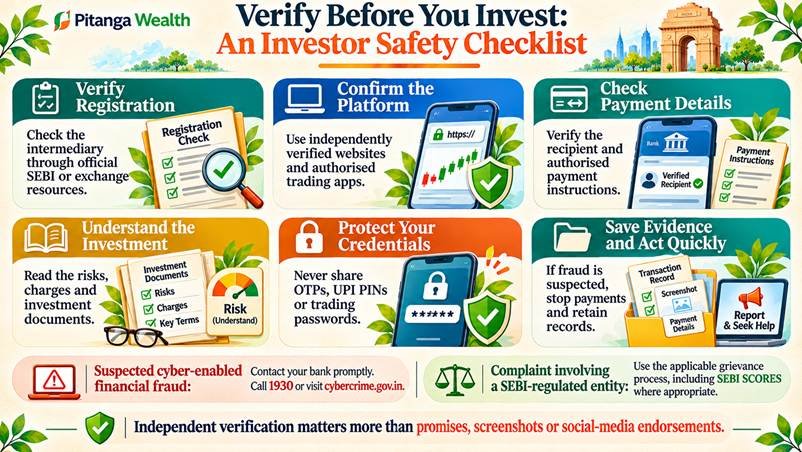
What to Do If You Suspect a Scam Before Paying
Do not continue discussions simply to test whether the scammer will admit wrongdoing. Avoid opening new links, installing files or signing additional documents. Save the messages, URLs, account details, names used and offer screenshots. Verify the firm through genuine public sources. If the suspicious approach involved a phone number, SMS or WhatsApp message, the Department of Telecommunications’ Sanchar Saathi/Chakshu reporting service may be relevant for suspected fraud communications, although it is not a replacement for reporting a completed cybercrime.
Tell a trusted person what happened, especially if there is pressure, secrecy, coercion or fear of missing out. Avoid posting your personal financial identifiers publicly while seeking advice. Publicly sharing screenshots may inadvertently expose bank details and passwords; preserve evidence in a secure, private record.
What to Do If You Have Already Sent Money
Act promptly: Contact the bank, broker, payment app or card issuer through its official support channel and report a potentially fraudulent transaction. Ask about steps available to secure your account and initiate a trace, recall or other response where applicable. Do not assume an institution can reverse every authorised transfer.
Report cyber-enabled financial fraud: Call the national cybercrime helpline 1930 and submit the appropriate report at https://cybercrime.gov.in/. Follow the portal’s current process and save the acknowledgement. Depending on the facts, contact local police. Preserve transaction IDs, beneficiary account details, dates, communication records, links and any downloaded application information. Avoid promising or expecting a particular refund result.
Use the correct securities-market complaint route: If your grievance concerns a genuine SEBI-regulated entity, first raise it with that entity. Where unresolved and eligible, SCORES provides a route for complaints about regulated entities. A fake trading platform operated by criminals may require a police or cybercrime report rather than—or in addition to—a securities grievance. SCORES is not a universal fraud-recovery portal and should not delay urgent cybercrime reporting.
Secure affected accounts and devices: Change passwords using a trusted device, review active sessions, disable unauthorised access, notify the institution of compromised credentials and follow its security instructions. If an app or remote-control tool was installed, consider professional device-security help before using the phone for banking again.
Beware of recovery scams: A message promising to recover lost investments in exchange for another fee may be a new attempt to obtain money or data. Verify the identity and legal role of anyone claiming to be an investigator, regulator, lawyer or recovery agency. Investment scams in India can involve multiple rounds of pressure after an initial loss.
How Families Can Build Better Investment Safety Habits
Establish a simple family rule that no unfamiliar investment offer is funded on the same day it arrives. Check the legal entity and payment destination before making a transfer, and keep a private list of genuine broker, bank and mutual fund contact channels. Educate first-time investors about the difference between regulated services and unverified social-media claims. Older relatives and young adults may face different channels of pressure; the verification steps are similar.
Review account alerts and balances from official providers rather than screenshots shared by group administrators. Encourage relatives to speak up when an offer feels confusing or embarrassing. Investment scams in India often rely on silence and urgency. Early conversations can reduce the chance of a second payment or recovery-fee trap without assigning blame to the person approached.
Frequently Asked Questions
1. What is the first warning sign of an investment scam?
A guarantee of unusually high or quick securities-market returns with little or no risk is a major warning sign. Still, no single sign determines every case. Verify the legal entity, product, payment recipient and documents before investing. Across investment scams in India, an unverifiable promise often matters more than a polished sales pitch.
2. Can a legitimate investment lose money without being a scam?
Yes. Market risk, liquidity restrictions, poor timing and other genuine factors may cause losses. Fraud is a separate question involving potentially deceptive conduct. A loss by itself does not establish that an intermediary or product is fraudulent.
3. Is an investment company genuine if it displays a SEBI registration number?
Not necessarily. Check the number and category on an official source, then independently confirm that the person, website, app and bank details belong to the genuine entity. Scammers may copy someone else’s registration information.
4. Are all Telegram or WhatsApp investing groups fraudulent?
No. A messaging group can discuss public information, but anonymity, invented testimonials, guaranteed profits and instructions to fund an unknown account are serious concerns. Do not treat social popularity as proof of authorisation.
5. How can I check a trading app in India?
Use the exchange-linked authorised mobile app lists from SEBI Investor’s support page and independently verify the broker’s official website and contact details. Avoid app download links from unknown group administrators.
6. Does a screenshot showing trading profits prove that trades occurred?
No. Screenshots can be manipulated, and fake platforms can display fictional balances. Verify transactions through the actual regulated intermediary and independent bank or demat records where applicable.
7. Is it safe to pay an adviser to a personal UPI ID?
Do not assume so. Check the service category, contractual arrangements and exact official payment instructions. Where available for relevant SEBI-regulated intermediaries, use SEBI Check and confirm details directly with the legitimate organisation.
8. Why do scammers ask for an extra fee before withdrawal?
An unexpected advance “unlocking,” “tax” or “verification” fee may be a way to extract additional money after displaying fictitious profits. Pause and verify through independent channels. Do not keep paying based solely on an in-app explanation.
9. Can an investor use 1930 after being cheated through a fake trading app?
For cyber-enabled financial fraud in India, 1930 is the national reporting helpline. File the corresponding report through cybercrime.gov.in as directed, and alert the relevant financial institutions promptly. Outcome and recovery depend on the facts and investigative process.
10. Can I lodge a complaint on SEBI SCORES for every scam?
No. SCORES is designed for eligible grievances concerning SEBI-regulated entities. Pure impersonation or an unregulated fraudulent operation may require cybercrime or police reporting. Use official guidance to decide whether a separate regulated-entity grievance is also appropriate.
11. Should I share my OTP to complete an investment KYC process?
Never disclose a bank, broker or UPI transaction authentication code to a person contacting you. Complete verification only through the authentic provider’s secure channels. Ask the institution directly if instructions are unclear.
12. What if the promoter says the investment is for institutional investors only?
Ask what the product legally is, who may participate, which entity operates it, and where the funds will be held. SEBI has warned about fraudulent schemes falsely claiming FPI or institutional trading access. The label alone provides no assurance of legality.
13. Can a small successful withdrawal mean that the platform is genuine?
Not necessarily. A scam may allow an initial payment or withdrawal to build trust, then demand much larger deposits. Assess the organisation and product independently rather than relying on a single successful interaction.
14. How often should an investor review scam warnings?
Review official investor advisories whenever you encounter an unfamiliar app, new payment method or unusual offer. Scams evolve as platforms and impersonation techniques change. A repeatable verification habit is more useful than memorising any single script.
Conclusion: Verify Before You Transfer
The most reliable protection is a process, not a prediction. Ask who is making the offer, whether they are authorised for that activity, how a genuine investment is documented, and where the money will be received. Refuse to share credentials or fund an unknown account to obtain supposedly guaranteed returns. Understanding investment scams in India means recognising the point at which a persuasive claim stops being verifiable.
If you suspect wrongdoing, preserve evidence and use the right official channel. If money or credentials have already been exposed, act promptly with your bank and cybercrime authorities. Financial education helps investors ask better questions; it cannot eliminate every risk or guarantee a recovery.
Disclaimer
This material is general investor awareness from Pitanga Wealth, not a legal opinion, personal investment recommendation, police report or guarantee of scam detection or fund recovery. A warning sign is not conclusive proof of criminal conduct; facts and legal outcomes vary. Verification mechanisms, contact details and procedures can change. This article references public materials reviewed on 10 November 2026. Use the current official instructions of SEBI, exchanges, financial institutions and Indian cybercrime authorities. Pitanga Wealth’s financial education and mutual fund distribution activities should not be confused with law enforcement, legal practice or an assurance of investment results.
Written by Pitanga Wealth Team.
Follow us on Instagram @pitangawealth for more educational insights.
This article is for educational and informational purposes only. It is not investment, tax, legal or insurance advice. Consider your circumstances and relevant documents before making a financial decision.