

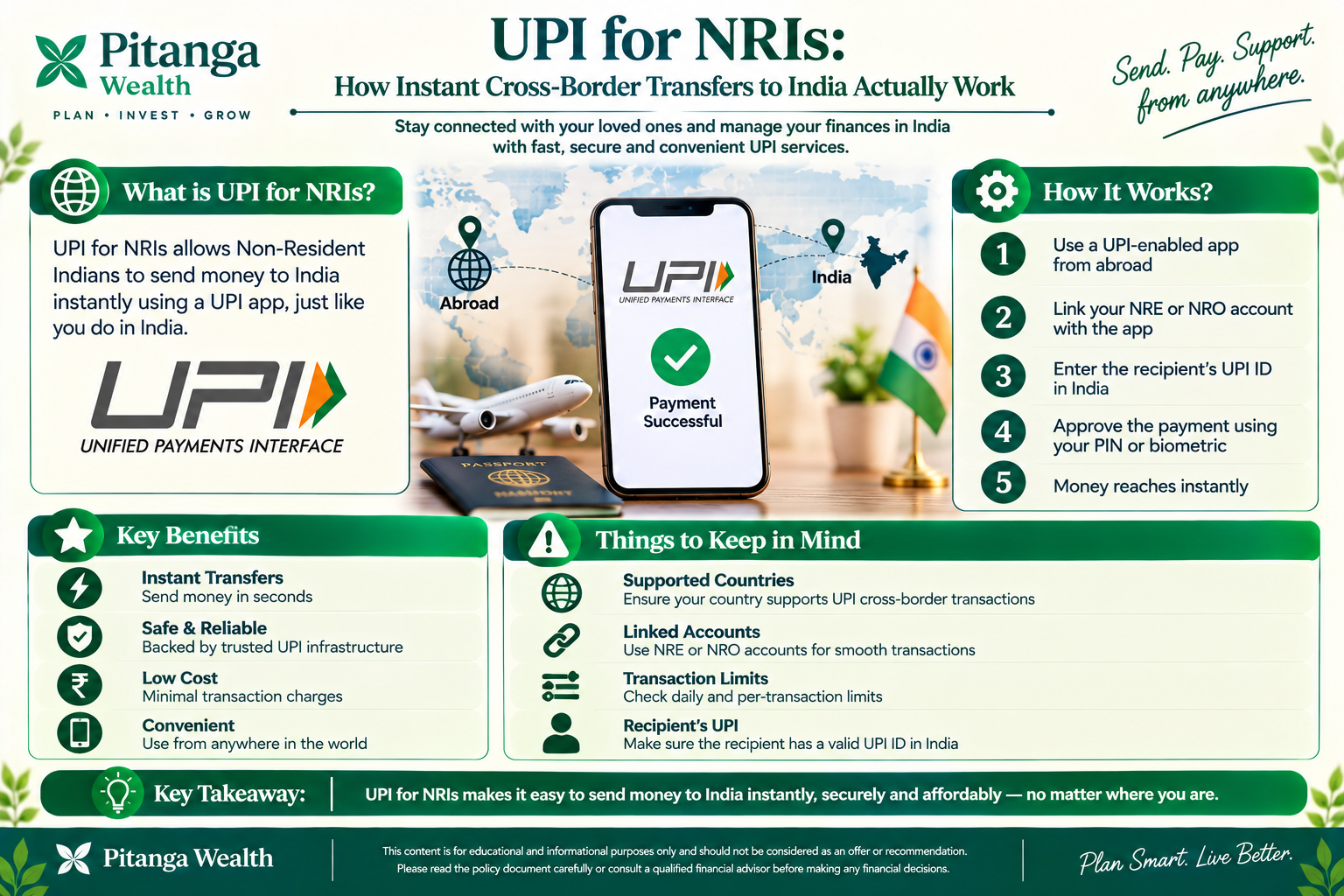
A family member in Singapore wants to send money to India within minutes. An NRI in Dubai wants to pay an Indian electricity bill using an overseas mobile number. Someone in London has heard that UPI now works internationally and assumes money can move from any foreign bank account to India by scanning a QR code. These situations sound similar, but they involve different payment arrangements.
UPI for NRIs is becoming more accessible, yet “international UPI” can mean three separate things: UPI payments from an eligible Indian non-resident account, a supported cross-border remittance connection between payment systems, or international merchant acceptance when travelling. Confusing them can lead to failed transactions, unexpected charges or wrong assumptions about speed.
This guide explains the current framework as checked on 9 November 2026. It focuses on Indian NRE and NRO accounts, the India–Singapore UPI–PayNow linkage, NPCI’s foreign inward remittance functionality, exchange-rate costs, bank restrictions and safe ways to verify a payment route. It is educational information rather than a guarantee that any named bank, app or corridor will accept a particular transaction.
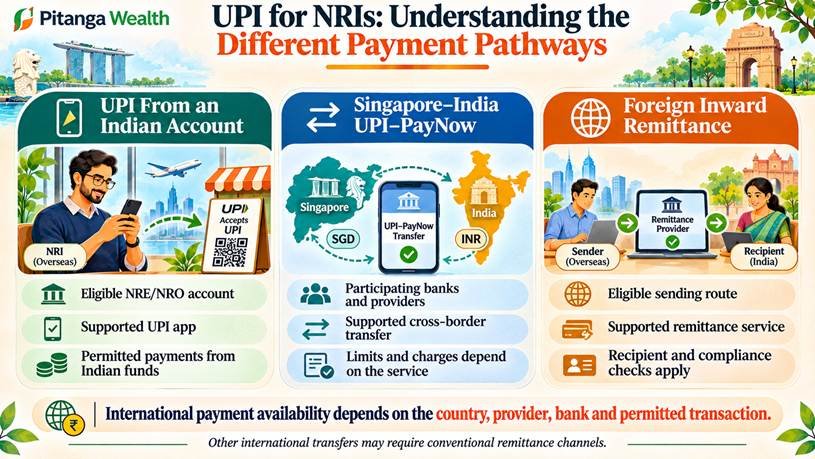
UPI for NRIs: Three Different Meanings to Understand
The Unified Payments Interface (UPI) is an Indian instant-payment infrastructure operated by the National Payments Corporation of India (NPCI). A UPI ID or virtual payment address can identify an eligible account for payment instructions. Whether an overseas user can transact depends on the account, provider and the transaction route—not merely on where a smartphone is located.
1. Domestic UPI payments using an NRE or NRO account
An eligible NRI may link a supported international mobile number to an Indian NRE or NRO account, complete an app’s onboarding checks and use permitted UPI functions. In that case the money may already be sitting in an Indian rupee account; a payment to someone in India is not necessarily a new transfer of foreign currency across the border. NPCI explicitly makes availability subject to the bank’s terms and conditions.
2. A genuine international person-to-person remittance
A separate facility must connect the overseas sender’s payment system or authorised provider with an Indian receiving account. The India–Singapore UPI–PayNow linkage is a documented example. NPCI also describes a foreign inward remittance (FIR) service involving UPI-linked Indian accounts, subject to participating countries, banks, apps and permitted arrangements.
3. Paying a merchant outside India with UPI
UPI Global Acceptance permits eligible users to scan supported merchant QR codes at selected international locations using Indian linked accounts. Paying a merchant while travelling abroad is different from sending a personal remittance from an overseas bank account to a family member in India. Country-wide availability must never be assumed.
| Use case | Where funds originate | What to verify |
| NRI UPI payment in India | Existing eligible NRE/NRO rupee balance | Bank, registered international number, app and permitted transaction |
| Cross-border transfer into India | Foreign account or authorised overseas payment provider | Live corridor, participant, remittance purpose, FX costs and limit |
| UPI QR payment overseas | Eligible Indian account used at an overseas merchant | Supported merchant, app, country, FX quote and charges |
Who Can Activate UPI for NRIs with an International Mobile Number?
NPCI states that NRIs with NRE/NRO accounts can use supported international mobile numbers for UPI transactions. This does not mean that all non-residents, all banks or all phone country codes are enabled. Each of the bank, app, account type, identity verification process and the particular country code must be supported.
A bank account, not simply an Indian passport
To use UPI for NRIs, the practical starting point is an eligible Indian bank account held in the correct non-resident category. An overseas bank account is not automatically linked to UPI merely because its owner is an Indian citizen. The participating Indian bank must have the correct number recorded and must permit UPI services for that account and mobile country code.
NRE and NRO accounts are not interchangeable
An NRE account generally accommodates eligible foreign earnings remitted into India, subject to the applicable rules, and allows repatriation under its conditions. An NRO account is commonly used for eligible Indian-source income and local transactions and has different rules for remittances abroad. Both have permitted-credit and permitted-debit requirements. The UPI interface does not remove those underlying FEMA and banking conditions.
Do you still need an Indian SIM?
Not necessarily. NPCI’s non-resident UPI framework allows international mobile numbers for supported country codes and participating banks/apps. In practice, registration may require the same registered number, a compatible device, SMS verification or other security checks. Check international SMS and roaming capability before beginning onboarding, and ask your bank to confirm the exact application and process.
When assessing UPI for NRIs, separate permission to activate an app from permission to use a specific financial product. A UPI registration success screen does not establish that every domestic merchant, investment transaction or cross-border remittance is permitted.
How to Set Up UPI on an NRE or NRO Account: A Practical Guide
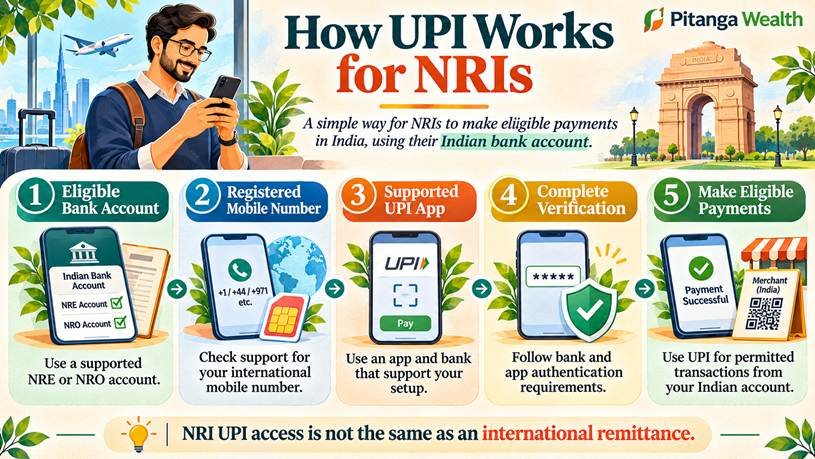
When setting up UPI for NRIs, use the following sequence as a checklist; individual banks can ask for different documents and may update supported apps, countries and onboarding methods.
- Confirm NRI account classification: Check whether the account is NRE or NRO, active, KYC-compliant and appropriate for the intended payment.
- Check your country code: Use NPCI’s current UPI-for-NRIs resource and ask your bank whether your overseas phone number is supported.
- Update the registered number: Make sure the precise international mobile number is registered to the eligible account with the bank.
- Choose a compatible UPI app: Ask the bank which UPI-enabled applications accept its NRE/NRO account and your international number.
- Complete security verification: Follow only the bank/app’s official device, SMS and account-verification screens. Never send an OTP or debit-card credentials to a helper.
- Set or verify the UPI PIN: Follow the authorised app’s procedure and the bank’s requirements; methods are not identical across all providers.
- Test a small permitted payment: Check the recipient name and account, review any on-screen charges and confirm the result in the bank statement.
- Secure and document the setup: Activate transaction alerts, maintain access to your bank’s complaint channel and review device security regularly.
What if the app does not recognise the account?
Possible reasons include an unsupported country code, mismatched mobile registration, bank-specific UPI restrictions, a temporarily unavailable SMS route, incomplete KYC or a device-security check. Avoid repeatedly attempting high-value transactions or trying unofficial workarounds. Start with the bank and application’s official support channels.
Can an NRI Really Send Money from Abroad to India Instantly?
Sometimes, yes—but only through a payment corridor and participating institutions designed for international remittances. Instant domestic UPI settlement does not make every foreign exchange leg instant. Different systems may need to verify the originator, permitted purpose, account eligibility, foreign exchange conversion, screening and beneficiary details.
For UPI for NRIs, it is more useful to ask “Which bank or payment provider is sending funds, from which country, to which eligible Indian recipient?” than to ask whether UPI itself is instant. The answer may differ by direction, account, timing and transaction category.
Why the word “instant” needs context
A fast-payment message can travel quickly while compliance checks or beneficiary-bank processing still take time. A sender seeing “successful” on an overseas app should verify actual credit in the recipient’s Indian account. A transfer described as real-time under a particular arrangement cannot be assumed to have the same service level through an unrelated bank or remittance company.
India–Singapore UPI–PayNow: The Clear Cross-Border Example
The Reserve Bank of India and Monetary Authority of Singapore launched the linkage in February 2023. It connects participating institutions in the two countries for eligible person-to-person payments. RBI’s published FAQ identifies participating banks, permitted purposes, a transaction cap and the recipient-consent process; these details should be checked again immediately before use.
Who can send and receive?
Account holders of participating banks and financial institutions can use the linkage where their provider enables it. RBI’s FAQ lists Axis Bank, DBS Bank India, ICICI Bank, Indian Bank, Indian Overseas Bank and State Bank of India for inward receipt on the Indian side. Sending support and app availability can differ. The overseas sender must also use an eligible Singapore participant or platform.
What transactions and limits does RBI describe?
RBI’s FAQ states a daily limit of ₹60,000 (around SGD 1,000 in the regulator’s illustration) for the linkage. It describes permitted person-to-person remittances for the purposes of gifts and maintenance of relatives abroad; India-to-Singapore payments also fall under relevant Liberalised Remittance Scheme conditions. This is a linkage-specific published limit, not a universal cap for all international transfers or all ordinary UPI transactions.
How quickly should it arrive?
According to the RBI FAQ, an eligible UPI–PayNow remittance can generally be completed within a minute. There may still be an exception or failed transaction requiring support. RBI also describes an opt-in/opt-out facility for receiving remittances in participating Indian banks’ apps and requires the eligible UPI ID to be registered with the same receiving bank account under its published arrangement.
Illustrative Singapore-to-India workflow
- The sender confirms that a participating Singapore institution supports the UPI–PayNow transaction and checks the permitted purpose.
- The recipient checks that the Indian bank, UPI identity and app are enabled for receiving through this linkage, and completes any opt-in.
- The sender enters the supported recipient identifier, reviews the displayed foreign currency and rupee amounts, exchange rate, charges and transaction limit.
- The sender authorises the payment through their own provider and keeps the reference number.
- Both parties confirm actual credit and retain a receipt and purpose description if later needed.
Illustrative example: Priya lives in Singapore and wants to send an eligible family-maintenance remittance to her parent in India. If both sides use participating institutions and satisfy the live rules, the linkage may be suitable for a small urgent payment. This example does not claim that a bank named in a historical FAQ supports every app or account today.
NPCI Foreign Inward Remittance: Why the Final Indian Leg Matters
NPCI’s Foreign Inward Remittance (FIR) product description says an Indian user with an eligible UPI-linked bank account may be able to receive money from overseas through participating countries, banks and UPI apps. This is an additional relevant development, but product support and sender routes must be checked; a UPI ID alone does not make an unsupported foreign account or payment app eligible.
What happens behind the scenes?
An overseas sender may initiate payment with a licensed or authorised provider. Foreign exchange conversion and remittance screening occur through the permitted arrangement. The India-side beneficiary credit may then be carried by domestic payment infrastructure such as UPI or IMPS. NPCI’s 2018 circular specifically authorised use of the domestic UPI leg for foreign inward remittance credits subject to KYC, audit trail and regulatory compliance.
Why this is not a universal international UPI wallet
A local UPI ID is a convenient recipient identifier for supported services; it is not an instruction to debit any account anywhere in the world. The sending institution must have an authorised route and the receiving institution must accept the transaction. Some providers may ask for standard bank account details rather than a UPI ID, and not every foreign payment can be delivered by the same mechanism.
UPI for NRIs can therefore describe both a way to spend existing rupee balances and a recipient-side feature in select inward remittance arrangements. Always confirm which one a bank or app is advertising.
What About the UAE, UK, United States and Other Countries?
UPI for NRIs, international merchant payments and remittance fintech services are often discussed together in countries with large Indian communities. These should be tested separately. Being in a country that accepts UPI merchant QR payments does not prove a live person-to-person remittance corridor from that country to India.
UAE: three different scenarios
An NRI in the UAE may be able to use a supported UAE mobile number with an eligible Indian NRE/NRO account for domestic UPI transactions. An Indian-account holder visiting the UAE may be able to pay at selected participating merchants through international UPI acceptance. Sending UAE dirhams from an unrelated UAE bank account directly to an Indian UPI ID requires an actual supported remittance route; do not infer that this is enabled from the first two examples.
UK or US: check the channel, not the headline
The same distinction applies to the UK, United States and other countries. NRI onboarding depends on current supported country codes, banks and apps. Cross-border remittances depend on particular licensed providers and partnerships. A family may find a bank transfer or regulated remittance service more suitable for regular transfers, large expenses or business payments.
International merchant QR acceptance is not cash remittance
NPCI’s UPI Global Acceptance service covers QR payments at selected international merchants, with the app showing the amount and any exchange-rate or fee information. It should not be described as a general service for transferring overseas wages or personal funds into Indian bank accounts.
The 2026 RBI Rules for Faster Inward Credits
On 9 April 2026 RBI issued final guidelines intended to reduce avoidable delays after an inward cross-border payment message reaches the beneficiary bank. They took effect six months later, on 9 October 2026. The guidelines concern inward payment processing by scheduled commercial banks; they do not transform every traditional international transfer into an instant UPI payment.
What banks are expected to improve
- Prompt customer information: Banks are to inform beneficiaries of receipt of inward payment messages immediately, or at the next business-day start if received after their operating hours.
- More frequent reconciliation: Banks are advised to reconcile inward nostro receipts on a near-real-time or periodic basis, with an interval normally not exceeding one hour.
- Timely beneficiary credit: Banks should endeavour to credit inward payments received during foreign-exchange market hours on the same business day, or on the next business day for payments received after market hours, subject to FEMA and other compliance requirements.
These are important service improvements, but a sender should not read “same business day” as “within seconds.” If a bank needs missing documents or additional compliance checks, the actual outcome depends on the case. RBI also encourages better digital interfaces for customers to submit information and track foreign exchange transactions.
What Will a Cross-Border Transfer Actually Cost?
Before choosing UPI for NRIs or an international remittance provider, compare more than the fee advertised on a payment screen. Exchange rates, conversion spread, sending fees, receiving/intermediary charges, applicable taxes and the beneficiary bank’s treatment of the payment can all affect the final credit. Some low-cost payment linkages may show a clear quote upfront, while other remittance routes have multiple fee components.
Compare the delivered rupees, not just the service fee
Suppose one provider advertises a zero explicit transfer fee but quotes a less favourable exchange rate. Another charges a visible fee but offers a better conversion rate. The relevant comparison is the final INR that reaches the intended beneficiary at the stated exchange rate, after all known charges. Do not present a sample rate as current market pricing.
| Check before sending | Why it matters |
| Sending currency and INR credited | Shows the effective exchange result |
| Quoted exchange rate and validity | A rate may be time-limited |
| Provider and correspondent charges | Visible and hidden deductions differ |
| FX conversion location | Sender and beneficiary bank may treat conversion differently |
| Transfer reference and receipt | Supports tracking and a bank query |
| Purpose and documents | May affect eligibility, reporting or compliance |
Are family transfers automatically tax-free?
No blanket answer should be given. The Indian tax treatment can depend on the relationship, amount, nature of receipt, donor and recipient status, purpose and applicable law. The transfer itself may differ from any income later earned from the funds. NRIs should confirm both Indian and foreign tax or reporting obligations with qualified advisers when material.
Three Practical Examples of What Works—and What Does Not
Example 1: Paying an Indian bill from Dubai
Arjun has an eligible Indian NRO account linked to a UAE mobile number and a UPI app supported by his bank. He wants to pay a permitted Indian service provider from the rupee balance already in his NRO account. The transaction may be a normal domestic UPI debit, even though Arjun physically lives abroad. This example involves no new foreign currency crossing the border at that moment.
Example 2: Small family remittance from Singapore
An NRI in Singapore uses a participating payment institution to send an allowed family-support transfer through UPI–PayNow to a parent’s eligible Indian account. The app shows a conversion quote and applicable limit. If the parties and transaction qualify, the linkage can complete quickly. The recipient should still confirm that the bank account was actually credited.
Example 3: Sending savings from a UK bank
A worker in London wants to transfer a larger amount from a UK salary account to an Indian NRE account. Having a UPI app associated with that NRE account does not establish a UK-to-India instant UPI corridor. The worker should select a properly authorised remittance channel, verify NRE credit eligibility, compare the final rupee credit and retain evidence of source of funds if required.
A Safe Eight-Point Remittance Checklist for NRIs
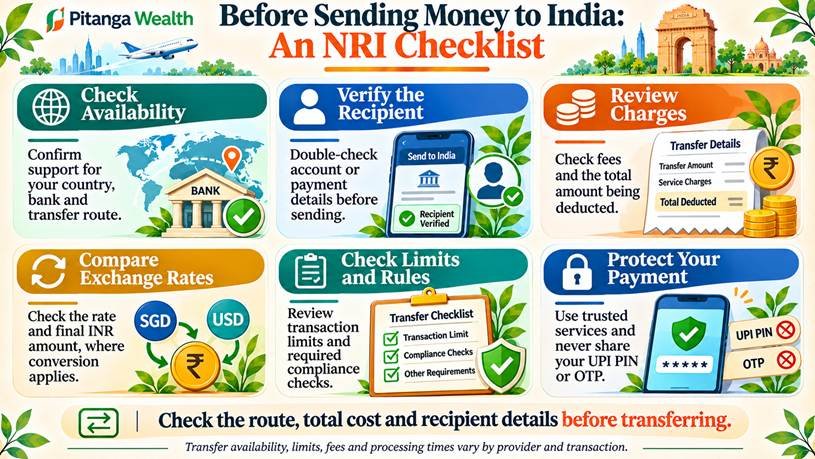
- Identify the actual purpose: Is this a domestic rupee payment, a personal inward remittance or a merchant payment abroad?
- Check eligibility: Confirm the payer’s and recipient’s account types, mobile country codes and participating apps/banks.
- Confirm the live corridor: Use official bank or payment-provider information, not an old country list or social-media post.
- Check limits and permitted uses: Look for rules specific to the arrangement, payment direction and purpose.
- Compare full costs: Review the fee, conversion rate, final amount, validity period and potential deductions.
- Check beneficiary details: Use the correct UPI ID or account information and verify the displayed name.
- Keep proof: Save the transaction reference, confirmation and necessary purpose documentation securely.
- Follow through: Confirm account credit and use the provider’s official dispute or refund process if delayed.
UPI for NRIs: Common Mistakes to Avoid
Confusing “NRI UPI enabled” with “global remittance enabled”
A registered international mobile number can enable eligible Indian-account payments without funding them from a foreign bank. Ask which country-to-country service is actually being offered and which bank accounts it supports.
Assuming every international UPI payment is free or instant
Currency conversion and foreign-provider fees still matter. Some fast-payment linkages may be near real-time; conventional outward or inward transfers can involve bank hours, intermediaries and compliance screening. Use the specific service terms rather than a slogan.
Using the wrong NRE/NRO account for a payment
The legal nature of the account and source of funds matters independently of the convenience of an app. A bank can reject or return a payment that does not satisfy permitted-credit or debit rules. Do not bypass account classification to improve apparent speed.
Sharing UPI credentials or “receiving” through a payment request
NPCI warns that entering a UPI PIN or scanning a payment QR for a supposed incoming transfer can be a fraud trap. An ordinary recipient should not have to reveal a PIN or OTP to receive money. Confirm suspicious instructions directly with the bank through a trusted channel.
Ignoring the recipient’s bank statement
A completed sender-side screen is not a substitute for verified beneficiary credit. If funds are delayed, use the reference number, contact the authorised provider, and avoid resending without understanding whether the first payment may still be processing.
Frequently Asked Questions
Can NRIs use UPI without an Indian mobile number?
Yes, eligible NRIs with supported NRE or NRO accounts may use supported international mobile numbers under NPCI’s framework. Bank, country code, application and verification requirements must be confirmed. An international number alone is not sufficient.
Does UPI for NRIs mean I can send money from any foreign bank?
No. NRI UPI activation generally concerns a supported Indian bank account. Moving money from a foreign bank into India requires an authorised cross-border arrangement, such as a supported corridor or remittance provider.
Can an NRE account be linked to UPI?
NPCI identifies NRE/NRO accounts within its NRI UPI framework, subject to supported banks and applications. Whether a particular NRE savings account works must be checked with its bank and the current provider list.
Can an NRO account be linked to UPI?
An eligible NRO account may be linked where the bank and UPI app support it. Applicable FEMA rules for permitted deposits, debits and remittances continue to apply even when the app makes a payment easy.
Is UPI–PayNow available from Singapore to India?
Yes, the RBI describes a bilateral UPI–PayNow linkage for eligible persons and participating institutions. Users must check live receiving and sending support, allowed purposes, limits and recipient opt-in requirements.
What is the UPI–PayNow daily transfer limit?
RBI’s publicly available FAQ specifies ₹60,000 per day (about SGD 1,000 in its illustration). Treat that as a published linkage-specific figure and confirm the current limit with the institution before sending.
Can I send business payments through UPI–PayNow?
The RBI FAQ describes person-to-person transfers for specified purposes, including gifts and maintenance of relatives abroad. It should not be treated as approval for every business or commercial payment.
Will I receive the money in under one minute?
An eligible UPI–PayNow transaction can generally complete within a minute according to RBI. Other inward remittances can take longer, particularly where foreign-exchange conversion, bank operating hours or compliance checks apply.
What is NPCI Foreign Inward Remittance via UPI?
It is an NPCI-described facility through which eligible inward remittances can be credited to UPI-linked Indian bank accounts through participating arrangements. Availability is specific to the overseas originator, banks, countries and apps.
Can I pay an Indian merchant from Dubai using an NRO account?
Potentially, if your bank, international mobile country code, UPI app and transaction are eligible. The payment may use the rupee balance in India and should not be confused with a UAE-to-India currency remittance.
Does UPI work for all NRIs in the United States or UK?
No universal availability can be assumed. NPCI’s supported country codes and participating banks/apps may change, and cross-border remittance corridors are separate from ordinary NRI UPI onboarding.
What are the hidden costs in an international transfer?
Possible costs include exchange-rate margin, provider fees, intermediary or beneficiary-bank charges, and applicable taxes. Compare the amount actually credited in INR rather than only the advertised transaction fee.
Should I enter my UPI PIN to receive an international remittance?
Never share a UPI PIN or OTP with a sender. Be suspicious of instructions to scan a QR code or approve a payment request to receive funds. Follow only your bank or UPI app’s authenticated instructions.
How do I report a delayed or failed inward transfer?
Keep the sender’s reference, transaction date and amount, verify whether the beneficiary account was credited, and raise a query through the authorised sending provider and receiving bank. Avoid duplicate transfers until status is established.
Conclusion: Match the Payment Route to the Real Need
The promise of UPI for NRIs is meaningful: eligible overseas mobile numbers can make Indian-account payments more convenient, while selected international arrangements can shorten genuine remittances. But an app feature, an Indian bank account and an overseas-to-India corridor are three distinct things. Understanding the route is more useful than assuming every UPI-branded feature sends foreign currency instantly.
Before paying or sending money, confirm the supported parties, account type, purpose, fees, exchange rate, limit and beneficiary credit process. For significant transfers or unusual tax, FEMA or residency circumstances, obtain guidance from your bank and a qualified adviser. Convenience is most valuable when the underlying transaction is also permitted, transparent and secure.
Educational Disclaimer
This article is for general financial education by Pitanga Wealth and is not individual banking, investment, remittance, tax or legal advice. Banking and payment service availability can change by jurisdiction, country code, app, account type and institution. All limits, timelines and regulations are stated with their official context as researched on 9 November 2026; reconfirm them before acting. Cross-border transactions must satisfy applicable FEMA, AML/KYC and other rules. No payment speed, exchange rate, tax result, refund or service availability is guaranteed.
Written by Pitanga Wealth Team.
Follow us on Instagram @pitangawealth for more educational insights.
This article is for educational and informational purposes only. It is not investment, tax, legal or insurance advice. Consider your circumstances and relevant documents before making a financial decision.