


Financial records are increasingly accessible online, yet there are circumstances in which an investor cannot personally complete every form, visit a bank branch or coordinate each transaction. An older adult may need help with paperwork. An NRI may be overseas when an Indian institution requests signed documents. A person recovering from an illness may want a trusted relative to handle narrowly defined administrative steps.
A power of attorney for investments in India can sometimes help in these situations, but it should never be treated as a blanket invitation for someone else to control your savings. It is a legal authorisation with a defined scope, not a substitute for sound financial judgement, institutional safeguards or professional advice.
This guide explains how an investment-related Power of Attorney (PoA) works, where financial institutions may accept one, what rules apply to mutual fund and demat transactions, and how to reduce the risk of misuse. It also explains why a family PoA is not the same thing as the authorisation sometimes offered during stockbroking account opening.
What Is a Power of Attorney for Investments?
A Power of Attorney is a legal instrument by which one person, called the principal or donor, authorises another person, called the attorney or agent, to act on the principal’s behalf within the powers granted. The term “attorney” here does not necessarily mean a lawyer; it refers to the person receiving authority.
The Powers-of-Attorney Act, 1882 recognises the general concept of a person acting for another under such an instrument. However, the exact rights and limitations of a particular PoA also depend on agency law, its wording, relevant personal and commercial circumstances and the requirements of the institution being asked to accept it.

The three people or organisations involved
- Principal: The investment or account holder who grants authority and remains the owner of the assets, subject to applicable law and account terms.
- Attorney or agent: The person named to perform specified acts for the principal.
- Receiving institution: The bank, asset management company (AMC), registrar and transfer agent (RTA), depository participant (DP) or other regulated intermediary that checks whether the authority is acceptable for a proposed transaction.
What authorisation does not automatically mean
Granting a power of attorney for investments in India does not, by itself, transfer beneficial ownership of the investments. Nor does it automatically authorise every investment product, every bank instruction or every form of transfer. An institution may require identification, KYC, specimen signatures, prescribed forms and verification of the instrument before allowing an agent to act.
Why Might Someone Need an Investment-Related PoA?
The sensible reason to use a PoA is to solve a specific access or operational problem, not to give up oversight. Circumstances differ, and sometimes the safer option is to continue using the institution’s own digital authorisation facility.
An NRI managing Indian financial matters
An Indian investor living overseas may need someone in India to submit permitted forms, liaise with a bank or carry out allowable transactions. A properly drafted PoA may help, but non-resident banking and investing remain subject to Foreign Exchange Management Act (FEMA) restrictions and the receiving institution’s procedures.
An older adult who wants help with paperwork
An older investor might choose a reliable relative to obtain statements, communicate with institutions or submit specifically authorised instructions. The principal should remain involved whenever able. A PoA is not evidence that an older investor lacks capacity, and no one should pressure them to sign one.
Temporary illness or mobility constraints
Someone unable to visit an office may authorise narrow administrative actions during recovery. Importantly, an ordinary agency may terminate if the principal becomes of unsound mind under the Indian Contract Act, 1872; do not assume a PoA can automatically operate indefinitely after loss of legal capacity.
Complex recordkeeping across institutions
Investors with several folios, deposits and demat holdings may occasionally need help coordinating paperwork. A power of attorney for investments in India may be useful for discrete duties, but a nominee, joint holder, financial planner and authorised agent all occupy different legal roles.
General PoA vs Special PoA: Which Is More Appropriate?
A general PoA typically grants a comparatively broad range of powers, while a special or limited PoA addresses identified acts, accounts or periods. The precise legal result depends on the wording rather than the label printed at the top.
| Feature | General or broad PoA | Special or limited PoA |
| Scope | May authorise many kinds of actions | Confines authority to specified actions or accounts |
| Control | Greater potential exposure if poorly drafted | Easier to restrict permitted activities |
| Suitable use | Only where breadth is genuinely necessary and reviewed | Often preferable for a defined investment-related task |
| Review requirement | Close scrutiny of every clause | Confirm institution accepts the restricted mandate |
| Main risk | Unintended authority beyond the original purpose | Ambiguity or rejection if permitted acts are unclear |
When evaluating a power of attorney for investments in India, first ask whether a narrowly drafted permission or institution-specific form can solve the problem. Broad authority to sell holdings, receive money, change bank details or appoint another person should never appear casually in a document merely intended for collecting statements.
What Can an Attorney Actually Do With Investments?
There is no universal checklist of powers that every PoA holder receives. A power of attorney for investments in India must be read alongside the relevant institution’s rules. Examples of actions that may be permitted, if properly authorised and accepted, include the following.
Administrative tasks
An agent might be permitted to submit forms, request statements, update specified information or correspond with service providers. Some changes may still require the investor’s direct authentication, fresh KYC or additional verification.
Mutual fund transactions
An AMC or RTA may permit duly authorised purchases, redemptions or other folio-related instructions subject to the PoA’s language and its own process. AMFI states that both the investor who issues the PoA and the constituted attorney must complete KYC in their individual capacities for investments made under a PoA.
Permitted bank instructions
An account-specific banking PoA may cover particular local payments or other allowed operations. A bank can reject an overbroad or inadequately executed document and may insist on its own mandate or supporting documents.
Demat and securities-related actions
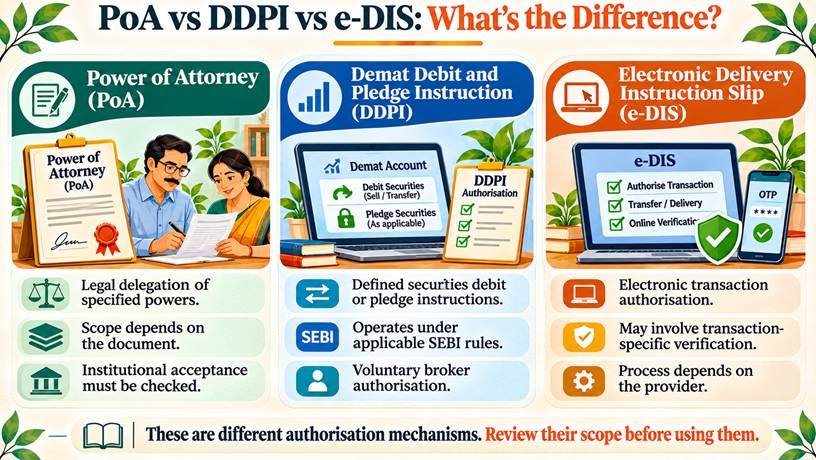
These require special care. The familiar PoA or Demat Debit and Pledge Instruction (DDPI) used in stockbroking is an operational authorisation with SEBI-defined purposes. It is not the same as granting a family member authority to choose investments, nor is it permission for a broker to withdraw securities arbitrarily.
Actions requiring special scrutiny
Changing registered bank accounts, transferring securities outside normal settlement, granting gifts, creating pledges, dealing with property or appointing further agents may be restricted, prohibited or require a separate legal and institutional process. Do not infer permission from a generic clause such as “manage all my financial affairs.”
Power of Attorney for Mutual Fund Investments in India
For mutual funds, the investor retains the economic exposure and remains subject to scheme risks. Authorised paperwork does not remove the need to understand the product, read the scheme documents or confirm the suitability of each transaction.
KYC is required for both sides
AMFI’s investor guidance says the investor and the constituted attorney must separately satisfy KYC requirements when investing through a PoA. KYC is an identity and regulatory compliance process; it does not mean the institution approves the investment decision or guarantees the fund’s returns.
How the institution checks authority
An AMC or RTA may ask for a certified copy of the PoA, identity and signature details, KYC information and its own transaction forms. The precise document list varies, so obtain current requirements from the relevant AMC or RTA before preparing a PoA solely for mutual funds.
Purchases, redemptions and payment safeguards
An institution may allow a clearly authorised agent to sign a permitted transaction request. Redemption payouts ordinarily follow the scheme’s approved payment framework and registered investor-bank arrangements; do not assume the agent can direct proceeds to their personal account. Always confirm the destination of money and review confirmations directly.
A power of attorney for investments in India should ideally identify the applicable folios and any permitted transaction types. If an investor only needs help with documentation, giving unrestricted redemption authority is unnecessary.
Demat Accounts: How PoA, DDPI and e-DIS Differ
Many new investors encounter a “Power of Attorney” while opening a trading and demat account. This is where misunderstandings are common.
PoA was traditionally used for specified broker operations
SEBI’s investor material explains that a client PoA for a broker could allow prescribed operations associated with securities settlement. SEBI also states that executing a PoA is not mandatory for a trading or demat account. An investor should not be pressured to sign a general PoA as a condition of access.
DDPI is a narrower regulatory authorisation
SEBI introduced Demat Debit and Pledge Instructions (DDPI) to support defined settlement and pledge/re-pledge purposes. Under the framework, DDPI is a voluntary document and must be executed with the client’s explicit consent. Existing eligible PoAs can remain valid until revoked under the relevant framework, but new broker authorisation should be assessed according to current SEBI rules.
Investors may use DIS or e-DIS alternatives
SEBI’s framework also recognises physical Delivery Instruction Slips (DIS) or electronic DIS (e-DIS) for appropriate settlement instructions. Where an alternative is available and suitable, the investor may prefer authorising a particular transaction rather than providing an ongoing mandate.
Broker authority does not equal discretionary portfolio management
A power of attorney for investments in India should never be confused with a licence for a broker or relative to trade freely on an investor’s behalf. Trading, advisory and portfolio management activities are subject to their respective regulatory frameworks. Check the scope of any authority, avoid sharing passwords and review depository alerts.
NRI Power of Attorney: What Changes When You Live Abroad?
Non-resident Indians may face distance, time-zone and documentation barriers. A PoA can help with permitted Indian-side operations, but the underlying account and investment restrictions remain in force.
NRE and FCNR(B) account restrictions
RBI guidance allows specified operations under a PoA granted by an eligible non-resident account holder to a resident, including permitted local payments and remittances through banking channels to the account holder, subject to the account type and applicable rules. Authorisation does not allow unrestricted gifting or transfers to third parties.
NRO account restrictions
RBI guidance describes permitted local rupee payments, including eligible investments subject to regulations, and limited remittances of current income net of taxes. A resident attorney generally cannot use the principal’s NRO account for unrelated gifts, transfers to another NRO account or remittances to third parties contrary to the rules.
Execution abroad, attestation and apostille
If the principal signs abroad, the accepting institution may ask for notarisation, consular authentication or an apostille, along with applicable stamping and verification on arrival in India. The Registration Act, 1908 provides particular authentication rules for an agent presenting documents for registration. The Hague Apostille Convention can simplify document legalisation between participating countries, but it does not waive all Indian stamp, registration or institution-specific requirements.
Always verify product eligibility
A power of attorney for investments in India does not cure an otherwise ineligible NRI transaction. The principal’s residential status, permitted account routes, tax treatment, investment restrictions and the intermediary’s rules must still be checked. When facts span countries, obtain legal and tax guidance in the relevant jurisdictions.
How to Prepare a Limited PoA for Investment Administration
The following steps are a preparation framework, not a universally valid PoA template. The legal requirements and institution’s acceptance criteria should be confirmed before signing.
Step 1: Define the task before naming the person
Write down the exact problem: for example, submitting mutual fund service forms or arranging a permitted bank-related operation while abroad. If access to statements is enough, avoid giving authority to redeem or transfer assets.
Step 2: Choose a reliable attorney
Consider the person’s trustworthiness, ability to keep records, availability and willingness to follow instructions. Family relationship alone does not establish suitability. Discuss what they may and may not do before appointing them.
Step 3: Specify the accounts and permitted actions
Where appropriate, identify institutions, account categories or folios, allowed transactions, monetary limits and any conditions requiring written approval. Keep sensitive account numbers in secure institution-specific records when possible.
Step 4: Add exclusions and safeguards
Common safeguards include prohibiting gifts, personal transfers, borrowing, sub-delegation and conflict-of-interest transactions unless specifically intended and legally supported. Consider an expiry date, reporting obligations and direct confirmations to the principal.
Step 5: Check local execution requirements
Stamp duty and execution formalities vary by instrument, state and intended transaction. The relevant institution may have its own format. Some property-registration or document-presentation acts have particular authentication requirements. A generic assertion that every investment PoA must be registered, or that none ever needs registration, would be misleading.
Step 6: Submit and obtain institutional acknowledgement
Give the institution the PoA and accompanying KYC or identity documents it requires. Obtain written confirmation of acceptance and what rights it has actually activated. Keep a dated record and store the original securely.
Step 7: Monitor and review periodically
A power of attorney for investments in India requires continuing oversight: check statements, alerts and transactions, verify that the purpose still exists and withdraw unnecessary authority using the correct legal and institutional steps.
Essential Safeguards Against Misuse
The strongest protection when granting a power of attorney for investments in India is proportionality: authorise only what is necessary, keep independent access to your records and ensure the principal receives information directly.
Do not hand over passwords or OTPs
SEBI’s investor education resources warn against sharing trading passwords, even with trusted persons. A legally authorised representative should use an approved institutional process rather than impersonating the account holder online.
Ask for transaction-level alerts
Keep email, SMS and app alerts linked to channels the principal independently controls. Review account and consolidated statements for unexpected debits, redemptions or new payees.
Prevent self-dealing
Where possible, exclude the agent from sending funds to their own accounts, making gifts to themselves or receiving investments in their own name. Conflicts can trigger legal and financial disputes even when the agent is a close relative.
Review unexpected requests immediately
Treat requests for blank signed forms, unrestricted account access, unusual “processing” payments or secrecy as warning signs. Ask the institution to confirm the actual requirement through an official channel.
Keep a revocation plan ready
Know how to revoke the PoA, whom to notify and which institutions must update their records. A signed revocation document alone may not instantly disable every previously activated channel. Under agency law, notice and the knowledge of third parties can matter.

How Do You Revoke a Power of Attorney?
The Indian Contract Act generally addresses termination of agency by revocation, renunciation, completion of the authorised business, death or unsoundness of mind, with exceptions and qualifications. Section 202, for example, addresses certain agencies in which the agent has an interest in the subject matter. Legal advice is important for unusual “irrevocable” clauses.
Practical revocation steps
- Review the existing PoA and legal requirements for revoking it.
- Execute an appropriate revocation instrument with professional guidance where necessary.
- Deliver dated written notice to the attorney and every institution that accepted the PoA.
- Request confirmation that permissions, standing mandates or account flags have been updated.
- Review recent transactions, change credentials if compromised and keep the records.
If the PoA was executed, authenticated or registered in a particular way, ask counsel whether an additional formal step is needed. A power of attorney for investments in India should not be assumed to continue automatically after the principal’s death; heirs, nominees, executors and institutional claimants follow separate rules.
PoA vs Nominee vs Joint Holder vs Will
These four concepts address different questions and should not be used interchangeably.
| Arrangement | Main function | Key limitation |
| Power of Attorney | Authorises specified actions during the principal’s lifetime | Does not itself transfer ownership or replace succession processes |
| Nomination | Names a person under an account or product’s nomination rules | Rights differ by product and applicable law |
| Joint holding | Establishes rights and operations according to account and ownership terms | A joint holder is not merely an attorney |
| Will | Records intended distribution of eligible estate assets after death | Must comply with succession law and does not automatically update each account record |
Someone may need a PoA to administer a transaction during life and a Will or nomination review to plan for death. They solve different problems. For a fuller explanation of the latter, see Pitanga Wealth’s article, “Nomination vs Will: Why You Need Both,” once its published URL is confirmed.
Three Practical Examples
Example 1: An NRI handling routine mutual fund paperwork
Rahul, a fictional NRI, holds eligible Indian mutual fund investments. An AMC asks for a prescribed form that he cannot conveniently submit in person. After confirming the AMC’s process, Rahul arranges a limited PoA allowing his sister to submit specific permitted instructions. Both comply with applicable KYC rules. Rahul receives transaction confirmations directly and continues to monitor the folio.
The example does not imply that every NRI account, fund or transaction is eligible, nor that an attorney can receive redemption money into a personal account.
Example 2: A senior investor with a mobility limitation
Meera wants her adult son to help obtain statements and submit an account-maintenance form. A restricted authority can identify these administrative tasks without permitting the son to select investments or redeem assets. She keeps copies of every form and verifies institutional acknowledgement.
A power of attorney for investments in India can be helpful when it preserves the principal’s agency and independence rather than replacing their choices.
Example 3: A new demat account holder asked to sign DDPI
Anika opens a demat account and is shown an optional DDPI. Before signing, she reviews which settlement or pledge activities it covers, asks about e-DIS or physical DIS alternatives and checks how to withdraw the mandate later. She does not treat DDPI as a general permission for a broker to make investment decisions.
Common Mistakes to Avoid
Signing a broad document without reading every power
A blanket “manage any financial asset” clause may reach much further than the original reason for giving the authority. Restrict the actions and clarify ambiguities before execution.
Assuming broker PoA is compulsory
SEBI materials describe the relevant PoA and DDPI arrangements as voluntary, and identify authorised alternatives. Do not sign a document just because it appears in a large account-opening package.
Ignoring mutual fund KYC requirements
AMFI specifies KYC for both the principal and PoA holder in PoA-based mutual fund investments. Failing to prepare both records can delay or prevent acceptance.
Overlooking FEMA restrictions for NRIs
Permitted local operations do not mean unlimited remittances, gifts or changes to investment ownership. Verify the relevant NRE, NRO or other account rules.
Forgetting to notify institutions after revocation
The attorney may be told that a PoA has ended, while an institution still holds the earlier document. Written notification and confirmation are essential practical safeguards.
Using a PoA as a Will or inheritance shortcut
An ordinary PoA is primarily a lifetime authority arrangement. It is not a substitute for nominations, estate records or a legally valid Will.
A Checklist Before You Sign
- I can explain why a PoA is needed instead of a simpler alternative.
- I have identified the exact permitted acts and institutions.
- Broad transfers, gifts, borrowing and self-dealing are excluded unless deliberately authorised.
- The attorney understands the responsibilities and limitations.
- Required identity checks and KYC steps have been confirmed.
- Stamping, authentication and registration requirements have been checked for the intended use.
- I have verified any FEMA or non-resident account restrictions.
- I will receive account alerts and transaction confirmations directly.
- I know how to notify institutions and revoke the authority.
- I understand this is not a substitute for a Will, a nominee or suitable investment advice.
Frequently Asked Questions
1. What is a power of attorney for investments in India?
It is an authorisation that may allow a named person to complete specified investment-related actions on the principal’s behalf, subject to its terms and the receiving institution’s acceptance. It does not automatically transfer ownership of the investments.
2. Is a Power of Attorney mandatory to open a demat account?
No. SEBI investor materials state that a broker PoA is not compulsory. Investors should also understand the voluntary DDPI framework and available transaction authorisation methods such as DIS or e-DIS.
3. Can my spouse or child operate my mutual fund investments using a PoA?
Potentially, if the PoA authorises the relevant actions, the AMC or RTA accepts it and the required procedures are followed. AMFI states that both the investor and the PoA holder must complete their own KYC requirements.
4. Can the PoA holder redeem mutual fund units?
An AMC may accept a properly authorised redemption instruction subject to its processes. Do not presume that the proceeds can be redirected to the attorney’s personal bank account.
5. Does signing a PoA transfer ownership of shares or mutual funds?
No, not merely by granting agency authority. Transfers and changes of beneficial ownership require their own applicable legal and operational conditions.
6. Is a general PoA safer than a special PoA?
Not automatically. When only a limited task is needed, a narrowly defined authority can reduce unintended permissions, provided the receiving institution accepts it.
7. Does a PoA need to be registered in India?
There is no universal answer for every kind of PoA. Requirements depend on the instrument’s purpose, state law, contemplated act and institution. Certain document-registration activities have specific authentication rules under the Registration Act.
8. Can an NRI execute a PoA while abroad?
Often yes, subject to the relevant authority, notarisation, consular or apostille requirements, Indian stamping considerations and the receiving institution’s acceptance process. Verify the destination institution’s requirements first.
9. Can a resident PoA holder operate an NRE or NRO account without restriction?
No. RBI sets restrictions according to account type, eligible purposes and remittance destinations. A resident attorney does not receive unrestricted authority to gift or transfer non-resident funds.
10. Does a PoA remain valid after the principal dies?
Ordinary agency generally terminates on death under Section 201 of the Indian Contract Act, subject to applicable legal qualifications. After death, claim and succession procedures are separate from ordinary lifetime agency.
11. Can I revoke a PoA?
Often yes, subject to the instrument, applicable law and special cases such as an agency coupled with interest. Notify the attorney and all affected institutions, and seek confirmation that their records were updated.
12. Is DDPI the same as a family Power of Attorney?
No. DDPI is a defined securities-market authorisation for specified demat-related operations. A family PoA may address different tasks and is not automatically accepted as a broker DDPI.
13. Can a PoA holder make investment decisions without asking me?
Only if the relevant conduct is legally permitted, falls within valid authority and is consistent with the institution’s and regulatory requirements. Giving administrative authority should not be assumed to confer unrestricted discretionary investment management powers.
14. What should I do if I suspect misuse?
Contact the bank, AMC, DP or broker promptly through official channels, request restrictions where available and preserve statements and correspondence. Consider legal advice and the relevant grievance or regulatory channels based on the circumstances.
Final Thoughts
A power of attorney for investments in India is most useful when it solves a narrow, genuine access problem and preserves the investor’s ability to monitor the result. It can help with certain authorised paperwork and transactions, but it cannot bypass KYC, FEMA restrictions, securities-market safeguards or the basic need to understand investment risk.
Before signing, clarify why authority is necessary, define its limits, confirm acceptance with each financial institution, and put safeguards and revocation procedures in place. Treat the document as a carefully controlled legal tool, not a replacement for personal oversight or long-term estate planning.
Important Legal and Financial Disclaimer
This article is for general education and awareness and does not constitute personalised investment, legal, taxation or foreign-exchange advice. Whether a particular PoA is valid or acceptable depends on its wording, execution, stamping, applicable state and central laws, institutional processes and the specific transaction. Regulatory requirements and operational procedures may change after publication. Examples are fictional and are not transaction recommendations. Pitanga Wealth provides financial education and mutual fund distribution, not a legal opinion or assurance of a financial outcome. Consult a qualified Indian legal professional and relevant financial institution before executing, using or revoking a PoA. Mutual fund investments are subject to market risks; read all scheme-related documents carefully.
Written by Pitanga Wealth Team.
Follow us on Instagram @pitangawealth for more educational insights.
This article is for educational and informational purposes only. It is not investment, tax, legal or insurance advice. Consider your circumstances and relevant documents before making a financial decision.