


Preparing a Will can feel like something to do much later in life. Yet property, savings, financial accounts and family responsibilities can become more complicated long before retirement. Without a clear record of your wishes, your family may have to identify assets, interpret ownership documents and navigate succession procedures at a difficult time.
A Will is one part of estate planning: a legal declaration about how eligible property should be dealt with after a person’s death. It does not replace insurance, nomination records, an asset inventory or conversations about where important documents can be found. But it can help communicate intentions that might otherwise remain unclear.
If you are wondering how to write a will in India, start with the basics rather than copying a form from the internet. Understanding who owns each asset, the applicable personal law, the role of an executor and the signing requirements is more important than producing an impressive-looking document.
This practical guide explains the typical steps, common mistakes and legal points that deserve professional attention. It is general educational information, not a substitute for advice on an individual estate.
What Is a Will and Why Does Estate Planning Matter?
A Will sets out a person’s testamentary intentions for property that can legally pass through their estate after death. The person making it is generally called the testator; people intended to receive property are beneficiaries; and an executor is the person chosen to help administer the estate under the Will and applicable procedures.
A Will generally takes effect on death, not simply when it is signed. The maker can ordinarily reconsider or change their wishes while alive and legally competent, following the applicable rules. It cannot create ownership over an asset that does not belong to the maker.
What happens when someone dies without a Will?
A person who dies without a valid Will for the relevant assets is described as dying intestate. Distribution then depends on the applicable succession law, the nature of ownership and any special legal arrangements. Family assumptions about who “should get” a bank balance or property may not match the legal process.
India has different personal-law frameworks, and not every family follows the same rules. When learning how to write a will in India, first identify which inheritance and testamentary rules apply to the maker; do not assume a single template settles every situation.
What a Will can and cannot do
A carefully prepared Will can identify intended beneficiaries, describe eligible estate assets, appoint an executor, provide for alternative beneficiaries and express wishes concerning minor children. However, a Will cannot simply override another person’s ownership, wipe out the deceased’s debts, rewrite every financial product contract or guarantee an undisputed transfer.
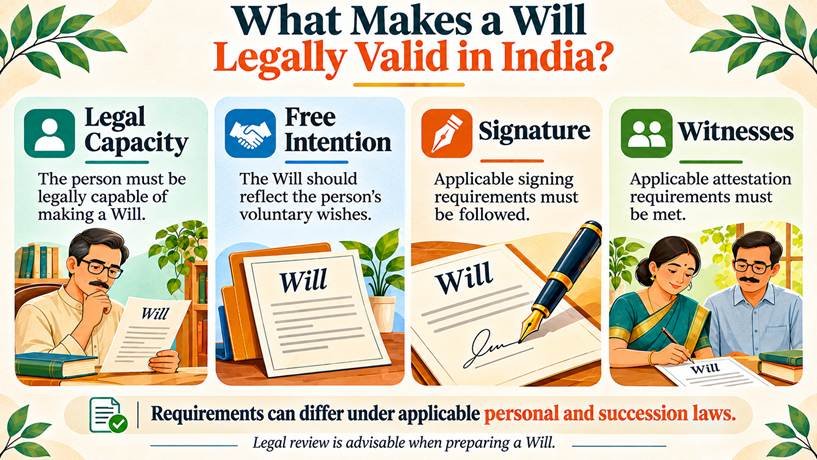
Who Can Make a Will in India?
Section 59 of the Indian Succession Act, 1925 generally recognises the capacity of a person of sound mind who is not a minor to make a Will. It also explains that a physical disability does not, by itself, remove capacity when the person understands what they are doing. Capacity and the applicable statutory provisions must be considered in the particular case.
Mental capacity and free choice
The maker should understand broadly the nature of the document, the assets involved and the people who may reasonably be affected. Fraud, coercion or undue influence can make a Will vulnerable to challenge. If there are serious questions about capacity, obtain specialised legal advice and appropriate contemporaneous records rather than assuming a signature settles the issue.
Personal laws and ownership restrictions
The Indian Succession Act does not apply identically to all communities. Muslim testamentary succession, for example, has important personal-law distinctions, including restrictions that may apply to the disposable share of an estate. Hindu joint-family or coparcenary property can also present ownership questions. People with cross-border assets, blended families or business interests may need specialist guidance.
A sound approach to how to write a will in India is to distinguish what you own from what you use, manage or expect to inherit.
How to Write a Will in India: A 12-Step Starting Framework
The following sequence is an educational planning framework. It is not a legally sufficient fill-in-the-blank Will. The exact language and execution process should be reviewed against the maker’s personal law and circumstances.
Step 1: List your assets and important liabilities
Create a private inventory of bank deposits, mutual fund folios, demat accounts, real estate, business interests, vehicles, jewellery, valuable possessions and eligible digital assets. Include loans, mortgages and material obligations. Keep account identifiers and supporting documents in a secure companion record rather than publishing sensitive information inside broadly shared copies.
Include assets held alone and jointly, but flag the difference. A personal inventory can help a lawyer identify what can actually be gifted under a Will.
Step 2: Check who legally owns each asset
Review title deeds, purchase documents, shareholding records, bank mandates, HUF or family arrangements and co-ownership shares. Do not assume that paying for an asset, living in a house or operating a bank account automatically means exclusive ownership.
For example, if a home belongs to two people, one person’s Will cannot automatically dispose of the entire property. The relevant ownership share and any applicable succession restrictions must be examined.
Step 3: Record family details and potential beneficiaries
Write down accurate names and relationships of the people you wish to benefit. Consider dependants, minor children, elderly relatives and anyone who may require ongoing support. Record enough identifying information to avoid confusion between people with similar names, without inserting unnecessary sensitive identity numbers.
If a beneficiary dies before the maker, decide whether another person or that beneficiary’s descendants should take the relevant interest, subject to legal advice.
Step 4: Choose a suitable executor and an alternative
An executor is entrusted with implementing the Will and handling estate administration as the law permits. Choose someone willing, capable, organised and likely to be reachable. Discuss the responsibility before naming them, and consider an alternative in case the first choice cannot act.
Executors may have to locate documents, engage with institutions, account for debts and expenses, and deal with legal procedures. Naming a trusted person is useful, but it does not remove statutory duties or potential conflicts.
Step 5: Explain specific gifts clearly
A specific gift might concern a clearly identified property interest, jewellery item or other asset. Describe the asset and the intended beneficiary in a way that reduces ambiguity. Where property is co-owned or subject to a loan, the Will should not imply that the beneficiary receives more than the maker can legally transfer.
A statement such as “my assets go to my family” may leave important questions unanswered. Clarity is central to how to write a will in India, but clarity of language does not cure a defect in ownership or execution.
Step 6: Include a plan for the remaining estate
A residuary clause deals with eligible estate property that is not specifically addressed, including assets acquired later or gifts that cannot take effect as planned. Without a well-considered residual provision, part of an estate may require distribution under the relevant intestacy rules.
Professional drafting is particularly useful when several beneficiaries are involved or when assets may change over time.
Step 7: Consider minor children and vulnerable dependants
Where appropriate, state preferences concerning care, guardianship and how any property intended for a minor should be handled. Guardianship outcomes are governed by applicable law and the child’s welfare; a clause in a Will does not guarantee that a court will appoint a named guardian.
If a beneficiary has a disability, complex care needs or concerns about managing a lump sum, a lawyer can consider whether a different lawful structure is suitable.
Step 8: Address debts, expenses and practical administration
An estate may have liabilities, taxes, expenses and claims that must be addressed before the remaining property is distributed. A Will should not promise beneficiaries an asset free from legal obligations that continue to attach to it. Specify practical instructions only after understanding the available estate assets and the relevant duties of the executor.
Step 9: Prepare a clear written draft
Use straightforward language, consistent names, accurate descriptions and a clearly dated document. For ordinary Wills governed by the Indian Succession Act’s unprivileged-Will formalities, handwritten and typed forms can both be considered; the key issue is valid execution, not decorative legal language.
Avoid blanks, contradictory instructions, unexplained corrections and copied clauses that are inappropriate to the family. A legal professional can check that the draft reflects the maker’s intentions without unintended consequences.
Step 10: Sign with the required witnesses
For an ordinary unprivileged Will covered by Section 63 of the Indian Succession Act, the maker signs or makes a mark (or a person signs in the maker’s presence and by direction), and two or more attesting witnesses are required. Each witness must satisfy the statutory requirements concerning seeing the signature or receiving personal acknowledgment, and must sign in the maker’s presence. The witnesses do not necessarily have to be present simultaneously with each other.
Independent adult witnesses who are not beneficiaries are generally a prudent choice. Certain gifts to attesting witnesses or their spouses may have adverse legal consequences under applicable provisions. Personal-law exceptions and unusual circumstances need proper advice. Simply adding signatures after an event may not satisfy the legal test.
Step 11: Decide whether to register and where to store the original
Registration of a Will is generally optional under Section 18 of the Registration Act, 1908. A Will may be presented for registration at a later time under the Act’s provisions. Registration may help with records, but is not a guarantee that a Will is valid or dispute-proof. Notarisation or expensive stamp paper should not be mistaken for the required statutory execution steps.
Keep the signed original secure and retrievable. Inform a trusted person or the executor how to locate it without giving unrestricted access to financial passwords, PINs or OTPs.
Step 12: Coordinate nominations and review the Will regularly
Review nominee details for eligible bank accounts, mutual funds, demat holdings and insurance policies. Nomination and succession are related but not identical; the nominee’s legal status can differ by product and statute. Record updates, major acquisitions, births, deaths, marriages, separations, relocations and other material changes that may warrant a review.
The final step in how to write a will in India is not filing away the document permanently. It is making sure the Will, ownership records and family circumstances continue to make sense together.

Signing a Will: What Do Two Witnesses Actually Need to Do?
Witnessing is not merely an administrative formality. The ordinary statutory requirements under Section 63 focus on the maker’s execution or acknowledgment and each witness signing in the maker’s presence. A dispute can turn on whether these events were actually proved.
A simple execution checklist
- Confirm the document expresses the maker’s own intentions and the maker understands it.
- Check the final document for missing pages, inconsistent names and material blanks.
- Arrange two suitable, independent witnesses and explain the purpose of attestation.
- Follow the signing and acknowledgment requirements under the applicable law.
- Ensure each witness signs in the maker’s presence and is identifiable later.
- Store the final original securely; avoid informal alteration after signing.
In deciding how to write a will in India, do not substitute a scanned signature, a witness’s later recollection or a generic online checkbox for valid execution. The legal effect of digital or electronic methods should be assessed by a qualified professional rather than assumed.
Is Registration or Stamp Paper Necessary for a Will?
Knowing how to write a will in India also means separating mandatory execution requirements from optional recordkeeping. Many first-time readers focus on stamped documents because property transactions often involve stamp duty and registration. An ordinary Will is different from a sale deed or gift deed. The Registration Act identifies Wills as documents whose registration is optional, and Section 27 permits presentation or deposit at any time under the relevant procedures.
What registration may help with
Registration may create an institutional record and can make document identification easier in some situations. It does not automatically prove capacity, remove coercion concerns or prevent every challenge. Conversely, a properly executed unregistered Will is not invalid simply because it was not registered.
When legal assistance is especially important
Seek guidance if the Will involves multiple properties, foreign assets, non-resident beneficiaries, substantial business interests, family disputes, special-needs beneficiaries or personal-law restrictions. A lawyer can advise on drafting, execution and registration choices suitable to the situation.
Probate and Wills: What Changed in December 2025?
India’s Repealing and Amending Act, 2025, dated 20 December 2025, omitted Section 213 of the Indian Succession Act. That provision had previously restricted establishing certain executor or legatee rights in court without probate or letters of administration in specified cases. The amendment changed the historical mandatory-probate framework.
However, it does not mean every Will will automatically be accepted without questions, that probate is legally impossible, or that banks, registries and courts will never require additional estate documents. A contested Will or complicated transfer may still involve court proceedings or other proof. The exact position should be checked for the asset, institution, personal law and pending case.
Older online guides sometimes still state that probate is invariably compulsory in specified cities. When researching how to write a will in India in 2026, distinguish outdated summaries from current statutory text and current institutional procedures.
Will vs Nomination: Why Both Records Matter
A nomination generally identifies a person under the rules of a particular account, policy or holding. A Will sets out testamentary intentions for assets legally forming part of an estate. The eventual entitlement of a nominee is not identical across all products.
| Question | Nomination | Will |
| What does it record? | An institutional nominee for a specified asset or product | Testamentary intentions for eligible estate assets |
| Where is it maintained? | With the relevant bank, insurer, AMC, depository or other institution | In a properly executed testamentary document |
| Does it always establish ownership? | No; legal effect depends on applicable law | Only as permitted by ownership, validity and succession law |
| Can one replace the other? | Not generally a universal estate plan | Does not automatically update institutional nominee records |
For readers comparing how to write a will in India with nomination requirements, the practical task is to review the two sets of records together without assuming that they have the same legal function.
Example: A Family Planning Its First Will
Consider a fictional married person named Asha. She has a jointly owned apartment, a savings account, mutual fund holdings, a life insurance policy, a home loan and two minor children. She wants to write down her wishes but has never checked how the accounts are held.
Her first task is to identify her legal interest in the apartment rather than treating the whole house as hers alone. Next she checks loan obligations, bank and investment nominee details, the insurance policy’s beneficiary arrangements and whether the property is subject to any other rights.
After understanding those facts and the applicable personal law, she can discuss a draft with a lawyer, name a capable executor and consider a lawful arrangement for assets intended for the children. She also records where supporting documents are stored so that a trusted person knows how to begin.
For a beginner, how to write a will in India is therefore a series of ownership checks before it becomes a document. This example illustrates a process, not a declaration of who must inherit which assets. The correct legal outcome would depend on title, policy terms, valid testamentary provisions and applicable law.
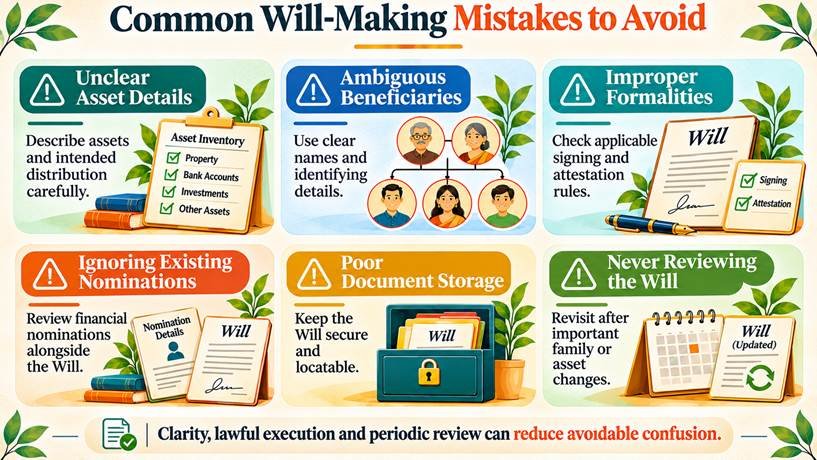
Common Mistakes People Make When Writing a First Will
1. Copying a template without checking personal law
A generic form may omit legally relevant restrictions, special family structures or necessary execution details. The law governing one family may differ from that governing another.
2. Treating jointly held assets as exclusively owned
Joint ownership, survivorship instructions, co-ownership and family property issues require careful analysis. A Will cannot distribute someone else’s interest.
3. Naming an unsuitable executor
A person may be trusted but unavailable, unwilling or unable to manage the work. Consider a willing alternative.
4. Leaving the residual estate unaddressed
A Will might list one house and one bank account but fail to explain what happens to future or forgotten assets.
5. Choosing witnesses without considering conflicts
Using a beneficiary as a witness may trigger complications under applicable provisions. Independent witnesses are usually a safer practical choice.
6. Assuming registration makes defects disappear
Registration cannot automatically cure problems with capacity, ownership, coercion or the terms of the Will.
7. Ignoring nominations and insurance arrangements
Product-specific nomination or beneficial-entitlement rules may affect how claims and eventual rights are assessed.
8. Hiding the only copy or leaving no record of its location
A valid document is harder to administer if nobody can find it. At the same time, sensitive credentials should remain protected.
9. Never reviewing the Will after major changes
A new child, property sale, marriage, separation or death of a beneficiary can make old instructions unsuitable. Changes should be executed lawfully, not scribbled into a signed original without advice.
The recurring lesson in how to write a will in India is to prioritise precise facts, lawful execution and ongoing review over speed.
A First-Will Preparation Checklist
Before meeting a legal professional, gather a concise planning file. You need not collect every original certificate on day one; begin with information that helps identify ownership and responsibilities.
- ☐ Names and contact details of close family members and intended beneficiaries.
- ☐ Inventory of personally held and jointly held assets.
- ☐ List of loans, mortgages and important liabilities.
- ☐ Relevant title deeds, statements and policy references.
- ☐ Details of current nominees and joint-holder arrangements.
- ☐ Initial thoughts about an executor and alternative executor.
- ☐ Preferences concerning eligible gifts and the remaining estate.
- ☐ Information about dependants and potential guardianship concerns.
- ☐ Known cross-border, family-business or personal-law complexities.
- ☐ Secure plan for storing the executed original and notifying the right person.
This checklist is a preparation aid, not proof that a Will will be valid. It can make professional discussions more focused and help reduce accidental omissions.
Frequently Asked Questions About Writing a Will in India
1. Is a Will compulsory in India?
No. Making a Will is generally a choice. Without a valid Will for eligible assets, distribution follows the applicable intestate succession framework and other legal arrangements.
2. Who is legally eligible to make a Will?
Under the generally applicable Section 59 framework, a person who is not a minor and is of sound mind may make a Will. Personal-law application and actual capacity must be examined in context.
3. Can I write my own Will without hiring a lawyer?
A professionally drafted Will is not universally mandatory. Someone researching how to write a will in India independently should still check execution and ownership with a qualified professional when uncertain. Complex ownership, family circumstances, personal law, witnessing or disputes may make legal review important. A basic draft should not be confused with valid execution.
4. Does a Will have to be handwritten?
For ordinary Wills governed by the relevant statutory formalities, the document need not necessarily be handwritten. The substantive intentions and required signing and attestation matter. Special categories and personal-law exceptions need separate consideration.
5. Must a Will be made on stamp paper?
Do not assume expensive stamp paper is required merely because the document is a Will. The applicable law focuses on the character and valid execution of the document. Obtain advice on any special local procedure or linked transaction.
6. Is Will registration mandatory in India?
Registration is generally optional under the Registration Act, 1908. A registered Will is not automatically immune from legal challenge, and non-registration does not by itself make an otherwise valid Will invalid.
7. How many witnesses are required?
An ordinary unprivileged Will covered by Section 63 generally needs at least two attesting witnesses, with the statutory signature and acknowledgment requirements fulfilled. Different rules may apply to specific exceptional categories and personal-law situations.
8. Can my beneficiary also be a witness?
Using an interested witness can create significant legal risks, including consequences for a bequest under applicable provisions. Independent, non-beneficiary witnesses are usually preferable.
9. Can a Will cover property that I jointly own?
A Will may address an interest the maker legally owns and can dispose of, but should not purport to transfer the co-owner’s separate share. The title documents and applicable law determine the position.
10. Can I update or cancel my Will later?
Generally, a competent maker can change or revoke a Will using the applicable legal formalities. A new Will or properly executed codicil may be appropriate; informal handwritten changes can create disputes.
11. Does a nominee always inherit the account balance?
No universal rule applies. The rights of nominees differ by product and statute. Some arrangements have special beneficial-entitlement rules, so bank, securities and insurance positions should not be treated as identical.
12. Is probate still mandatory after the 2025 change?
The December 2025 amendment omitted Section 213 and changed the historical mandatory-probate rule. That does not remove every possible judicial process, document requirement or dispute concerning the Will.
13. Can a Will appoint a guardian for minor children?
A Will may express guardianship wishes where applicable, but the child’s welfare and governing law control the eventual legal position. Obtain specialised advice when minors are involved.
14. How often should I review my Will?
Review after significant family, ownership or legal changes, and periodically even without a major event. Updates should be made through valid procedures, especially if beneficiaries, assets or the executor have changed.
Final Thoughts
A first Will is not primarily about predicting every future event. It is about clarifying what is legally yours, considering the people affected and recording intentions in a form that meets the applicable rules.
Learning how to write a will in India begins with an accurate asset list, a capable executor, clear beneficiaries and lawful signing. Reviewing nominations and maintaining secure, discoverable records are equally important supporting tasks.
A well-considered estate plan may reduce confusion, but no document guarantees that a family will avoid delay, legal proceedings or disagreement. When assets or family arrangements are complicated, careful legal advice is a valuable part of the process.
Important Legal and Financial Disclaimer
This article is general financial and legal education for readers in India, not personalised legal, tax, estate-planning or investment advice. Testamentary validity, personal-law application, ownership rights, probate, guardianship, beneficiary claims and institutional requirements depend on the specific facts and current law. Examples are fictional. Readers should consult a qualified Indian legal professional before drafting, signing, altering or acting on a Will.
Pitanga Wealth is an AMFI-registered mutual fund distributor (ARN-134606), not represented here as a law firm or a source of legal opinions. Mutual fund investments are subject to market risks. Read all scheme-related documents carefully before investing.
Written by Pitanga Wealth Team.
Follow us on Instagram @pitangawealth for more educational insights.
This article is for educational and informational purposes only. It is not investment, tax, legal or insurance advice. Consider your circumstances and relevant documents before making a financial decision.