

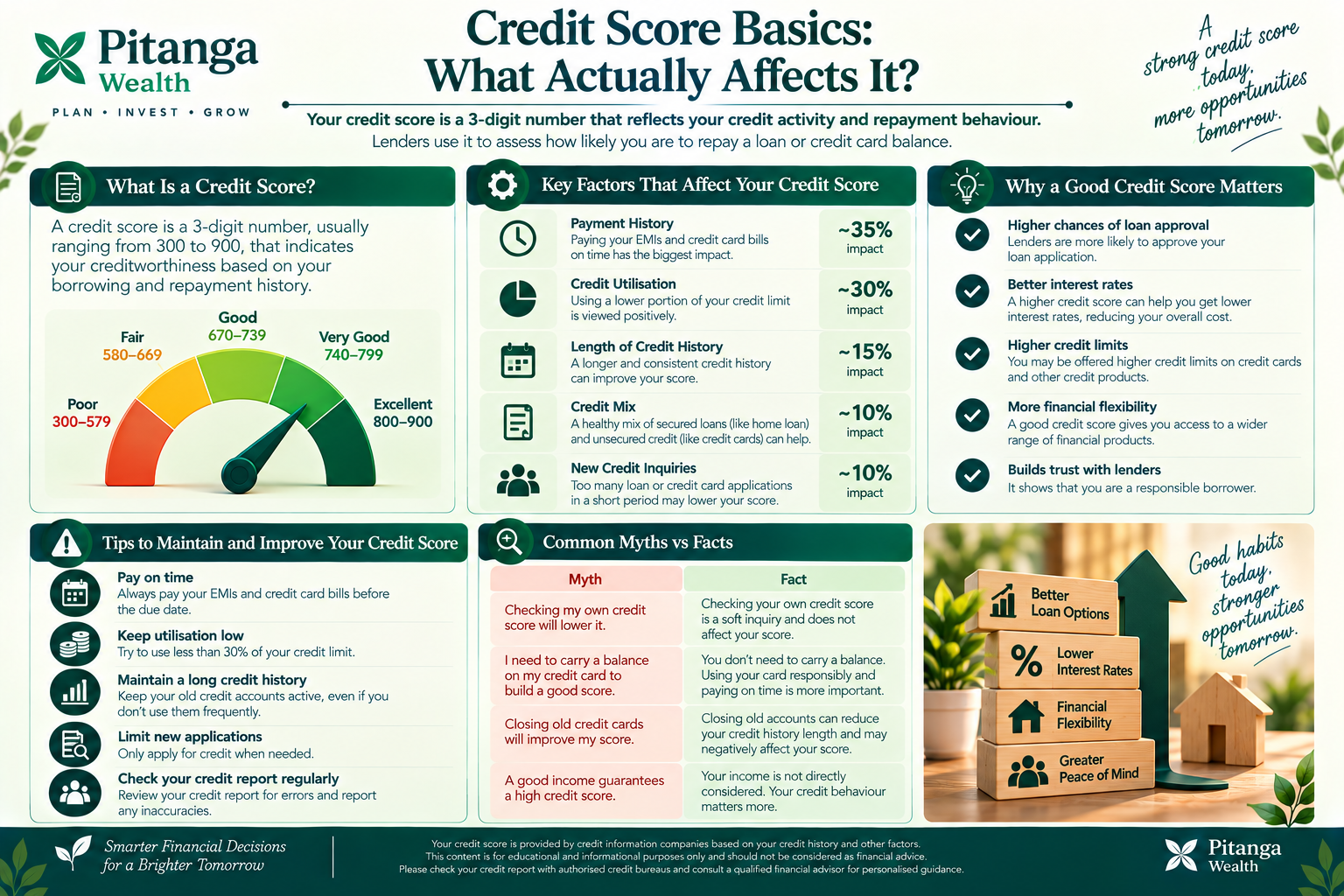
Your credit score can influence how lenders evaluate your applications for loans and credit cards. Whether you are applying for a home loan, considering a personal loan, or planning to use a credit card, your credit history may play an important role in the lender’s decision.
However, many people misunderstand how credit scores work.
Some believe that earning a high salary automatically results in an excellent credit score. Others assume that checking their own credit report will reduce their score or that paying the minimum amount due on a credit card is enough to maintain a healthy credit profile.
These assumptions can lead to poor financial decisions.
Understanding the factors affecting credit score is important because a credit score reflects aspects of your borrowing and repayment history—not your overall wealth or financial success.
In India, credit information companies use information reported by lenders to prepare credit reports and calculate credit scores. These reports help lenders assess credit risk alongside income, existing obligations, and their own eligibility criteria.
This guide explains what a credit score means, which financial behaviours can influence it, what does not directly determine it, and how to build healthier credit habits over time.
What Is a Credit Score?
A credit score is a numerical assessment derived from information in a person’s credit file.
It is designed to help lenders evaluate the likelihood that a borrower will meet their credit obligations.
In India, credit scores are provided by credit information companies such as TransUnion CIBIL, Experian, Equifax, and CRIF High Mark.
Different credit bureaus may use different scoring models, and the scores they produce may not be identical.
What Is a CIBIL Score?
A CIBIL Score is a credit score generated by TransUnion CIBIL based on eligible credit information available in an individual’s credit report.
The commonly used CIBIL Score ranges from 300 to 900.
A higher score generally indicates a stronger credit profile under the applicable scoring model.
However, the score alone does not determine whether a lender will approve an application.
Is a Credit Score the Same as a Credit Report?
No.
A credit report contains information about a person’s credit accounts, repayment history, outstanding balances, enquiries, and other reported credit-related details.
A credit score is a numerical assessment calculated using information from the credit file.
The report provides context, while the score summarises aspects of credit risk.
Why Does Your Credit Score Matter?
A credit score can be relevant when applying for financial products involving borrowing.
Loan Approval
Lenders may use credit scores as one factor when evaluating applications for personal loans, home loans, vehicle loans, and other credit facilities.
Interest Rates and Loan Terms
Some lenders may consider credit history when determining interest rates, eligible amounts, or other lending terms.
A stronger credit profile may improve access to certain offers, but it does not guarantee a lower rate.
Credit Card Applications
Card issuers may review credit information alongside income, existing obligations, and internal eligibility criteria.
Financial Planning
A credit report can help you identify existing obligations, repayment issues, and inaccuracies that may require attention.
Maintaining a healthy credit profile is therefore part of responsible financial management.
1. Payment History: One of the Most Important Factors Affecting Credit Score
Payment history reflects how consistently a borrower has met repayment obligations.
It is generally an important component of credit risk assessment.
Why Do On-Time Payments Matter?
When a borrower makes required payments on time, the reported history may demonstrate consistent repayment behaviour.
Late or missed payments can indicate higher repayment risk.
Which Payments Can Affect Your Credit Score?
Reported credit obligations may include:
- Personal loan EMIs
- Home loan EMIs
- Vehicle loan EMIs
- Credit card payments
- Education loan repayments
- Other eligible reported credit facilities
Ordinary household bills do not automatically affect a traditional credit score unless the relevant information is included through an applicable reporting arrangement.
What Happens if You Miss an EMI?
A missed EMI may be reflected in the repayment history reported by the lender.
The impact on the score depends on the severity of the delay, the borrower’s broader credit profile, and the scoring model.
Does One Late Payment Permanently Damage Your Score?
Not necessarily.
Negative repayment information may remain relevant for a period, but a credit score can change as the underlying information and repayment behaviour change.
There is no universal recovery timeline.

2. Credit Utilisation: How Much of Your Available Credit Are You Using?
Credit utilisation generally refers to the proportion of available revolving credit being used.
It is particularly relevant to credit cards.
How Is Credit Utilisation Calculated?
Consider a hypothetical example:
| Detail | Amount |
| Credit card limit | ₹1,00,000 |
| Reported outstanding balance | ₹30,000 |
| Credit utilisation | 30% |
The calculation is:
Credit utilisation = (Outstanding balance ÷ Credit limit) × 100
In this example:
(₹30,000 ÷ ₹1,00,000) × 100 = 30%
Is 30% Credit Utilisation a Fixed Rule?
No.
You may encounter recommendations to keep credit utilisation below 30%.
However, 30% is not a universal regulatory threshold or a guarantee of a particular credit score.
Different scoring models can evaluate balances and utilisation differently.
In general, consistently using a large proportion of available revolving credit may indicate greater reliance on borrowing.
Does Paying the Full Credit Card Bill Help?
Paying the full applicable statement balance by the due date can help avoid finance charges when the card’s interest-free conditions are met.
However, the balance appearing in a credit report may depend on when the issuer reports account information.
A card can therefore show a reported balance even when the cardholder subsequently pays the bill in full.
3. Length of Credit History: Why Older Accounts Can Matter
Credit history length describes how long a person has maintained credit accounts.
Scoring models may consider the age of individual accounts and the overall history of borrowing.
Why Can an Older Credit Account Be Useful?
An established account with a consistent repayment record may provide more historical information about borrowing behaviour.
Does Closing an Old Credit Card Reduce Your Score?
It can affect your credit profile, but the outcome is not automatic.
Closing a card may reduce total available credit and change utilisation.
The treatment of closed accounts and account age also depends on the credit bureau’s model.
Should You Keep Every Old Credit Card Open?
Not necessarily.
Consider annual fees, account security, spending habits, and whether the card is still useful.
Maintaining an unnecessary credit product solely for a possible score benefit may not be appropriate.
4. Credit Mix: Does Having Different Types of Loans Help?
Credit mix refers to the variety of credit products appearing in a credit report.
These may include secured and unsecured credit.
What Is Secured Credit?
Secured credit is supported by collateral or another eligible form of security.
A home loan is a common example.
What Is Unsecured Credit?
Unsecured credit does not generally require the same type of asset collateral.
Examples include many personal loans and credit cards.
Does a Mix of Credit Improve Your Score?
Some scoring models consider the types of credit accounts in a person’s file.
However, the exact effect varies.
Taking a personal loan or opening another credit account simply to create a better credit mix is not a sound financial strategy.
Borrow only when there is a genuine need and a realistic repayment plan.
5. New Credit Applications and Hard Enquiries
When you apply for a loan or credit card, the lender may request your credit information to assess the application.
This can generate a lender enquiry recorded in your credit file.
What Is a Hard Enquiry?
A hard enquiry is generally associated with a lender accessing credit information as part of an application or credit assessment.
Depending on the scoring model and circumstances, such enquiries may influence a credit score.
Do Multiple Applications Affect Your Credit Score?
Several applications within a short period can create multiple enquiries.
These may be interpreted as increased credit-seeking activity.
However, the effect depends on the type of enquiry, timing, and scoring model.
Should You Avoid Comparing Loan Offers?
No.
Comparing lenders, interest rates, fees, and repayment terms is important.
However, consumers should understand whether a particular eligibility check involves a lender enquiry before submitting multiple formal applications.
6. Outstanding Debt and Existing Repayment Obligations
Your existing borrowing obligations can influence how lenders assess your financial position.
Does Having More Loans Automatically Mean a Lower Score?
No.
The number of accounts alone does not determine a credit score.
Repayment history, balances, utilisation, account types, and other reported information can all matter.
Why Do Lenders Check Existing EMIs?
Even when a credit score is healthy, a lender may assess whether the applicant can afford additional repayments.
This may involve reviewing income, existing EMIs, and other financial commitments.
Can Someone Have a Good Credit Score but Still Be Rejected?
Yes.
Loan approval also depends on factors such as income, employment, repayment capacity, documentation, internal credit policies, and product-specific eligibility.
A credit score is only one part of the assessment.
7. Settled, Written-Off and Defaulted Accounts
Credit reports may contain account statuses reflecting how credit obligations were resolved.
These details can be important to lenders.
What Does a Settled Loan Mean?
A settlement may occur when a lender agrees to accept an amount different from the full contractual outstanding amount to resolve an account.
A settled status is not necessarily equivalent to an account that was fully repaid according to its original terms.
What Does Written-Off Mean?
A write-off is an accounting treatment used by a lender.
It does not automatically mean that the borrower has been released from the repayment obligation.
The legal position depends on the circumstances.
Why Do These Statuses Matter?
They may indicate previous repayment difficulties.
Lenders may consider them when evaluating future applications.
Can a Credit Report Be Updated After Repayment?
Yes, account information may be updated through the lender’s reporting process.
However, repayment does not necessarily erase accurate historical information.
If an account is reported incorrectly, the borrower should raise a dispute through the appropriate channels.
8. Does Your Salary Affect Your Credit Score?
Income is important for assessing borrowing capacity, but it is not generally a direct component of traditional bureau credit scoring in the same way as reported credit behaviour.
Can Someone With a High Salary Have a Low Credit Score?
Yes.
A high-income borrower who repeatedly misses payments or maintains problematic credit obligations may have a weaker credit profile.
Can Someone With a Modest Salary Have a Good Credit Score?
Yes.
A borrower with a modest income may maintain a strong credit profile through responsible repayment behaviour.
Why Do Lenders Still Ask for Income Details?
Income helps lenders evaluate whether the applicant can afford the proposed repayment obligations.
Creditworthiness and affordability are related but distinct assessments.
9. Does Checking Your Own Credit Score Reduce It?
This is a common misconception.
Checking your own credit report or score through an authorised consumer-access channel is generally treated differently from a lender enquiry associated with a credit application.
What Is a Soft Enquiry?
A soft enquiry is a credit information access that generally does not affect the consumer’s credit score.
Checking your own credit information is commonly treated this way.
How Often Should You Check Your Credit Report?
Reviewing your report periodically can help identify errors, unfamiliar accounts, and repayment information that requires clarification.
You may also check it before applying for a major loan.
Can Checking Your Report Improve Your Score?
Checking alone does not automatically increase your score.
Its value comes from helping you identify inaccuracies and improve financial habits.
10. How Do Credit Cards Affect Your Credit Score?
Credit cards can influence credit profiles in several ways.
Payment History
Making required payments on time helps maintain a responsible repayment record.
Reported Balances
High outstanding balances relative to credit limits may affect credit utilisation.
Account Age
The length of time an account has been maintained may be relevant.
New Applications
Opening new cards may involve lender enquiries and changes to the credit profile.
Does Having Multiple Credit Cards Help?
Not automatically.
Multiple cards can increase available credit, but they may also encourage spending, increase account-management complexity, and involve additional fees.
The number of cards is less important than whether they are used responsibly.
11. Does Buy Now Pay Later Affect Your Credit Score?
Buy Now Pay Later, or BNPL, arrangements can differ significantly.
Some involve credit extended through regulated lending institutions.
Others may use different payment structures.
Can BNPL Repayments Be Reported?
Depending on the underlying arrangement and applicable reporting requirements, borrowing and repayment information may be reported to credit information companies.
Can Missing a BNPL Payment Affect Your Score?
It may affect your credit profile where the relevant obligation and repayment activity are reported.
Should You Use BNPL to Build a Credit Score?
Do not take on unnecessary repayment obligations merely to influence a credit score.
A genuinely interest-free arrangement can still create financial pressure if multiple instalments become difficult to manage.
12. How Long Does It Take to Improve a Credit Score?
There is no fixed timeline for improving a credit score.
The outcome depends on the existing credit profile, the type of negative information, lender reporting cycles, and future borrowing behaviour.
Can Your Score Improve in One Month?
Some reported information may change between reporting periods.
However, meaningful improvement is not guaranteed within any specific number of days.
What if You Have Missed Several Payments?
Resolving overdue obligations and maintaining future repayments may help establish a more responsible repayment pattern.
The effect on the score may take time.
Can You Instantly Repair a Credit Score?
Be cautious of services promising guaranteed or immediate credit-score improvement.
Accurate historical information generally cannot be removed merely because a consumer pays a third party.
13. How to Check Your Credit Score in India
Consumers can obtain credit information through authorised channels.
Step 1: Choose an Official Credit Bureau
Visit the official website of a recognised credit information company.
Step 2: Complete Identity Verification
Follow the bureau’s process for confirming your identity.
Step 3: Access Your Credit Report
Review the score and underlying account information available through the service.
Step 4: Check Important Details
Look at:
- Personal identification information
- Open and closed credit accounts
- Outstanding balances
- Repayment history
- Reported account status
- Credit enquiries
- Unfamiliar accounts or discrepancies
Step 5: Save or Review the Report
Keep a secure copy if needed for future reference.
Avoid sharing credit reports unnecessarily because they contain sensitive financial information.
14. What to Do if Your Credit Report Contains an Error
Credit reports may occasionally contain outdated or incorrect information.
Common Credit Report Errors
Examples may include:
- An unfamiliar loan account
- Incorrect outstanding balance
- A repayment marked overdue despite payment
- An incorrect account status
- Duplicate credit information
- Incorrect personal details
How Do You Raise a Dispute?
Contact the relevant credit information company through its official dispute-resolution process.
Where appropriate, also contact the lender that furnished the information.
Can a Credit Bureau Change Any Entry Immediately?
Not necessarily.
The disputed information may require verification with the reporting institution.
What if the Issue Is Not Resolved?
Use the applicable grievance-redressal and escalation mechanisms.
Depending on the circumstances, eligible complaints may be escalated through the relevant regulatory complaint process.
Maintain records of the dispute and supporting documents.
15. Practical Habits That May Help Maintain a Healthy Credit Profile
Improving credit health is usually about consistent behaviour rather than quick fixes.
Pay EMIs and Credit Card Bills on Time
Use reminders or appropriate automatic payment arrangements to reduce the risk of missed due dates.
Avoid Carrying Unnecessary Credit Card Balances
Paying the full applicable statement amount by the due date can help avoid finance charges when the card’s conditions are met.
Monitor Credit Utilisation
Be mindful of how much revolving credit you use relative to available limits.
Apply for Credit Only When Necessary
Avoid submitting repeated applications without understanding the eligibility criteria.
Review Your Credit Report Periodically
Look for inaccuracies and unfamiliar accounts.
Do Not Borrow Solely to Improve Your Score
A new credit obligation creates repayment risk and does not guarantee a score improvement.
Keep Existing Debts Manageable
Consider your monthly cash flow before accepting additional borrowing.
Protect Your Financial Information
Use official websites and secure channels when accessing credit information.

Credit Score Myths vs Facts
| Common Myth | What You Should Know |
| A high salary guarantees a high score | Credit history and income are different considerations |
| Checking your own score lowers it | Consumer self-checks generally do not affect scores |
| Paying the minimum credit card due avoids interest | Finance charges may apply to unpaid balances |
| A score above a particular number guarantees loan approval | Lenders assess additional eligibility factors |
| Every BNPL product is invisible to credit bureaus | Reporting depends on the arrangement and applicable rules |
| Closing old credit cards always improves the score | Closing accounts can change the credit profile |
| You must borrow money to build wealth | Borrowing is not a requirement for wealth creation |
| Credit scores improve instantly after repayment | Changes depend on reporting and scoring processes |
| Credit bureaus always produce identical scores | Different bureaus may use different data and models |
| A good credit score means you can afford any EMI | Affordability depends on income, expenses, and obligations |

Credit Score Checklist: 10 Things to Review
Before applying for a major loan or evaluating your credit health, review the following:
- Are all required EMIs being paid on time?
- Are credit card payments being made by the due date?
- Is credit utilisation manageable?
- Are there any overdue accounts?
- Are all reported credit accounts familiar?
- Are outstanding balances accurate?
- Are there unexpected lender enquiries?
- Are settled or written-off statuses correctly reported?
- Are existing monthly obligations affordable?
- Have you checked your credit report for inaccuracies?
This checklist can help identify issues that deserve attention, but it cannot predict a particular credit score.
Frequently Asked Questions
1. What are the main factors affecting credit score in India?
Important factors can include repayment history, credit utilisation, length of credit history, types of credit accounts, outstanding balances, and recent credit enquiries. Their relative importance depends on the scoring model.
2. What is a good CIBIL score?
The commonly used CIBIL Score ranges from 300 to 900. Higher scores generally indicate a stronger credit profile, but lenders establish their own eligibility criteria. No single score guarantees approval.
3. Does checking my CIBIL score reduce it?
Checking your own score through an authorised consumer-access channel generally does not reduce it.
4. Does paying the minimum credit card amount improve my score?
Making the required minimum payment may help avoid a missed minimum-payment obligation, but it does not eliminate finance charges on unpaid balances. Credit-score outcomes depend on the broader credit profile.
5. Can I have a credit score without a credit card?
Yes. Other reported credit products may contribute to a credit file. However, having no eligible credit history may mean that a score is unavailable.
6. Does a personal loan improve a credit score?
Responsible repayment may contribute positively to credit history, but taking a personal loan does not guarantee a higher score. New enquiries and additional debt can also affect the profile.
7. How quickly can a credit score improve?
There is no guaranteed timeframe. Changes depend on lender reporting, the existing credit file, and subsequent credit behaviour.
8. Does closing a credit card affect my credit score?
It may. Closing a card can change available credit, utilisation, and other account characteristics. The effect depends on the scoring model and overall profile.
9. Can a missed EMI affect future loan applications?
Yes. Reported repayment delays may influence credit assessments and future lending decisions.
10. Can I correct an error in my credit report?
Yes. Consumers can use the official dispute process of the relevant credit information company and contact the reporting lender where appropriate.
Final Thoughts
Understanding the factors affecting credit score can help you make more informed borrowing decisions and avoid common financial misconceptions.
A healthy credit profile is not built through a single trick, a particular salary level, or a guaranteed score-improvement formula.
It generally reflects how credit obligations have been managed over time.
Making repayments on time, avoiding unnecessary debt, monitoring credit utilisation, reviewing credit reports, and correcting inaccuracies can all contribute to more responsible credit management.
Equally important, a good credit score should not become a reason to borrow more than you can comfortably repay.
At Pitanga Wealth, we believe that financial awareness should support long-term financial stability rather than encourage unnecessary borrowing.
Explore our financial education resources to understand credit products, borrowing costs, emergency savings, and practical money management.
Important Disclaimer
This article is intended solely for general financial education. It does not constitute personalised financial advice, a credit-score improvement guarantee, a loan recommendation, or an offer of lending services.
Credit scores, scoring ranges, credit reporting practices, and eligibility criteria may differ between credit information companies and lenders. Individual score outcomes depend on the information available and the relevant scoring model.
Readers should refer to the official websites of recognised credit information companies, their lenders, and applicable regulatory authorities for current information.
Distributor Disclosure: Pitanga Wealth is an AMFI-Registered Mutual Fund Distributor (ARN-134606). AMFI registration relates to mutual fund distribution and does not itself authorise lending, credit repair services, or regulated credit intermediation.
Written by the Pitanga Wealth Team.
Follow us on Instagram @pitangawealth for more educational insights.
This article is for educational and informational purposes only. It is not investment, tax, legal or insurance advice. Consider your circumstances and relevant documents before making a financial decision.