

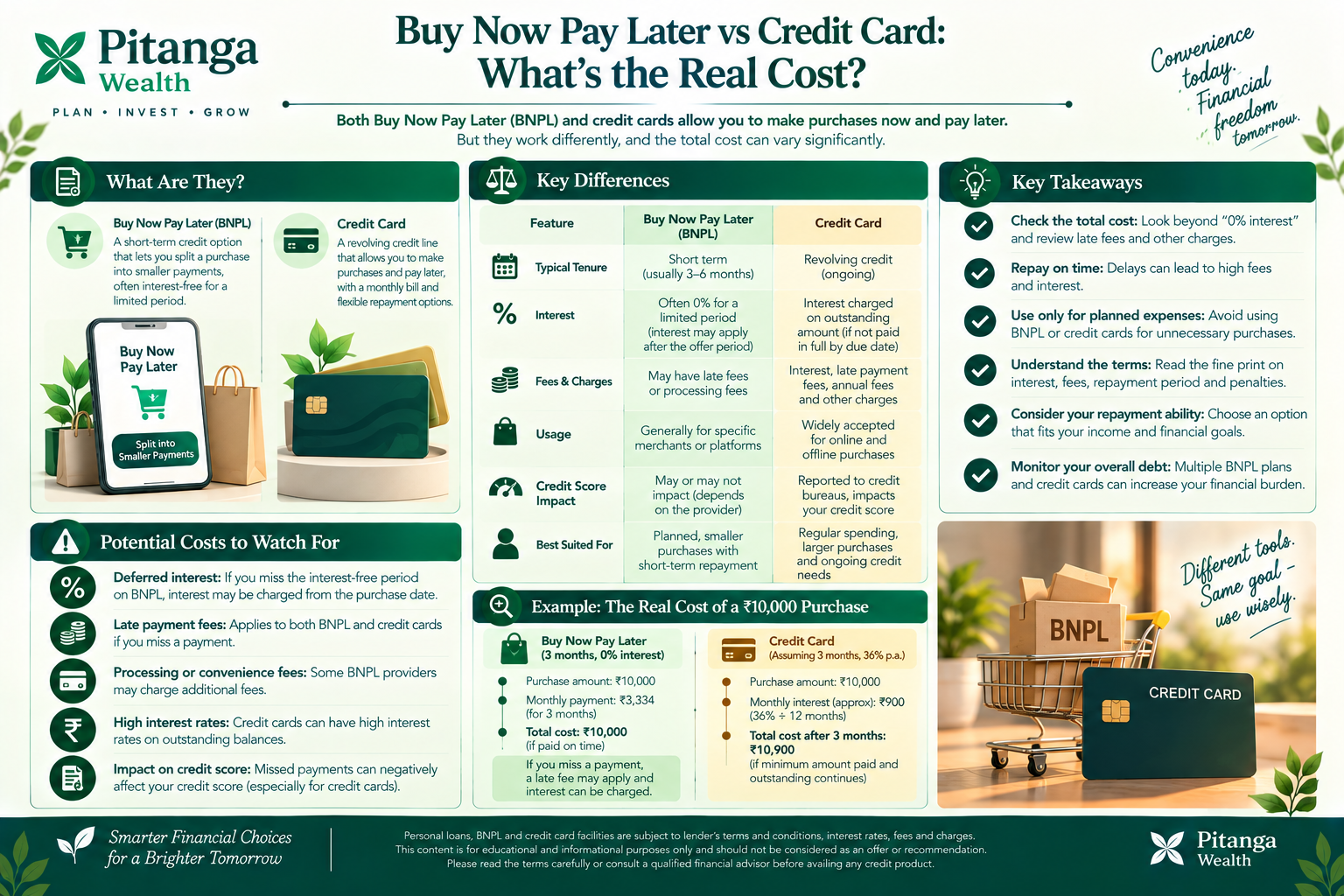
Buying something today and paying for it later has become a familiar part of shopping in India.
From online marketplaces and electronics stores to travel bookings and everyday purchases, consumers may encounter several payment options at checkout.
Two common choices are Buy Now Pay Later (BNPL) and credit cards.
Both allow customers to make purchases without necessarily paying the full amount immediately. Some BNPL services divide purchases into instalments, while credit cards may offer an interest-free period if the required conditions are met.
At first glance, these options can appear similar.
However, their repayment structures, interest charges, fees, credit reporting practices, and financial consequences may differ significantly.
A BNPL offer advertised as interest-free may still involve late fees or other conditions. A credit card may provide a convenient billing cycle, but carrying unpaid balances can result in substantial finance charges.
Understanding buy now pay later vs credit card is therefore important before choosing either option.
The real question is not simply which payment method makes shopping easier. It is which option fits your budget, what happens if repayment is delayed, and how much the purchase will ultimately cost.
This guide explains the differences in practical terms, using India-focused examples to help consumers make informed borrowing decisions.
What Is Buy Now Pay Later (BNPL)?
Buy Now Pay Later, commonly abbreviated as BNPL, is a payment arrangement that allows a consumer to purchase goods or services and pay at a later date or through scheduled instalments.
Depending on the provider and product, the arrangement may involve a short deferred-payment period or multiple repayments.
Some BNPL arrangements are offered through partnerships involving regulated financial institutions, while others may use different payment or credit structures.
How Does BNPL Work?
A typical BNPL purchase may involve the following steps:
- The customer selects a product or service.
- A BNPL payment option is offered at checkout.
- The provider assesses eligibility under its applicable process.
- The customer reviews the repayment terms.
- The purchase is completed if the arrangement is approved.
- The customer makes payments according to the agreed schedule.
The exact process depends on the provider.
Is BNPL Always Interest-Free?
No.
Some BNPL arrangements offer zero-interest instalments when payments are made according to the agreed terms.
Others may involve interest, convenience fees, processing charges, or other costs.
Even when an offer carries no stated interest, delayed repayment may lead to additional charges or other consequences.
Always review the complete payment agreement.
What Is a Credit Card?
A credit card is a payment instrument that allows eligible cardholders to make purchases or other permitted transactions using an approved credit limit.
The card issuer provides a billing statement showing transactions, amounts due, and the relevant payment dates.
How Does a Credit Card Billing Cycle Work?
Credit card transactions are generally accumulated during a billing cycle.
At the end of that cycle, the issuer generates a statement.
The cardholder is then required to make the applicable payment by the due date.
What Is the Interest-Free Period?
For eligible retail purchases, a credit card may offer an interest-free period when the full outstanding amount is paid within the applicable due date and other contractual conditions are satisfied.
The length and availability of this benefit depend on the issuer’s terms, transaction timing, and repayment history.
What Happens if You Pay Only the Minimum Amount Due?
Paying the minimum amount due may help avoid certain consequences associated with failing to make the required minimum payment.
However, it generally does not mean that the remaining balance becomes interest-free.
Finance charges may apply to unpaid amounts, and the interest-free benefit on subsequent purchases may be affected according to the card’s terms.
This is one of the most important distinctions consumers should understand.
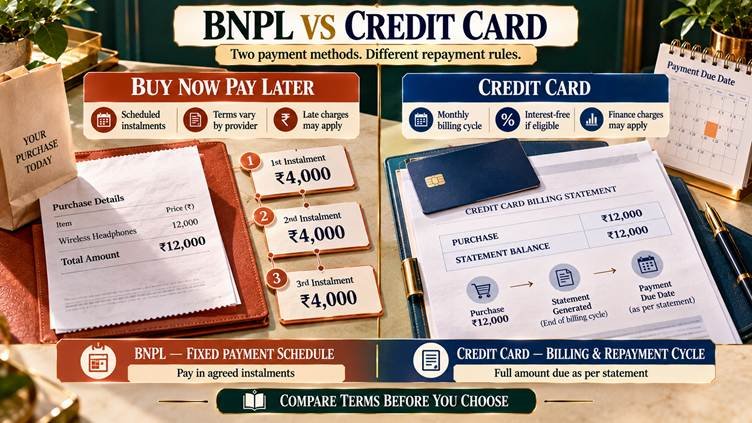
Buy Now Pay Later vs Credit Card: Key Differences
Both BNPL and credit cards allow deferred payment, but they can differ in several important ways.
| Feature | Buy Now Pay Later | Credit Card |
| Basic structure | Deferred payment or instalment arrangement | Revolving credit facility |
| Payment schedule | Usually linked to a purchase or plan | Based on billing cycle and statement |
| Interest | May be zero or charged | May be avoided on eligible purchases if conditions are met |
| Late-payment charges | Depend on provider and agreement | Depend on issuer and applicable terms |
| Credit limit | Depends on provider and product | Issuer-approved credit limit |
| Credit reporting | Depends on lending structure and reporting | Typically reported by issuer |
| Rewards | Product-dependent | May include rewards or cashback |
| Repayment flexibility | Usually follows agreed instalments | Full payment, minimum due, or other permitted arrangements |
| Regulation | Depends on underlying product and provider | Subject to applicable card-issuer rules |
| Main risk | Multiple instalment commitments and missed payments | Revolving balances and accumulating finance charges |
Neither option is automatically cheaper in every situation.
The real cost depends on the specific offer, fees, repayment behaviour, and contractual terms.
1. Interest Charges: Which Option Costs More?
Interest is one of the most important factors in comparing BNPL and credit cards.
When Can BNPL Be Interest-Free?
Some BNPL offers allow a purchase to be repaid through scheduled instalments without a separately stated interest charge.
For example, a ₹12,000 purchase may be divided into three payments of ₹4,000 each.
If the arrangement genuinely has no additional charges and every payment is made on time, the total amount paid may remain ₹12,000.
However, this depends on the actual offer.
When Can a Credit Card Be Interest-Free?
A credit card purchase may also result in no finance charges if the cardholder pays the full applicable statement balance by the due date and satisfies the conditions for the interest-free period.
For example, a ₹12,000 purchase paid in full within the applicable billing and payment window may not attract purchase interest.
Which Is Cheaper?
If both arrangements genuinely involve no additional charges and are repaid according to their terms, their direct borrowing cost may be the same.
The difference becomes more significant when repayments are delayed or balances are carried forward.
2. What Happens When You Miss a Payment?
Missing a repayment can make either option more expensive.
Late Payments Under BNPL
Depending on the agreement, a missed BNPL instalment may result in late charges, account restrictions, collection activity, or adverse credit reporting where applicable.
Not every provider follows the same structure.
Late Payments on Credit Cards
A missed credit card payment may result in late-payment charges, finance charges, and credit reporting consequences, depending on the circumstances.
If the cardholder does not pay the full amount due, finance charges may apply even if the minimum payment is made.
Why Is This Important?
A payment option that appears inexpensive at checkout may become costly when the borrower cannot meet the repayment schedule.
The risk is particularly relevant when several purchases are being repaid simultaneously.
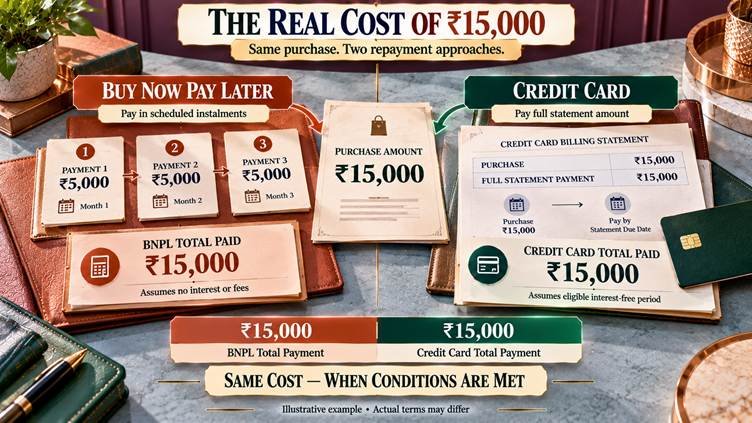
3. The Real Cost of a ₹15,000 Purchase
Consider a hypothetical purchase worth ₹15,000.
The customer has two available payment options.
Option A: BNPL With Three Equal Instalments
Assume the BNPL offer has:
- Purchase price: ₹15,000
- Three equal instalments
- No interest
- No processing or convenience fee
- All payments made on time
The repayment schedule would be:
| Instalment | Amount |
| First payment | ₹5,000 |
| Second payment | ₹5,000 |
| Third payment | ₹5,000 |
| Total paid | ₹15,000 |
Under these assumptions, the customer pays no additional borrowing cost.
Option B: Credit Card Paid in Full
Assume the customer uses a credit card for the same ₹15,000 purchase.
If the transaction qualifies for an interest-free period and the full applicable statement balance is paid by the due date, the customer may also pay only ₹15,000.
What Changes if Repayment Is Delayed?
The comparison becomes different.
A BNPL provider may apply charges according to the agreement.
A credit card issuer may apply finance charges and other fees according to its terms.
The actual cost cannot be calculated accurately without the specific interest rate, payment dates, outstanding balance, and fee schedule.
Key Lesson
An interest-free offer is valuable only when its conditions are understood and met.
The purchase price alone does not reveal the full financial risk.
4. Credit Card Minimum Due: Why It Can Be Misleading
Credit card statements generally show a total amount due and a minimum amount due.
These are not interchangeable.
What Does Minimum Amount Due Mean?
The minimum amount due is the amount specified by the issuer that must be paid by the due date to satisfy the minimum-payment requirement.
Its calculation varies according to the issuer’s terms.
Does Paying the Minimum Avoid Interest?
Generally, no.
The unpaid balance may continue to attract finance charges.
Additional purchases may also lose the usual interest-free benefit under the applicable card terms.
Why Can This Become Expensive?
If a cardholder repeatedly pays only the minimum, the unpaid balance may remain outstanding for a prolonged period.
Finance charges can increase the total repayment burden.
For consumers who use credit cards regularly, this can create a cycle of revolving debt.
5. Does BNPL Affect Your Credit Score?
Some consumers assume BNPL does not affect their credit profile because it may not resemble a traditional loan.
That assumption can be incorrect.
Can BNPL Be Reported to Credit Bureaus?
Yes, depending on the underlying credit arrangement, lender, and applicable reporting requirements.
Where BNPL involves credit extended by a regulated lender, relevant borrowing and repayment information may be reported to credit information companies.
What About Missed BNPL Payments?
Late or missed payments may affect the borrower’s credit history where the relevant account information is reported.
How Do Credit Cards Affect Credit Scores?
Credit cards can influence a credit profile through factors such as repayment history, reported balances, credit utilisation, and other information used by credit scoring models.
Which Is Better for Building Credit?
Neither product should be taken solely to improve a credit score.
Responsible repayment behaviour matters, but borrowing creates a financial obligation and does not guarantee a particular score outcome.
6. BNPL vs Credit Card EMI: Are They the Same?
BNPL instalments and credit card EMIs may look similar because both divide payments over time.
However, their terms may differ.
BNPL Instalments
A BNPL plan may divide a purchase into a fixed number of repayments.
Depending on the product, the plan may involve interest, fees, or a zero-interest arrangement.
Credit Card EMI
Some credit card issuers allow eligible transactions to be converted into EMIs.
Such plans may involve interest, processing fees, applicable taxes, or other conditions.
What Is a No-Cost EMI?
A no-cost EMI offer generally refers to an arrangement designed to offset or eliminate a stated interest burden for the customer under specified promotional terms.
However, the final economics may depend on discounts, fees, taxes, and the actual offer structure.
A no-cost EMI label should not replace a review of the total amount payable.
What Should You Compare?
Compare the final purchase price, upfront payment, instalment amounts, processing charges, applicable taxes, total repayment, and cancellation or prepayment conditions.
7. Hidden Costs to Check Before Choosing BNPL or a Credit Card
The cost of borrowing is not limited to interest.
BNPL Charges to Review
Depending on the product, borrowers should check for:
- Processing or convenience fees
- Late-payment charges
- Interest, where applicable
- Other disclosed contractual charges
- Applicable taxes
Credit Card Charges to Review
Depending on the card and transaction, check for:
- Finance charges on unpaid balances
- Late-payment fees
- Annual or renewal fees
- EMI conversion or processing fees
- Cash advance charges
- Applicable taxes
Why Does the Total Amount Payable Matter?
A payment plan with a lower instalment is not necessarily cheaper.
It may simply spread the obligation over a longer period.
Compare the final cost rather than only the monthly payment.
8. Which Option Offers Better Repayment Flexibility?
Flexibility can be useful, but it may also encourage unnecessary borrowing.
BNPL Repayment Structure
BNPL plans often have predefined repayment dates.
The borrower may have limited flexibility to change the schedule without consequences.
Credit Card Repayment Structure
Credit cards generally allow the cardholder to pay the full statement balance or a permitted lower amount, subject to the issuer’s terms.
However, paying less than the full amount can result in finance charges.
Is More Flexibility Always Better?
Not necessarily.
A flexible repayment facility can be convenient, but it may become expensive when the borrower regularly carries balances.
The most suitable option is one that supports predictable, affordable repayment.
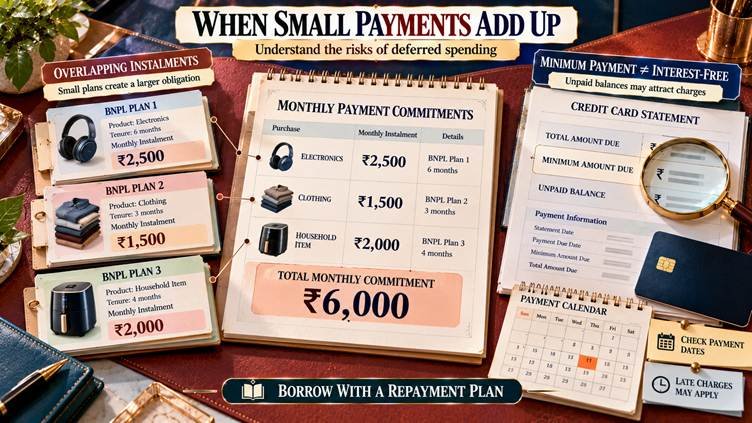
9. Credit Limits and the Risk of Overspending
Both BNPL and credit cards can make spending feel easier because payment is separated from the moment of purchase.
How Can BNPL Encourage Multiple Commitments?
A consumer may take several small instalment plans for different purchases.
Individually, each payment may appear manageable.
Together, they can create a substantial monthly obligation.
How Can Credit Cards Encourage Overspending?
An available credit limit may create the impression that a purchase is affordable.
However, a credit limit is not the same as disposable income.
A Practical Example
Suppose a person has three separate instalment commitments:
| Purchase | Monthly Payment |
| Electronics | ₹2,500 |
| Clothing | ₹1,500 |
| Household item | ₹2,000 |
| Total monthly commitment | ₹6,000 |
Even if each purchase was described as interest-free, the consumer still needs ₹6,000 every month to meet the combined obligations.
This illustrates why repayment affordability matters as much as borrowing cost.
10. Rewards, Cashback and Discounts: Are They Worth It?
Credit cards may offer rewards, cashback, travel benefits, or merchant discounts.
BNPL providers may also offer promotional benefits.
Can Rewards Make a Credit Card Better?
Rewards can provide value when the cardholder pays on time and avoids unnecessary charges.
However, their value may be outweighed by finance charges, fees, or overspending.
What About BNPL Discounts?
A BNPL discount may reduce the effective purchase price.
However, the customer should still review whether the payment plan involves other charges or conditions.
The Right Comparison
Compare the final amount payable after all genuine discounts, charges, and applicable conditions.
Do not make a purchase merely to earn a reward.
11. Is BNPL Safer Than a Credit Card?
Safety depends on more than the payment method.
Important factors include the provider’s legitimacy, the underlying credit arrangement, data practices, dispute handling, and repayment terms.
What Should BNPL Users Verify?
Identify the provider and, where relevant, the actual lender.
Review the agreement, repayment schedule, charges, and complaint channels.
What Should Credit Card Users Verify?
Review the issuer’s official terms, fees, transaction alerts, billing statements, and security features.
What About Fraud and Unauthorised Transactions?
The applicable protections and liability rules depend on the product, institution, transaction circumstances, and relevant regulations.
Do not assume BNPL and credit cards provide identical dispute or fraud protections.
12. When Might BNPL Be Suitable?
BNPL may be worth considering when:
- The purchase is necessary and already budgeted
- The repayment schedule is clear
- The total cost is understood
- The instalments fit comfortably within monthly cash flow
- The borrower can meet every payment on time
When Should You Avoid BNPL?
Be cautious if the purchase is impulsive, the agreement is unclear, or several existing instalment commitments are already affecting your budget.
An interest-free label does not make an unnecessary purchase financially sensible.
13. When Might a Credit Card Be Suitable?
A credit card may be useful for eligible consumers who can manage spending and repayment responsibly.
Potential benefits include billing convenience, payment records, issuer-specific protections, and rewards.
When Can a Credit Card Become Expensive?
A credit card can become costly when the cardholder regularly carries unpaid balances, misses due dates, or uses expensive transaction facilities without understanding the charges.
What Is a Responsible Credit Card Habit?
Review statements regularly and aim to pay the full applicable statement balance by the due date.
Also monitor credit utilisation and avoid treating the credit limit as additional income.
14. BNPL vs Credit Card: Which Is Better for Different Purchases?
The answer depends on the specific offer and repayment circumstances.
| Situation | What to Consider |
| Small planned purchase | Compare total payable and repayment dates |
| Large electronics purchase | Review instalment costs, discounts and fees |
| Emergency essential expense | Consider affordability and alternatives |
| Regular monthly spending | Avoid accumulating unpaid balances |
| Promotional zero-interest offer | Verify all conditions and charges |
| Existing high debt burden | Avoid adding obligations without a repayment plan |
A product that works well for one consumer may be unsuitable for another.
15. Alternatives to BNPL and Credit Cards
Before using deferred payment, consider whether borrowing is necessary.
Pay From Available Savings
Paying directly may avoid credit costs, provided doing so does not compromise essential emergency savings.
Delay the Purchase
For non-essential expenses, waiting can eliminate the need to borrow.
Save Through a Purchase Budget
Setting aside a fixed amount each month can make a future purchase more manageable.
Compare the Cash Price
Some merchants may offer different effective prices or discounts depending on the payment method.
Compare the final payable amount.
Reduce Existing Debt First
If current repayment obligations are already difficult to manage, adding another purchase commitment may increase financial stress.
Buy Now Pay Later vs Credit Card: Practical Comparison Checklist
Before choosing a payment method, ask these questions:
| Question | Why It Matters |
| What is the final amount payable? | Reveals the actual cost |
| Is interest charged? | Affects affordability |
| Are there processing or convenience fees? | Adds to total expense |
| What happens if payment is late? | Identifies penalties and risks |
| When are payments due? | Helps manage cash flow |
| Is the arrangement reported to credit bureaus? | May affect credit history |
| Can the plan be cancelled or prepaid? | Affects flexibility |
| Are rewards or discounts genuine? | Helps compare net cost |
| Who is the actual provider or lender? | Helps verify legitimacy |
| Can I comfortably repay on time? | Reduces financial stress |
The most important question is whether the purchase remains affordable without relying on future borrowing.
Common Mistakes When Using BNPL and Credit Cards
Assuming Interest-Free Means Risk-Free
An arrangement with no interest may still involve repayment obligations and late-payment consequences.
Ignoring the Total Repayment Amount
Small instalments can hide the scale of the overall commitment.
Paying Only the Credit Card Minimum
This may result in finance charges on the unpaid balance.
Taking Multiple BNPL Plans
Several separate plans can create a substantial combined monthly obligation.
Spending to Earn Rewards
Rewards rarely justify unnecessary purchases or expensive revolving debt.
Missing Repayment Dates
Late payments may result in charges and credit reporting consequences.
Not Reading Promotional Conditions
Discounts, no-cost EMI offers, and deferred-payment plans may have specific terms.
Treating Credit Limits as Income
Available borrowing capacity is not equivalent to available savings.
Ignoring Existing Debt
New payment obligations can worsen an already stretched budget.
Choosing Convenience Over Affordability
A simple checkout process does not make the purchase financially appropriate.
Frequently Asked Questions
1. Is Buy Now Pay Later better than a credit card?
Neither is universally better. The choice depends on total cost, repayment terms, fees, eligibility, and the borrower’s ability to repay on time.
2. Is BNPL completely interest-free?
Not always. Some plans offer zero-interest repayments, while others may involve interest or additional charges.
3. Does BNPL affect your CIBIL score?
It can affect credit information and scores where the underlying credit arrangement and repayment activity are reported to credit information companies. The impact depends on the reported data and scoring model.
4. Is paying the minimum amount due on a credit card safe?
Paying the minimum may satisfy the issuer’s minimum-payment requirement, but unpaid balances can attract finance charges and increase borrowing costs.
5. Which is cheaper: BNPL or a credit card?
Either can have little or no direct borrowing cost under certain conditions. Compare the actual offer, total repayment, fees, and consequences of delayed payment.
6. What happens if I miss a BNPL payment?
Depending on the agreement, missed payments may result in late charges, account restrictions, recovery activity, or credit reporting consequences.
7. Is a credit card EMI the same as BNPL?
No. Both may involve instalments, but the underlying credit arrangement, fees, interest, and contractual conditions can differ.
8. Can I use BNPL for multiple purchases?
Some providers may allow it, subject to eligibility and product conditions. However, multiple plans can create significant combined repayment obligations.
9. Does a credit card always offer an interest-free period?
No. The availability of an interest-free period depends on the transaction type, billing cycle, repayment status, and issuer’s terms.
10. Should I use BNPL or a credit card for non-essential shopping?
Consider whether the purchase is necessary, whether it fits your budget, and whether delaying it would be financially preferable. Easy access to credit should not determine the purchase decision.
Final Thoughts
The comparison of buy now pay later vs credit card is not simply about choosing the faster or more convenient checkout option.
Both products can be useful when their costs are understood and repayment obligations are managed responsibly.
BNPL may provide a straightforward instalment schedule, while credit cards may offer billing flexibility, rewards, and an interest-free period for eligible purchases under the applicable conditions.
However, both can become financially stressful when consumers miss payments, accumulate multiple obligations, or borrow beyond their means.
Before choosing either option, compare the total amount payable, interest, fees, repayment dates, credit reporting implications, and consequences of late payment.
At Pitanga Wealth, we believe informed financial decisions begin with understanding the complete cost of borrowing and protecting long-term financial stability.
Explore our educational resources to learn more about responsible borrowing, credit management, and financial planning.
Important Disclaimer
This article is intended solely for general financial education and information. It does not constitute personalised financial advice, a credit product recommendation, or an offer to provide BNPL services, credit cards, or loans.
BNPL arrangements and credit card products differ across providers. Actual interest rates, fees, payment schedules, credit reporting practices, rewards, dispute protections, and contractual conditions depend on the specific product and applicable regulations.
Illustrations are hypothetical and are not representations of actual offers.
Readers should review the official product terms, Key Facts Statement where applicable, cardholder agreement, and current regulatory disclosures before entering into a borrowing arrangement.
Distributor Disclosure: Pitanga Wealth is an AMFI-Registered Mutual Fund Distributor (ARN-134606). AMFI registration relates to mutual fund distribution and does not itself authorise credit card issuance, lending, or regulated credit intermediation.
Written by the Pitanga Wealth Team.
Follow us on Instagram @pitangawealth for more educational insights.
This article is for educational and informational purposes only. It is not investment, tax, legal or insurance advice. Consider your circumstances and relevant documents before making a financial decision.