

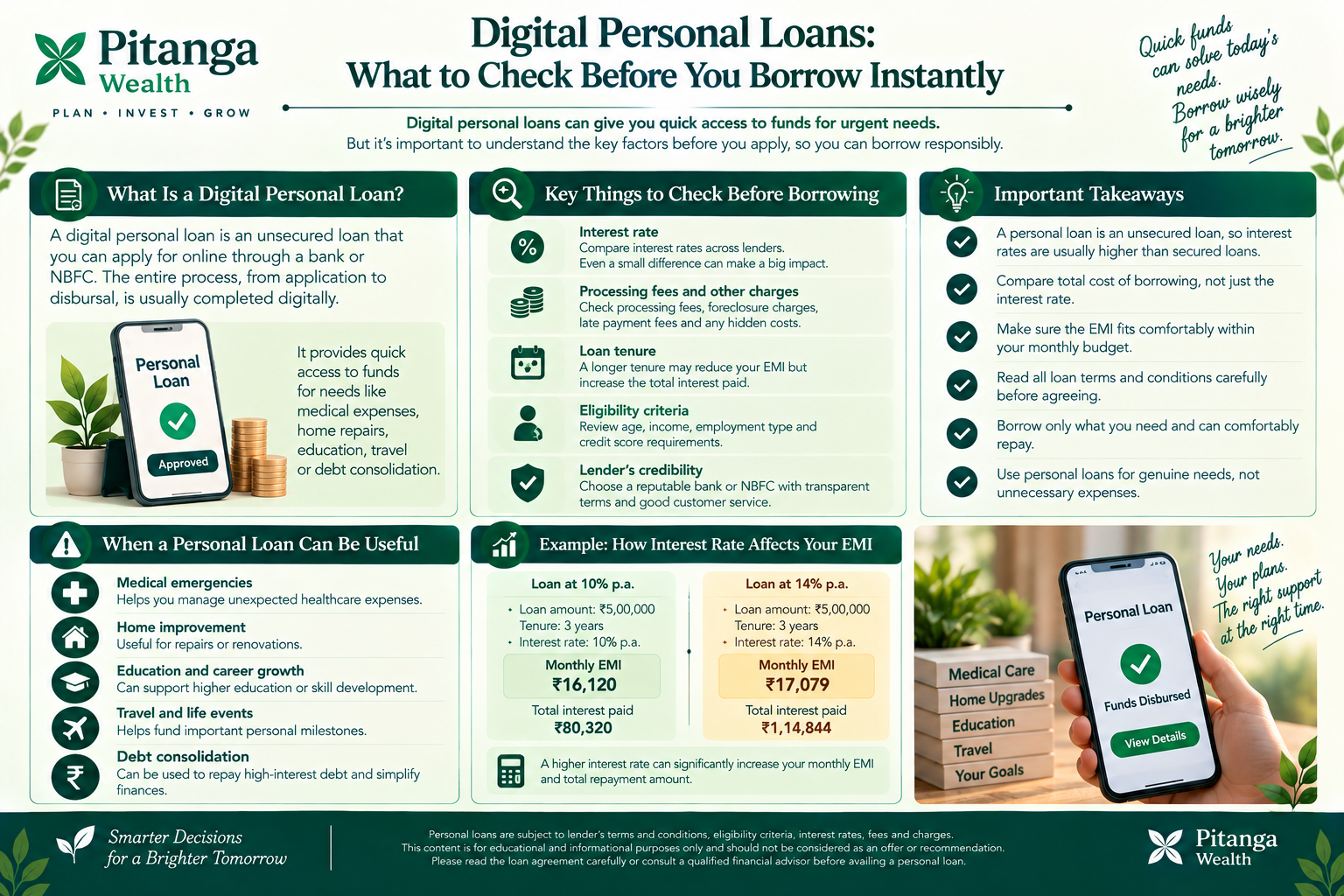
Getting a personal loan has become significantly more convenient in India.
Today, borrowers can apply for loans through banking applications, financial technology platforms, and digital lending services without necessarily visiting a physical branch.
Some platforms advertise quick approvals, minimal documentation, and rapid disbursal.
For someone facing an urgent financial requirement, these features may seem attractive.
However, the convenience of borrowing digitally does not automatically make a loan affordable, suitable, or safe.
A loan advertised with an attractive interest rate may involve additional charges. A short repayment period may increase the monthly financial burden. An unfamiliar lending application may also raise questions about the identity of the actual lender and how personal information is handled.
This is why understanding digital personal loans is important before accepting an instant borrowing offer.
The key is not simply how quickly the money becomes available, but how much the loan will cost, who is providing it, what information you are sharing, and whether you can comfortably repay it.
This guide explains the important factors every borrower should review before taking a digital personal loan in India.
What Are Digital Personal Loans?
Digital personal loans are personal loans offered through an application, website, or another digital lending channel.
The application, verification, approval, documentation, and disbursal processes may be conducted partly or largely online.
These loans are commonly unsecured, meaning the borrower generally does not pledge a specific asset as collateral.
However, product structures and requirements can vary.
How Are Digital Personal Loans Different From Traditional Personal Loans?
The primary difference is often the application and servicing experience rather than the fundamental nature of the borrowing obligation.
A traditional personal loan may involve a branch-based process.
A digital personal loan may allow the borrower to complete most steps remotely.
In both cases, the borrower remains responsible for repaying the agreed loan amount, interest, and applicable charges according to the contract.
Does Digital Mean Instant Approval?
Not necessarily.
Approval depends on the lender’s eligibility checks, credit assessment, verification requirements, and internal policies.
Some applications may offer faster processing, but advertised approval or disbursal timelines should not be treated as guarantees.
How Do Digital Personal Loans Work in India?
The exact process differs between lenders and lending platforms, but digital borrowing commonly involves several stages.
Step 1: Select a Lending Platform
The borrower chooses a bank, non-banking financial company (NBFC), or digital platform facilitating a loan.
It is important to identify the actual regulated lender behind the product.
Step 2: Submit the Loan Application
The applicant may be asked to provide information such as name, contact details, income, employment, and other relevant financial information.
Step 3: Complete Identity and Eligibility Verification
The lender may use permitted digital verification methods and credit assessment processes.
Additional documentation may be required.
Step 4: Review the Loan Offer
If an offer is made, the borrower should review the interest rate, annual percentage rate, loan tenure, repayment schedule, fees, and other terms.
Step 5: Review the Key Facts Statement
The Key Facts Statement provides a standardised summary of important loan terms and costs under the applicable regulatory framework.
It should be reviewed before accepting the loan.
Step 6: Accept the Agreement
The borrower accepts the loan only after understanding the applicable terms and repayment obligations.
Step 7: Disbursal and Repayment
The loan is disbursed according to the applicable lending arrangements.
The borrower then makes repayments according to the agreed schedule.
A quick digital process does not eliminate the need for careful review at each stage.
1. Verify Who Is Actually Lending You the Money
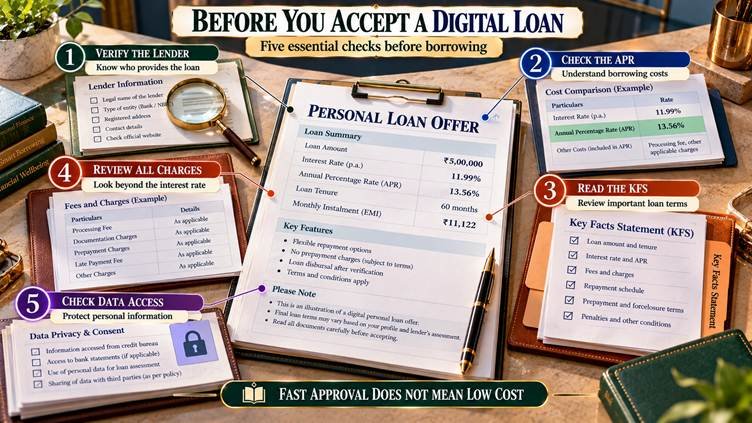
One of the most important checks before using a digital lending application is identifying the actual lender.
A loan application may be operated by a technology company or lending service provider rather than the financial institution extending the credit.
Bank, NBFC and Lending Service Provider: What Is the Difference?
A bank or an appropriately registered NBFC may act as the regulated lender.
A lending service provider may perform functions such as customer acquisition, application processing, or loan servicing on behalf of a regulated lender.
The exact relationship should be disclosed appropriately.
What Should You Check?
Look for the legal name of the lending institution.
Verify relevant information through the lender’s official website and appropriate regulatory sources.
Review the relationship between the digital application and the actual lender.
Why Does This Matter?
Knowing the lender helps you understand who is responsible for the loan, which documents apply, and where you can raise questions or complaints.
Do not assume an application is trustworthy simply because it appears in a popular app store.
2. Understand the Interest Rate Before Borrowing
The interest rate influences the cost of borrowing.
However, comparing only advertised interest rates can be misleading.
Fixed vs Floating Interest Rates
Some personal loans may use a fixed interest rate, while others may have a floating rate.
A fixed rate generally remains unchanged according to the contractual terms.
A floating rate may change based on the applicable benchmark or other contractual provisions.
Why Should Borrowers Read the Loan Agreement?
The agreement should explain the interest rate structure and applicable conditions.
Borrowers should understand whether the advertised rate is actually available to them.
The rate offered can depend on creditworthiness, income, repayment history, and the lender’s assessment.
3. Check the Annual Percentage Rate (APR)
The Annual Percentage Rate, or APR, is an important measure when evaluating digital personal loans.
APR is intended to communicate the annualised cost of credit, including interest and applicable charges under the relevant calculation framework.
It can provide a more useful basis for comparison than an advertised interest rate alone.
Interest Rate vs APR
The interest rate reflects the cost of borrowing principal under the loan’s interest terms.
APR incorporates the annualised cost of credit using the charges required to be included under the applicable rules.
The two figures may therefore differ.
Why Is APR Important?
Two loans may advertise similar interest rates but involve different additional charges.
Comparing the disclosed APR alongside the loan tenure, total repayment, and contractual terms can help borrowers evaluate the offers more meaningfully.
Is the Loan With the Lowest APR Always Best?
Not automatically.
APR is an important comparison tool, but borrowers should also consider repayment flexibility, loan duration, prepayment terms, lender reliability, and whether the loan meets their actual needs.
4. Read the Key Facts Statement Before Accepting the Loan
The Key Facts Statement, commonly called the KFS, is one of the most important documents for borrowers.
Under the applicable RBI framework, regulated lenders are required to provide key loan information in a standardised format for covered lending products.
What Information Should You Look For?
Depending on the applicable product and regulatory requirements, the KFS includes important information relating to:
- Loan amount
- Interest rate
- Annual Percentage Rate
- Repayment schedule
- Applicable fees and charges
- Other prescribed contractual information
Why Should You Save the KFS?
It provides a useful reference for understanding the offer and comparing it with the loan agreement.
Keeping a copy can also help if a question arises later about the disclosed terms.
What if You Do Not Understand a Charge?
Ask the lender for clarification before accepting the loan.
Do not assume that a small or unfamiliar fee is insignificant.
5. Understand Processing Fees and Other Charges
The total cost of a personal loan may include more than interest.
Depending on the product, charges may include processing fees, applicable taxes, late-payment charges, and other permitted fees.
Processing Fee
Some lenders charge a fee for processing the loan application or disbursal.
The amount and calculation method vary.
Late-Payment Charges
Missing a repayment may result in additional charges under the loan agreement.
Applicable rules distinguish certain penal charges from interest, and borrowers should review how the lender discloses and applies them.
Prepayment or Foreclosure Charges
Some loans may involve conditions or charges for repaying early.
The applicability of such charges depends on the loan type, interest rate structure, lender category, contractual terms, and current regulatory requirements.
Do not assume every personal loan has the same prepayment rules.
Why Do These Charges Matter?
A loan with a relatively low advertised interest rate may still be expensive after applicable charges are considered.
Always compare the disclosed total borrowing cost.
6. Calculate the EMI Before Borrowing
An Equated Monthly Instalment, or EMI, is the regular repayment amount payable according to the loan schedule.
For a conventional fixed-rate reducing-balance loan with equal monthly instalments, the EMI depends on the principal, interest rate, and tenure.
Example: A ₹1 Lakh Personal Loan
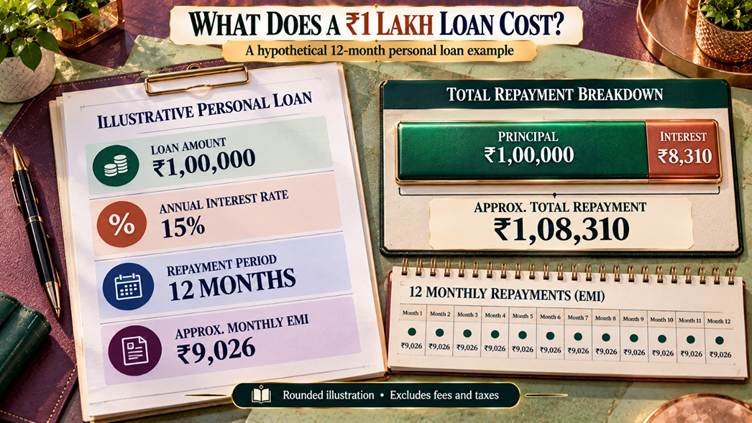
Consider a hypothetical loan with the following assumptions:
| Particular | Value |
| Loan amount | ₹1,00,000 |
| Annual interest rate | 15% |
| Loan tenure | 12 months |
| Approximate monthly EMI | ₹9,026 |
| Approximate total repayment | ₹1,08,310 |
| Approximate total interest | ₹8,310 |
These figures are rounded illustrations using a standard monthly reducing-balance EMI calculation. They exclude processing fees, taxes, and other charges.
Actual repayment figures depend on the lender’s terms and calculation method.
Why Is EMI Affordability Important?
An EMI should be evaluated against essential living expenses, existing debts, savings requirements, and income stability.
A lender’s approval does not automatically mean the repayment will be comfortable for the borrower.
7. Shorter Tenure vs Longer Tenure: Which Is Better?
Loan tenure influences both monthly repayments and total interest costs.
Shorter Loan Tenure
A shorter tenure generally results in higher monthly repayments but may reduce total interest costs, assuming comparable terms.
Longer Loan Tenure
A longer tenure generally reduces the monthly instalment but can increase the total interest paid over the life of the loan.
What Should You Choose?
The objective is to balance monthly affordability with the total cost of borrowing.
A very high EMI may strain household finances.
A very long tenure may make the loan more expensive overall.
Compare actual repayment schedules before choosing.
8. Check Whether the Loan Is Truly Necessary
Before taking a digital personal loan, consider the reason for borrowing.
Borrowing for a genuine urgent need is different from taking a loan for an avoidable purchase simply because approval is convenient.
Questions to Ask Yourself
Is the expense essential?
Can it be postponed?
Are there less expensive alternatives?
Would using available savings leave you without an adequate emergency reserve?
Can the repayment be managed without disrupting essential household expenses?
When Should You Be More Cautious?
Be particularly careful about borrowing to fund recurring lifestyle expenses, speculative investments, or repayments on other loans without a credible plan to address the underlying financial problem.
A new loan can provide temporary liquidity while increasing future financial obligations.
9. Understand the Impact on Your Credit Score
Digital personal loans can affect your credit profile when the relevant borrowing and repayment information is reported to credit information companies.
How Can Repayment Affect Credit History?
Timely repayments can contribute positively to an overall credit profile.
Late payments or defaults may negatively affect it.
The precise impact depends on the information reported and the credit scoring model.
Do Multiple Loan Applications Matter?
Credit enquiries and new borrowing can influence a credit profile.
The effect depends on the type of enquiry, reporting practices, and scoring methodology.
Avoid applying indiscriminately across numerous platforms simply to see how much money is available.
Does a Digital Loan Always Improve Your Credit Score?
No.
A loan is a financial obligation, not a guaranteed credit-score improvement strategy.
Borrowing solely to influence a score may create unnecessary costs and risk.
10. Be Careful With App Permissions and Personal Data
Digital lending involves sharing financial and personal information.
Borrowers should understand what data is being collected, why it is needed, and how it will be used.
What Permissions Should Raise Questions?
Be cautious if a lending application seeks access to unrelated personal information without a clear and legitimate reason.
Examples include broad access to contacts, call logs, or other sensitive device information unrelated to a legitimate lending purpose.
What Should You Review?
Read the privacy notice and applicable consent disclosures.
Check the lender’s identity and the application’s stated data practices.
Use official download sources and avoid installing applications through suspicious links.
Can a Lending App Contact Your Friends or Family?
A borrower should not assume that a lender or service provider may freely use personal contact information for recovery activities.
Applicable RBI requirements and other laws impose restrictions and responsibilities concerning digital lending, customer information, and recovery conduct.
If you experience harassment or misuse of personal data, preserve evidence and use the relevant complaint channels.
11. Know the Cooling-Off Period and Exit Options
Under the RBI digital lending framework, covered digital loans include a cooling-off or look-up period that allows borrowers to exit the loan within the applicable window by paying the principal and proportionate APR, subject to the regulatory framework.
The minimum period and related requirements are governed by applicable RBI directions.
Why Is This Important?
A borrower who reconsiders a loan soon after disbursal may have a defined exit option.
However, the exact contractual and regulatory conditions must be checked.
Does Cooling-Off Mean the Loan Is Completely Free?
No.
The borrower may still need to repay the principal and applicable proportionate borrowing cost.
Do not confuse a cooling-off provision with an unconditional interest-free loan.
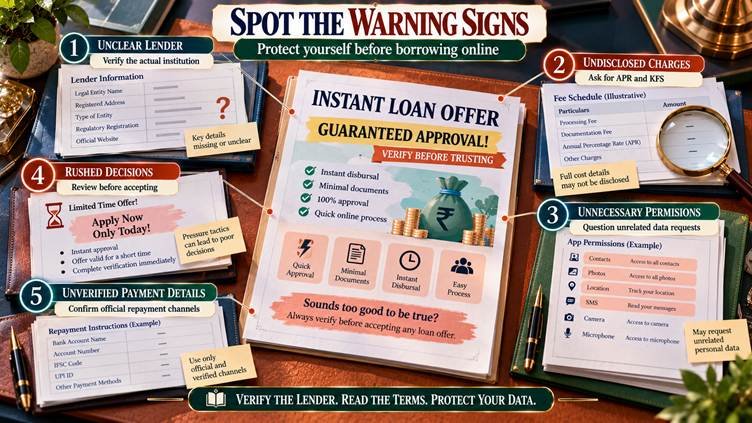
12. Watch for Warning Signs of Unsafe Lending Apps
Some digital lending offers may present risks beyond ordinary borrowing costs.
Common Warning Signs
Be cautious when a platform:
- Does not clearly identify the actual lender
- Refuses to provide important loan terms
- Advertises guaranteed approval without meaningful eligibility checks
- Pressures borrowers to accept immediately
- Requests suspicious upfront payments
- Demands unnecessary access to personal contacts or device information
- Uses threatening or abusive recovery tactics
- Communicates through unofficial or unverifiable channels
No single warning sign automatically proves fraud, but several such indicators warrant serious caution.
What Should You Do?
Avoid accepting an offer until the lender and contractual terms have been verified.
Do not share OTPs, passwords, or other authentication credentials.
Keep copies of advertisements, loan documents, payment records, and relevant communications.
13. Understand the Loan Disbursal and Repayment Process
The route through which loan funds are disbursed and repayments are collected matters.
Under the applicable RBI digital lending framework, disbursal and repayment arrangements are subject to specific requirements concerning the regulated lender and borrower accounts, with defined exceptions.
Why Should Borrowers Check Account Details?
Borrowers should know which entity is receiving repayments and whether the payment instructions are consistent with official loan documentation.
What if Someone Asks You to Repay Through a Personal Account?
Treat unexpected payment requests with caution.
Verify repayment instructions directly through the lender’s official channels before transferring money.
Do not rely solely on a message from an unknown representative.
14. What Happens if You Miss a Digital Personal Loan EMI?
Missing a scheduled EMI can create several consequences.
Depending on the agreement and applicable rules, these may include:
- Overdue amounts
- Applicable penal charges
- Adverse credit reporting
- Collection and recovery communications
- Additional financial stress
Can a Lender Use Harassment to Recover Money?
Regulated lenders and their agents are subject to applicable rules concerning fair recovery practices.
Threats, intimidation, or abusive conduct should not be treated as acceptable simply because a repayment is overdue.
What Should You Do if Repayment Becomes Difficult?
Contact the lender through official channels as early as possible.
Explain the financial difficulty and ask whether any legitimate repayment assistance or restructuring options are available.
Such options are not guaranteed.
Avoid ignoring the loan or taking additional expensive borrowing without evaluating the consequences.
15. How to Compare Two Digital Personal Loan Offers
Consider two hypothetical offers for the same loan amount.
| Comparison Factor | Loan A | Loan B |
| Loan amount | ₹1,00,000 | ₹1,00,000 |
| Interest rate | 13% annually | 15% annually |
| Processing fee | Higher | Lower |
| APR | Must be checked | Must be checked |
| Tenure | 12 months | 12 months |
| EMI | Based on final terms | Based on final terms |
| Total repayment | Must be calculated | Must be calculated |
| Prepayment terms | Check agreement | Check agreement |
| Actual lender | Verify | Verify |
Loan A has a lower stated interest rate, but it cannot automatically be declared cheaper without knowing the applicable charges and actual APR.
Similarly, Loan B cannot be assumed to offer better value simply because its processing fee is lower.
What Is the Better Comparison Method?
Review the KFS and repayment schedule for each offer.
Compare the APR, amount actually disbursed, total repayments, charges, and repayment flexibility.
Also consider lender credibility and your ability to meet the EMI comfortably.
16. Alternatives to Digital Personal Loans
A personal loan is not the only possible way to manage a financial requirement.
Depending on the situation, alternatives may include:
Using Available Savings
This may avoid borrowing costs, but it should be balanced against the need to preserve emergency liquidity.
Delaying a Non-Essential Expense
Postponing a purchase may be more suitable than creating an unnecessary repayment obligation.
Reviewing Existing Financial Commitments
Adjusting discretionary spending may free up funds without adding new debt.
Considering Other Suitable Credit Options
Different credit products may have different costs, collateral requirements, and risks.
They should be compared carefully rather than assumed to be cheaper.
Seeking Financial Assistance or Negotiating Payment Terms
For certain expenses, discussing payment arrangements with the relevant provider may be worth exploring.
The right alternative depends on the urgency, amount, available resources, and potential financial consequences.
Digital Personal Loan Checklist: 12 Things to Verify
Before accepting a digital personal loan, use the following checklist.
| No. | What to Check | Why It Matters |
| 1 | Actual lender’s identity | Helps verify who provides the loan |
| 2 | Lender’s regulatory status | Helps assess legitimacy |
| 3 | Key Facts Statement | Summarises important terms |
| 4 | Annual Percentage Rate | Helps compare borrowing costs |
| 5 | Processing and other fees | Reveals additional expenses |
| 6 | EMI amount | Tests monthly affordability |
| 7 | Loan tenure | Influences EMI and total interest |
| 8 | Total repayment | Shows the overall obligation |
| 9 | Prepayment conditions | Affects early repayment flexibility |
| 10 | App permissions and privacy | Helps protect personal information |
| 11 | Cooling-off provisions | Explains applicable early exit rights |
| 12 | Grievance and repayment channels | Helps resolve issues safely |
Do not accept an offer merely because the application process is fast.
Common Mistakes People Make With Instant Personal Loans
Looking Only at the Advertised Interest Rate
The APR and total repayment may provide a more complete picture.
Borrowing the Maximum Approved Amount
An approved limit does not mean the entire amount is necessary or affordable.
Ignoring the Key Facts Statement
Skipping the KFS can cause borrowers to overlook important terms.
Choosing an EMI Without Checking Monthly Cash Flow
A manageable-looking instalment may still create problems when combined with existing commitments.
Trusting an App Without Verifying the Lender
A professional-looking application is not proof of regulatory compliance.
Giving Unnecessary Device Permissions
Excessive data access can create privacy risks.
Taking Another Loan to Repay an Existing Loan
Repeated borrowing without addressing the underlying problem can worsen financial stress.
Ignoring Late-Payment Consequences
Missed repayments may result in charges and credit reporting consequences.
Assuming Instant Approval Means Low Risk
Fast processing does not make a loan inherently suitable.
Not Keeping Loan Documents
The KFS, agreement, repayment schedule, and payment confirmations may be important later.
Frequently Asked Questions
1. What are digital personal loans?
Digital personal loans are personal loans applied for or serviced through digital channels such as websites and applications.
2. Are instant personal loan apps safe in India?
Safety depends on the actual lender, applicable regulatory compliance, contractual terms, data practices, and recovery conduct. Borrowers should verify the lender before applying.
3. What is APR in a digital personal loan?
APR is an annualised measure of borrowing cost that includes interest and applicable charges under the relevant calculation framework.
4. What is the Key Facts Statement for a personal loan?
The KFS is a standardised disclosure document containing important loan terms and costs for covered lending products.
5. Can I get a digital personal loan without a credit score?
Eligibility depends on the lender’s underwriting criteria. Some lenders may use additional information, but approval is not guaranteed.
6. Does applying for an instant loan affect my credit score?
Credit enquiries and subsequent borrowing may influence credit records and scores, depending on reporting practices and scoring models.
7. Can I repay a digital personal loan early?
Early repayment may be possible, subject to applicable rules and the loan agreement. Check prepayment and foreclosure conditions.
8. What happens if I miss an EMI?
A missed EMI may result in overdue amounts, applicable charges, adverse credit reporting, and recovery communications.
9. Can a loan app access my phone contacts?
Digital lending applications are subject to applicable data-access, consent, and privacy requirements. Unnecessary access requests should be treated cautiously.
10. Should I take an instant personal loan for shopping?
Borrowing for discretionary spending should be evaluated carefully. Consider whether the expense can be delayed and whether the total repayment is affordable.
Final Thoughts
Digital personal loans have made borrowing more accessible and convenient, but speed should never replace financial judgment.
Before accepting a loan, verify the actual lender, read the Key Facts Statement, compare the APR and total repayment, understand the fees, and calculate whether the EMI fits comfortably within your budget.
Also examine the application’s data practices, the repayment process, cooling-off provisions, and the consequences of missing instalments.
A loan that is easy to obtain can still become expensive or financially stressful if the terms are misunderstood.
At Pitanga Wealth, we believe responsible borrowing begins with understanding the complete financial obligation rather than focusing only on how quickly funds can be disbursed.
Explore our educational resources to learn more about credit, loans, financial planning, and managing financial decisions responsibly.
Important Disclaimer
This article is provided solely for general financial education and information. It is not personalised borrowing advice, a loan recommendation, an offer of credit, or a guarantee of loan approval.
All loan examples and calculations are hypothetical. Actual interest rates, APRs, charges, eligibility, repayment schedules, disbursal arrangements, and contractual conditions vary by lender and product.
Digital lending requirements are subject to applicable Reserve Bank of India directions and other laws. Readers should verify the latest applicable rules, review official lender documentation, and obtain clarification from an appropriately authorised professional where necessary.
Distributor Disclosure: Pitanga Wealth is an AMFI-Registered Mutual Fund Distributor (ARN-134606). AMFI registration relates to mutual fund distribution and does not, by itself, authorise lending, loan intermediation, or registration as a SEBI investment adviser.
Written by the Pitanga Wealth Team.
Follow us on Instagram @pitangawealth for more educational insights.
This article is for educational and informational purposes only. It is not investment, tax, legal or insurance advice. Consider your circumstances and relevant documents before making a financial decision.