

Buying health insurance can provide financial protection against eligible medical expenses. But purchasing a policy does not necessarily mean every illness, treatment, or hospitalisation will be covered from the first day.
Many health insurance policies include waiting periods.
These are specified periods during which certain treatments, conditions, or benefits may not be covered, even though the policy is active.
For someone purchasing health insurance for the first time, this can be confusing.
You may wonder why a policy is active but a particular claim is not payable. Or why an illness that develops after buying insurance may still fall under a waiting-period restriction.
Understanding waiting periods in health insurance can help you interpret policy terms, avoid incorrect assumptions, and make more informed coverage decisions.
Let’s examine how waiting periods work in India and what they mean for policyholders.
What Is a Waiting Period in Health Insurance?
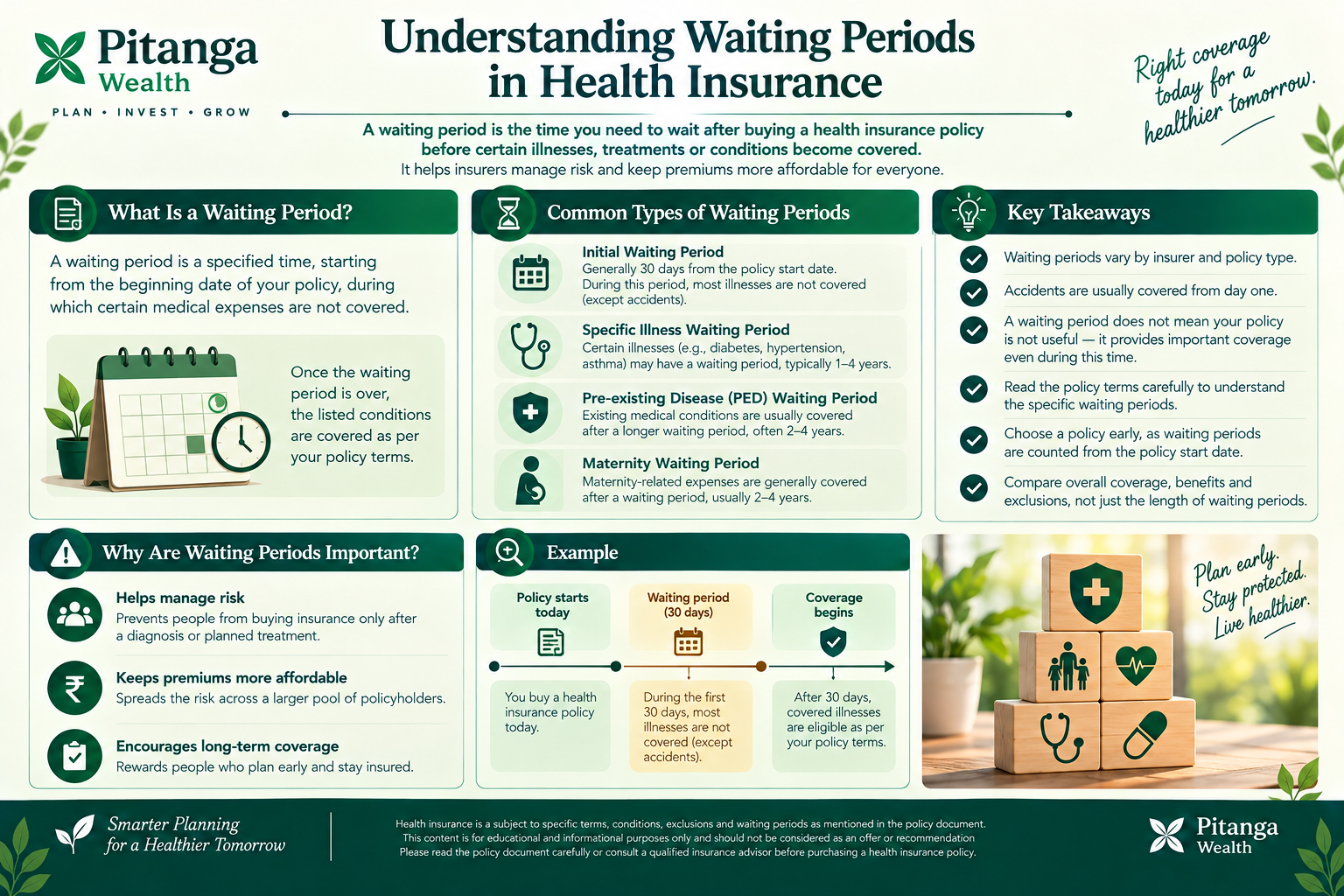
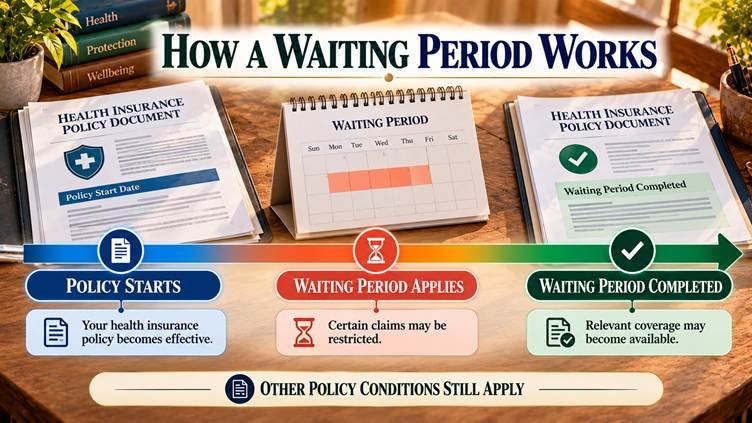
A waiting period is a specified duration during which coverage for certain medical conditions, treatments, or benefits is restricted under a health insurance policy.
The waiting period generally begins according to the conditions stated in the policy, often from the commencement of the relevant coverage.
During this period, the insurer may not pay claims for specified conditions or treatments, even if those expenses would otherwise fall within the policy’s coverage.
Once the applicable waiting period has been completed, the relevant condition or treatment may become eligible for coverage, subject to the remaining policy terms.
Completing a waiting period does not guarantee that every claim will be approved.
Other provisions, such as exclusions, sub-limits, co-payments, deductibles, medical necessity requirements, and sum insured availability, may still apply.
A Simple Example
Suppose someone purchases a health insurance policy on 1 January.
The policy contains a 30-day initial waiting period for certain illnesses, while accidental injuries are treated differently under its terms.
If the insured person requires treatment for an illness during the initial waiting period, the claim may not be covered.
However, treatment for an eligible accidental injury may be covered from the start, subject to the policy conditions.
The exact outcome depends on the wording of the policy.
This is why it is important to understand the different types of waiting periods rather than treating all medical conditions alike.
Why Do Health Insurance Policies Have Waiting Periods?
Health insurance is designed to provide protection against covered medical expenses under agreed policy conditions.
Waiting periods form part of how insurers define the timing and scope of certain benefits.
They can help manage situations where a policy is purchased shortly before an anticipated medical expense.
They also form part of the underwriting and pricing structure of insurance products.
However, waiting periods should not be confused with permanent exclusions.
A waiting period generally restricts coverage for a specified duration.
A permanent exclusion may continue to apply regardless of how long the policy has been held.
Understanding this difference is essential when reading policy documents.
What Are the Different Types of Waiting Periods in Health Insurance?
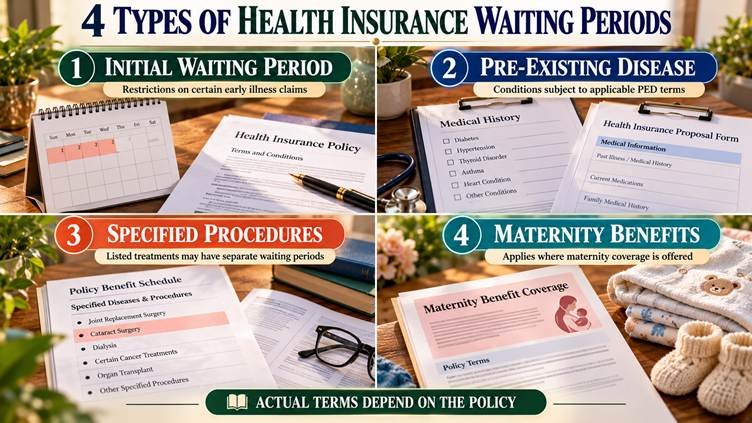
Health insurance policies may contain several types of waiting periods.
The most commonly discussed categories are:
- Initial waiting period
- Pre-existing disease waiting period
- Waiting period for specified diseases or procedures
- Maternity-related waiting period, where applicable
- Other benefit-specific waiting periods
Not every policy includes every type, and the precise terms vary.
Let’s understand them individually.
1. Initial Waiting Period
The initial waiting period is the period immediately following the commencement of coverage during which certain illness-related claims may not be payable.
Many health insurance products specify an initial waiting period of 30 days.
However, the exact duration and exceptions must be checked in the policy.
Does the Initial Waiting Period Apply to Accidents?
Many policies provide an exception for eligible accidental injuries.
This means that certain accident-related hospitalisation claims may be considered even during the initial waiting period.
But this should not be interpreted as a guarantee that every accident-related expense is covered.
The treatment must still satisfy the policy’s eligibility requirements, exclusions, and other conditions.
Example
A person purchases health insurance on 1 March.
The policy specifies a 30-day initial waiting period for illness-related hospitalisation.
If the insured person is hospitalised for a covered illness within that period, the claim may be excluded under the initial waiting-period provision.
If the person instead suffers an accidental injury, different coverage rules may apply.
The policy wording determines the actual claim outcome.
2. Pre-Existing Disease Waiting Period
A pre-existing disease, commonly abbreviated as PED, refers to a medical condition that falls within the applicable definition under the policy and regulatory framework.
In India, the relevant definition generally considers certain medical conditions diagnosed or for which medical advice or treatment was recommended or received within a specified period before the policy’s commencement.
It is important to refer to the current regulatory definition and the policy’s wording rather than assuming every past illness is treated identically.
How Long Is the Waiting Period for Pre-Existing Diseases?
Under the IRDAI framework introduced in 2024, the maximum permitted waiting period for pre-existing diseases was reduced to 36 months for applicable health insurance policies.
However, the actual waiting period may be shorter, and the relevant terms depend on the policy and applicable rules.
This should not be read as a statement that every existing or historical policy automatically provides identical PED conditions.
Policyholders should check their specific documents and any subsequent regulatory changes.
Example
Suppose someone has an existing medical condition that is disclosed when purchasing a health insurance policy.
The insurer accepts the application, subject to a specified waiting period for that condition.
If treatment related to the condition is required during the applicable waiting period, the policy may restrict coverage.
After the waiting period is completed, eligible treatment may become covered, subject to the policy’s other terms.
Why Is Medical Disclosure Important?
Accurate disclosure is essential.
When applying for health insurance, answer medical-history questions truthfully and completely.
Failing to disclose relevant information can lead to disputes or consequences under applicable policy terms and law.
A waiting period is not a substitute for disclosure.
If you are uncertain whether a past diagnosis or treatment needs to be mentioned, seek clarification through the insurer’s official application process.
3. Waiting Period for Specified Diseases and Procedures
Some policies contain waiting periods for particular illnesses, medical conditions, or procedures.
These are sometimes called specific disease or procedure waiting periods.
Examples that may appear in policy wording include certain hernia treatments, cataract procedures, joint-related conditions, and other listed treatments.
The exact list differs by product.
Under the 2024 IRDAI health insurance framework, specified disease or procedure waiting periods were generally subject to a maximum of 36 months for applicable policies.
Insurers may provide shorter waiting periods.
Example
Suppose a policy lists a particular elective procedure under a specified waiting-period clause.
If the insured person undergoes that procedure before the waiting period ends, the insurer may not cover the claim under that benefit.
Once the waiting period is completed, coverage may become available if the procedure is otherwise admissible.
Always read the specific list of diseases and procedures rather than assuming a condition is or is not subject to a waiting period.
4. Maternity Waiting Period
Maternity coverage is not automatically included in every health insurance policy.
Some policies offer maternity benefits, while others may provide them through an optional add-on or a separate product arrangement.
Where maternity coverage is available, it may be subject to a waiting period.
The applicable duration and scope vary by policy.
What Should You Check?
Before relying on maternity coverage, examine:
- Whether maternity benefits are included
- The applicable waiting period
- Delivery-related coverage limits
- Newborn coverage conditions
- Eligible hospitalisation expenses
- Exclusions and other restrictions
Do not assume that purchasing a policy shortly before a planned delivery will make all maternity expenses payable.
Example
A couple purchases a policy that includes maternity coverage subject to a waiting period.
If a maternity-related claim occurs before that period is completed, the claim may not be payable under the maternity benefit.
The actual decision depends on the specific policy terms.
5. Waiting Periods for Other Benefits
Certain additional health insurance benefits may also have eligibility conditions or waiting periods.
These could relate to specific optional covers, treatments, or benefit categories.
For example, a policy may contain special conditions for particular advanced treatments or additional benefits.
The relevant details should be available in the policy wording, benefit schedule, and customer information sheet.
The important point is that a policy can have more than one waiting period operating at the same time.
Completing the initial waiting period does not necessarily mean every other waiting period has also ended.
Waiting Period vs Exclusion: What’s the Difference?
These two terms are often confused.
| Feature | Waiting Period | Exclusion |
| Meaning | Temporary restriction on specified coverage | A condition, treatment, or expense that is not covered under specified terms |
| Duration | Applies for a defined period | May apply for a particular period or permanently, depending on the exclusion |
| What happens later? | Relevant coverage may become available after completion | Coverage depends on whether the exclusion continues to apply |
| Where to check | Waiting-period clauses | Exclusions and policy wording |
A waiting period should not be treated as a promise of unrestricted coverage once it expires.
The insurer will still assess any claim according to the full policy terms.
Does Health Insurance Cover Accidents During Waiting Periods?
Accident-related coverage is an important consideration.
Many health insurance policies provide coverage for eligible accidental injuries without applying the standard initial illness waiting period.
However, this does not mean all accident-related claims are automatically payable.
For example, coverage may depend on:
- Whether the treatment falls within the insured benefits
- Hospitalisation or treatment eligibility
- Applicable exclusions
- Policy commencement and validity
- Deductibles, co-payments, and sub-limits
Check the exact wording for accidental injury and emergency treatment.
What Happens if You Are Hospitalised During a Waiting Period?
The answer depends on why hospitalisation is required and which waiting-period clause applies.
Consider three hypothetical situations.
Situation A: An Illness During the Initial Waiting Period
If an illness falls within an applicable initial waiting-period restriction, the claim may not be covered.
Situation B: An Eligible Accidental Injury
An accident-related claim may be covered under an exception to the initial waiting period, subject to the policy conditions.
Situation C: Treatment for a Listed Pre-Existing Disease
If the condition is subject to an uncompleted PED waiting period, the relevant claim may be restricted.
These examples demonstrate why the medical reason for treatment matters.
Two claims made during the same policy month can have different outcomes.
Do Waiting Periods Reset Every Year?
Generally, waiting periods are not intended to restart at every annual renewal when eligible coverage continues without a break, subject to applicable policy and regulatory conditions.
For example, if a policy provides a specified waiting period and the insured maintains qualifying continuous coverage, the time already completed generally counts toward satisfying that waiting period.
However, continuity benefits depend on the policy and applicable rules.
A break in coverage, a change in benefits, or an increase in sum insured may introduce additional considerations.
This is why timely renewal and careful review of changes are important.
What Happens if You Increase Your Sum Insured?
Increasing your sum insured can affect how waiting periods apply.
Depending on the policy and applicable regulations, the increased portion of coverage may be subject to fresh waiting-period conditions.
For example, suppose a person has maintained health insurance for several years and later increases the sum insured.
The existing coverage and the enhanced portion may not necessarily receive identical waiting-period treatment.
The insurer’s terms and applicable rules determine how the increased coverage is handled.
Before increasing coverage, ask for written clarification about any fresh waiting periods that may apply to the enhanced amount.
What Happens to Waiting Periods When You Port Health Insurance?
Health insurance portability allows eligible policyholders to move from one insurer to another while receiving applicable continuity benefits, subject to regulatory and policy conditions.
This can include credit for waiting periods already served.
However, portability does not mean the new insurer must provide every requested benefit on identical terms.
The receiving insurer may evaluate the application under applicable underwriting rules.
Example
Suppose a policyholder has completed part of an applicable waiting period under an existing health insurance policy.
When moving to another insurer through a valid portability process, the eligible waiting-period credit may be recognised under the new policy.
Any remaining waiting period, treatment of enhanced coverage, and other conditions depend on the applicable rules and policy terms.
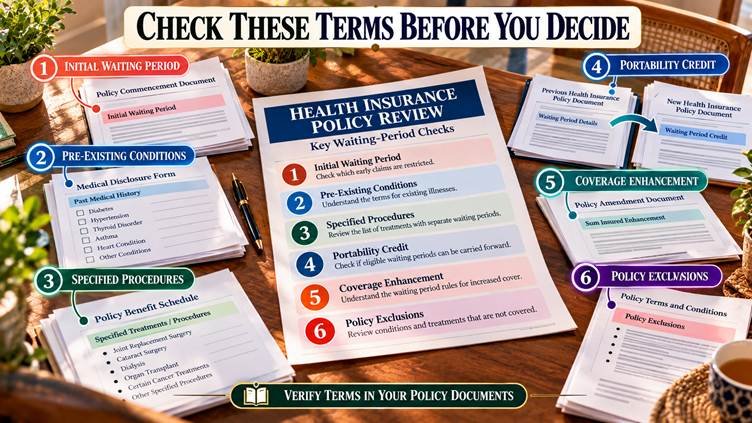
What Should You Check Before Porting?
Review:
- Whether the policy is eligible for portability
- The applicable application timelines
- Waiting-period credits
- Treatment of any increased sum insured
- New policy exclusions and benefits
- Premium and underwriting conditions
Do not cancel existing coverage merely because a new policy quotation looks attractive.
Confirm the new policy’s acceptance and continuity conditions first.
What Is the Difference Between Portability and Migration?
These terms are related but not identical.
Portability generally refers to moving eligible health insurance coverage from one insurer to another while retaining applicable continuity benefits.
Migration generally refers to moving between eligible health insurance products of the same insurer, subject to applicable conditions.
Both may involve recognition of eligible waiting-period credits.
However, the detailed treatment of benefits, underwriting, and enhanced coverage can differ.
Review the relevant rules and obtain clarification from the insurer before making a change.
Can You Buy Health Insurance Without Waiting Periods?
Some products may offer shorter waiting periods, reduced waiting periods for specified conditions, or certain benefits with different eligibility arrangements.
In some cases, insurers may offer optional benefits that modify particular waiting periods.
However, claims that a policy has “zero waiting period” should be examined carefully.
A reduced waiting period for one condition does not necessarily eliminate all other waiting periods or exclusions.
For example, a product may have different rules for initial illness coverage, pre-existing diseases, maternity benefits, and specified procedures.
Always identify exactly which waiting period is being reduced or waived.
How Do Waiting Periods Work in Family Floater Policies?
A family floater provides a shared sum insured for eligible members, but waiting-period considerations can still depend on the individual insured person and the relevant condition.
Different family members may have different medical histories or coverage commencement dates.
For example, an adult added to an existing policy may not necessarily have the same continuity history as a person who has been insured from the beginning.
Similarly, pre-existing disease disclosures and underwriting conditions may differ among insured members.
Therefore, the shared sum insured should not be confused with identical waiting-period eligibility for every member.
For a broader comparison of shared and separate coverage, read our article on family floater vs individual health insurance.
How Can You Check Waiting Periods Before Buying a Policy?
The most reliable approach is to review the insurer’s official policy documents.
1. Read the Customer Information Sheet
The Customer Information Sheet, or CIS, summarises important policy features and conditions.
Use it as a starting point, but also review the complete policy wording.
2. Check the Policy Wording
Look for the sections on initial waiting periods, pre-existing diseases, specified illnesses, exclusions, and optional benefits.
3. Review the Benefit Schedule
Check whether certain treatments or benefits have separate waiting periods or coverage conditions.
4. Disclose Medical History Accurately
Provide complete and truthful answers to relevant medical questions.
5. Ask About Existing Coverage Credits
If you already have insurance, check whether portability or migration benefits may apply.
6. Check Conditions for Increased Coverage
Ask whether a higher sum insured will result in fresh waiting periods on the additional amount.
7. Keep Written Records
Retain the proposal form, policy documents, medical disclosures, endorsements, and relevant insurer communications.
These documents can be important if questions arise during a claim.
Common Mistakes People Make About Waiting Periods
Assuming Everything Is Covered From Day One
Health insurance policies may contain several waiting periods and exclusions.
Confusing the Initial Waiting Period With the PED Waiting Period
Completing the initial waiting period does not automatically complete other waiting periods.
Hiding Existing Medical Conditions
Incomplete medical disclosure can create serious complications when claims are assessed.
Assuming All Policies Have the Same Waiting Periods
Actual terms vary by insurer, product, and applicable regulations.
Ignoring Waiting Periods When Changing Insurers
Portability benefits should be verified before switching.
Assuming Waiting Periods Always Restart on Renewal
Eligible continuous coverage generally carries forward relevant waiting-period credit, subject to applicable conditions.
Believing Restoration Benefits Remove Waiting Periods
Restoration of sum insured and waiting-period eligibility are separate policy concepts.
Buying a Policy Only When Treatment Is Expected
Waiting periods may restrict coverage for certain foreseeable or existing medical needs.
Frequently Asked Questions
1. What are waiting periods in health insurance?
Waiting periods are specified durations during which certain conditions, treatments, or benefits may not be covered under a health insurance policy.
2. What is the initial waiting period in health insurance?
Many policies have an initial waiting period of 30 days for specified illness-related claims, although actual terms and exceptions depend on the policy.
3. What is the waiting period for pre-existing diseases in India?
Under the IRDAI framework introduced in 2024, the maximum PED waiting period for applicable health insurance policies was reduced to 36 months. Actual terms may be shorter, and policyholders should verify their specific coverage and current rules.
4. Are accidents covered during the initial waiting period?
Many policies provide an exception for eligible accidental injuries, subject to the policy’s conditions and exclusions.
5. Do waiting periods reset after every renewal?
Generally, eligible continuous coverage carries forward relevant waiting-period credit, subject to applicable rules and policy conditions.
6. Can I reduce the waiting period for pre-existing diseases?
Some products may offer shorter waiting periods or optional features that modify certain waiting-period conditions. Availability and eligibility vary.
7. Does maternity insurance have a waiting period?
Maternity benefits, where offered, may be subject to a waiting period and other coverage conditions. Not all health insurance policies include maternity coverage.
8. Will my waiting period carry forward if I change insurers?
Eligible waiting-period credits may carry forward through valid portability arrangements, subject to applicable rules and the new policy’s terms.
9. Does a higher sum insured create a new waiting period?
Fresh waiting-period conditions may apply to the enhanced portion of coverage, depending on the policy and applicable regulations.
10. Can a claim be rejected after the waiting period ends?
A claim may still be declined or reduced if it does not satisfy other applicable policy terms, exclusions, or coverage conditions. Completion of a waiting period is not a guarantee of claim approval.
Final Thoughts
Understanding waiting periods in health insurance is an essential part of understanding what your policy actually covers.
A health insurance policy can be active while particular illnesses, procedures, or benefits remain subject to waiting-period restrictions.
Initial waiting periods, pre-existing disease waiting periods, specified disease waiting periods, and maternity-related conditions can all work differently.
The important step is to read the policy carefully, disclose medical information accurately, maintain eligible continuity of coverage, and verify how waiting periods apply when changing or enhancing insurance.
At Pitanga Wealth, we believe that understanding insurance terms before a medical emergency can help families make more informed financial decisions.
Explore our insurance education resources to learn more about family floater coverage, policy add-ons, and other important health insurance concepts.
Important Disclaimer
This article is intended solely for general financial and insurance education. It is not personalised insurance advice, a recommendation to purchase a particular policy, or an assurance of claim approval.
All examples are hypothetical. Actual insurance benefits, waiting periods, underwriting decisions, portability and migration conditions, exclusions, and claims depend on the relevant policy wording and applicable regulations.
Regulatory references in this article describe the IRDAI framework introduced in 2024 and should be checked against any subsequent amendments or clarifications before publication or reliance.
Readers should review the latest policy wording, Customer Information Sheet, and official insurer communications, and seek clarification from an appropriately authorised professional where necessary.
Distributor Disclosure: Pitanga Wealth is an AMFI-Registered Mutual Fund Distributor (ARN-134606). This registration relates to mutual fund distribution and does not, by itself, constitute authorisation to distribute insurance products or registration as an investment adviser with SEBI.
Written by the Pitanga Wealth Team.
Follow us on Instagram @pitangawealth for more educational insights.
This article is for educational and informational purposes only. It is not investment, tax, legal or insurance advice. Consider your circumstances and relevant documents before making a financial decision.