


Health insurance is often one of the first things families consider when planning for unexpected medical expenses.
But choosing a health insurance policy involves more than deciding how much coverage you need.
One important question is whether to buy a single family floater policy or separate individual health insurance policies for each family member.
Both approaches can provide financial protection against eligible medical expenses. However, they work differently, particularly when multiple people need treatment during the same policy year.
So, how should you compare family floater vs individual health insurance?
The answer depends on your family’s ages, health requirements, budget, existing coverage, and the terms of the policies being considered.
Let’s understand the differences before looking at situations where each option may be worth evaluating.
What Is Family Floater Health Insurance?
A family floater health insurance policy covers multiple eligible family members under a shared sum insured.
Instead of assigning a completely separate coverage amount to each insured person, the policy provides a common pool of coverage that eligible members can use, subject to policy conditions.
For example, suppose a family floater policy has a sum insured of ₹10 lakh.
It covers two adults and their eligible children.
If one family member has an admissible hospitalisation claim of ₹3 lakh, that amount may be paid from the shared coverage pool.
The remaining available coverage would then depend on the policy’s terms, other claims, and any applicable restoration or reinstatement benefits.
Who Can Be Covered Under a Family Floater?
Depending on the insurer and product, a family floater may cover:
- The policyholder
- Their spouse
- Dependent children
- Parents or parents-in-law, where the product permits
Not every family floater covers every relationship.
Insurers may also impose eligibility rules relating to age, dependency, family composition, and the number of insured members.
Always check the specific policy’s eligibility conditions rather than assuming all family members can be included.
What Is Individual Health Insurance?
Individual health insurance provides coverage for a particular insured person.
Each individual policy has its own sum insured, benefits, limits, and conditions.
For example, a family might purchase separate policies for two adults, each with a sum insured of ₹10 lakh.
If one person has an admissible claim, that claim generally affects their own policy’s available coverage rather than the other person’s separate policy.
Individual policies can be particularly relevant when family members have different ages, medical needs, or coverage requirements.
However, separate policies may involve different premiums, renewal dates, policy conditions, and administrative responsibilities.
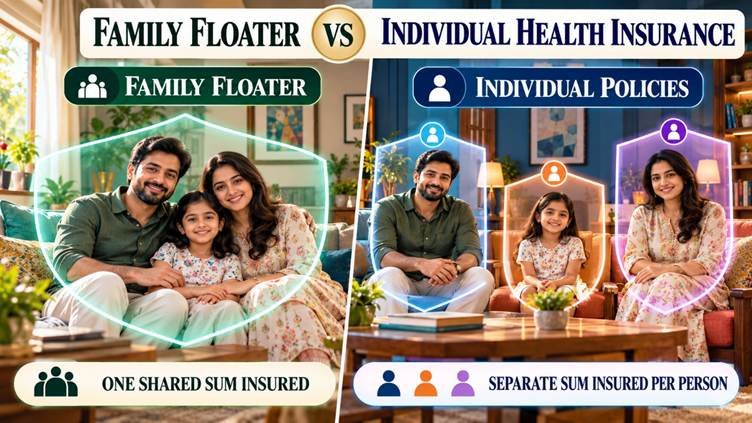
Family Floater vs Individual Health Insurance: Key Differences
The following comparison explains the broad structural differences.
| Feature | Family Floater | Individual Health Insurance |
| Who is covered? | Multiple eligible family members | One insured person per individual policy |
| Sum insured | Shared among covered members | Separate for each insured person |
| Claims | Claims can reduce the common available coverage | Claims generally affect the relevant individual’s coverage |
| Premium | One premium for the family floater | Premiums for separate policies |
| Coverage flexibility | Depends on shared family requirements and product rules | Can be selected according to individual requirements |
| Suitability considerations | Family composition, ages, health needs, shared coverage | Personal medical needs, separate limits, individual circumstances |
| Renewal and administration | Generally managed as one policy | Multiple policies may need separate management |
These are general differences. Actual premiums, coverage, benefits, and claim conditions vary by insurer and product.
How Does the Shared Sum Insured Work in a Family Floater?
Understanding shared coverage is central to comparing family floater vs individual health insurance.
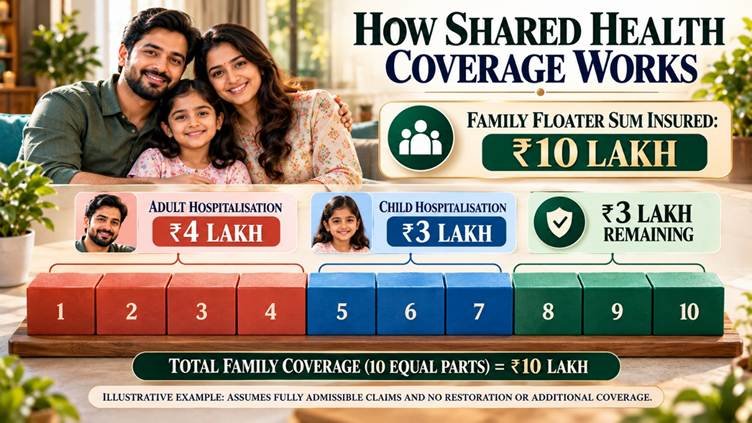
Consider a hypothetical family floater with a ₹10 lakh sum insured.
The policy covers two adults and one child.
During the policy year:
- One adult has an admissible hospitalisation claim of ₹4 lakh.
- The child later has an admissible hospitalisation claim of ₹3 lakh.
Assuming both claims are fully payable from the base sum insured, with no restoration or other additional coverage applying, ₹7 lakh would have been used.
That would leave ₹3 lakh of the original base sum insured available for further eligible claims during that policy year.
This is why a family floater’s shared structure matters.
Multiple hospitalisations involving different family members may draw on the same coverage pool.
Some policies offer restoration or reinstatement features, but the conditions vary. A restoration benefit should not be assumed to work for every claim, every person, or every situation.
How Do Claims Work Under Individual Health Insurance?
Now consider three family members who each hold a separate individual health insurance policy with a ₹10 lakh sum insured.
Suppose one adult has an admissible hospitalisation claim of ₹4 lakh.
That claim generally affects the available coverage under that adult’s policy.
It would not ordinarily reduce the separate sum insured under the other family members’ policies.
This separation can be valuable when more than one person requires significant medical treatment.
However, it does not automatically mean that separate policies are always the most economical or suitable arrangement.
The total premium, benefits, exclusions, and other terms still need to be compared.
Is Family Floater Health Insurance Cheaper Than Individual Plans?
A family floater can sometimes be more cost-efficient than purchasing separate individual policies with comparable coverage features.
But this is not a universal rule.
Premiums depend on several factors, which may include:
- Ages of the insured members
- Number of people covered
- Sum insured
- Medical history and underwriting
- Policy features and optional benefits
- Geographic and other rating factors
- Insurer-specific pricing
The age of the oldest insured member may be particularly relevant in the pricing of some family floater products, but pricing methods vary.
A family floater that appears affordable for two younger adults may not remain the most suitable arrangement when older family members are added.
Likewise, individual policies may offer separate coverage limits but result in a higher combined premium.
Compare actual policy quotations with reasonably similar benefits instead of assuming one structure will always cost less.
Family Floater vs Individual Health Insurance for Young Families
For a young couple or a family with younger dependent children, a family floater may be worth evaluating.
It provides a shared sum insured under one policy and may simplify policy administration.
If family members have relatively similar coverage requirements, a shared policy can be a practical option.
However, the decision should not be based on age alone.
A young family may still need to consider:
- Existing medical conditions
- Expected healthcare requirements
- Adequacy of the shared sum insured
- Waiting periods
- Maternity and newborn coverage, where relevant
- Room-rent restrictions and other sub-limits
- Network hospitals and claims procedures
A family floater should be evaluated for both its cost and its ability to meet the family’s potential medical needs.
Should You Include Your Parents in a Family Floater?
This is an important question for households that include older parents.
Some insurers allow parents to be covered under certain family floater products.
However, including older family members can change the overall coverage and pricing considerations.
Older adults may have different medical requirements, existing conditions, and a greater need for ongoing healthcare.
Their claims may also use a substantial portion of the shared sum insured.
For these reasons, families often evaluate whether separate health insurance coverage for parents would be more appropriate.
But there is no universal rule that parents must always have separate policies.
The decision depends on eligibility, underwriting, premium, existing coverage, medical requirements, and the benefits available under specific products.
What Should You Check for Aging Parents?
Review the policy’s entry-age conditions, pre-existing disease waiting periods, co-payment requirements, disease-specific limits, room eligibility, and other relevant restrictions.
Also consider whether the policy provides access to hospitals and services that are practical for your parents.
A lower premium should not be the only deciding factor.
What Happens if Two Family Members Are Hospitalised Together?
Simultaneous hospitalisations are one of the clearest ways to understand the difference between family floater and individual health insurance.
Under a family floater, eligible claims from both insured members may draw on the same shared sum insured.
If the combined admissible claims exceed the available coverage, the family may need to pay the uncovered amount, subject to any applicable additional benefits.
Under separate individual policies, each person’s claim is generally assessed against their own policy’s available sum insured and conditions.
This does not mean an individual policy will pay every medical bill.
Deductibles, co-payments, exclusions, waiting periods, sub-limits, and other policy conditions may still affect the amount payable.
The important distinction is whether coverage is shared or separately allocated.
What Is a Restoration Benefit in Health Insurance?
Some health insurance products include a restoration or reinstatement benefit.
This feature may replenish some or all of the available sum insured after specified conditions are met.
However, restoration benefits are not identical across insurers.
Important questions include:
- When does restoration become available?
- Is restoration partial or complete?
- Can it apply to the same insured person?
- Can it apply to the same illness?
- Does it apply only after the base sum insured is exhausted?
- Are there limits on how often it can be used?
The answers depend on the product wording.
A family floater with a restoration benefit may offer additional flexibility, but it should not be treated as unlimited coverage.
Does Individual Health Insurance Provide Better Coverage?
Not automatically.
Individual health insurance offers separate coverage limits, which can be useful when family members have different needs.
However, the overall quality of coverage depends on the policy’s benefits and conditions.
For example, an individual policy with a lower sum insured and restrictive sub-limits may not necessarily provide more useful protection than a well-designed family floater with broader benefits.
Similarly, a family floater with a high advertised sum insured may still contain important restrictions.
When comparing policies, examine what expenses are covered, which conditions are excluded, and what limitations apply.
The type of policy is only one part of the decision.
What About Pre-Existing Diseases and Waiting Periods?
Pre-existing diseases and waiting periods deserve particular attention when evaluating family floater vs individual health insurance.
Health insurance policies may have waiting periods for specified conditions or treatments.
Pre-existing disease coverage is also subject to applicable policy terms and regulatory requirements.
The exact treatment of these conditions depends on the policy, the insured person’s disclosures, and other relevant circumstances.
An important point is that different insured members may have different medical histories and coverage conditions, even under a shared family policy.
Therefore, do not assume that one family member’s eligibility or claim experience establishes the same conditions for everyone.
Before purchasing, review the policy wording and disclose relevant medical information accurately.
Also check how waiting-period credits and continuity benefits may apply when renewing, migrating, or porting eligible coverage.
Is a Family Floater Suitable for a Family With Different Medical Needs?
It depends on the extent of those differences.
Suppose one family member has substantial ongoing healthcare needs, while the others have different medical requirements.
A shared coverage pool may be affected by repeated or significant claims involving that member.
Separate individual coverage could be worth evaluating in such circumstances.
Another possible arrangement is a combination of individual policies and a family floater for eligible members, depending on the family’s circumstances.
However, any such arrangement must be assessed against real premiums, underwriting conditions, policy benefits, and the coverage already in place.
There is no single policy structure that fits every household.
Can You Combine Family Floater and Individual Health Insurance?
Yes, a household may hold a combination of policies.
For example, some families choose to evaluate a family floater for certain eligible members while maintaining separate individual coverage for another member.
Others may already have employer-provided group health insurance alongside personal policies.
However, having multiple policies does not mean an investor can recover the same medical expense more than once.
Claim settlement and coordination between indemnity-based policies are subject to applicable terms and regulatory requirements.
Families should understand how claims are handled across policies and maintain clear records of their coverage.

What Should You Check Before Choosing Health Insurance?
Whether you are considering family floater vs individual health insurance, the following factors deserve attention.
Adequacy of Sum Insured
Consider whether the available coverage is appropriate for the medical costs and needs of the people being insured.
Age and Family Composition
Review the ages of family members, eligibility conditions, and how the household’s needs may change.
Pre-Existing Medical Conditions
Understand relevant disclosures, underwriting requirements, waiting periods, and exclusions.
Co-Payment Conditions
A co-payment requires the insured person to bear a specified portion of an admissible claim.
Room-Rent Limits and Sub-Limits
Certain policies may limit particular expenses or categories of treatment.
Network Hospitals
Check whether practical hospital options are available in locations relevant to your family.
Restoration Benefits
Review the actual conditions under which coverage can be restored.
Renewal Terms
Understand the applicable renewal conditions, changes in premium, and policy continuity provisions.
Total Premium
Compare the overall cost alongside coverage features rather than choosing solely on price.
Policy Exclusions
Read what is not covered and when restrictions apply.
These considerations often matter more than the label “family floater” or “individual policy.”
Common Mistakes Families Make When Buying Health Insurance
Choosing Only Based on the Lowest Premium
A lower premium may come with different coverage features or restrictions.
Assuming the Full Family Floater Sum Insured Is Available Separately to Everyone
The base sum insured is generally shared, not individually duplicated for each member.
Ignoring the Needs of Older Family Members
Parents and older adults may have different medical requirements and policy conditions.
Overlooking Waiting Periods
Coverage for certain illnesses or treatments may not be available immediately.
Assuming Restoration Means Unlimited Coverage
Restoration benefits operate according to specific policy conditions.
Ignoring Co-Payments and Sub-Limits
These provisions can affect the amount payable when a claim occurs.
Relying Only on Employer Health Insurance
Employer-provided coverage may change when employment or group policy arrangements change.
Not Reviewing Policy Documents
Marketing summaries do not replace the policy wording, exclusions, and benefit schedule.
Frequently Asked Questions
1. What is the main difference between family floater and individual health insurance?
A family floater provides a shared sum insured for multiple eligible family members. Individual health insurance provides a separate sum insured for each person covered under their respective policies.
2. Is family floater health insurance cheaper?
It can be more cost-efficient in some situations, but not always. Premiums depend on ages, health conditions, coverage, product features, and insurer pricing.
3. Can parents be included in a family floater?
Some products allow parents to be included, subject to eligibility conditions. Families should compare the implications of shared coverage, premiums, and the parents’ medical requirements.
4. What happens if one person uses the entire family floater sum insured?
Other members may have reduced or no remaining base coverage for that policy year, subject to the policy’s additional benefits and restoration provisions.
5. Can a family have both floater and individual policies?
Yes. Families can hold different types of health insurance policies, subject to product eligibility and terms.
6. Does a family floater cover pre-existing diseases?
Coverage depends on the policy wording, medical disclosures, applicable waiting periods, and other conditions. It should not be assumed that all pre-existing conditions are covered immediately.
7. Is individual health insurance better for senior citizens?
Separate coverage may be worth evaluating for older adults because their medical needs and claims patterns may differ. However, suitability depends on the actual policies and circumstances.
8. What happens if two people claim under a family floater in the same year?
Their admissible claims generally draw from the shared available coverage, subject to policy conditions and any applicable restoration benefits.
9. Is ₹10 lakh family floater coverage enough?
There is no universally appropriate amount. Adequacy depends on family composition, location, medical needs, expected treatment costs, existing insurance, and policy conditions.
10. Should I choose family floater or individual health insurance?
Compare both structures based on your family’s ages, medical needs, budget, available sum insured, exclusions, waiting periods, and other policy conditions. The more suitable option depends on your circumstances.
Final Thoughts
The decision between family floater vs individual health insurance is not simply about finding the lowest premium.
A family floater offers shared coverage for eligible members, while individual policies provide separate coverage limits.
Both structures have advantages and limitations.
For some households, a shared policy may be practical and cost-efficient.
For others, separate policies or a combination of coverage arrangements may be more appropriate to evaluate.
The important step is to understand how the sum insured works, what restrictions apply, and how the policy may respond when family members need medical treatment.
At Pitanga Wealth, we believe that understanding insurance features and limitations is an important part of making informed financial decisions.
Explore our financial education resources to learn more about health insurance waiting periods, policy benefits, and other essential insurance concepts.
Important Disclaimer
This article is intended solely for general financial education and information. It does not constitute personalised insurance advice, a recommendation to purchase a specific policy, or an assurance that any claim will be approved.
All examples are hypothetical. Insurance coverage, premiums, eligibility, waiting periods, exclusions, restoration benefits, and claim settlement depend on the terms of the relevant policy and applicable regulations.
Readers should carefully review the policy wording, benefit schedule, exclusions, and other official documents before making insurance decisions. Where necessary, seek clarification from the insurer or an appropriately authorised professional.
Distributor Disclosure: Pitanga Wealth is an AMFI-Registered Mutual Fund Distributor (ARN-134606). This registration relates to mutual fund distribution and does not, by itself, constitute authorisation to distribute insurance products or registration as an investment adviser with SEBI.
Written by the Pitanga Wealth Team. Follow us on Instagram: We explain investing and financial planning in plain language. Follow @pitangawealth for more educational insights.
This article is for educational and informational purposes only. It is not investment, tax, legal or insurance advice. Consider your circumstances and relevant documents before making a financial decision.