

Someone I know redeemed a chunk of his mutual fund units expecting a certain tax outcome, based on what he remembered reading a few years earlier. When he actually filed his return, the number looked different from what he expected not because he’d made an error, but because the specific rates and provisions had changed since he last paid attention, and he’d carried the old numbers in his head without realising tax rules on this front get revised periodically.
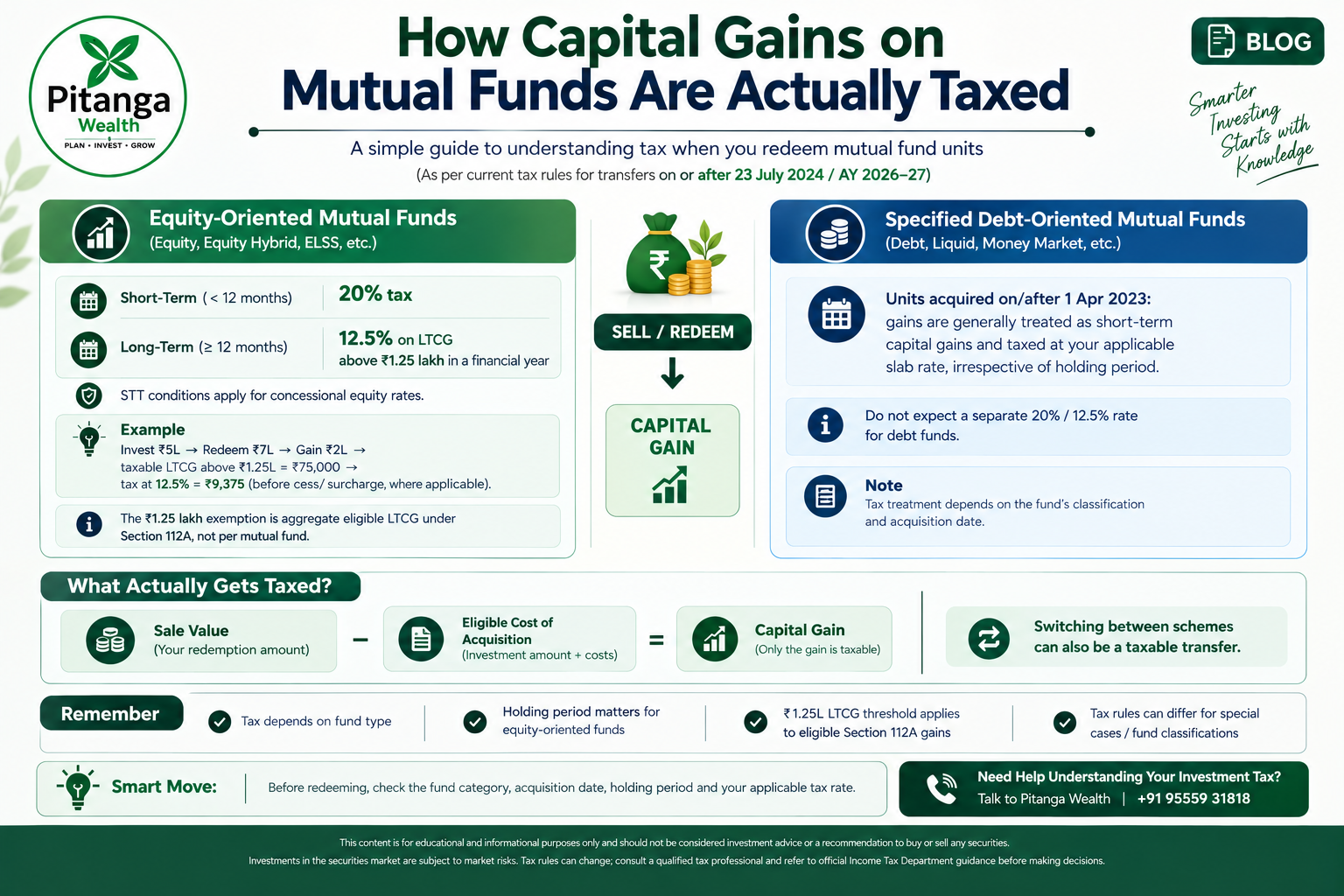
Capital gains on mutual funds work on a fairly consistent underlying logic, even though the specific rates applied to that logic shift over time with changes in tax law. This article focuses on the logic what actually determines how your gain is taxed rather than quoting today’s rates, which is exactly the kind of detail worth confirming fresh each time you need it, either through the Income Tax Department’s resources or a chartered accountant.

What Counts as a Capital Gain on a Mutual Fund
A capital gain arises when you redeem (sell) your mutual fund units for more than what you originally invested. If a redemption is for less than your original investment, that’s a capital loss instead, which can often be used to offset gains elsewhere, subject to specific rules. Importantly, this gain is only realised, for tax purposes, when you actually redeem or switch out of units simply holding an investment that has grown in value doesn’t trigger a tax event on its own.
The Two Things That Determine How Much Tax You Pay
Broadly, two factors decide how a given capital gain on a mutual fund is treated: what the fund actually invests in (its underlying asset allocation), and how long you held the units before redeeming.
Equity-Oriented vs Debt-Oriented Funds: Different Rules Apply
The first big split in how capital gains on mutual funds are taxed comes from what the fund actually holds. Mutual fund schemes are generally categorised for tax purposes based on how much of their portfolio is invested in equities. Equity-oriented funds (those with a sufficiently high equity allocation, as defined under current tax provisions) are taxed under one set of rules, while funds that don’t meet that equity threshold commonly debt-oriented or hybrid funds with lower equity exposure are taxed under a different set of rules. The classification is about where the fund’s money is actually invested, not the name of the scheme, so it’s worth checking a fund’s actual composition rather than assuming based on its label alone.
This distinction matters because the two categories are treated quite differently when it comes to how gains are computed and taxed, which is exactly why “how much tax will I pay” doesn’t have one universal answer across all mutual funds.

Why Holding Period Matters
The second big factor in capital gains on mutual funds is timing. Within each of these two broad categories, how long you’ve held the units before redeeming also affects the tax treatment. Tax law defines a specific holding period threshold that separates what’s treated as a short-term gain from what’s treated as a long-term gain, and this threshold can differ between equity-oriented and debt-oriented funds. Gains realised within that threshold are generally taxed differently and often less favourably than gains realised after holding for longer than the threshold.
The specific number of months that defines this threshold, and the rates applied on either side of it, are set under current tax law and have been revised in the past, which is exactly why this article avoids stating a fixed number here. What’s durable is the underlying principle: holding longer, past a defined threshold, generally receives different (often more favourable) tax treatment than a shorter holding period, and that principle has remained consistent even as the specific numbers around it have shifted.
What About SIP Investments? Each Instalment Has Its Own Clock
This is a detail that surprises a lot of SIP investors. Each SIP instalment is treated as a separate investment for tax purposes, with its own purchase date and therefore its own individual holding period. This means that if you redeem your SIP investment, the units bought earliest may qualify for long-term treatment while units bought more recently might still fall under short-term treatment, even though you think of the whole SIP as “one investment.” Mutual fund statements and capital gains reports typically account for this automatically, generally using a first-in-first-out approach for calculating which units were redeemed, but it’s useful to understand why a single redemption can sometimes show a mix of short-term and long-term gains.

Switching Between Funds Is Also a Taxable Event
Switching from one scheme to another even within the same fund house, and even if it’s part of a deliberate rebalancing or moving from a regular to a direct plan is treated as a redemption of the first scheme followed by a fresh investment into the second. This means a switch can trigger capital gains tax exactly the way a straightforward redemption to your bank account would, which catches people off guard when they assume “switching” doesn’t count as cashing out.
SWPs and Capital Gains: Each Withdrawal Is a Partial Redemption
If you’re using a Systematic Withdrawal Plan to draw a regular income from your mutual fund investment, it’s worth knowing that each withdrawal is, for tax purposes, a partial redemption of units and is therefore subject to capital gains tax on whatever portion of that withdrawal represents a gain, calculated the same way a lump sum redemption would be. This is a detail that’s easy to overlook when SWPs are thought of purely as an “income stream” rather than a series of individual redemptions, each with its own tax consequence.
Does TDS Apply to Capital Gains on Mutual Funds?
For resident Indian investors, mutual funds generally don’t deduct TDS on capital gains at the time of redemption the way certain other payments do. For NRI investors, the treatment is different, and TDS is generally applicable on capital gains at the time of redemption a distinction worth understanding if your residency status has changed, or if you’re investing on behalf of an NRI family member.
How This Actually Shows Up on Your Tax Return
Capital gains from mutual funds need to be reported under the capital gains section of your income tax return, and most fund houses or registrars provide a capital gains statement summarising your transactions for the year, which can help with this reporting. It’s worth cross-checking this against your Annual Information Statement (AIS), since discrepancies between what you report and what’s reflected there can sometimes trigger queries from the tax department.
Common Mistakes People Make
A few patterns show up repeatedly in how people misunderstand capital gains on mutual funds.
Assuming no TDS means no tax liability. For resident investors, the absence of TDS on a mutual fund redemption doesn’t mean the gain is tax-free it simply means the responsibility to calculate and report it falls on you at the time of filing.
Forgetting that switches and SWPs are taxable events. Both are easy to mentally file away as “not really selling,” when for tax purposes, they’re treated exactly like a redemption.
Carrying old rate assumptions forward. As in the story that opened this piece, assuming today’s tax treatment matches what you remember from a few years ago is a genuinely common and avoidable mistake, given how often these specific provisions get revised.
Not tracking the holding period of individual SIP instalments. This can lead to confusion when a capital gains statement shows a mix of short-term and long-term gains from what felt like a single, continuous investment.
Frequently Asked Questions
Is capital gains tax on mutual funds the same for equity and debt funds? No equity-oriented and debt-oriented (or other non-equity) funds are generally taxed under different rules, both in terms of the holding period that defines short-term versus long-term, and the rates applied. It’s worth checking your specific fund’s classification rather than assuming based on its name.
Do I pay tax every year on my mutual fund gains, even if I don’t redeem? No capital gains tax applies when you actually redeem or switch out of units. Simply holding an investment that has grown in value doesn’t create a tax liability on its own.
Is switching from a regular plan to a direct plan of the same fund tax-free since it’s “the same fund”? No this is treated as a redemption followed by a fresh investment, and can trigger capital gains tax depending on your holding period and the gain involved, even though the underlying portfolio is identical.
How do I know which units were sold if I invested through a SIP over several years? Capital gains statements provided by fund houses or registrars generally calculate this using a first-in-first-out method, matching the earliest purchased units to the earliest units redeemed. This is usually handled automatically in the statement rather than something you need to calculate by hand.
Does a Systematic Withdrawal Plan have any special tax treatment compared to a lump sum redemption? Not fundamentally each SWP instalment is a partial redemption and is taxed the same way a proportional lump sum redemption would be, based on the gain portion of that specific withdrawal.
Where can I find the exact current capital gains tax rates for mutual funds? The Income Tax Department’s official resources, or a chartered accountant, will have the rates and thresholds currently in force, since these are revised periodically and this article deliberately avoids quoting a number that could go out of date.
If you’re trying to understand how capital gains on mutual funds will actually apply to a planned redemption, switch, or SWP, our team at Pitanga Wealth can help you think through the implications before you act.
Mutual Fund investments are subject to market risks. Read all scheme-related documents carefully before investing. This article is for general educational purposes only and does not constitute tax advice. Capital gains tax rates, holding period thresholds, and related provisions are subject to change and are specific to each tax year; please refer to the Income Tax Department’s official resources or consult a qualified chartered accountant for figures applicable to your situation. Pitanga Wealth is an AMFI-Registered Mutual Fund Distributor (ARN-134606).
Written by the Pitanga Wealth team.
Follow us on Instagram: We break down how your investments are actually taxed, in plain language — follow @pitangawealth for more.
This article is for educational and informational purposes only. It is not investment, tax, legal or insurance advice. Consider your circumstances and relevant documents before making a financial decision.