

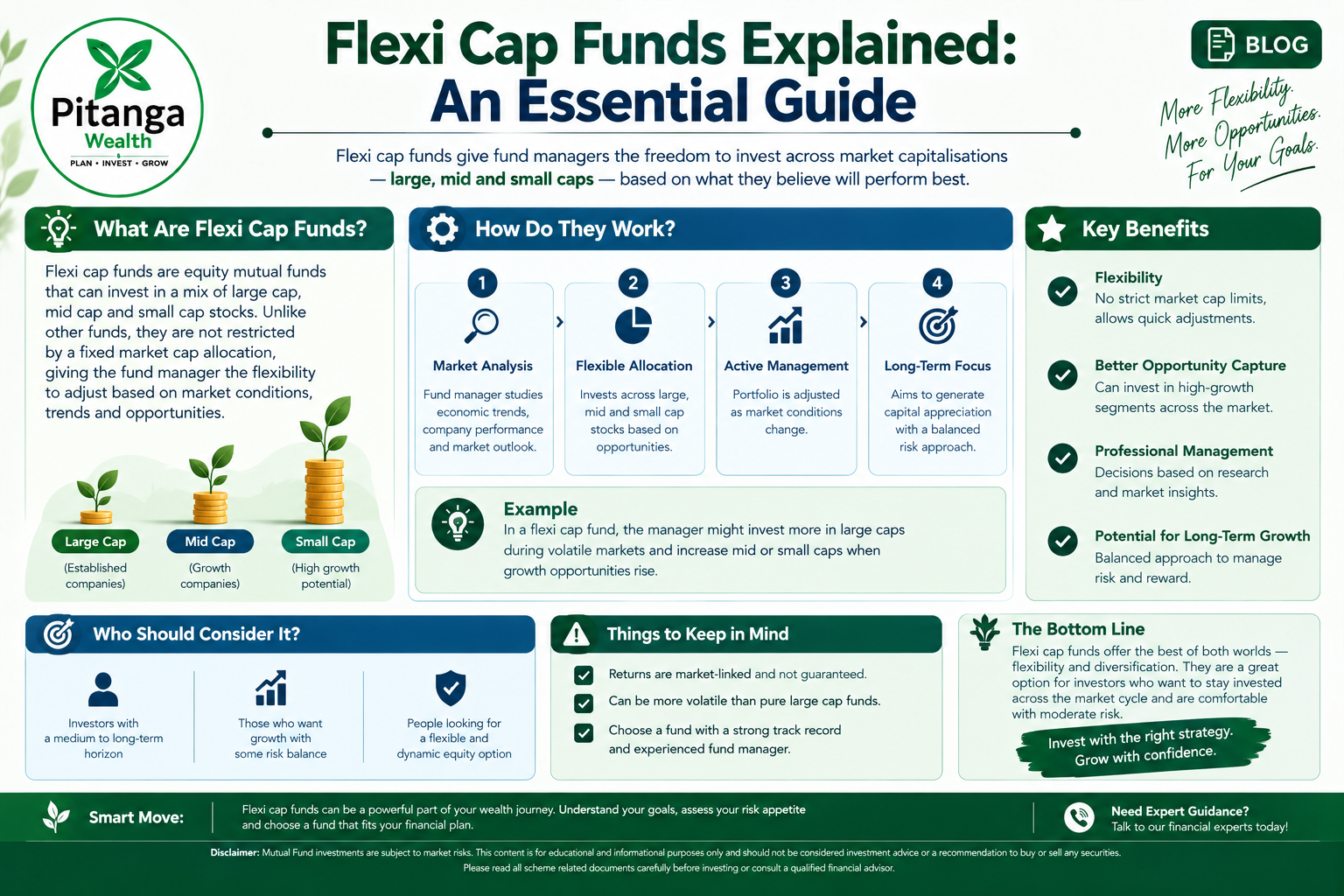
A friend asked me a few months ago why her “multi-cap” fund suddenly seemed to be called something else on her investment app. It hadn’t actually changed hands or strategy overnight — what had happened was a broader shift across the industry, where several funds that previously operated with more flexible mandates were reclassified into what’s now called the flexi cap category, following a SEBI-driven restructuring of how these equity categories are defined. She’d been holding a flexible, multi-market-cap fund the whole time; she just hadn’t understood what that flexibility actually meant or why it mattered.
Flexi cap funds have become one of the more actively discussed categories in Indian mutual funds, and a meaningful part of that interest comes down to one feature: unlike several other equity categories, they’re not boxed into investing a fixed portion of their portfolio in any particular market-cap segment. Here’s what that actually means, and what’s worth checking before you treat “flexi cap” as a single, predictable kind of fund.
What Is a Flexi Cap Fund?
A flexi cap fund is an open-ended equity scheme that can invest across large-cap, mid-cap, and small-cap companies without being required to maintain a fixed minimum allocation to any particular segment, subject to an overall minimum equity exposure requirement defined under current mutual fund categorisation rules. In practice, this means the fund manager has discretion to shift the portfolio’s weighting toward large caps, mid caps, or small caps — or some blend of all three — based on where they see opportunity, without a regulatory floor forcing a fixed split.
This is the defining feature of the category, and it’s worth sitting with for a moment: the flexibility lives with the fund manager, not with you as the investor picking a fixed-allocation product. What you’re actually getting depends heavily on how a specific fund’s manager chooses to use that flexibility, which varies meaningfully from one flexi cap fund to another.

How Flexi Cap Differs From Multi Cap Funds
This comparison comes up constantly, and for good reason — the two categories exist precisely because of a distinction SEBI introduced to separate them. Multi-cap funds, under current categorisation rules, are required to maintain minimum allocations to large-cap, mid-cap, and small-cap stocks, meaning the fund manager has less room to concentrate heavily in any one segment even if that’s where they see the strongest opportunity. Flexi cap funds don’t carry that same mandated minimum split, giving the manager considerably more discretion over how the portfolio is weighted across market caps at any given time.
Neither structure is inherently better — a mandated minimum split offers more predictability about what you’re holding, while flexi cap’s discretion offers the fund manager more room to adapt, for better or worse, depending on their decisions.
How Flexi Cap Differs From Large Cap, Mid Cap, and Small Cap Funds
Large-cap, mid-cap, and small-cap funds are each required to invest predominantly within their named segment, under current categorisation rules. If you buy a large-cap fund, you’re largely getting exposure to bigger, more established companies, with limited room for the fund to meaningfully venture into smaller companies. Flexi cap funds aren’t bound by any single segment this way, which is the core reason they’re often framed as offering broader exposure within a single scheme rather than requiring an investor to separately hold large-cap, mid-cap, and small-cap funds to get that same spread.
Why This Category Has Grown in Popularity
A few genuine reasons show up repeatedly in why investors and advisors have gravitated toward flexi cap funds:
- Single-fund convenience. Rather than managing separate allocations across large-cap, mid-cap, and small-cap funds and rebalancing between them yourself, a flexi cap fund folds that decision into one investment, with the fund manager making the cap-allocation calls.
- Manager discretion during changing market conditions. Because the fund isn’t locked into a fixed minimum per segment, the manager can, in principle, lean more heavily toward whichever segment they currently find more attractively valued, without being constrained by a regulatory floor elsewhere.
- A single category that can suit a core equity holding. Many investors and advisors use a flexi cap fund as a core, foundational equity holding precisely because of its broad mandate, often pairing it with more specific satellite holdings elsewhere in a portfolio.
None of this is a claim that flexi cap funds perform better than other categories — that depends entirely on the specific fund, the specific manager’s decisions, and market conditions during any given period, none of which can be predicted or guaranteed in advance.

What the Flexibility Doesn’t Mean: It’s Not Automatically Safer
This is worth stating plainly, because it’s a common and understandable misunderstanding. The word “flexible” can sound like it implies caution or adaptability toward safety, but a flexi cap fund’s manager could just as easily lean heavily into small-cap or mid-cap stocks — which generally carry more volatility than large caps — as they could lean conservative. The flexibility is about discretion, not a built-in bias toward lower risk. Two flexi cap funds from different fund houses can carry meaningfully different risk profiles at any given time, purely because their managers have made different allocation choices within the same flexible mandate.
Who Might Consider a Flexi Cap Fund
- Investors who want broad equity exposure across market caps through a single fund, rather than managing multiple category funds themselves
- Those comfortable trusting a fund manager’s judgment on how to weight large, mid, and small caps over time, rather than wanting that decision fixed or made by themselves
- Investors looking for a core, long-term equity holding as part of a broader portfolio, rather than a narrowly focused bet on one market-cap segment
What to Actually Check Before Choosing One
Because the category name alone doesn’t tell you much about a specific fund’s current positioning, it’s worth looking at a few things before choosing:
- The fund’s current portfolio composition, available in its factsheet, to see its actual present allocation across large, mid, and small caps — this can and does shift over time within the same fund.
- The fund manager’s stated approach and track record of navigating different market conditions, rather than assuming all flexi cap funds behave similarly simply because they share a category label.
- How the fund fits alongside your other holdings, since a flexi cap fund with heavy small-cap exposure sitting next to several other small-cap-heavy funds could mean more overlapping risk than you intended.

Common Mistakes People Make
Assuming “flexi cap” automatically means well-diversified or lower risk. The category’s flexibility doesn’t guarantee a balanced spread across market caps — that depends entirely on the specific manager’s current decisions.
Choosing a fund based on the category label alone, without checking its actual current allocation. Two flexi cap funds can look quite different in practice depending on where their respective managers currently see opportunity.
Not understanding the SEBI-driven history of this category. Some long-term investors are still holding funds that were reclassified into flexi cap from what used to be structured as more flexible multi-cap offerings, and not realising this can lead to confusion about what changed and why.
Frequently Asked Questions
Is a flexi cap fund the same as a multi-cap fund? No — multi-cap funds are required to maintain minimum allocations across large, mid, and small caps under current categorisation rules, while flexi cap funds have no such mandated minimum split, giving the fund manager more discretion.
Are flexi cap funds less risky than small-cap or mid-cap funds? Not necessarily — a flexi cap fund’s risk depends on its current actual allocation, which the fund manager can shift. A flexi cap fund heavily weighted toward smaller companies at a given time can carry risk closer to a small-cap or mid-cap fund than its category name might suggest.
How do I know what a flexi cap fund is currently invested in? The fund’s factsheet, published regularly by the fund house, shows its current portfolio composition across market-cap segments, and this is worth checking rather than assuming based on the category alone.
Can a flexi cap fund change its allocation significantly over time? Yes, that’s the defining feature of the category — the fund manager has discretion to shift the portfolio’s weighting across large, mid, and small caps as their view of opportunities changes, without a fixed minimum constraining them to any one segment.
Is a flexi cap fund a good first mutual fund for a new investor? It’s one option some investors and advisors consider for a core equity holding, given its broad mandate, but suitability depends on your specific goals, risk comfort, and overall portfolio — it isn’t automatically the right starting point for everyone.
Why did some multi-cap funds become flexi cap funds? This followed a SEBI-driven update to how equity mutual fund categories are defined, which introduced flexi cap as a distinct category and led several existing funds to be reclassified or to adjust their mandates to fit either the multi-cap or flexi cap definition going forward.
If you’re trying to understand whether a flexi cap fund fits into your portfolio, or want help reviewing what a specific fund is actually invested in right now, our team at Pitanga Wealth can help you think it through.
Mutual Fund investments are subject to market risks. Read all scheme-related documents carefully before investing. Fund categorisation rules are set by SEBI and are subject to change; a fund’s actual portfolio composition can shift over time within its category mandate. This article is for educational purposes only and should not be construed as investment advice or a recommendation to invest in any particular scheme. Pitanga Wealth is an AMFI-Registered Mutual Fund Distributor (ARN-134606).
Written by the Pitanga Wealth team. Follow us on Instagram: We break down mutual fund categories like this one in plain language — follow @pitangawealth for more.
This article is for educational and informational purposes only. It is not investment, tax, legal or insurance advice. Consider your circumstances and relevant documents before making a financial decision.