

A relative of mine kept almost everything he owned in physical gold and fixed deposits for over a decade, convinced this was the safest possible approach. It wasn’t a bad instinct, exactly — both are genuinely lower-volatility choices compared to equity. But when he actually needed a large sum for a medical emergency, he realised his entire net worth had grown slowly for ten years, missing out on the kind of long-term growth that a properly diversified mix could have offered, without him taking on dramatically more risk than he already had.
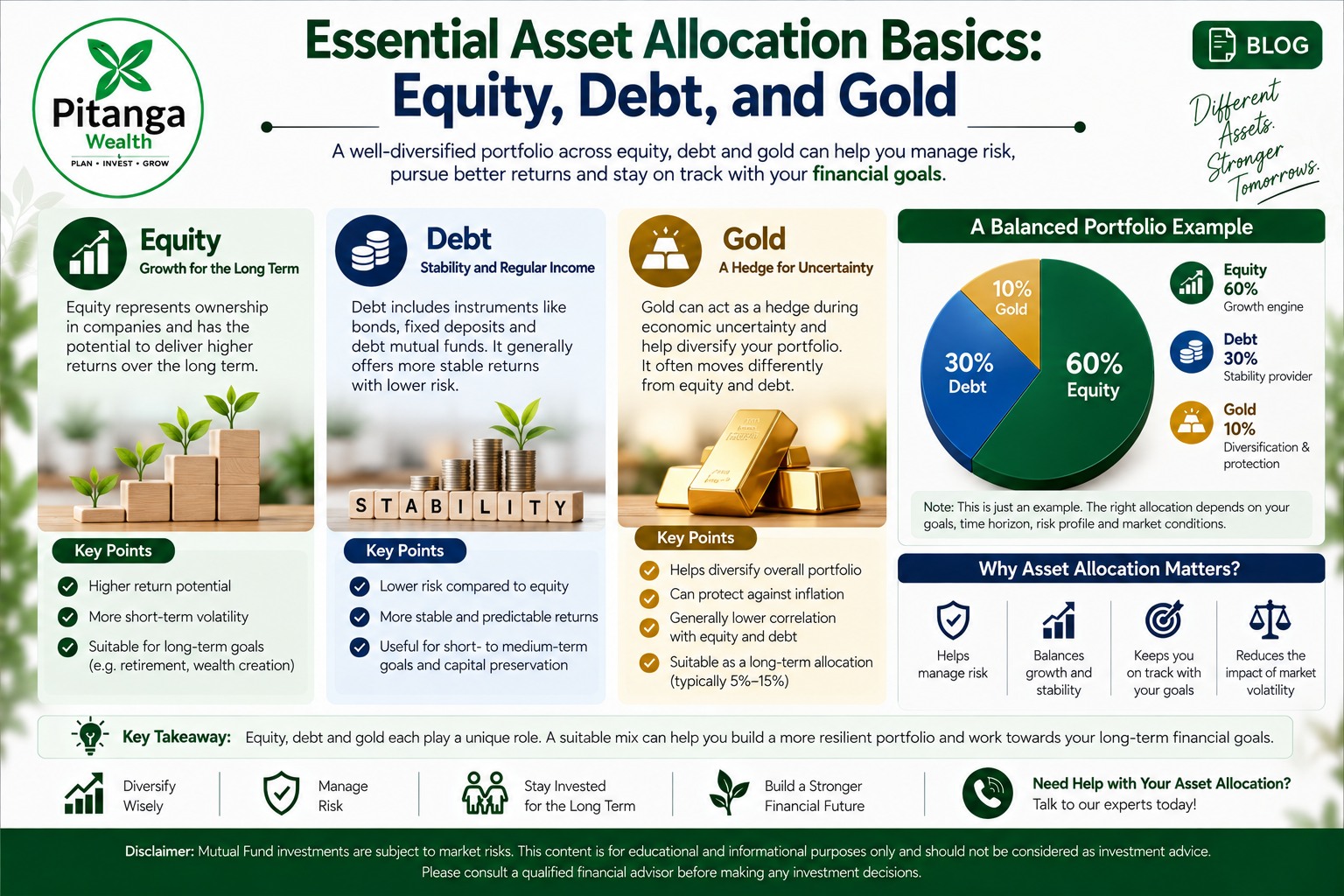
Asset allocation basics come down to one deceptively simple idea: don’t put everything in one place, because different assets behave differently, and you rarely know in advance which one will do well in a given period. Here’s how equity, debt, and gold actually differ, and how they typically work together.
What Is Asset Allocation, Really?
Asset allocation is the process of dividing your investments across different asset classes — commonly equity, debt, and gold — based on your goals, how much risk you’re comfortable with, and how long you have until you need the money. It’s a different concept from diversification within a single asset class (owning several stocks or several mutual funds), though both ideas work together in a well-constructed portfolio.
The logic behind asset allocation isn’t about picking winners. It’s about not being fully exposed to any single asset class’s bad years, since each behaves differently depending on economic conditions, and nobody can reliably predict which one will lead in any given period.
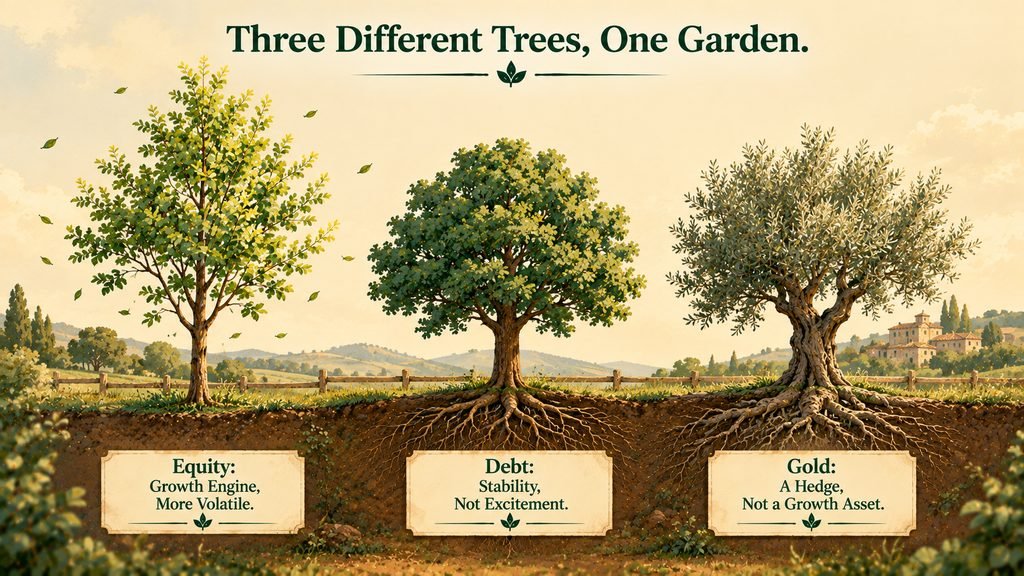
Equity: The Growth Engine, With Real Volatility
Equity mutual funds invest in shares of companies, and their value moves with the stock market. Over long periods, equity has historically had the potential for meaningfully higher growth than debt or gold, though this comes with genuine short-term volatility, and there’s no guarantee of positive returns in any specific period. Equity generally makes sense for goals with a longer time horizon, where there’s more time to potentially recover from a downturn.
Debt: Stability and Predictability, Not Excitement
Debt mutual funds and instruments (bonds, fixed deposits, and similar) generally offer more predictable, lower-volatility returns compared to equity, though they carry their own risks — interest rate movements and credit risk among them — and returns are still not guaranteed. Debt tends to play a stabilising role in a portfolio, cushioning against equity’s swings and providing a source of relatively steadier value, particularly useful for shorter-term goals or as a counterbalance to equity risk.
Gold: A Hedge, Not a Growth Strategy
This is the asset class most commonly misunderstood, especially in Indian households where gold often holds cultural as well as financial significance. Gold has historically tended to behave differently from equity and debt during certain periods — sometimes moving in the opposite direction during market stress — which is why it’s often included as a diversifier rather than a primary growth driver. It’s worth being clear that gold’s role in a portfolio is generally about reducing overall volatility through low correlation with other assets, not about being the asset expected to deliver the highest returns over time.

Why These Three Specifically
Equity, debt, and gold don’t move in lockstep with each other, and that’s the entire point of including all three rather than concentrating in one. When equity is going through a rough patch, debt or gold may hold up better, and vice versa. This isn’t a guarantee that any two will always move in opposite directions — correlations between asset classes can shift over time — but the general tendency toward imperfect correlation is what makes combining them useful for smoothing out a portfolio’s overall ups and downs.
What Actually Determines Your Ideal Mix
There’s no single asset allocation basics formula that applies to everyone, because the right mix depends on factors specific to you:
- Your time horizon. A longer runway generally allows more room for equity, since there’s more time to recover from volatility. A shorter one usually calls for a larger allocation to debt.
- Your risk tolerance. Two people with identical goals and timelines can reasonably choose different mixes based purely on how much volatility they can tolerate without making poor emotional decisions.
- Your specific goals. Money earmarked for a near-term need should generally be allocated more conservatively than money meant for a goal decades away.
- Your existing assets. Someone who already owns significant physical gold or real estate may reasonably allocate their new investments differently than someone starting from scratch.
Common Ways People Think About Their Mix
Asset allocation basics get more concrete once you think in terms of broad risk profiles rather than exact numbers. Rather than a fixed universal percentage, many investors think in terms of broad risk profiles:
- Conservative portfolios tend to lean more heavily toward debt, with smaller equity and gold allocations, prioritising capital protection over growth.
- Moderate portfolios generally hold a more even mix across the three, balancing growth potential against volatility.
- Aggressive portfolios tend to lean more heavily toward equity, accepting more short-term volatility in pursuit of potentially higher long-term growth.
These are broad descriptions, not prescriptions — the exact percentages within each profile vary by individual circumstances and should be considered as a starting point for a real conversation, not a fixed target to copy.

Allocation Isn’t a One-Time Decision
There’s one more piece of asset allocation basics worth understanding: the mix doesn’t stay put on its own. Once you’ve settled on a mix, it doesn’t stay fixed — different asset classes grow at different rates, so your actual allocation drifts away from your intended target over time, even without you doing anything. This is exactly why periodic rebalancing matters: it’s what brings a drifted portfolio back to the allocation you actually intended, rather than whatever it happened to become.
Common Mistakes People Make
A few patterns show up repeatedly when people get asset allocation basics wrong in practice.
Over-concentrating in one familiar asset class. Physical gold and fixed deposits feel safe because they’re familiar, but leaning entirely on them, as in the story above, can mean missing out on the growth potential a properly diversified mix offers.
Treating gold as a primary growth asset rather than a hedge. Expecting gold to deliver equity-like returns misunderstands the role it’s actually meant to play in a portfolio.
Ignoring debt entirely while chasing equity growth. A portfolio with no stabilising component can feel fine during a rally and genuinely stressful during a downturn, particularly if funds are needed around the same time.
Setting an allocation once and never revisiting it. As covered above, allocations drift on their own, and an unreviewed mix can end up reflecting far more or less risk than originally intended.
At its core, asset allocation basics come down to spreading risk deliberately across assets that don’t all move together, and revisiting that mix as your life and goals change.
Frequently Asked Questions
What’s a good starting split between equity, debt, and gold? There’s no universal split that fits everyone — the right mix depends on your time horizon, risk tolerance, and specific goals. It’s worth thinking of any percentage you read as a general starting point for a conversation, not a fixed number to copy directly.
Is gold really necessary in a portfolio, or can I just hold equity and debt? Gold isn’t mandatory, but many investors include a smaller allocation specifically for its historical tendency to behave differently from equity and debt during certain periods, which can help smooth overall portfolio volatility.
Should I include physical gold or gold-related financial instruments in my asset allocation? Both can play a similar role in terms of allocation, though they differ in liquidity, storage considerations, and costs. This is worth thinking through based on your specific preferences and needs.
How is asset allocation different from just diversifying across many mutual funds? Diversification within an asset class (owning several equity funds, for instance) reduces the risk of any single scheme underperforming, but it doesn’t reduce your overall exposure to equity as an asset class. Asset allocation operates at a broader level, across equity, debt, and gold.
Does my asset allocation need to change as I get older? Many financial plans do shift the mix over time, generally reducing equity exposure and increasing debt as goals get closer, though the specific pace and degree of this shift depends on individual circumstances.
How often should I check whether my allocation still matches what I originally intended? A periodic review — commonly annual — helps catch drift before it becomes significant, though the right frequency depends on how closely you want to track your portfolio.
If you’re not sure what asset allocation actually makes sense for your goals and risk comfort, our team at Pitanga Wealth can help you think it through properly.
Mutual Fund investments are subject to market risks. Read all scheme-related documents carefully before investing. The information in this article is for educational purposes only and should not be construed as investment advice or a recommendation to invest in any particular scheme, asset class, or proportion. Pitanga Wealth is an AMFI-Registered Mutual Fund Distributor (ARN-134606).
Written by the Pitanga Wealth team.
Follow us on Instagram: We break down concepts like equity, debt, and gold allocation regularly on Instagram — follow @pitangawealth for more plain-language investing explainers.
This article is for educational and informational purposes only. It is not investment, tax, legal or insurance advice. Consider your circumstances and relevant documents before making a financial decision.