

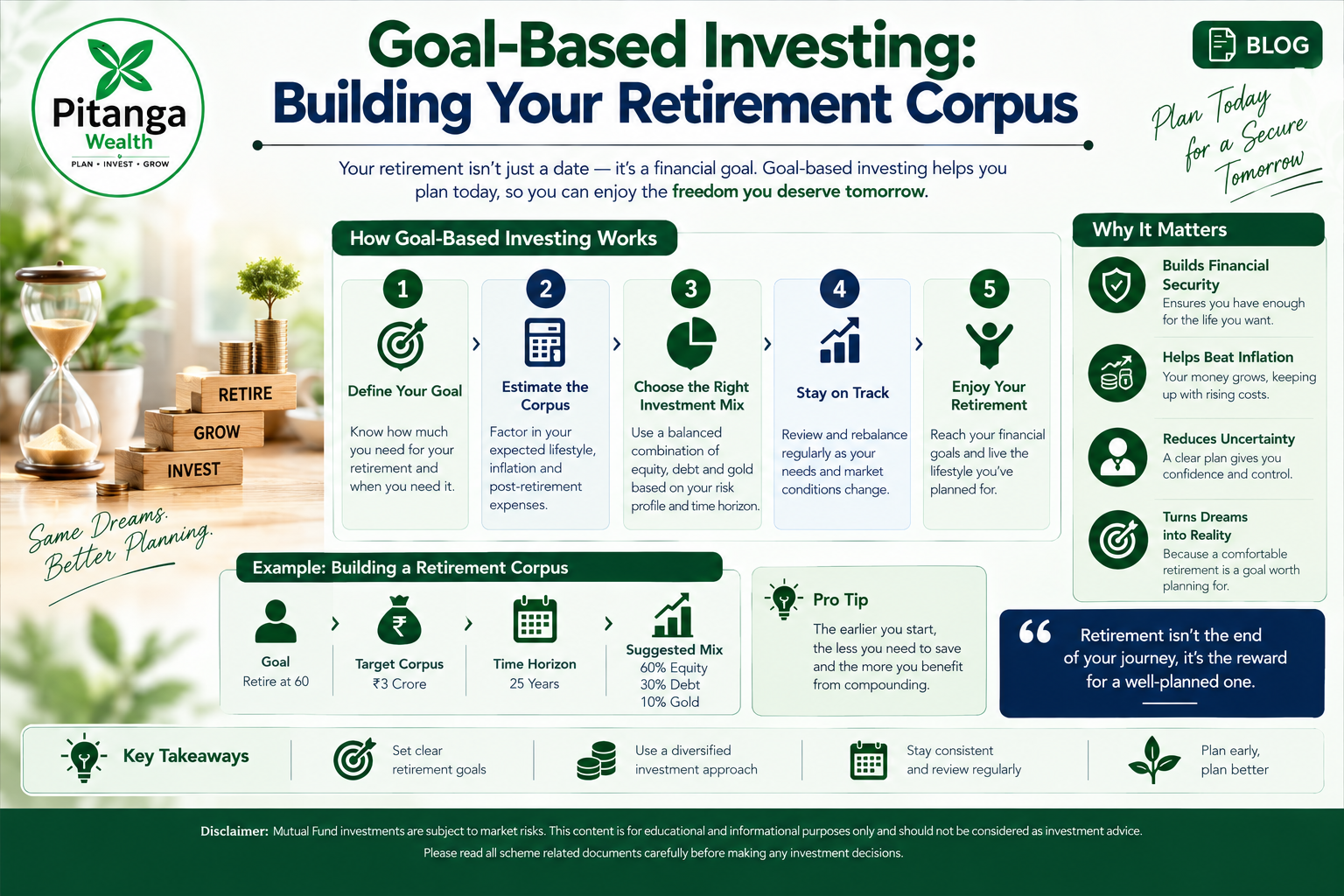
A former colleague once told me, with genuine pride, that he’d been investing consistently for over twenty years. When I asked how much he thought he’d actually need at retirement, he paused for a long moment and admitted he’d never worked out an actual number. He’d been diligent about the habit of investing without ever translating it into a specific target — which meant he had no real way of knowing, even after two decades, whether he was on track or quietly behind.
Building your retirement corpus is different from simply “saving for retirement” in one crucial way: it requires an actual number, a realistic timeline, and a plan for both growing that money and eventually drawing it down. Here’s how to approach each part properly, bringing together the pieces that often get handled separately.
Why “Saving Regularly” Isn’t the Same as Having a Plan
Consistent investing is a genuinely good habit, but it isn’t the same as building your retirement corpus with intention. Without an actual target, there’s no way to know whether your current contribution rate, asset mix, and timeline will realistically get you where you need to be. You might be investing comfortably more than enough, or significantly short — and without doing the work to find out, you’re guessing either way.
Step 1: Estimate What You’ll Actually Need
This starts with your expected annual expenses in retirement, not your current income. A commonly used approach is to estimate your current annual expenses, adjust for how your spending might change in retirement (some costs drop, like commuting; others may rise, like healthcare), and then project that figure forward to your retirement age accounting for inflation between now and then.
From there, a rough thumb-rule multiple — often cited in the 25 to 30 times annual expense range, intended to support a retirement that could last 20 to 30 years — is sometimes used as a starting benchmark. This is genuinely a rough illustration, not a precise or universal formula; the right multiple for you depends on your specific retirement age, expected lifespan, the mix of guaranteed versus market-linked income you’ll have, and how your expenses are likely to evolve. Treat any such number as a reason to start a proper calculation, not as the answer itself.
Step 2: Remember Inflation Doesn’t Stop the Day You Retire
This is one of the more commonly missed pieces of building your retirement corpus. People often inflate their expenses correctly up to the retirement date, then quietly assume costs stay flat for the next 20 to 30 years of retirement itself. They don’t. Your corpus needs to continue working and growing during retirement too, not just sit static, which is part of why a 100% ultra-conservative allocation at the point of retirement can actually be its own risk — it may not keep pace with ongoing inflation across what could be a multi-decade retirement.
Healthcare costs deserve a specific mention here, since they tend to rise faster than general inflation and also tend to increase with age, right at the point in life when income from active work has usually stopped. A retirement plan that accounts for general living expenses but treats healthcare as an afterthought is one of the more common gaps that surfaces only when it’s genuinely inconvenient to discover.
Step 3: Choose a Mix That Evolves Over Time
Building your retirement corpus usually draws on more than one type of instrument, and the right combination depends on your specific tax situation and comfort with market-linked instruments — NPS, PPF, and mutual funds each bring something different to this goal, with their own structures, tax treatment, and withdrawal rules. Earlier in your working years, a higher allocation toward equity-oriented instruments is commonly considered appropriate for the growth potential long time horizons allow, with a gradual shift toward more stable, debt-oriented instruments as retirement approaches. None of this guarantees an outcome — it’s a general principle about matching risk to time horizon, not a promise about returns.

Step 4: Automate It, and Let Your Contribution Grow With You
A dedicated retirement SIP, ideally one that increases periodically (a step-up SIP, tied to salary increments, for instance) tends to outperform a fixed contribution that never adjusts for a rising income or rising future costs. The discipline of automating this removes the dependence on remembering or feeling motivated every single month, which matters over a savings horizon that can stretch across decades.
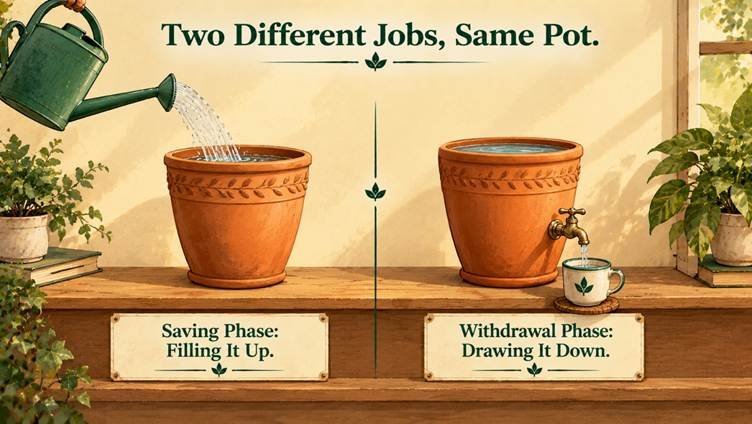
Step 5: Plan the Withdrawal Phase, Not Just the Saving Phase
This is the part building your retirement corpus discussions often skip entirely, focusing only on accumulation and assuming the drawdown will somehow sort itself out. A Systematic Withdrawal Plan is commonly used to convert an accumulated corpus into a regular income stream, allowing the remaining invested amount to continue working rather than withdrawing everything as one lump sum. The withdrawal rate matters a great deal here — withdrawing too aggressively early in retirement, particularly if markets happen to perform poorly in those first few years, can meaningfully shorten how long a corpus actually lasts, a risk sometimes called sequence-of-returns risk.
Step 6: Review the Plan Periodically, Not Just Once
A plan built at 35 based on then-current expenses, inflation assumptions, and market expectations will need revisiting well before retirement actually arrives. Rebalancing your portfolio periodically, adjusting your contribution rate if your income or goals change, and reassessing your target number every few years are all part of genuinely building your retirement corpus, rather than setting a plan once in your 30s and assuming it stays accurate for the next thirty years.

Common Mistakes People Make
Never calculating an actual target number. This was exactly the gap in the story that opened this piece — investing consistently without translating that habit into a known destination.
Forgetting inflation continues through retirement, not just up to it. A corpus that looks adequate on the day you retire can still fall short years into retirement if this is overlooked.
Becoming too conservative too early, or too late. Both an overly cautious allocation decades before retirement and a still-aggressive one right at the point of retirement carry real, different risks.
Treating the withdrawal phase as an afterthought. How you draw down the corpus affects how long it lasts just as much as how well you built it up in the first place.
Frequently Asked Questions
How much should I actually save each month for retirement? This depends entirely on your target corpus, years remaining until retirement, and expected returns from your chosen mix of instruments — there’s no universal monthly figure. Working backward from an estimated target is more useful than picking an arbitrary monthly amount.
Is 25-30 times my annual expenses really the right retirement corpus target? It’s a commonly cited rough benchmark, not a guaranteed or precise figure for your specific situation. The right number depends on your retirement age, expected lifestyle, other income sources, and how long you expect to need the corpus to last.
Should my entire retirement corpus move to debt instruments once I actually retire? Not necessarily — moving entirely to ultra-conservative instruments can leave your corpus struggling to keep pace with inflation across a retirement that could last decades. Many plans retain some market-linked exposure even during retirement, calibrated to individual comfort with risk.
What is sequence-of-returns risk, and why does it matter for retirement withdrawals? It refers to the risk that poor market performance in the early years of withdrawal can disproportionately damage how long a corpus lasts, compared to the same poor performance occurring later. This is part of why withdrawal rate and timing genuinely matter, not just the total corpus size.
Can I rely on NPS alone for my entire retirement corpus? NPS can be a meaningful part of a retirement plan, particularly for its tax benefits, but its mandatory annuitization structure means it may not single-handedly cover every need, such as full liquidity or flexibility. Many people combine it with PPF and mutual funds rather than relying on just one instrument.
At what age should I start seriously building my retirement corpus? Earlier generally provides more flexibility and a longer runway for growth, but starting later than ideal is still meaningfully better than not starting at all — the required monthly contribution simply needs to be reassessed honestly against the shorter remaining timeline.
If you’re trying to work out your actual retirement number, the right mix of instruments, or how to plan the withdrawal phase, our team at Pitanga Wealth can help you build a plan around your specific situation.
Mutual Fund investments are subject to market risks. Read all scheme-related documents carefully before investing. NPS is regulated by PFRDA and subject to its own scheme rules; tax benefits are subject to prevailing tax laws. The information in this article is for educational purposes only and should not be construed as investment advice or a recommendation to invest in any particular scheme or product. Pitanga Wealth is an AMFI-Registered Mutual Fund Distributor (ARN-134606).
Written by the Pitanga Wealth team. Follow us on Instagram: We share practical, goal-based retirement planning tips regularly — follow @pitangawealth for more.
This article is for educational and informational purposes only. It is not investment, tax, legal or insurance advice. Consider your circumstances and relevant documents before making a financial decision.