

Two people I know made opposite choices with the same starting point. The first read an article about expense ratios, moved everything into direct plans, and felt smart about the savings. Then a sharp market fall arrived, and with nobody to talk to and no plan written down, he redeemed a large part of his holdings near the bottom. The second stayed with a distributor for years without ever asking what she was actually paying for, or what she was getting in return. Neither is a cautionary tale about a product. Both are stories about a decision that was made without looking at the full picture.
The mutual fund distributor vs direct plan question deserves a fairer treatment than the internet usually gives it. One side tends to say direct plans are always better because they cost less. The other tends to say advice is always worth paying for. The truth depends on who you are, what you need, and what a particular distributor actually does. One disclosure before we start: Pitanga Wealth is a mutual fund distributor, so we have an obvious stake in this topic. We’ve tried to lay out both sides honestly, including the parts that don’t flatter our own model.

What’s Actually Different Between the Two
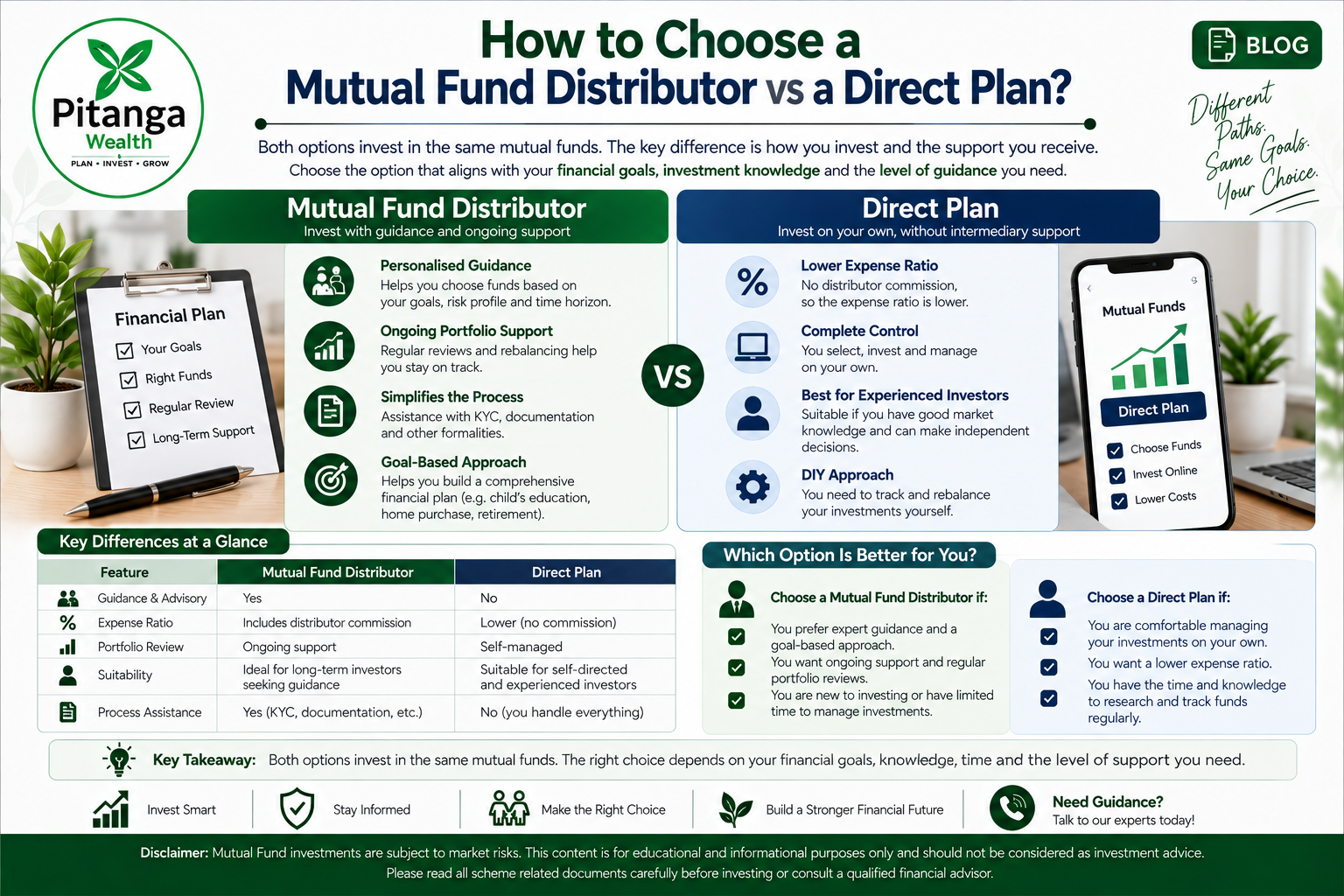
At the heart of the mutual fund distributor vs direct plan question is a simple matter of cost and channel, so it helps to be precise here, because a lot of confusion comes from assuming the two routes involve different funds. They don’t. A regular plan and a direct plan of the same scheme hold the same portfolio, are run by the same fund manager, and follow the same investment strategy.
The difference lies in cost and channel:
- A direct plan is bought straight from the fund house (or a platform offering direct plans), with no distributor involved. Because there’s no distribution commission, the expense ratio is typically lower.
- A regular plan is bought through a distributor, and a portion of the scheme’s expense ratio goes to the distributor as commission for the services they provide.
Over long periods, a lower expense ratio can compound into a meaningful difference in the value of your investment, all else being equal. That’s a genuine point in favour of direct plans, and it would be misleading to pretend otherwise. The real question is what, if anything, you get in exchange for the higher cost of a regular plan, and whether that’s worth it for you.
What a Distributor Does, and What They Don’t
A mutual fund distributor, registered with AMFI and holding a valid ARN, helps investors with things like completing KYC and paperwork, explaining scheme features and risks, setting up SIPs and other transactions, keeping track of investments, and providing service when something goes wrong.
It’s worth being clear about what a distributor is not. A distributor isn’t a SEBI-registered investment adviser, and the support they provide is generally described as execution-related and incidental, not formal, personalised investment advice for a fee. If you want dedicated, fee-based advice, a SEBI-registered investment adviser (RIA) is a separate category of professional, and a legitimate third option alongside the two routes discussed here. Any distributor who blurs this distinction, or talks as though they’re offering guaranteed outcomes, is a reason for caution.

When a Direct Plan May Suit You Well
In the mutual fund distributor vs direct plan comparison, a direct plan tends to make sense for people who:
- Are comfortable researching schemes and understanding what they’re buying
- Have the discipline to stick to a plan through market ups and downs without someone to talk them out of a panic
- Keep a relatively simple portfolio they’re confident tracking and rebalancing themselves
- Don’t need help with paperwork, KYC, or ongoing servicing
For these investors, paying for a distributor’s services may simply be paying for something they don’t use.
When Working With a Distributor May Add Value
On the other side of the mutual fund distributor vs direct plan choice, a regular plan through a distributor tends to make more sense for people who:
- Are new to investing and want help getting started properly
- Have several goals with different timelines and want help mapping investments to them
- Find that having someone to talk to during volatile periods genuinely helps them avoid costly emotional decisions
- Have complex paperwork situations, such as NRIs handling KYC, FATCA-related documents, or repatriation questions
- Simply don’t have the time or interest to manage this themselves
The honest caveat is that this value depends entirely on the quality of the distributor. A good one can make a real difference to how investors behave. A poor one collects commission while providing little beyond a transaction. The cost is identical either way, which is exactly why choosing well matters.

How to Evaluate a Distributor Before You Commit
If you’re leaning toward a distributor, a few checks are worth doing before you sign anything:
- Verify their AMFI registration. A valid ARN can be checked on AMFI’s website, and any legitimate distributor should be willing to share theirs upfront.
- Ask about NISM certification. Distributors are required to hold the relevant NISM certification, and it’s reasonable to ask.
- Ask how they’re compensated. You’re entitled to understand that a commission is built into regular plans, and a trustworthy distributor will explain it plainly rather than deflect.
- Watch for red flags: promises of guaranteed or assured returns, pressure to invest in every new fund launch, frequent unnecessary switching between schemes, or pushing insurance-linked investment products without explaining the trade-offs.
- Notice whether they ask about you first. A good conversation starts with your goals, timeline, and risk comfort, not with a list of funds they’d like you to buy.
A Few Questions Worth Asking Any Distributor
- How exactly are you compensated on the schemes you’re recommending to me?
- What will you actually do for me after the first investment is made?
- How often will we review my portfolio, and what does that review include?
- If I decide later to move to direct plans, how would you handle that?
Their answers, and how comfortable they are giving them, will tell you a lot.
Can You Switch From a Regular Plan to a Direct Plan?
Yes, it’s possible, but it isn’t free of consequences. Moving from a regular plan to a direct plan of the same scheme is treated as a redemption followed by a fresh investment. Depending on your holding period and the scheme’s terms, that can trigger capital gains tax and potentially an exit load, as per current provisions. It’s worth checking the specific impact before switching, particularly for long-held investments with significant gains. Some investors choose to keep existing regular plan holdings and direct only new investments through direct plans, though whether that makes sense depends on the numbers in your case.
Common Mistakes in This Decision
A few patterns show up repeatedly when people weigh mutual fund distributor vs direct plan.
Choosing purely on cost without considering your own behaviour. A lower expense ratio only helps if you actually stay invested through difficult periods. Savings that disappear in a panic sale weren’t really savings.
Choosing a distributor without ever asking what you’re paying for. Silence about the commission model isn’t a reason to trust someone, and it’s worth raising the question early.
Assuming all distributors offer the same quality of service. Registration is a baseline, not a guarantee of how good the support will be.
Treating it as a permanent choice. Your needs may change, and there’s nothing wrong with reassessing as your knowledge and confidence grow.
Frequently Asked Questions
Are direct plans always cheaper than regular plans? Direct plans have a lower expense ratio than the regular plan of the same scheme, since there’s no distribution commission. Whether that saving is worth more to you than the services a distributor provides depends on your situation.
Do direct plans and regular plans invest in different stocks or bonds? No. Both plans of a scheme hold the same underlying portfolio and are managed by the same fund manager. The difference is the expense ratio and how you invest.
Is a mutual fund distributor allowed to give investment advice? Distributors provide execution-related support and scheme information, and are generally not permitted to offer formal, personalised investment advice for a fee unless separately registered as an investment adviser. Fee-based advice comes from SEBI-registered investment advisers.
How do I check whether a distributor is genuinely registered? You can verify an ARN through AMFI’s official website. It’s a quick check and worth doing before you invest through anyone.
Can I invest in both direct and regular plans at the same time? Yes. Some investors use direct plans for simple, self-managed holdings and a distributor for more complex needs, though the right mix depends on your circumstances.
Does using a distributor mean I’m paying more for the same fund? In the mutual fund distributor vs direct plan comparison, effectively yes, in terms of the expense ratio. The relevant question is whether the services, guidance, and behavioural support you receive are worth that difference to you.
If you’re stuck on mutual fund distributor vs direct plan and would like to talk through which route suits you, including a plain explanation of how we’re compensated, our team at Pitanga Wealth is happy to walk you through it with no pressure to decide.
Mutual Fund investments are subject to market risks. Read all scheme-related documents carefully before investing. Distributors earn commission on regular plans, and investors may choose to invest directly in direct plans. This article is for educational purposes only and does not constitute investment advice or a recommendation to invest in any particular scheme or route. Pitanga Wealth is an AMFI-Registered Mutual Fund Distributor (ARN-134606).
Written by the Pitanga Wealth team.
📲 Questions like this deserve straight answers. We share plain-language investing explainers on Instagram — follow @pitangawealth for more.
This article is for educational and informational purposes only. It is not investment, tax, legal or insurance advice. Consider your circumstances and relevant documents before making a financial decision.