

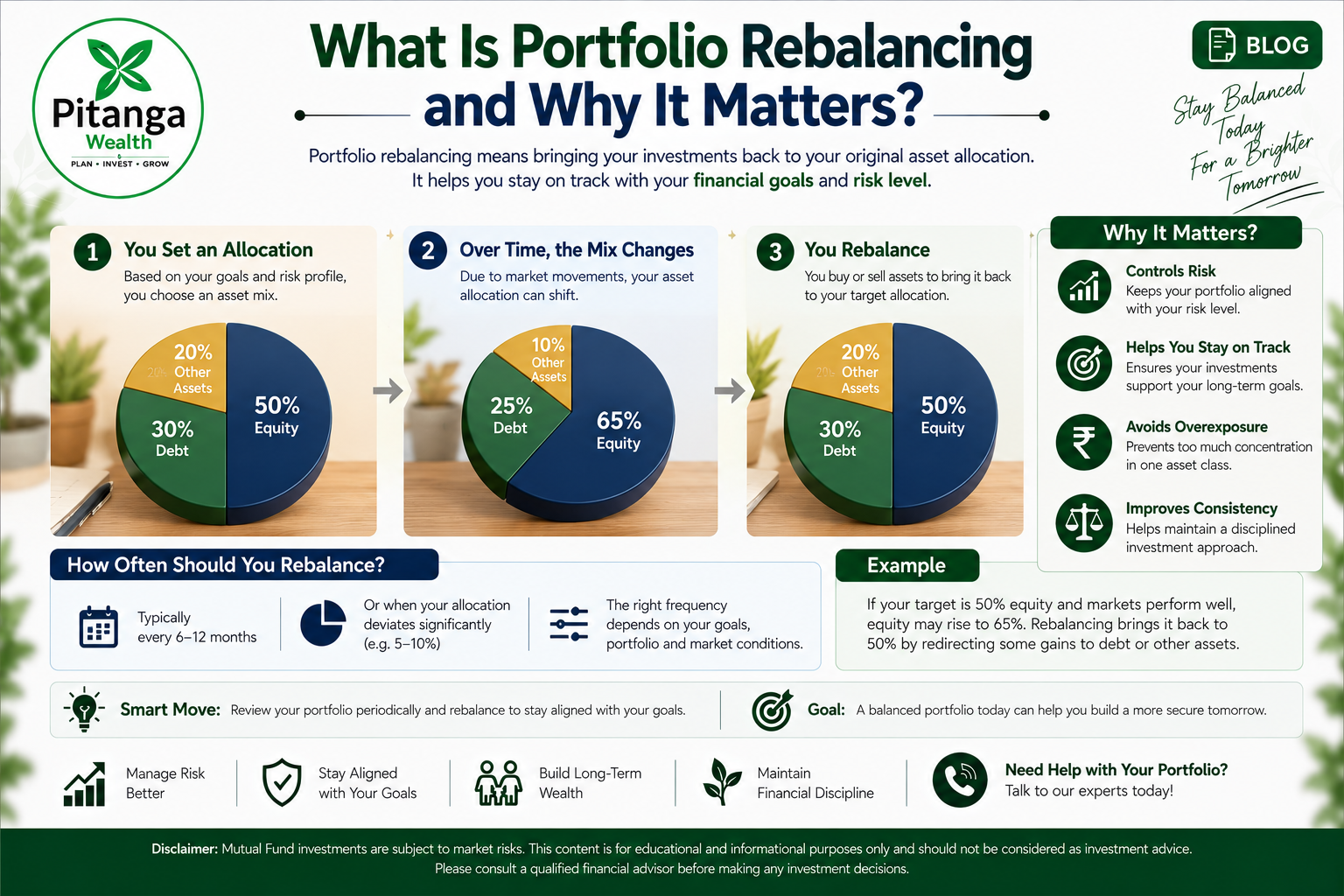
Someone I know set up her portfolio five years ago with a deliberate 60% equity, 40% debt split — a mix she’d chosen carefully based on how much risk she was comfortable with. She never touched it again, which she thought meant she was leaving a good decision alone. When she finally checked it recently, equity had grown enough on its own that the split had quietly become closer to 80% equity, 20% debt. Nothing had gone wrong exactly, but she was carrying meaningfully more risk than she’d ever consciously agreed to.
Portfolio rebalancing exists specifically to catch this kind of drift before it becomes a problem. It’s one of the less exciting parts of investing, which is probably why it gets skipped more often than it should — but it’s also one of the more important habits for making sure your portfolio still reflects the risk level you actually chose, not just whatever it happened to become.

What Is Portfolio Rebalancing, Exactly?
Portfolio rebalancing is the process of adjusting your investments back to your originally intended asset allocation, after market movements have caused it to drift away from that target. If you started with a 60:40 equity-to-debt split and equity has grown faster than debt over time, rebalancing means bringing the ratio back toward 60:40 — either by moving some money out of equity into debt, or by directing new contributions preferentially toward the underweight portion until the balance is restored.
It’s worth being clear about what this isn’t: portfolio rebalancing isn’t about chasing better returns or timing the market. It’s a risk management exercise, focused on keeping your portfolio’s risk profile aligned with what you originally decided was appropriate for your goals and comfort level.
Why Portfolios Drift in the First Place
Different asset classes grow at different rates, and that alone is enough to shift your original allocation over time, even if you never add or withdraw a single rupee. If equity grows faster than debt over a few years — which is a common pattern, though not guaranteed in every period — the equity portion of your portfolio naturally becomes a larger share of the total, simply because it grew more. Nobody has to make an active decision for this drift to happen; it’s just the arithmetic of two things growing at different speeds.
This is exactly why portfolio rebalancing needs to be a deliberate, periodic check rather than something that happens automatically. Left alone indefinitely, a portfolio’s risk level can end up quite different from what its owner actually intended, purely as a side effect of markets doing what markets do.

Why This Genuinely Matters
The real risk isn’t that drift happens — it’s that it happens invisibly. Someone who deliberately chooses an 80% equity allocation because they’re comfortable with that risk is in a completely different position from someone who ends up at 80% equity by accident, without ever having decided they wanted that much risk. The portfolios might look identical on paper, but one reflects an informed choice and the other reflects a decision nobody actually made.
Portfolio rebalancing is what keeps your risk exposure tied to an actual decision, revisited periodically, rather than to whatever the market happened to do since you last looked.
Two Common Approaches to Rebalancing
Calendar-based rebalancing means reviewing and adjusting your allocation at fixed intervals — commonly once a year — regardless of how much drift has actually occurred. This is simple and predictable, which makes it easier to stick to as a habit.
Threshold-based rebalancing means acting only when your allocation drifts beyond a certain band from your target — for instance, if your target is 60:40 and you’d decided a 10-percentage-point drift warrants action, you’d rebalance once equity crosses roughly 70%. This approach responds to actual drift rather than the calendar, though it requires more regular monitoring to know when the threshold’s been crossed.
Neither approach is universally superior — the right choice depends on how closely you want to track your portfolio and how much drift you’re personally comfortable tolerating between reviews.
How Rebalancing Actually Happens in Practice
There are generally two ways to execute a rebalance:
- Redeeming from the overweight asset class and reinvesting into the underweight one. This directly restores the target ratio but can trigger capital gains tax on the units sold, and possibly an exit load depending on the specific scheme and holding period.
- Directing new contributions preferentially toward the underweight asset class, without touching existing holdings. This achieves the same rebalancing effect more gradually, and avoids triggering a taxable redemption on the overweight portion.
Many investors use a combination of both, leaning toward the second approach where possible since it tends to be more tax-efficient, and reserving the first for situations where the drift is too significant to correct through new contributions alone.

A Simple Illustration of How Drift Happens
To make this more concrete: imagine starting with ₹10,00,000 split exactly 60:40 between equity and debt — ₹6,00,000 in equity, ₹4,00,000 in debt. Purely for illustration, say equity grows at a hypothetical 12% over a year while debt grows at a hypothetical 6% — these are illustrative figures only, not projections or promises of actual returns. Equity would grow to roughly ₹6,72,000, and debt to roughly ₹4,24,000, bringing the total to about ₹10,96,000. The equity share has now moved from 60% to close to 61.3% — a small shift in this single year, but one that compounds further if left unaddressed year after year, especially during periods when equity outperforms debt by a wider margin.
This is the mechanism behind every real-world case of portfolio drift: no decisions were made, nothing was mismanaged, and yet the original allocation no longer holds without a conscious correction.
Rebalancing Isn’t Free — Weigh the Cost
Because redeeming units can trigger capital gains tax and, in some cases, exit loads, portfolio rebalancing isn’t something to do reflexively every time the market moves. As per current tax provisions, the specific tax impact depends on the asset type and how long the units were held, which is worth factoring into the decision alongside the actual amount of drift involved. A small amount of drift may not be worth the tax cost of correcting immediately, whereas a large, sustained drift away from your intended risk level usually is.
Common Mistakes People Make With Rebalancing
Never rebalancing at all. This is probably the most common mistake, simply because rebalancing isn’t urgent in the way a bill payment is — nothing forces you to do it, so it’s easy to let years pass without a single review.
Rebalancing too frequently, reacting to every market wobble. This tends to increase transaction costs and tax impact without a corresponding benefit, since normal short-term market movement isn’t the same thing as a meaningful, sustained drift in allocation.
Treating rebalancing as a way to chase returns rather than manage risk. Rebalancing is about restoring your intended risk level, not about predicting which asset class will do better next — conflating the two can lead to decisions driven by market views rather than your actual financial plan.
Frequently Asked Questions
How often should I actually rebalance my portfolio? There’s no single right frequency — annual reviews are common and reasonably practical for most individual investors, though some prefer a threshold-based approach instead. What matters more than the exact frequency is that some form of periodic review actually happens.
Does portfolio rebalancing guarantee better returns? No — it’s a risk management practice, not a return-enhancing strategy. Its purpose is keeping your risk exposure aligned with what you intended, not predicting or improving market outcomes.
Is rebalancing only relevant for large portfolios? No, portfolio drift can happen at any portfolio size, since it’s driven by the relative growth rates of asset classes, not the total amount invested. The tax and cost impact of correcting it, however, may be more noticeable on larger portfolios.
Can I avoid the tax impact of rebalancing entirely? Not entirely, if rebalancing requires redeeming units, but directing new contributions toward underweight asset classes instead of redeeming existing holdings can reduce how much rebalancing needs to happen through taxable transactions.
What happens if I just never rebalance my portfolio? Your allocation will likely continue drifting based on how each asset class performs, potentially leaving you with meaningfully more or less risk than you originally intended — not immediately harmful, but a gap that tends to widen over time if left unchecked.
Should retirement portfolios be rebalanced differently than other goals? The same underlying principle applies, but the direction of rebalancing as retirement approaches often leans toward reducing risk over time (shifting from equity toward debt), rather than simply restoring a fixed ratio indefinitely — this is sometimes called a glide path.
If you’re not sure whether your portfolio still reflects the risk level you originally intended, our team at Pitanga Wealth can help you review it and think through whether rebalancing makes sense for your situation.
Mutual Fund investments are subject to market risks. Read all scheme-related documents carefully before investing. The information in this article is for educational purposes only and should not be construed as investment advice or a recommendation to invest in any particular scheme or product. Tax treatment on redemptions is subject to prevailing tax laws. Pitanga Wealth is an AMFI-Registered Mutual Fund Distributor (ARN-134606).
Written by the Pitanga Wealth team.
📲 We break down concepts like this one regularly on Instagram — follow @pitangawealth for more plain-language investing explainers.
This article is for educational and informational purposes only. It is not investment, tax, legal or insurance advice. Consider your circumstances and relevant documents before making a financial decision.