

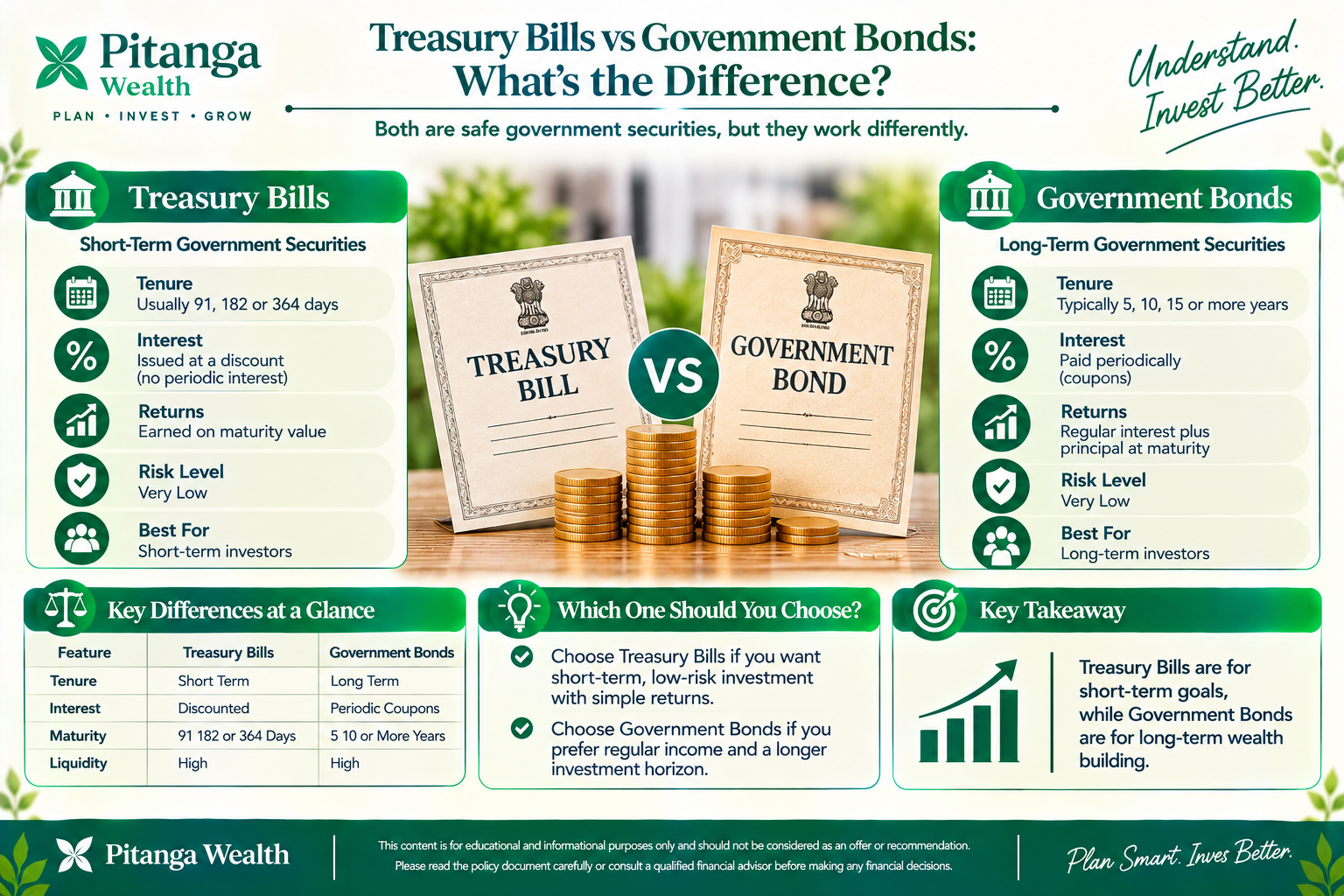
Someone comparing government debt products may find a 91-day Treasury bill alongside a ten-year government bond and assume both simply pay a fixed interest rate. They do not. The Treasury bill is generally purchased at a discount and redeemed at face value, while a conventional dated government security makes coupon payments and has a longer life. The cash-flow pattern, market-price sensitivity, access route and timing of money received differ. Understanding treasury bills in India starts with those differences rather than with a headline yield alone.
This guide compares Government of India Treasury bills with Central Government dated securities. It explains the three regularly issued T-bill tenors, auctions and RBI Retail Direct, discount pricing, bond coupons, interest-rate and liquidity risks, reinvestment, taxation considerations and eight pre-investment checks. All rupee amounts below are illustrative, not live quotations or investment recommendations. The discussion is based on RBI and public investor-education material reviewed on 18 November 2026. [1][2][3]
Quick Answer: Treasury Bills vs Government Bonds
Treasury bills (T-bills) are short-term Government of India securities ordinarily issued for 91, 182 or 364 days. They pay no periodic coupon: investors buy them below face value and receive face value at maturity. Dated Government of India bonds generally have longer maturities and pay a fixed or floating coupon, typically half-yearly. Both are government debt, but the longer bond is usually more sensitive to changes in market yields. The right comparison is not simply which offers the higher displayed rate; it is when your money is needed, what cash flows are promised and whether you might need to sell early. [1][2]
What Are Treasury Bills in India?
A short-term Central Government borrowing instrument
The Reserve Bank of India describes Treasury bills as short-term money-market debt instruments issued by the Government of India. The standard tenors currently offered are 91, 182 and 364 days. State Governments issue dated securities known as State Development Loans (SDLs), but they do not issue the Central Government T-bills described here. A Treasury bill is a tradable security; it is not a bank fixed deposit, savings account or unit of a money-market mutual fund. [1]
The Government uses T-bills as part of managing short-term borrowing requirements. RBI conducts auctions and publishes issue announcements, settlement information and results. For example, an RBI press release dated 13 November 2026 announced auctions for all three standard maturities on 18 November 2026. This illustrates the ongoing auction mechanism; it is not a quotation of the yield available to a particular investor. [4]
No coupon: the discount is the economic return
A typical T-bill has a face value and a lower purchase price. The investor pays that discount price and, if held to maturity and redeemed under the terms, receives the face value. There is no separate six-monthly interest transfer. For this reason, the amount by which redemption exceeds acquisition cost is an essential part of the return calculation. In everyday explanations of treasury bills in India, this is sometimes called discount income, but the correct tax treatment requires examining the instrument, transaction and current tax provisions. [1][5]
A zero-coupon bill is therefore not a security with zero potential earnings. It is a security whose compensation is embedded in the difference between what is paid and what is received, rather than in a scheduled coupon. If sold before maturity, the actual result is instead determined by the sale price, acquisition price, costs and applicable taxes.
The standard 91-, 182- and 364-day tenors
A 91-day bill is intended to mature in approximately one quarter of a year, a 182-day bill in approximately half a year and a 364-day bill in approximately a year. These labels describe the instrument’s original maturity at issue. A person buying a previously issued bill in the secondary market may have substantially fewer days until redemption. Before buying, read the actual maturity date, not merely the security’s original category. [1]
RBI also discusses Cash Management Bills for maturities shorter than the standard 91-day tenor. CMBs are a separate short-term government instrument and should not be presented as a fourth regularly auctioned retail T-bill tenor. Eligibility and availability depend on current issuance terms. [1]
What Are Dated Government Bonds?
A longer-term Government of India debt security
A dated Government of India security is a marketable debt obligation with a specific redemption date. RBI’s primer describes conventional dated securities as generally having longer original maturities, often spanning five to forty years, although issuance structures and available maturities can change. An investor who buys a dated bond through an auction or in the secondary market owns a security with contractual cash flows rather than a simple promise to return a bank deposit on demand. [1]
The expression government bonds needs precision. In this comparison it refers mainly to Central Government of India dated securities. State Development Loans, government-linked public-sector bonds, floating-rate savings bonds and Sovereign Gold Bonds have different issuers or terms; they should not all be treated as the same product. Central Government securities are distinguished from corporate bonds principally by the sovereign issuer, not by an absence of all financial risk.
Coupons arrive during the life of the bond
Many dated securities have a fixed annual coupon rate paid semi-annually on face value. Some securities have floating-rate or other contractual structures. For a hypothetical ₹10,000 face-value government bond bearing a fixed 7% annual coupon, annual coupon income would be ₹700, commonly split into two payments of ₹350 if the instrument pays exactly twice a year and no unusual terms apply. On maturity, face value is repaid under the terms. That payment stream is materially different from the single maturity payment on a standard T-bill. [1]
A coupon of 7% does not prove that a new buyer earns exactly 7%. If a bond is bought above or below face value, or sold early, its realised return will differ. A bond’s purchase price, accrued interest, remaining cash flows, maturity and transaction costs all matter.
Why government bond prices move
When market interest rates or required yields rise, prices of existing fixed-coupon bonds generally fall; when yields fall, prices generally rise. Investors who hold a suitable Government of India security to redemption may receive its stated contractual cash flows, but those who sell early can realise gains or losses. Longer-duration dated securities typically have greater sensitivity to an equivalent change in yields than near-maturity Treasury bills. [1][2]
This is one reason treasury bills in India and long-dated government bonds should not be described as interchangeable safe parking places for money. Both are exposed to market pricing when sold ahead of maturity; their typical level of sensitivity can be very different.

Treasury Bills vs Government Bonds: A Practical Comparison
| Feature | Government of India Treasury bill | Central Government dated bond |
| Typical original maturity | 91, 182 or 364 days | Generally longer, often several years |
| Cash-flow pattern | No periodic coupon; redeemed at face value | Usually half-yearly fixed or floating coupon plus redemption |
| Purchase price | Normally below face value at issue | May trade at discount, par or premium |
| What investors quote | Auction/market price and implied yield | Coupon rate, price and yield to maturity |
| Interest-rate sensitivity | Generally lower due to short remaining tenor | May be substantially higher, particularly for long-duration bonds |
| Need for income | No periodic cash payment | Periodic income for coupon-paying securities |
| Reinvestment exposure | Need another investment after maturity | Coupon payments also create reinvestment decisions; eventual principal matures later |
| Selling before maturity | Possible at prevailing market price, subject to liquidity | Possible at prevailing market price, subject to liquidity |
| Issuer in this comparison | Government of India | Government of India |
| Retail access | Eligible RBI Retail Direct auctions/secondary market | Eligible RBI Retail Direct auctions/secondary market |
For newcomers examining treasury bills in India, start with the maturity and payment row rather than treating the securities as interchangeable. The table compares standard T-bills with conventional coupon-paying dated securities. Zero-coupon government bonds, floating-rate bonds, State Development Loans and other special issues may behave differently. Neither column promises a live rate, uninterrupted liquidity or a particular after-tax return. [1][3]
Example 1: How a Treasury Bill Earns Its Return
A hypothetical ₹10,000 face-value bill
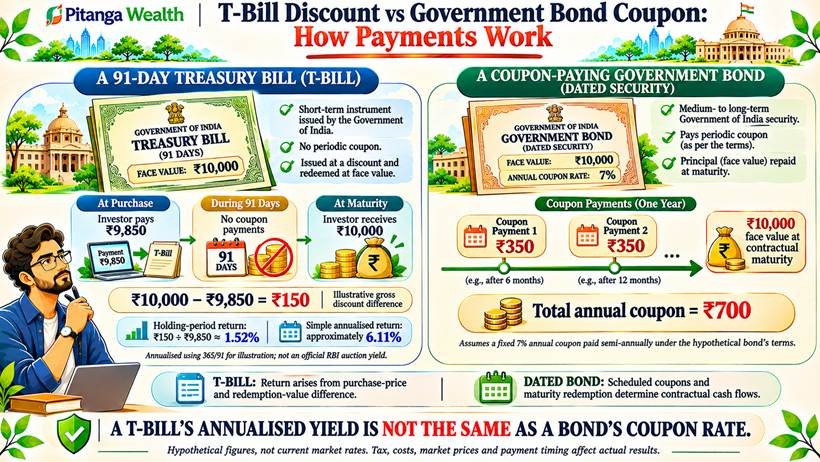
Imagine a hypothetical 91-day Government of India T-bill with a face value of ₹10,000 that is available at an illustrative purchase price of ₹9,850. Ignore transaction expenses and tax purely to demonstrate the arithmetic. If the investor holds it to maturity, the contractual redemption value is ₹10,000. The gross difference is ₹150. No separate ₹150 coupon is paid on day 91; the return is the difference between the redemption amount and the amount initially invested. [1]
| Calculation | Illustrative amount |
| Face value received at maturity | ₹10,000 |
| Purchase price paid | ₹9,850 |
| Gross maturity difference | ₹150 |
| Simple holding-period return on price paid | ₹150 ÷ ₹9,850 ≈ 1.52% |
| Approximate simple annualised return using 365 days | (₹150 ÷ ₹9,850) × (365 ÷ 91) ≈ 6.11% |
The 6.11% figure is only an illustrative, simplified annualisation of a hypothetical 91-day holding-period result. RBI market conventions can use specified price/yield and day-count calculations, so an auction’s published yield may follow its own exact convention. This table is not a current Treasury bill yield or an offer. A higher or lower purchase price changes the result. [1]
Why a 91-day return must not be compared casually with a yearly coupon
An investor might see a gross gain of ₹150 over 91 days and compare it with ₹700 of annual coupon payments on a completely different bond. Those are not comparable without accounting for capital invested, time, purchase price and what happens at maturity. The first security matures quickly, so the investor must choose where to reinvest proceeds. The second produces coupons during a longer holding period and has a market price that can fluctuate substantially.
For a clear comparison of treasury bills in India, express both investments using a consistent measure such as an appropriate annualised yield under stated assumptions, while also showing the actual cash flow dates. Annualisation helps compare quotations; it does not guarantee that a short-term rate can be earned over and over for a full year.
Example 2: How a Coupon-Paying Government Bond Works
The ₹10,000 face-value, 7% coupon illustration
Consider a hypothetical dated Central Government security with face value ₹10,000, a 7% fixed annual coupon and annual total coupon of ₹700. If coupons are paid semi-annually under the issue terms, that is ₹350 per payment. At maturity, the issuer repays the stated face value. The actual payment calendar, settlement price and final proceeds should always be checked in the security’s issue documentation. This is a stylised example, not a bond currently offered at a particular price.
If an investor buys the bond at ₹10,400, the annual coupon still totals ₹700, but the simple current yield based on that purchase price is about 6.73% (₹700 ÷ ₹10,400). If bought at ₹9,600, the same coupon implies a simple current yield of about 7.29% (₹700 ÷ ₹9,600). Neither figure equals a complete yield-to-maturity calculation, because YTM also reflects remaining payment dates, redemption at face value and any applicable accrued interest or costs. [1][2]
Comparing the cash-flow timelines
In the illustrative 91-day T-bill, one payment leaves the investor at purchase and one redemption amount arrives at maturity. In the hypothetical government bond, the investor makes the initial purchase and then receives scheduled coupons and the maturity amount, assuming terms are honoured. The bond’s regular coupon can be useful for an income schedule, but the investor must still decide what to do with each coupon and whether a sale before maturity is likely.
A nominal annual coupon, a simple current yield and a YTM quotation are three different measures. Neither the T-bill’s annualised discount yield nor a dated bond’s YTM should be casually presented as a guaranteed realised return after all costs, reinvestment choices and taxes. [2]
Interest-Rate Risk, Duration and Inflation
Why shorter securities usually move less
RBI explains that bond prices and yields generally move in opposite directions. A security with only weeks or months remaining until its face-value payment usually has less time for yield changes to affect the present value of its cash flows than a long coupon-paying bond. That is why short-term Treasury bills tend to show less market-price sensitivity than long-duration dated government securities. The word usually matters: liquidity, exceptional market events and actual terms can change the precise outcome. [1]
When examining treasury bills in India, distinguish credit exposure to the Government of India from the risk of selling at an unfavourable market price. Even if the issuer is expected to make the promised rupee payment at maturity, an investor who needs cash beforehand may be exposed to quoted prices and a bid-ask spread.
Duration is not simply the number of years left
In fixed-income analysis, duration measures sensitivity of price to yield changes through the timing and present value of payments. A long-dated low-coupon bond generally has greater price sensitivity than a near-maturity bill, all else equal. But one cannot estimate an exact percentage loss from the remaining maturity alone. Coupon level, yield, optionality and the size of the yield move also affect the calculation. [1]
For someone with a fixed spending date, this matters more than a sensational headline about bond markets. Selling a long-duration bond during a period of higher yields can produce a price loss even though it was issued by the Central Government. Matching the maturity of an appropriate instrument to a known future obligation can reduce—but does not eliminate—some mismatch risk.
Inflation and the purchasing power of future cash
A rupee amount received years later may buy less if consumer prices rise. Treasury bills mature sooner, limiting the initial period during which principal is tied to an instrument, but any decision to roll over bills for years introduces uncertainty about future reinvestment yields. Long-term bonds may lock in a nominal coupon for longer, which can become less attractive if inflation or market yields increase. Neither security automatically protects purchasing power.
Reinvestment and Liquidity: The Trade-Off Investors Miss
T-bill reinvestment is not automatic income at the same rate
A 91-day bill ends after the specified term. The investor can spend the proceeds, keep cash or attempt another investment. If future T-bill auction yields are lower, reinvesting may produce less than the earlier annualised rate. If future yields rise, later reinvestment may be available on different terms. This uncertainty is reinvestment risk, not evidence that the original bill failed to meet its stated redemption obligation. [1]
RBI Retail Direct also describes an auto-bidding facility for reinvestment of T-bill maturity proceeds, with rules and lot-size requirements. Such an option can help automate a new bid, but it does not lock the future auction yield or guarantee allocation on identical terms. Investors must review the actual facility conditions and ensure enough proceeds for the applicable lot size. [6]
A government security is not a bank account with instant withdrawal
Both T-bills and dated government bonds may be sold before maturity through available market facilities. That does not mean every security can be sold instantly at face value. Sale prices depend on live bids, settlement arrangements and available liquidity. RBI Retail Direct provides an access route to the government securities secondary market; the investor still bears price risk and should confirm order execution, charges and settlement details. [3]
For many readers considering treasury bills in India, the core mistake to avoid is equating a short maturity with an anytime withdrawal promise. Money required tomorrow should not be committed solely because the security is issued by a highly creditworthy government. Keep immediate-liquidity needs distinct from investable funds with a suitable time horizon.
How RBI Auctions and Non-Competitive Bidding Work
What happens in a primary auction?
RBI announces the security, auction date, settlement date, notified amount and applicable instructions. Professional market participants may submit price or yield bids under auction rules. The accepted auction results determine allocation and pricing. Retail participants through eligible non-competitive routes do not choose a specific price or yield; the applicable allocation price emerges from the auction process. A person seeing a rate from an earlier auction should not assume it applies to the next one. [1][4]
On 13 November 2026, RBI announced that the auctions scheduled for 18 November would cover 91-, 182- and 364-day Treasury bills and that eligible individuals could submit non-competitive bids through RBI Retail Direct. The announcement is useful evidence of the mechanism, but auction notifications and actual settlement/payment requirements must be checked for each issue. This article deliberately does not reproduce unconfirmed results from that day’s auction. [4]
Non-competitive does not mean a fixed, pre-promised yield
Auctions of treasury bills in India require the investor to separate the proposed face-value amount from the price eventually determined through the auction. The phrase non-competitive means an eligible retail investor states the quantity sought without bidding for a custom price. It does not mean all applications are always filled, or that a known yield is guaranteed when the request is submitted. Auction demand and the scheme’s allotment rules matter. Investors should read the result, confirm how much was allotted and reconcile the funds and securities credited to their account. [1][3]
Primary auction versus secondary-market purchase
At an auction, the Government issues the security under primary-market arrangements. In the secondary market, an existing holder sells a security to a buyer at a price available then. A previously issued 364-day bill with 40 days remaining is economically a short-remaining-maturity investment, not a new 364-day commitment. The correct quoted price, remaining days, settlement and redemption date should be checked before calculating return. [1]
How to Access Treasury Bills and Government Bonds Through Retail Direct
Account eligibility and opening
RBI’s Retail Direct scheme allows eligible individual investors to open a Retail Direct Gilt (RDG) account and access specified government securities in primary and secondary markets. Eligibility, KYC, linked bank account requirements and account types are explained in RBI’s official FAQs. An RDG account is distinct from a regular savings account, and a normal stockbroking demat interface is not the same service as a direct RBI gilt holding. [3]
According to RBI’s published Retail Direct FAQ, opening and maintaining the RDG account is free of charge, and RBI does not impose a charge on primary-auction bids through the portal; applicable payment-gateway charges can still arise, and investors should check other transaction-related costs where relevant. Do not interpret the absence of one fee as proof that every possible trade or payment is cost-free. [3]
Minimum lot and funding considerations
RBI lists a ₹10,000 minimum face-value investment for Government of India T-bills through Retail Direct, with increments determined by the applicable security and platform instructions. The amount paid for a bill at auction is linked to its accepted price and funding process, so the sum temporarily required at bid placement may differ from its eventual discount purchase amount. Check the live portal instructions, available balance and funding timetable. [3]
When buying treasury bills in India, be precise about the face-value denomination and the payment requirement. A ₹10,000 face-value bill is not necessarily purchased for exactly ₹10,000, because the bill is typically issued at a discount; yet bid placement can involve temporary funding or markup mechanics under the portal’s procedure. Verify the final allotment statement instead of relying only on a promotional calculator.
Five practical steps for a retail investor
- Open the authentic RBI Retail Direct website from an independently verified RBI source; avoid links offered by unknown messaging groups.
- Check RDG account eligibility, complete the official KYC requirements and link an appropriate bank account.
- Review current auction notices and identify the exact T-bill tenor or dated security, maturity date and minimum lot.
- Submit the eligible non-competitive bid through the official process; review funds blocked or required and retain the acknowledgement.
- After the auction, confirm actual allotment, price, settlement, security ID and eventual payment dates. For secondary purchases, separately confirm quoted price and available liquidity.
RBI states that Retail Direct’s primary auction facility is for non-competitive bids by individuals, not for submitting a personal price/yield in a competitive auction. Investors who seek another route should consult authorised institutions and the applicable RBI rules rather than assuming every bank or app offers the same service. [3]
Treasury Bills, State Development Loans and Corporate Debt Are Not Identical
Why SDLs should not be called Treasury bills
State Development Loans are dated securities issued by State Governments under the relevant framework. They are included among the government securities eligible through Retail Direct, but they have a different issuer and generally differ in maturity and cash-flow profile from Central Government Treasury bills. A State Government borrowing and a Central Government borrowing should not be collapsed into one category merely because both appear in a fixed-income product list. [1][3]
Corporate bonds introduce another type of credit assessment
A corporate bond or non-convertible debenture is generally a contractual debt obligation of an issuing company. Its repayment depends on the issuer and security structure, and its yield may reflect credit risk beyond that associated with Government of India securities. Credit ratings can be informative but do not guarantee payment. Readers who need a broader comparison of sovereign and corporate fixed income can consult Pitanga Wealth’s Blog 53 on Government Bonds vs Corporate Bonds. [2]
Debt mutual funds are pooled products, not direct T-bill ownership
A liquid, money-market or gilt mutual fund may own short-term or government securities, but its investor owns units in a scheme, not a specific bill with a personally fixed maturity-date redemption. Scheme returns, NAV movements, portfolio changes, expenses and redemption terms differ from holding a particular Government of India bill directly. Avoid presenting a mutual fund’s displayed past return as equivalent to a T-bill’s contractual cash flow.
Taxation and Costs: Why the Gross Yield Is Not the Final Answer
Discount difference, coupons and secondary-sale gains
T-bills do not make periodic coupon payments. Dated coupon-bearing G-Secs can produce coupon receipts and capital gains or losses on transfer depending on sale price and applicable rules. The economic difference between a T-bill’s acquisition amount and redemption value must also be analysed for tax purposes using the applicable law, instrument classification, holding circumstances and investor status. Do not assume every rupee from a government security is tax-free merely because the Government issued it. [5][7]
Indian income-tax rules, reporting treatment and exemptions can vary across investor categories and tax years. Specific legislative provisions have changed over time; capital gains treatment can differ by listing, security type and transfer or redemption facts. Investors should obtain current advice relevant to their own status and transaction date instead of applying a single oversimplified tax rate to all treasury bills in India. The Income Tax Department’s official capital-gains material is a starting point, not a substitute for advice on a particular holding. [7]
Gross yield versus money that actually reaches the investor
A comparison should recognise the bill’s purchase price, redemption value, market spread on early sale, payment charges, relevant taxes and any other costs. For coupon-bearing dated securities, accrued interest at settlement and the timing of coupons can also affect the amount paid and the return calculation. A fee-free gilt account and a no-coupon bill are not the same as a guaranteed cost-free transaction. [1][3]
Tax filing and documentation
Keep allotment confirmations, acquisition date and price, bond or bill identifier, sale or redemption entries, coupon records if applicable and bank statements. Use those records to reconcile any annual information statement or broker records where relevant. Account classification and tax treatment may require professional advice, especially for non-residents, business holdings or complicated secondary-market transactions.
Eight Checks Before Choosing a T-Bill or Government Bond
1. Identify the issuer and exact ISIN
Confirm whether the obligation is a Central Government T-bill, Central Government dated security, SDL or another issuer’s debt instrument. Note the unique security identifier and avoid relying solely on a broad category label.
2. Read the actual maturity date
Check the redemption date and remaining days, especially for a secondary-market purchase. A bill originally issued for 364 days may have only a few weeks remaining when you acquire it.
3. Understand the payment pattern
Does the security pay a coupon or no coupon? A T-bill generally pays nothing periodically and redeems at face value, whereas a conventional dated bond may pay half-yearly interest. Match payments to cash requirements.
4. Separate coupon, quoted yield and expected cash received
A government bond’s coupon is not the same as its current yield or YTM. A bill’s annualised discount yield is not a promise that the same rate will be available when proceeds are reinvested. Check actual purchase price and calculation assumptions.
5. Consider early-sale price risk
If there is any real possibility of selling before maturity, examine the security’s remaining duration, market liquidity and bid-ask spread. A longer bond can incur a material price loss when yields rise.
6. Plan what happens after maturity
A short bill may be suitable for a known period, but future auction rates and allocation are uncertain. Avoid building long-term spending plans on an assumption that today’s T-bill yield will persist indefinitely.
7. Verify the access and payment channel
Use RBI Retail Direct or another applicable authorised route and independently check the official website, account details and documentation. Never send investment money to an unrelated personal account presented through a social-media group.
8. Review costs, tax and concentration
Evaluate any charges, tax consequences, inflation exposure and whether too much of your portfolio is tied to one maturity or a single type of risk. Suitability depends on your obligations and broader finances, not just the posted yield.
For readers comparing treasury bills in India with dated government securities, this checklist turns product definitions into a decision process. It is not a guarantee of safety, a substitute for official terms or a recommendation to buy a particular instrument.
Common Misconceptions About Government Debt
“A T-bill pays 6% interest every three months”
An annualised yield quotation is not a quarterly coupon. A standard T-bill has no periodic coupon. If the bill has a 91-day term, compare purchase price and redemption amount; a rough annualised yield should not be mistaken for a payment made each quarter. [1]
“Government bonds can never lose money”
Government of India securities have a different domestic credit-risk profile from company debt, but their secondary-market prices move. Investors selling long-dated fixed-coupon bonds before maturity may realise losses when market yields rise. Inflation can also reduce real purchasing power. [1]
“A 364-day T-bill fixes my rate forever”
The contractual redemption of one bill occurs at its maturity. A subsequent investment is a new decision under then-prevailing conditions. Autoreinvestment features do not promise a repeated yield.
“Every RBI-looking website is authentic”
Online information about treasury bills in India can be copied by unauthorised promoters, so independent source checks are essential. Scammers may mimic official branding or use social platforms to promote investment links. Confirm the domain from RBI’s official pages. Never reveal login credentials or approve a payment to an unknown beneficiary merely because a message refers to a government security.
Frequently Asked Questions About Treasury Bills and Government Bonds
1. Are Treasury bills the same as government bonds in India?
They are both government debt instruments, but a standard Treasury bill is short-term, pays no periodic coupon and is generally issued at a discount. Conventional dated government bonds are longer-term and commonly make coupon payments. [1]
2. What are the standard Treasury bill maturities in India?
RBI currently identifies the principal T-bill tenors as 91, 182 and 364 days. Check the current auction notification and the actual maturity date of the security being purchased. [1][4]
3. Does a 91-day Treasury bill pay monthly interest?
No. A standard 91-day T-bill is a zero-coupon instrument. The investor generally buys below face value and receives face value on maturity, assuming redemption under the security’s terms. [1]
4. Can a retail investor buy T-bills through RBI Retail Direct?
Eligible investors can place non-competitive bids for applicable government-security auctions using Retail Direct, subject to eligibility, account setup, current scheme instructions, funding and allocation. [3]
5. What is the minimum T-bill investment via Retail Direct?
RBI’s published FAQ shows ₹10,000 as the minimum face-value investment for Government of India Treasury bills through Retail Direct. Check the live portal and the security’s current lot-size requirements. [3]
6. Does a non-competitive bid guarantee my selected yield?
No. A retail non-competitive bid specifies the amount desired, not a personalised price or yield. The final auction price and allotment are subject to the auction outcome and applicable rules. [1][3]
7. Are Treasury bills completely risk-free?
No investment should be described as free of every risk. Central Government rupee securities have a very low domestic sovereign default-risk profile, but early selling prices, liquidity, reinvestment, inflation and tax outcomes remain relevant. [1]
8. Can I sell a T-bill before maturity?
A T-bill is a tradable security, and eligible secondary-market facilities exist. However, sale depends on market access, quoted bids, settlement and price. An early sale can produce a different result from holding to maturity. [1][3]
9. Why do long-term government bond prices fall when rates rise?
Existing fixed-coupon payments become less attractive relative to newly available yields, so their market prices generally decline. Sensitivity depends on duration, coupon and cash-flow timing. [1]
10. Is a Treasury bill better than a bank fixed deposit?
They have different issuers, legal structures, access routes, liquidity arrangements, tax treatment and investor protections. A bank FD has contract-specific deposit terms and applicable deposit-insurance rules, whereas a T-bill is a tradeable government debt instrument. The suitable choice depends on your circumstances, not a universal ranking.
11. Does a government bond’s coupon equal its yield to maturity?
Not necessarily. Coupon is based on face value, while YTM reflects purchase price, future cash flows and the remaining time to maturity. The two may differ if the bond trades above or below face value. [1]
12. Can I receive monthly income from Treasury bills?
Standard T-bills themselves do not pay periodic interest. Any arrangement that schedules maturities over different dates requires separate purchases and careful cash-flow planning; it should not be described as a guaranteed monthly interest plan.
13. Are T-bill profits or government bond coupons tax-free?
Do not assume so. Tax treatment depends on the security, relevant law, transaction, investor and assessment year. Consult current official tax guidance and qualified advice for your case. [7]
14. What should I verify before buying through an app?
Check the correct RBI or authorised service, legal entity, security details, maturity, price, fees and payment instructions. Avoid unofficial download links or requests to transfer money to unrelated personal accounts. [3]
Conclusion: Match the Security to the Time Horizon
The essential difference is a cash-flow and maturity difference. Standard Treasury bills are short-dated Government of India zero-coupon securities that repay face value after being acquired at a discount. Conventional dated government bonds generally extend for years and pay scheduled coupons. Both are sovereign debt, but the decision to hold to maturity versus sell early affects exposure to market prices and reinvestment choices. Understanding treasury bills in India means looking past the single annualised yield figure to the actual money paid, the maturity date, the likely need for liquidity and the after-tax result.
A carefully matched short-term bill may suit some defined future cash needs, while a longer government bond may suit different income or maturity objectives; neither is universally better. Read the instrument’s details, use legitimate channels, keep records and avoid treating a simplified illustration as a live investment offer. The next step is not to guess which has the highest rate today, but to understand what each contract provides and which risks you can bear.
Disclaimer
This article is general investor education by Pitanga Wealth, not personalised investment, tax, legal, banking or financial planning advice. All calculations and prices are hypothetical. Official RBI and public materials were reviewed on 18 November 2026. Auction schedules, product terms, market prices, eligibility, tax laws and platform features may change. Government of India rupee securities have a different domestic sovereign credit-risk profile from corporate securities, but early selling, liquidity, reinvestment, inflation and tax risks remain. No yield, allotment, refund, liquidity or investment outcome is guaranteed. Verify current information through official sources before taking action.
Written by Pitanga Wealth Team.
Follow us on Instagram @pitangawealth for more educational insights.
This article is for educational and informational purposes only. It is not investment, tax, legal or insurance advice. Consider your circumstances and relevant documents before making a financial decision.