

When choosing a mutual fund, most investors focus on returns, risk, fund performance, and investment objectives.
But there is another important factor that deserves attention: the expense ratio.
You may have noticed that two mutual fund schemes with similar investment strategies can have different expense ratios. You might also have seen that the direct and regular plans of the same scheme have different costs.
So, what exactly are you paying for?
And does a higher expense ratio mean a mutual fund is better managed?
Understanding the expense ratio in mutual funds can help you make more informed comparisons and recognise how ongoing investment costs affect your money over time.
Let’s break it down.
What Is an Expense Ratio in Mutual Funds?
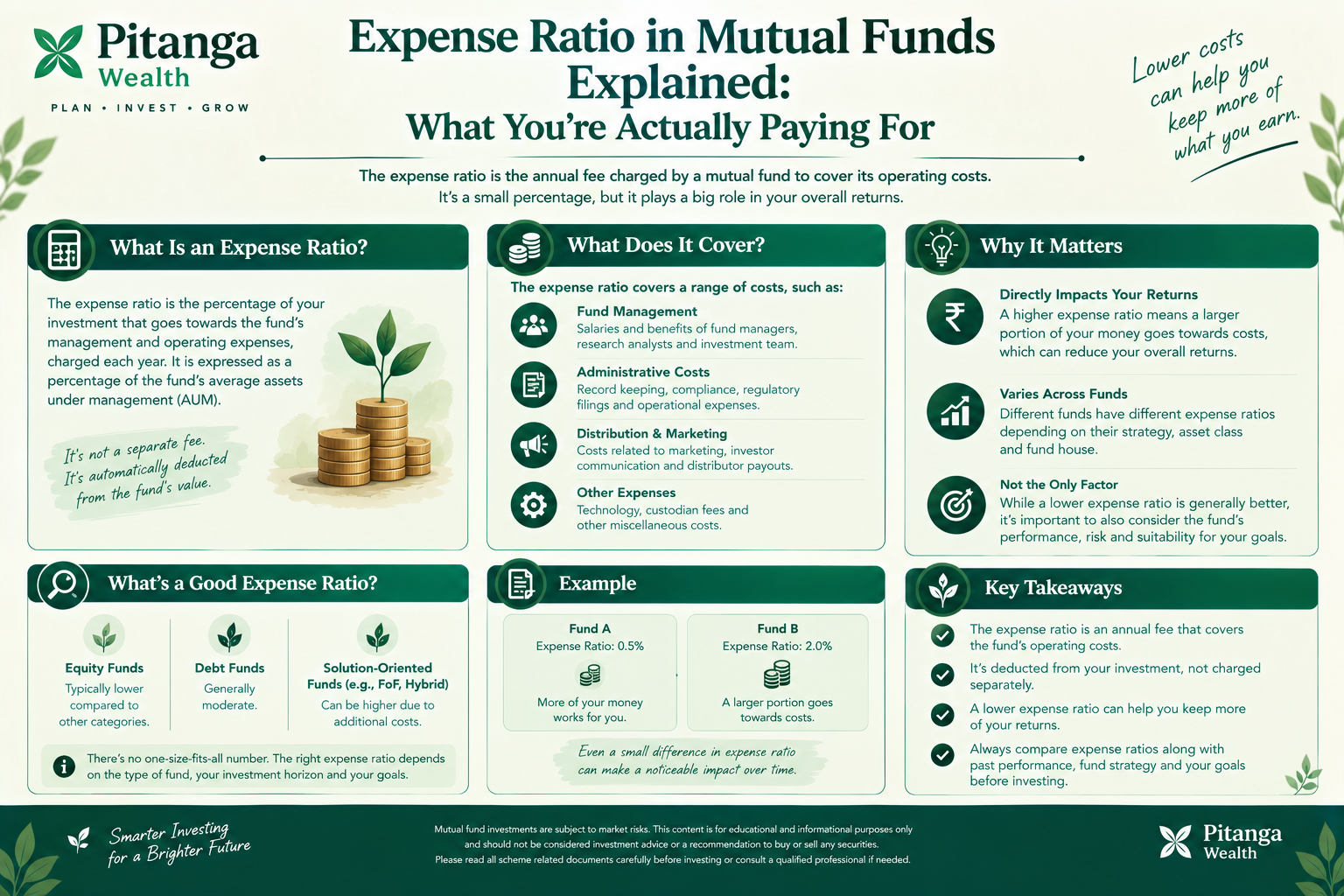
An expense ratio is a measure of the recurring expenses charged to a mutual fund scheme in relation to its assets.
It is generally expressed as an annual percentage of the scheme’s applicable average net assets.
In simple terms, the expense ratio tells you how much of the fund’s assets are used to meet certain expenses involved in operating and managing the scheme.
These expenses may include investment management, administration, recordkeeping, distribution-related costs where applicable, and other permitted expenses.
For example, if a mutual fund has an annual expense ratio of 1%, this broadly represents ₹1 in annual expenses for every ₹100 of the relevant asset base, assuming that rate remains constant.
It does not mean every investor receives a separate bill for 1% of their investment.
Instead, permitted scheme expenses are accounted for within the fund.
This distinction is important because investors generally experience these costs through their effect on the scheme’s Net Asset Value (NAV).
What Does the Expense Ratio Actually Pay For?
To understand the expense ratio in mutual funds, it helps to know the activities involved in running a scheme.
A mutual fund does more than simply buy and sell securities.
It requires investment research, portfolio management, operational systems, investor servicing, regulatory processes, and various administrative functions.
The total expense ratio, commonly called TER, reflects expenses charged to the scheme under the applicable regulatory framework.
Investment Management
The asset management company manages the scheme’s portfolio according to its stated investment objective and strategy.
This involves investment analysis, portfolio construction, monitoring, and related investment-management activities.
Administrative and Operational Services
Mutual funds require accounting, valuation, recordkeeping, reporting, and other operational support.
These functions help maintain the scheme’s day-to-day operations.
Registrar and Investor Servicing
Investor transactions, unit records, statements, and related services require systems and service providers.
Permitted expenses associated with these functions may be included in scheme costs.
Distribution-Related Expenses
Regular plans generally include distribution-related expenses or commissions as permitted under the applicable framework.
These expenses help explain why regular plans often have higher expense ratios than corresponding direct plans.
Other Permitted Expenses
Certain additional costs may be charged to a scheme where regulations allow them.
The precise composition and treatment of expenses depend on the scheme, plan, disclosures, and prevailing regulatory requirements.
Not every cost associated with investing is necessarily included in the published expense ratio. Investors should also understand separately applicable costs, taxes, and transaction conditions.

How Is the Expense Ratio Calculated?
The basic conceptual formula is:
Expense Ratio = Annualised Eligible Scheme Expenses ÷ Applicable Average Net Assets × 100
Consider a simplified hypothetical example.
Suppose a mutual fund scheme has:
- Applicable average net assets of ₹500 crore
- Annual eligible expenses of ₹5 crore
The expense ratio would be:
₹5 crore ÷ ₹500 crore × 100 = 1%
This means the scheme’s annual expense ratio is 1% in this simplified example.
In practice, the actual TER is calculated and disclosed according to the applicable regulatory framework. Expense ratios can change over time, and the calculation may involve different permitted components.
The example is for educational purposes only.
How Is the Expense Ratio Deducted From Your Investment?
One common misconception is that mutual fund investors pay the expense ratio as a separate annual charge from their bank accounts.
That is generally not how it works.
Recurring scheme expenses are accounted for in the calculation of the mutual fund’s NAV.
As a result, the published NAV reflects the effect of expenses charged to the scheme.
For example, if a fund reports a historical return, that return is generally based on NAV movements that already reflect the scheme’s recurring expenses.
This means investors should not simply subtract the published expense ratio again from the same NAV-based return.
Doing so would effectively count the expense twice.
However, other costs or taxes that are not reflected in the published NAV-based return may still be relevant to an individual investor.
A Simple Way to Understand It
Imagine a mutual fund’s underlying investments increase in value during a particular period.
The scheme may still incur management and operational expenses during that period.
Those expenses affect the net value attributable to unit holders.
The fund’s reported NAV therefore reflects both investment-related changes and the impact of relevant scheme expenses.
The expense ratio is an ongoing cost built into the scheme’s economics, not usually a separate bill sent to each investor.
What Is the Difference Between Direct and Regular Mutual Fund Plans?
The difference between direct and regular plans is especially important when discussing the expense ratio in mutual funds.
Many mutual fund schemes offer both plan types.
They generally invest in the same underlying portfolio and follow the same scheme-level investment strategy, but their expense structures differ.
Direct Plan
A direct plan is intended for investors who invest directly with the mutual fund without using a distributor for that investment.
It generally has a lower expense ratio because it does not include distributor commission in the same way as a regular plan.
Regular Plan
A regular plan involves investment through a mutual fund distributor.
Its expense structure generally includes permitted distribution-related costs.
The distributor may provide services such as explaining scheme features, facilitating transactions, assisting with documentation, and providing ongoing investor servicing.
The nature and extent of those services can vary.
Direct vs Regular Plans: Comparison
| Feature | Direct Plan | Regular Plan |
| Investment portfolio | Generally the same underlying scheme portfolio | Generally the same underlying scheme portfolio |
| Expense ratio | Usually lower | Usually higher |
| Distributor involvement | No distributor for the investment | Investment through a distributor |
| Distributor commission | Not included in the same way | Generally included through permitted distribution expenses |
| NAV | Separate plan NAV | Separate plan NAV |
| Suitability | Depends on investor needs and preferences | Depends on investor needs and preferences |
A direct plan’s lower expense ratio can create a cost advantage over time, all else being equal.
However, investors should also consider whether they need assistance understanding products, completing transactions, and managing investment-related processes.
A regular plan’s higher cost does not guarantee better investment outcomes or more suitable fund selection.
Similarly, a direct plan’s lower cost does not eliminate market risk.
Why Do Direct and Regular Plans Have Different NAVs?
Direct and regular plans of the same mutual fund scheme generally hold the same underlying portfolio.
However, their expense ratios differ.
Over time, differences in expenses can contribute to differences in their NAVs and NAV-based returns.
For example, if the direct plan has lower recurring expenses, it may retain more of the portfolio’s investment performance than the corresponding regular plan, assuming other relevant factors are the same.
This does not mean the direct plan is inherently less risky.
Both plans remain exposed to the underlying scheme’s investment risks.
It is also important not to compare the absolute NAV figures of two plans as though a higher or lower NAV automatically indicates better value.
The relevant comparison is the difference in costs, performance, services, and investor circumstances.
Does a Lower Expense Ratio Mean a Better Mutual Fund?
Not necessarily.
A lower expense ratio is generally favourable when comparing otherwise similar investment options because it reduces ongoing costs.
But a mutual fund cannot be evaluated using expenses alone.
Consider two hypothetical schemes.
Fund A has a lower expense ratio but follows an investment strategy that does not match your goals.
Fund B has a higher expense ratio but follows a different strategy that may be more relevant to your needs.
It would be misleading to declare Fund A the better investment solely because its expense ratio is lower.
Investors should also consider:
- Investment objective and strategy
- Fund category
- Underlying portfolio
- Risk profile
- Historical performance in context
- Benchmark relevance
- Investment horizon
- Overall suitability
Lower costs are valuable, but they do not replace the need to understand what you are investing in.

How Does Expense Ratio Affect Long-Term Investment Returns?
Small differences in recurring expenses can have a meaningful cumulative effect over long investment periods.
This is because investment outcomes are influenced not only by the performance of underlying assets but also by the costs borne by the scheme.
Consider a purely hypothetical illustration.
Suppose ₹1,00,000 is invested for 20 years, with no additional contributions or withdrawals.
Assume two illustrative net annual return rates:
- Scenario A: 9%
- Scenario B: 8%
The projected values would be approximately:
| Particulars | Scenario A | Scenario B |
| Initial investment | ₹1,00,000 | ₹1,00,000 |
| Assumed annual net return | 9% | 8% |
| Investment period | 20 years | 20 years |
| Illustrative ending value | ₹5.60 lakh | ₹4.66 lakh |
The difference is approximately ₹94,000.
This example demonstrates how a one-percentage-point difference in assumed annual net returns can compound over time.
It is not a forecast and should not be interpreted as a prediction of actual mutual fund returns or as proof that a particular expense-ratio difference will produce these exact outcomes.
Actual results depend on market performance, scheme expenses, cash flows, investment timing, and other factors.
The takeaway is that recurring costs deserve attention, particularly when comparing otherwise similar investment options.
Do Expense Ratios Change Over Time?
Yes.
The expense ratio in mutual funds is not necessarily fixed throughout the life of a scheme.
It can change as permitted expenses, scheme assets, and regulatory conditions change.
For example, changes in the scheme’s asset base or expense structure may affect its disclosed TER.
Asset management companies are required to provide relevant expense disclosures under the applicable rules.
Investors should review current disclosures rather than rely on an old expense ratio quoted in a blog, video, or comparison.
The expense ratio displayed when you first invest may not remain identical in future years.
Is Expense Ratio Different for Equity and Debt Mutual Funds?
Expense ratios can differ across fund categories and individual schemes.
An actively managed equity fund may involve different investment research and portfolio-management activities from a debt fund or an index fund.
However, the fund category alone does not determine the actual expense ratio.
Expenses also depend on factors such as the scheme’s structure, plan, permitted expense components, and applicable regulations.
Therefore, investors should compare the disclosed expense ratio of the specific scheme and plan they are evaluating.
Comparing an equity fund’s expense ratio directly with that of an unrelated debt fund may not provide a meaningful basis for deciding between them.
Their investment objectives and risks are different.
What About Expense Ratios in Index Funds and ETFs?
Index funds and exchange-traded funds (ETFs) generally seek to track a specified index rather than select securities through a conventional active-management approach.
Some passive funds have lower expense ratios than actively managed funds, but this is not universal.
Investors should also consider tracking difference, tracking error, portfolio replication, liquidity, and other relevant characteristics.
For ETFs, the market price at which units are bought or sold, brokerage charges, bid-ask spreads, and other applicable trading costs can matter in addition to the scheme’s expense ratio.
A low TER alone does not guarantee efficient index tracking or a favourable investor outcome.
Expense Ratio vs Exit Load: What’s the Difference?
Expense ratio and exit load are often confused, but they serve different purposes.
| Feature | Expense Ratio | Exit Load |
| What it is | Recurring scheme expenses relative to assets | Charge that may apply when redeeming or switching units under specified conditions |
| When it matters | During the investment period | When an applicable redemption or switch occurs |
| How it affects investors | Reflected in the scheme’s NAV | Can reduce redemption proceeds |
| Is it always applicable? | Schemes have applicable expense arrangements | Depends on the scheme’s exit-load structure and transaction conditions |
| Where to check | TER disclosures and scheme documents | Scheme documents and applicable exit-load disclosures |
An investor should understand both.
A scheme with a relatively low expense ratio may still have an exit load applicable to certain early redemptions.
Similarly, a scheme with no applicable exit load can still have ongoing expenses.
These costs should not be treated as interchangeable.

Is Expense Ratio the Only Cost of Investing in Mutual Funds?
No.
The expense ratio is an important measure of ongoing scheme expenses, but it is not necessarily the complete picture of every cost or tax an investor may encounter.
Depending on the scheme and transaction, other considerations may include:
Exit Load
An exit load may apply when units are redeemed or switched within a specified period.
Securities Transaction Tax
STT may apply to certain transactions involving equity-oriented mutual funds, subject to prevailing tax rules.
Capital Gains Tax
Gains realised on redemption or other taxable transactions may be subject to applicable income-tax provisions.
Stamp Duty
Stamp duty may apply to certain mutual fund unit transactions under prevailing rules.
ETF Trading Costs
Investors buying or selling ETF units on an exchange may face brokerage and bid-ask spread costs, among others.
These items are not all part of the published TER.
Their relevance depends on the investment and the applicable legal and tax framework.
How Can You Check a Mutual Fund’s Expense Ratio?
Before investing, review the latest disclosed TER for the specific mutual fund scheme and plan.
You can generally find expense-ratio information through:
- The asset management company’s official website
- Scheme-related disclosure documents
- Official mutual fund information resources, including AMFI
- Applicable fund factsheets and investor disclosures
Make sure you are checking the correct plan.
For example, the direct and regular plans of the same scheme may display different TER figures.
Also check the date of the information.
A comparison using outdated expense ratios may not reflect the scheme’s current costs.
Common Mistakes Investors Make About Expense Ratios
Ignoring the Expense Ratio Entirely
Ongoing expenses can affect investment outcomes and deserve attention.
Choosing a Fund Only Because It Has the Lowest TER
Low cost does not guarantee strong performance or suitability.
Comparing Unrelated Fund Categories
Expense ratios are most meaningful when considered alongside comparable investment objectives and strategies.
Confusing Direct and Regular Plans
The plans generally have different expense structures and separate NAVs.
Deducting the Expense Ratio Again From Published NAV Returns
Published NAV-based performance generally already reflects recurring scheme expenses.
Assuming a Higher Expense Ratio Guarantees Better Management
Higher expenses do not establish superior fund-management quality or future returns.
Forgetting About Other Costs
Exit loads, applicable taxes, and transaction-related costs may also matter.
Using Outdated TER Figures
Expense ratios can change, so current disclosures are important.
Frequently Asked Questions
1. What is the expense ratio in mutual funds?
The expense ratio measures the recurring expenses charged to a mutual fund scheme relative to its applicable assets. It is generally expressed as an annual percentage.
2. Is the expense ratio deducted every day?
Permitted recurring expenses are generally accrued in the scheme’s NAV calculation. Investors usually do not pay the published TER as a separate daily debit from their bank accounts.
3. Is a lower expense ratio always better?
A lower expense ratio reduces ongoing costs, all else being equal, but it does not automatically make a scheme more suitable or guarantee higher returns.
4. Why is the regular plan expense ratio usually higher?
Regular plans generally include permitted distribution-related expenses, which help explain the difference from corresponding direct plans.
5. Does the expense ratio affect NAV?
Yes. Permitted recurring scheme expenses are reflected in NAV calculations, so they affect the net value attributable to unit holders.
6. Are mutual fund returns shown before or after the expense ratio?
Returns calculated from published scheme NAVs generally reflect the recurring expenses already accounted for in those NAVs.
7. Can the expense ratio change after I invest?
Yes. Expense ratios can change within the applicable regulatory framework. Investors should review current disclosures.
8. Is expense ratio the same as exit load?
No. The expense ratio measures recurring scheme expenses, while an exit load may apply to particular redemptions or switches.
9. Do index funds always have lower expense ratios?
Not always. Many passive funds have relatively low expense ratios, but the actual cost depends on the specific scheme and plan.
10. Where can I find a mutual fund’s expense ratio?
Check the latest TER disclosure on the relevant asset management company’s website or in official scheme-related information.
Final Thoughts
Understanding the expense ratio in mutual funds is an important part of evaluating the actual cost of investing.
The expense ratio reflects recurring costs associated with operating and managing a mutual fund scheme.
These expenses are generally accounted for within the NAV, rather than charged separately to each investor through an annual bill.
Over time, cost differences can matter, particularly when comparing investment options with similar objectives and risk characteristics.
However, the cheapest fund is not automatically the most suitable fund.
Investors should evaluate expenses alongside the scheme’s investment objective, portfolio, risks, performance context, and their own financial circumstances.
At Pitanga Wealth, we believe that understanding how mutual funds work, including their costs, can help investors make more informed financial decisions.
Explore our financial education resources to learn more about mutual fund NAV, exit loads, fund categories, and other important investment concepts.
Important Disclaimer
This article is intended solely for general financial education and information. It does not constitute personalised investment advice, a recommendation to invest in a specific mutual fund, or an assurance of returns.
All numerical examples are hypothetical and are provided only to explain financial concepts. They do not represent actual or expected returns from any mutual fund scheme.
Mutual fund investments are subject to market risks. Investors should read all scheme-related documents carefully before investing.
Expense-ratio calculations, permitted expenses, disclosure requirements, transaction costs, and tax treatment are subject to the applicable regulatory framework and may change. Investors should verify the latest information from official sources.
Distributor Disclosure: Pitanga Wealth is an AMFI-Registered Mutual Fund Distributor (ARN-134606). Pitanga Wealth may receive commissions from eligible mutual fund distribution activities. AMFI registration does not constitute registration as an investment adviser with SEBI.
Written by the Pitanga Wealth Team.
Follow us on Instagram: We explain investing and financial planning in plain language. Follow @pitangawealth for more educational insights.
This article is for educational and informational purposes only. It is not investment, tax, legal or insurance advice. Consider your circumstances and relevant documents before making a financial decision.