

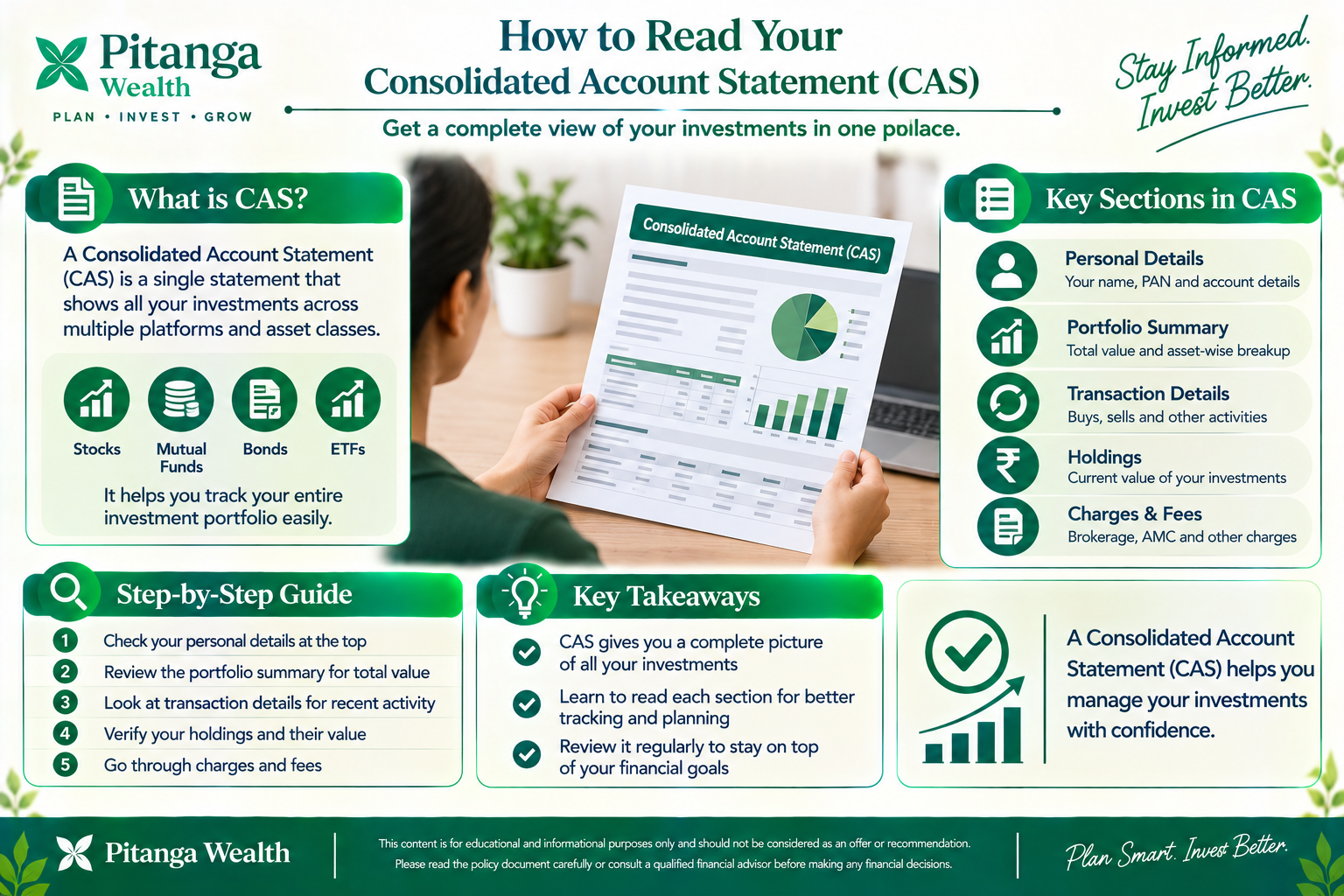
A mutual fund SIP gets debited from a bank account. A share purchase appears in a broker’s app. A bond sits in a demat holding statement. When an investor uses several institutions, it is easy to lose track of what was actually bought, what was sold and what remains owned. India’s Consolidated Account Statement (CAS) is designed to make eligible investment records easier to review together—not to replace every original statement or guarantee that an app’s portfolio value is correct.
This guide explains how to read a Consolidated Account Statement in India, line by line: the holder details, account and folio references, opening and closing units, credits and debits, market valuation, mutual fund cost disclosures and important warning signs. It also explains where to obtain an authentic statement, what may be missing and when to request clarification. Official SEBI, NSDL, CDSL and AMFI material was reviewed on 24 November 2026. [1][2][3][4][5][6][7]
Quick Answer: What Is a Consolidated Account Statement?
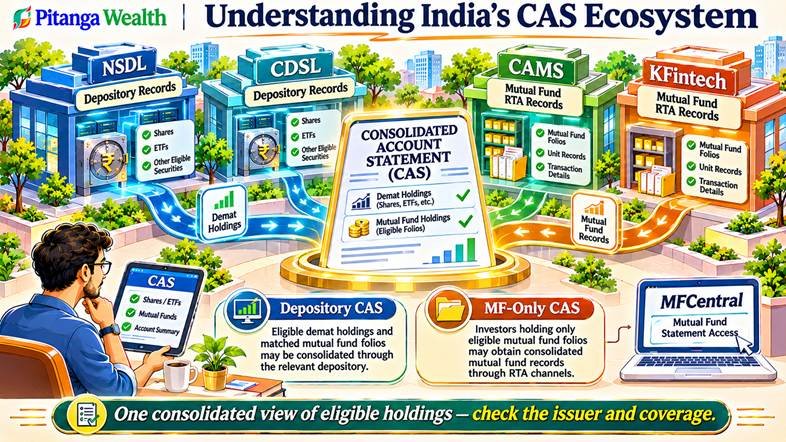
A Consolidated Account Statement (CAS) is an investor account statement that combines eligible securities transactions and holdings from demat accounts with mutual fund investments held in statement-of-account (SOA) or folio form, according to applicable consolidation rules. The statement is generally organised using PAN and, for joint holdings, the first-holder PAN and the pattern of holding. For investors who have both demat and eligible mutual fund folios, a depository—NSDL or CDSL—typically issues the combined CAS. Mutual fund-only investors can obtain consolidated mutual fund statements through authorised registrar and transfer agent (RTA) channels. [1][4][5][6]
Read the period first, then confirm the holder and accounts, reconcile opening balance + additions − reductions = closing balance, and only then review valuations. A CAS is a dated record. It is not a live trading terminal, a bank statement, a capital-gains computation or a complete inventory of every financial asset a family owns.
Why CAS Matters for Indian Investors
A single review point across several providers
An investor could hold delivery shares through one stockbroker, ETFs through a second demat account and mutual fund units through several AMCs. Without consolidation, checking every provider separately takes time and increases the possibility of missing an unexpected change. CAS brings relevant records together so the investor can review account coverage, quantities, transactions and portfolio composition. It is especially useful for people making periodic SIPs who otherwise rely on payment messages rather than verifying actual allotment. [1][5]
The convenience has limits. A single PDF may consolidate only the holdings that fit the applicable matching and reporting rules. It is still essential to retain broker contract notes, individual AMC or RTA statements, bank records and depository statements where necessary. A missing entry should prompt a methodical check, not immediate assumptions about either fraud or a processing failure.
Ownership and transaction checking—not investment advice
An independently sourced CAS helps answer whether eligible units or securities appear in the relevant records. It does not establish that the security is appropriate for the investor, that a share is undervalued, that a fund will outperform or that reported valuations can be withdrawn immediately. The main use is informed oversight: identifying holdings, understanding movements, spotting discrepancies and preserving evidence if a service provider must be contacted.
Who Sends the CAS: NSDL, CDSL, CAMS or KFintech?
Depository-issued consolidated statement
Where the investor has matching demat and mutual fund folio information under the regulatory framework, NSDL or CDSL generally coordinates the depository CAS. It can show eligible demat holdings across both depositories, along with mutual fund SOA holdings reported through participating RTAs. A person with multiple demat accounts may receive the CAS from the depository associated with the account opened earlier, subject to the specified allocation and any valid change request. The DP that services an account is not necessarily the organisation that assembles the consolidated statement. [4][5]
Mutual fund-only consolidated statement
Someone who holds mutual funds in non-demat folio form, with no relevant demat account, can obtain consolidated mutual fund information through CAMS, KFintech or MFCentral, using their genuine official channels. AMFI provides links to the RTA mail-back facilities and explains that a summary CAS and detailed CAS serve different purposes. The CAMS request page itself cautions that MF-focused statements may not contain complete, current information on demat holdings. Treat “CAS” as a family of related statements and check the issuing body before assuming the scope. [6][8]
| Investor situation | Typical source | What to verify |
| Demat account(s) with eligible MF folios | NSDL or CDSL CAS | PAN/holder pattern, all expected DP accounts and MF folios |
| MF units in folio/SOA form only | MF RTA channels, including CAMS/KFintech | Registered email, matched folios, statement period |
| Request for a detailed MF transaction history | CAMS/KFintech or MFCentral where available | Summary versus detailed report and date range |
| Specific unsettled trade or security debit | Broker contract note and DP/depository statement | Execution date, actual settlement, ISIN, quantity |
When Should You Receive Your CAS in 2026?
A material rule change took effect on 14 May 2025. Under SEBI’s revised depository timelines, for an investor with transactions in eligible demat accounts or mutual fund folios during a calendar month, the depository dispatches the monthly e-CAS within 12 days of the month-end and a physical CAS within 15 days of the month-end, where physical delivery is chosen. If there are no such transactions, a holdings-based CAS is generally sent on a half-yearly basis covering March and September end. The applicable half-yearly dispatch deadlines for depositories are the 18th of April/October for e-CAS and 21st for physical CAS. [2][3]
SEBI’s July 2024 framework made email the default dispatch mode where the relevant registered email is available, while permitting an investor to opt for physical delivery. The separate requirements applying to mutual fund-only AMC/RTA statements should not be confused with depository e-CAS deadlines. Some older websites and FAQs still refer to a tenth-day dispatch rule: use the revised regulatory circular rather than assuming those older timelines remain current. [2][3][7]
| Situation | Depository e-CAS | Depository physical CAS |
| Transactions in the month | By 12th day after month-end | By 15th day after month-end |
| No transactions: March or September holdings | By 18 April / 18 October | By 21 April / 21 October |
Important: These are the depository dispatch timelines prescribed in SEBI’s February 2025 circular, effective May 2025. A statement delivery date, trade settlement date, mutual fund processing date and bank transaction date are different events. Special account categories or facts may require clarification from the issuer. [3]
Before Reading: Six Details to Check on Page One
1. The issuer, statement period and authenticity
Identify whether the document is from NSDL, CDSL, a mutual fund RTA or a genuine authorised service channel. Note its “as of” or “for the period” dates and any statement identification reference. A statement for 1–31 October cannot prove what happened on 4 November. If an email appears suspicious, do not use the message’s login button or attachment instructions as proof of legitimacy. Open the provider’s website or app independently and fetch the record through its authenticated route.
2. Investor name and first-holder identity
Check the printed holder name and whether the account is single or joint. Under CAS consolidation rules, the first-holder PAN and the pattern of holding can affect which accounts appear together. Two holdings that involve the same family members but have different first holders may not merge in the way a reader expects. Do not share a full CAS publicly merely to demonstrate this point: names, account references, contacts and holdings can be sensitive personal and financial information. [4]
3. PAN-related matching, KYC and contact details
The PAN is central to consolidating eligible records, but matching also depends on the specified account and holding details. An incorrect PAN record, outdated registered email or mismatched joint-holder pattern may contribute to an incomplete view. Check contact and KYC information with the actual DP or RTA, using their verified process. Do not email a full PAN image or identity documents to an unknown person who claims they can “fix CAS” for a fee. [1][4][6]
4. Account identifiers and folio numbers
A depository section may contain the Depository Participant (DP), demat or beneficiary account reference and holdings associated with the account. A mutual fund section will usually refer to AMC, scheme, plan/option and folio identifiers. These numbers identify different account relationships. A mutual fund folio is not automatically the same as a demat account and an investment shown in one section should not be added a second time merely because a provider’s app also displays it.
5. Nomination and holding pattern
Some statements provide nomination status, joint-holder information or other profile disclosures. Treat these as prompts to check the institution’s current records and acknowledgements. Nomination is part of account administration and transmission planning; it is not evidence that ownership automatically passes free of all legal questions. If a displayed status differs from a recent confirmed change, ask the actual record keeper when the statement’s data snapshot was prepared. [5][7]
6. Account coverage and any exclusions
Do not assume a CAS includes savings accounts, bank fixed deposits, real estate, insurance policies, every retirement product, every app balance or every type of derivative position. It consolidates records within its reporting scope. Some providers may add other information or helpful portfolio views, but users should check the headings and footnotes to know what the included values represent. A CAS missing a particular asset category is not necessarily inaccurate; it may be outside the statement’s design.
The Main CAS Columns: A Plain-English Decoder
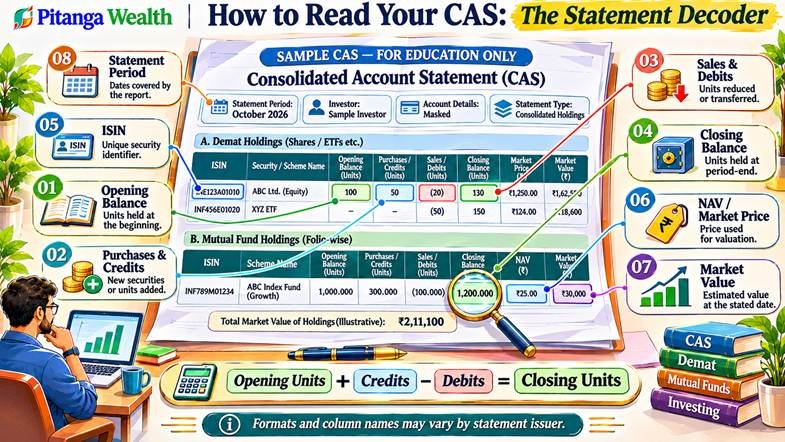
Layouts vary across NSDL, CDSL and mutual fund RTA statements. The following terms recur frequently, although the exact column names and placement can differ. Read the accompanying legend for the document you actually received. [4][5][6]
| CAS term | Meaning | Reader’s check |
| Opening balance | Units or securities held at the start of the stated period | Compare with prior closing balance |
| Purchase / allotment / credit | Eligible units or securities added in the period | Match order, allotment and settlement records |
| Redemption / sale / debit | Units or securities reduced in the period | Verify instruction, settlement and account movement |
| Closing balance | Recorded quantity held at the end of the period | Reconcile opening + additions − reductions |
| ISIN | Identifier for a particular security or eligible scheme/unit class | Match the actual instrument, not just a short name |
| NAV / market price | Valuation input for an investment at a particular date | Check valuation date and pricing basis |
| Market value | Indicated quantity multiplied by applicable valuation input | Not an amount guaranteed on sale |
| Purchase value / cost | Displayed investment cost information under the statement format | Do not assume it equals taxable cost or realised gain |
Step-by-Step: How to Read a Consolidated Account Statement
Step 1 — Separate the summary from the transaction detail
Start with the high-level summary: which depository accounts, MF folios and asset groups are represented? A portfolio chart or total is helpful for orientation but may hide account-level differences. Then locate the transaction section for each relevant account. A summary view can tell you an amount is present; detailed lines are usually necessary to explain how the closing quantity arose. When ordering an MF CAS separately, choose “Detailed” rather than “Summary” when reconciliation is the goal. [5][6][8]
Step 2 — Read holdings as quantities, not just rupee values
For a share, the key number is normally the number of securities credited in the demat record for a particular ISIN. For a mutual fund, it is the number of units for the precise scheme, plan and option. Two funds with similar names may have different ISINs, plans or unit classifications. Read the units first. A rising rupee value may reflect changing market prices rather than fresh investment; conversely, a new SIP can increase units while the total market value still falls.
Step 3 — Reconcile each line from opening to closing
Use a simple equation: opening units + units credited − units debited = closing units, subject to any correctly described adjustments or special corporate actions. A mutual fund SIP may add units; a redemption removes units; a switch can involve a corresponding redemption from one scheme and purchase into another; a bonus share issue may increase shares without a separate cash purchase. Do not confuse a price change with an unexplained quantity movement. [4][6]
Step 4 — Interpret the transaction type
Different transaction words describe different operations: purchase, SIP, switch-in, switch-out, STP, SWP, redemption, reinvestment, merger, bonus, transfer, pledge or an authorised debit. For example, a mutual fund switch is not merely a renamed holding; it ordinarily reflects a redemption and purchase under applicable rules and may have tax consequences. If you cannot identify a line, compare its date, type, scheme/ISIN and reference with original records before deciding what occurred.
Step 5 — Read valuation only after checking quantities
A statement may show total units, a valuation rate and an indicative portfolio value. A mutual fund holding of 115 units valued at a hypothetical NAV of ₹40 per unit has an indicated value of ₹4,600. That is a snapshot, not the amount necessarily receivable after a later redemption, and it is not proof of a gain without reliable cost and cash-flow records. Listed share valuations are similarly time-sensitive. Avoid judging the success of an investment solely by a consolidated dashboard total.
Step 6 — Look for disclosure and status fields
Relevant MF CAS information may include cost of investment, scheme or plan details and, particularly in half-yearly statements, distributor remuneration and scheme expense disclosures under the applicable framework. SEBI’s March 2026 mutual fund master circular addresses these requirements. Other sections may show joint-holder, nomination or account status information. The labels may have a regulatory purpose even if they do not change the quantity of units held. [7]
Step 7 — Match the statement to external evidence
Check selected entries against the broker’s contract notes, the DP or depository record, mutual fund account confirmations and the actual bank credits or debits. A verified purchase order, payment debit and units allotted are three related but different steps. If a record differs, check whether settlement is pending, an instruction failed, a switch involved two lines, the relevant date is outside the CAS period or the account is not within the consolidation scope. Record the explanation rather than silently adjusting figures in a personal spreadsheet.

Worked Example: A Fictional CAS You Can Reconcile
Consider a fictional investor, Riya. Her October statement includes one mutual fund folio and one demat holding. These are invented figures for education; they are not real market prices, an actual fund scheme or an offered investment. The objective is to calculate closing quantities, not predict returns.
| Holding | Opening units | Added | Reduced | Closing units |
| Fictional ABC Equity Fund — Regular Plan | 100.000 | 25.000 | 10.000 | 115.000 |
| Fictional XYZ Ltd equity shares | 10 | 5 | 2 | 13 |
The fund calculation is 100 + 25 − 10 = 115 units. If the document separately shows an illustrative NAV of ₹40 on its valuation date, the indicated holding value would be ₹4,600. The share calculation is 10 + 5 − 2 = 13 shares. At a hypothetical valuation price of ₹125 per share, that section would indicate ₹1,625. The two illustrative holdings would sum to ₹6,225 only on the stated valuation assumptions and dates. This does not indicate Riya’s investment profit or the amount her bank would receive on immediate sale.
Why the purchase amount can differ from the portfolio value
Suppose Riya’s bank shows a ₹1,000 debit for a fund purchase, while the CAS shows a change in units. To validate it, she would check the allotted units and applicable NAV and examine the AMC or RTA confirmation. A difference between current market value and historical contributions can arise from price movement, reinvestments, withdrawals, loads or other applicable factors. A CAS purchase-value line is useful disclosure, but a complete tax or performance calculation may need lot-level dates, cash flows and legally applicable tax treatments.
Why a broker’s “position” may not be in the holdings section
An executed order may be awaiting settlement, and certain derivative positions are not held as delivery shares in demat. The statement’s cut-off date may also precede the order. A broker interface could show an order, current position or ledger amount that is different from a depository closing holding. Ask first whether the two screens are reporting the same asset and same moment in its lifecycle. [5]
Reading the Mutual Fund Section Correctly
Scheme name, direct versus regular plan and option
The fund name alone may not identify the exact investment. Look for the AMC, scheme, plan, option, folio and ISIN where provided. Direct and regular plans can have different expense structures and NAVs; growth and IDCW options have different cash-flow characteristics. A reader should not combine units from distinct classes as if they were perfectly interchangeable. The safest check is the actual scheme identifier and the folio/transaction confirmation. [6][7]
SIP, SWP, STP and switch records
A SIP is a series of investments; each completed instalment generally generates its own transaction and allotted units. An SWP involves systematic withdrawals, while an STP involves systematic transfers between eligible schemes under the relevant terms. A switch may create separate switch-out and switch-in records. If a systematic instruction was scheduled but did not execute, the bank debit or app reminder alone cannot prove successful unit allotment. Compare actual units and transaction confirmations. [4][6]
Total purchase value, valuation and disclosed costs
SEBI’s mutual fund CAS framework provides for total purchase value or cost of investment per scheme and additional disclosures in half-yearly CAS. These include actual commissions paid by AMCs/MFs to distributors and information on the scheme’s average total expense ratio, subject to the applicable requirements. Do not read a distributor commission figure as an extra amount necessarily debited directly from your personal bank account on that date, or mistake it for the fund’s return. Use the statement notes and scheme documentation to interpret remuneration and expenses. [7]
A fund’s printed portfolio value is not a personalised assessment of suitability or liquidity. Market conditions, exit-load terms, applicable cut-off and NAV rules, tax treatment, and investment restrictions can all matter to a later redemption. A CAS is good evidence for holdings and displayed transactions but is not a substitute for reading the actual scheme documents.
Reading the Demat Section Correctly
ISIN and exact security description
In demat reporting, a security is more accurately identified by its ISIN than by an abbreviated stock name on an app. Look for listed equity shares, ETFs, eligible bonds and other securities actually recorded in the account. If two instruments look similar, check the ISIN and any separate series or rights information. A quoted value alongside a security is an estimate based on available market or valuation inputs, not a guarantee that the holding can be liquidated at that value.
Credits, debits, corporate actions and pledges
A credit can arise from a settled purchase, allotment, corporate action or eligible transfer. A debit can arise from authorised sale delivery, transfer or other applicable instructions. A bonus, split or merger can change quantity or instrument identifiers without corresponding new cash investment. A pledge or collateral status is operationally different from outright sale and should be checked in the underlying DP record. A CAS summary may not contain every instruction detail needed to investigate such movements.
Shares can be held while their value declines
A closing balance of 50 shares proves only the number reflected in that record at the cut-off point. If the share price declines, the rupee value declines while the share count may remain unchanged. A CAS is not deposit insurance and does not guarantee investment principal. Review instrument-level risk separately; the account statement solves a recordkeeping problem, not a market-risk problem.
Why an Investment Might Be Missing From Your CAS
The most common mistake is to assume an omitted line must mean that money disappeared. There are multiple explanations, and the correct answer depends on the account and statement type. [4][5][6]
- The transaction occurred after the CAS period or had not settled by the relevant date.
- The instrument or account is outside the statement’s consolidation scope.
- A mutual fund account was held under a different first-holder PAN or a different joint-holding pattern.
- A PAN, folio, DP or contact detail requires correction or matching in the responsible records.
- The downloaded file is an MF-only summary rather than a complete depository CAS or detailed transaction report.
- The investment is a derivatives position, bank deposit, insurance asset or another category that should not be expected in that CAS section.
- A transaction has been reversed, adjusted, renamed by corporate action or otherwise requires line-by-line confirmation.
Start by confirming the source, coverage and cut-off. Next obtain the original folio statement or DP/depository statement, locate the contract note or allotment advice, and identify the exact date and instrument. If the difference remains unexplained, request a written reconciliation from the registered intermediary. Do not submit a modified screenshot as evidence; preserve the original files and acknowledgement numbers.
How to Download CAS Safely
Option 1 — NSDL CAS and depository services
NSDL provides a CAS information and access route from its official site. Its investor page describes registration or access through the NSDL CAS service, and notes availability through specified NSDL online services. If you do not recognise an email sender, navigate to the official NSDL website yourself instead of trusting a forwarded link. Use the details and verification steps required by the legitimate portal. [5]
Option 2 — CDSL CAS
CDSL provides investor CAS information and a statement retrieval route on its official domain. CDSL’s CAS FAQ explains that its CAS can consolidate eligible demat accounts across NSDL and CDSL alongside MF folio holdings, and that investors may obtain dispatched statements through CDSL’s genuine CAS section. Where a password-protected attachment is involved, use only the legitimate provider’s instructions. Do not enter PAN or OTP on a lookalike site supplied in a messaging group. [4]
Option 3 — CAMS, KFintech and MFCentral for mutual fund records
AMFI links to CAMS and KFintech mail-back services and explains that eligible investors can receive statements at the registered email address. It also points to MFCentral as a channel for viewing and downloading MF portfolio and CAS information. Depending on the facility, users may request a summary or a detailed report for a chosen period. The CAMS request page expressly cautions that its MF-focused statement may not fully reflect demat holdings. [6][8]
Security rule: A CAS PDF contains sensitive financial information. Store it in a protected location, do not forward it to unknown advisers or social media accounts, and never disclose a bank, depository or trading OTP to someone claiming to assist with statement retrieval.
What to Do If Your CAS Is Wrong or You Do Not Receive It
Missing statement or incorrect delivery email
Check whether the month had an eligible transaction and whether the relevant half-yearly cycle applies. Verify the registered email, spam/junk folder and dispatch preferences using the genuine DP or AMC/RTA channel. If an email was changed recently, ask which address is active in the official records and how to obtain the original statement. The 2024 SEBI framework treats electronic delivery as default where email is registered, while the physical option remains available. [2][3]
Unexpected debit, transfer, pledge or fund redemption
Treat an unfamiliar securities debit or redemption as time-sensitive. First confirm the actual account and transaction using official DP, depository or AMC records, then contact the institution immediately through verified numbers or its secure portal. Ask for the transaction reference, date, authorisation record, beneficiary or payment details as appropriate, and a written explanation. Secure credentials and registered email access if compromise is suspected. Keep the original CAS, alerts, contract notes, screenshots and written complaint IDs. [4][5]
Escalation and formal complaint channels
If the regulated service provider does not resolve the complaint through its established process, consult SEBI’s investor grievance resources, SCORES and applicable online dispute-resolution mechanisms according to the complaint category and eligibility. Suspected impersonation, unauthorised fund transfers or other cybercrime may also require appropriate law-enforcement reporting. Do not pay a supposed “recovery agent” or disclose verification codes to unlock an investigation. [9]
A Simple Monthly CAS Review Routine
A disciplined review can be completed without building a complicated personal dashboard. Read the CAS when it arrives, keep the previous copy available and review these eight checks:
- Confirm issuer authenticity, statement month and registered contact details.
- Check first-holder name, joint-holding pattern and all expected folio/account identifiers.
- Match purchase or SIP entries to actual allotment and bank debits.
- Verify redemptions, sales, transfers, pledges and unusual security-debit entries.
- Reconcile opening quantity plus credits minus debits to the closing quantity.
- Check holdings, ISINs, plan/option details and valuation dates before reviewing totals.
- Read mutual fund cost, remuneration and expense disclosures when applicable.
- Record questions and resolve them directly with the authorised account provider.
Keep statements organised by month or half-year and maintain a private record of the provider, reference ID, query date and written resolution. Use careful file naming but avoid placing a complete PAN or account number in the filename. Some households also keep a separate inventory of non-CAS assets, such as bank deposits and insurance policies, so that a CAS review is not confused with a full net-worth statement.
Common CAS Mistakes to Avoid
Mistake 1: Counting every displayed total as an additional asset
A broker app may display the value of a holding that also appears in a depository CAS. Adding those two screens together would double-count the same investment. Determine whether records are independent assets or simply two views of one asset. Similarly, a scheme subtotal and a consolidated portfolio total should not be summed twice.
Mistake 2: Calling every change in market value a transaction
An investment’s estimated rupee value may rise or fall with NAVs and prices even when the unit count remains stable. The transaction section explains quantity movement; the valuation section estimates what holdings are worth at a snapshot date. Conflating these will produce misleading “profit” calculations and may hide actual unauthorised credits or debits.
Mistake 3: Using the CAS alone to calculate tax
Capital gains may depend on purchase lots, dates, product classification, holding periods, applicable law, transfers and other individual circumstances. CAS cost disclosures and purchase totals do not automatically supply a complete tax working. Use original purchase/redemption records, relevant broker or RTA capital-gains reports and competent tax advice for filing or individual decisions.
Mistake 4: Ignoring the small-print disclosures
Look for notes explaining the valuation basis, excluded categories, data source, holding pattern and statement type. Particularly for a mutual fund holding, half-yearly disclosures concerning distributor commissions and scheme expenses are meaningful transparency information. They should be read in context, not treated as a personalised recommendation to switch schemes. [7]
Mistake 5: Giving a stranger the complete CAS PDF
A statement can reveal wealth, investments, identifiers and contact details. Someone posing as a tax adviser, financial auditor or regulatory support person might request an unredacted file to conduct a fake portfolio review. Share information only through a necessary, verified channel and redact fields when the recipient does not legitimately need them. Protect the password and the account email itself.
Frequently Asked Questions About Consolidated Account Statements
1. What is CAS in the share market?
CAS stands for Consolidated Account Statement. It is a combined record covering eligible demat securities holdings and, where applicable, mutual fund folio transactions and holdings. It helps an investor review what is recorded across participating infrastructure. It is not a broker trading account, live price chart or confirmation that an investment will produce a return. [1][4]
2. Is CAS the same as a demat account statement?
No. A demat holding or transaction statement is associated with a particular account and the relevant DP/depository records. A depository CAS may consolidate eligible holdings across demat accounts and some mutual fund folios. If a transaction is disputed, the original detailed DP/depository record can be necessary even if a combined CAS displays a summary. [4][5]
3. Who sends the Consolidated Account Statement?
NSDL or CDSL generally dispatches the combined statement for eligible investors whose demat and mutual fund records fall within the consolidation rules. Mutual fund-only investors can access consolidated MF statements through authorised AMCs/RTAs and services such as CAMS, KFintech or MFCentral. The sender depends on the account mix and regulatory matching. [4][6]
4. When will I get my monthly CAS?
Under SEBI’s revised depository dispatch timelines effective 14 May 2025, electronic monthly CAS is to be dispatched within 12 days after month-end and physical CAS within 15 days after month-end for the covered monthly transaction scenario. A trade late in the next month will not appear in the previous month’s statement. Check the correct issuer and period. [3]
5. Will I receive CAS if I made no transactions?
The general depository CAS arrangement provides a half-yearly holdings statement when no eligible demat or MF folio transactions occur, associated with March and September-end holdings. Electronic dispatch is due by 18 April or October, and physical dispatch by 21 April or October under the revised rules. Special account circumstances may call for a separate DP statement. [3]
6. Is CAS available for mutual funds without a demat account?
Yes. A mutual fund investor using folio or SOA form can request consolidated mutual fund information through genuine RTA or industry services where the relevant records and registered email allow it. A mutual fund-only CAS does not necessarily provide a complete view of unrelated demat holdings. [6][8]
7. Why is one mutual fund folio missing from my CAS?
Check that the statement type and period cover it, whether the folio uses the same first-holder PAN and holding pattern, and whether the RTA has consistent records. A monthly MF report may focus on transacted folios, depending on its rules and output. Obtain the original folio statement and ask the AMC/RTA for an explanation before assuming the units are lost. [4][6]
8. Can I use CAS to calculate my mutual fund returns?
CAS can show holdings and relevant purchase values or transactions, but a meaningful return calculation may need all dated cash flows, redemptions, switches, distributions and an appropriate performance method. Current value minus total contributions can be misleading after withdrawals. It is also not automatically a tax capital-gains calculation. [7]
9. What does ISIN mean on a CAS?
ISIN means International Securities Identification Number, which identifies a security or relevant unit class. It is useful for distinguishing similarly named holdings. Always compare the ISIN, scheme/plan or share series alongside the quantity; a short app label by itself may not be enough to identify what was actually recorded.
10. Can I download CAS from NSDL or CDSL online?
Both depositories provide official investor information and access routes for their CAS services. Use the genuine NSDL or CDSL domain, follow authenticated registration or retrieval steps and verify the period requested. Do not follow a short link from an unknown sender asking for PAN, OTP or credentials. [4][5]
11. What is the difference between a Summary CAS and a Detailed CAS?
A summary provides a high-level view of current balances and valuation. A detailed mutual fund CAS may show transaction lines for a selected period. For checking SIP allotments, redemptions and switches, a detailed report is often more useful. AMFI’s CAS download guidance explains where authorised RTA and MFCentral options are available. [6][8]
12. Does CAS include bank balances and insurance?
A securities-market CAS is not a general bank account or universal personal-wealth statement. It primarily covers holdings under the relevant securities and mutual fund reporting frameworks; some issuer-specific pages may display additional account information. Do not expect ordinary savings balances, fixed deposits, all insurance assets or every derivative exposure to appear. [1][5]
13. Why is the CAS value different from my broker app?
The two systems may use different cut-off dates, market prices, settlement status, data sources or asset definitions. A broker dashboard might include cash, open positions or collateral alongside settled holdings. Compare the exact ISIN, quantity and “as of” date and use original confirmations and depository/AMC records to identify the reason for any difference.
14. What should I do if an unknown transaction appears?
Confirm it independently through the original DP, depository, AMC or RTA channel; preserve the CAS and related alerts; and immediately report any unexplained debit, pledge, transfer or redemption to the authorised institution. Request transaction references and written evidence. If unresolved, explore the relevant grievance and SEBI escalation mechanisms. Never disclose OTPs to a purported recovery agent. [9]
Conclusion: Read Your CAS as an Investment Control, Not a Scorecard
The strongest reason to learn how to read a Consolidated Account Statement is that it gives investors a repeatable method for reviewing ownership and transaction records. Start with authenticity, the statement period and the holder pattern. Then identify the accounts included, track actual units through credits and debits, understand the difference between cost and valuation, and independently reconcile items that do not match.
CAS is most useful when combined with authentic broker notes, DP records, RTA statements and bank information. Review it regularly, keep the documents secure, and seek a written explanation promptly when an entry is unfamiliar. Investing choices remain separate decisions involving risk, suitability and liquidity; the combined statement helps ensure the records used to make those decisions are understood.
Disclaimer
This article is general investor education prepared for Pitanga Wealth. It is not personalised investment, tax, legal, financial or cybersecurity advice, nor a recommendation for any securities transaction, depository, stockbroker, RTA, mutual fund scheme or trading platform. All numerical investment examples are fictional and illustrative. Market valuations, disclosure rules, statement access and complaint processes depend on prevailing regulation and the actual institution. Official sources were reviewed on 24 November 2026 and may change. Mutual fund investments and securities are subject to market risk. Pitanga Wealth is not the depository or record keeper of the investor’s securities merely because it may offer financial education or service guidance.
Written by Pitanga Wealth Team.
Follow us on Instagram @pitangawealth for more educational insights.
This article is for educational and informational purposes only. It is not investment, tax, legal or insurance advice. Consider your circumstances and relevant documents before making a financial decision.