


A beginner may open an investing app, purchase ten shares, and see the company name on a screen. That simple experience depends on several separate systems working together: a trading account for exchange orders, a bank account for money, a clearing and settlement arrangement, and a depository record of the securities that the investor beneficially owns. The dematerialised account—usually called a demat account—is the securities-holding part of this chain. It is not a bank deposit, a guaranteed-return product, or a licence to trade without understanding risk.
For an individual considering a demat account in India, the important questions go beyond whether an app allows free opening. Who is the registered Depository Participant? Which depository maintains the electronic record? What will be charged after opening? How does an exchange purchase reach the account? What authorisations permit securities to leave it? And how can the account holder independently verify holdings and report suspicious activity? This guide uses official SEBI, NSDL and CDSL material reviewed on 23 November 2026; it is general investor education, not a recommendation to open an account or to buy a security. [1][2][3]
Quick Answer: What Is a Demat Account?
A demat account holds eligible securities, such as shares and certain bonds, in electronic form through a SEBI-registered Depository Participant (DP) linked to one of India’s depositories, NSDL or CDSL. It records securities credited, debited and held on behalf of the beneficial owner. A trading account, normally maintained with a registered stockbroker, is used to place exchange buy and sell orders, while a bank account handles money flows. These accounts may appear inside one app but are not legally or operationally identical. The investor must still review fees, account authorisations, statements and market risks. [1][2]
Why India Uses Dematerialised Securities
The transition from paper certificates
Historically, investors could receive physical share certificates, endorse transfers and wait for registrations. Paper records introduced risks such as theft, forgery, loss, damage, signature mismatch and administrative delays. Dematerialisation replaced many of those certificate-handling steps with electronic beneficial ownership records, while companies and market intermediaries retain their distinct obligations. The fact that records are digital removes certain paper-specific problems; it does not remove phishing, incorrect instructions, market losses or disputes about ownership. [3][4]
A demat account in India is often compared to an electronic locker. The analogy helps only up to a point: the account records securities, not physical gold bars, rupees in a bank account or a guaranteed sum of money. A company share can lose value even though its digital record remains intact. Electronic custody does not independently assess whether the issuing business is sound, the securities were fairly priced or the investor’s purchase was suitable. The investor still bears the risks of choosing, holding and selling investments.
What may appear as a demat holding
Subject to product, eligibility and depository arrangements, demat holdings may include listed equity shares, exchange-traded funds, certain bonds or debentures, government securities and eligible mutual fund units. Product-specific treatment varies; for example, an ordinary mutual fund folio can often be held outside demat form, and trading in a cash-settled derivative does not by itself create a shareholding credited to demat. The correct test is the actual asset and account statement, not the name of an investment app or a screenshot claiming a portfolio value. [3][5]
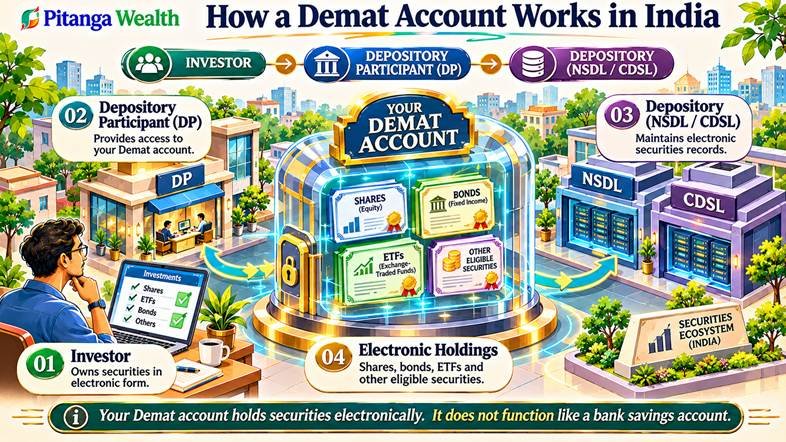
The Five Parties Behind a Demat Account
Investor and beneficial owner
The investor is normally the beneficial owner of eligible securities credited in the account, subject to applicable law, account status and contractual arrangements. Account records are identified by a depository account number and investor details. If an account is opened jointly, the operation, nomination and transmission processes must be read against the joint holding rules. The investor should ensure registered contact details are personally controlled because transaction alerts and instructions may depend on them. [3][4]
Depository: NSDL or CDSL
India has two securities depositories: National Securities Depository Limited (NSDL) and Central Depository Services (India) Limited (CDSL). They provide electronic recordkeeping and securities transfer infrastructure. Investors do not generally open a retail account directly with a depository; they approach a registered Depository Participant connected to it. NSDL and CDSL are not alternative stock exchanges, nor do they independently choose securities or promise investment returns. [1][3]
Depository Participant, stockbroker and bank
A Depository Participant is the intermediary that helps open and service the demat relationship. A DP may be a broker, bank or other eligible entity. A stockbroker supplies the exchange trading service, and a bank handles the related payment arrangements. One company group or app can package several services, but a user should read each legal entity’s registration and terms rather than assuming all functions are provided by the same licence. For a demat account in India, verify the particular DP as well as the broker if both are involved. [1][2]
Exchanges and clearing arrangements
An exchange matches appropriate buy and sell orders; clearing corporations and settlement mechanisms arrange the resulting securities and funds obligations according to applicable rules. Settlement is not the same as the moment an order appears as executed on a screen. The securities are credited or debited through the depository system according to the applicable process, while funds and broker-ledger entries reconcile separately. Different instruments, settlement options and holidays can change the timing. Do not assume that every security settles identically or that sale proceeds are instantly withdrawable.

Demat Account vs Trading Account vs Bank Account
| Feature | Demat account | Trading account | Bank account |
| Primary purpose | Hold eligible securities electronically | Place securities-market orders through a broker | Hold and transfer money |
| Main institution | Registered DP linked to NSDL or CDSL | SEBI-registered stockbroker | Regulated banking institution |
| What the statement shows | Securities, quantity, credits and debits | Orders, trades, positions, charges and ledger | Cash movements, balances and transfers |
| Needed for ordinary exchange share delivery? | Generally yes | Generally yes | Payment and settlement linkage generally needed |
| Can it guarantee profit? | No | No | A bank account is a different regulated financial service, not a share-return promise |
A novice may see a combined balance on a broker’s mobile dashboard, but that number may combine available cash, unsettled activity, current market valuation, pledged securities and derivative positions. It is not a substitute for checking separately the depository holding statement, official contract notes and bank transactions. A trading screen can be accurate while a settlement is still pending; it can also be fraudulent. Independent records help distinguish these possibilities. [2][5]
When opening a demat account in India, ask explicitly whether the package includes an exchange trading account and whether each component has different annual, transactional or activation fees. An account can sometimes be maintained for holding securities without actively placing exchange trades; whether a particular provider offers that arrangement is a matter of its service terms. Avoid paying for features that are not required for the intended holding pattern.
How a Share Purchase Reaches Your Demat Account
Step 1 — Place an order through the broker
Suppose an investor uses a properly registered broker to submit a delivery purchase order for ten shares of a fictional company at a chosen limit price of ₹250 per share. The order may execute, partially execute or remain unfilled depending on the exchange order book. If exactly ten shares execute at ₹250, the gross trade value is ₹2,500; taxes, brokerage and other applicable charges are additional. None of these fictional numbers describes a currently available listed security. Placing an order is a request to trade, not a guarantee of execution.
Step 2 — Trade confirmation, clearing and settlement
The broker provides trade records or contract notes under the applicable framework, and the clearing and settlement systems process the trade. The investor must distinguish the trade date from the actual credit date and confirm any settlement obligations. It can be risky to infer ownership solely from a temporary app line item saying ‘bought’. Check the broker’s legitimate confirmation and the depository credit once the securities settle. If a trade fails or is adjusted, seek the provider’s documented explanation rather than trusting an unauthorised chat message. [2][4]
Step 3 — The depository reflects the credit
Following successful settlement, eligible shares are credited to the beneficial owner’s account and appear in the DP or depository records. A sell transaction follows the reverse direction when the securities are duly authorised for debit and settlement. Account statements may show the security name, ISIN, quantity and transaction references. The company remains subject to market risk; a ten-share credit is evidence of securities held, not a promise that the ₹2,500 gross amount will remain recoverable. [3]
An illustrative ledger
| Event | Illustrative result | What to verify |
| Order placed | Buy 10 fictional shares at a ₹250 limit | Order status and broker identity |
| Executed trade | 10 × ₹250 = ₹2,500 gross value | Actual contract note and charges |
| Settlement | Eligible 10-share credit after settlement | DP or depository account statement |
| Price later changes | Market value may rise or fall | Current market quote, not ‘guaranteed capital’ |
| Eventual sale | Execution, authorised debit and funds settlement | Broker, DP and bank records |
The example shows why opening a demat account in India is primarily about ownership records and securities movement. A depository records the investor’s eligible securities; it does not pick an attractive purchase price, guarantee the broker’s displayed gains or insure against a decline in the underlying company’s shares.

How to Open a Demat Account: Practical Steps
Choose a registered DP and verify the link
Start with SEBI’s investor resources or the depositories’ current DP directories. Confirm the entity name, registration and whether the link or representative is genuinely authorised. If a person approaches through a Telegram or WhatsApp group, independently find the DP’s official contact channel instead of trusting a forwarded link or a registration number printed on an image. Review the account-opening agreement and all legal entities involved. If a third party offers ‘guidance’, understand that the regulated DP or associated platform—not the guide—makes the onboarding decision. [1][5]
Review KYC and documentation requirements
Account opening generally involves PAN, proof of identity and address, bank details, mobile number, email, declarations and completion of applicable KYC and verification processes. An eligible applicant may have a permitted online e-KYC or video-identification route, but precise requirements depend on investor category, residency, provider, regulation and available verification method. NRIs, minors through guardians, joint holders and entities may have different forms or restrictions. Do not share Aadhaar, PAN scans, account credentials or one-time passwords with someone merely offering informal help. Enter sensitive data only in a verified provider workflow. [2][6]
Read the tariff and authorisations before accepting
Ask for the schedule of charges, account-maintenance treatment, transaction debit costs, dematerialisation or transfer fees where relevant, statement charges, account closure procedure and any optional service fees. Review every consent separately, especially powers concerning security debits, pledges, bank mandates and advertising contacts. Check whether an authority such as a DDPI is offered, what it covers and what alternatives the institution permits. A digital consent click can have real operational consequences; do not treat a broad authorisation screen as routine decoration. [5][7]
Activate, check details and keep documents
Once approved, retain the client master details, DP identification information, demat or beneficiary account number, account-opening acknowledgements, tariff, broker and DP registration data and official login route. Check that your own mobile number, email, bank link and nominee decision are correctly recorded. Do not confuse the account-opening confirmation with a fully completed exchange trade. An investor using a demat account in India should keep independent access to the holding and transaction records, even when an all-in-one brokerage app makes this less obvious.
Understanding Demat Account Charges and the BSDA Facility
Opening charges, maintenance and transaction charges are different
‘Free demat account’ is incomplete advertising without a clear definition. An intermediary may waive opening fees but still levy annual maintenance charges (AMC), debit transaction charges when shares are sold or transferred, dematerialisation costs, pledge-related charges, GST on relevant services, and brokerage for trades. Conversely, an investor might pay little to maintain an account but incur material dealing costs through frequent trading. Compare the written tariff for the exact DP and broker rather than relying on a promotional home-page headline. [5][8]
For a demat account in India, request at least the following: account-opening charge; DP AMC; debit charges per transaction or ISIN where specified; statements or physical service charges; inter-depository transfers; pledge or unpledge service fees; closure or migration conditions; applicable taxes; and the linked trading account’s brokerage, exchange levies and other charges. An illustration: if a hypothetical DP charges ₹300 annual maintenance plus ₹15 on each of four eligible debit transactions, those named items total ₹360 before applicable tax; actual pricing and how transactions are grouped will differ. This is an arithmetic example, not a quoted provider tariff.
Basic Services Demat Account (BSDA)
SEBI introduced BSDA as an account-maintenance concession for eligible individual investors, subject to rules on account eligibility and value of holdings. Under the current framework reflected in SEBI’s 2024 circular and December 2025 enhancements, the broad AMC schedule is: up to ₹4 lakh of qualifying holdings, nil AMC; more than ₹4 lakh and up to ₹10 lakh, capped at ₹100 per year; above ₹10 lakh, the account ordinarily falls outside BSDA and the applicable standard tariff may apply. Eligibility and holdings valuation follow detailed conditions, including treatment of the account holder’s other demat accounts and security categories. Depositories and DPs have processes to assess and convert eligible accounts; confirm the DP’s current implementation and tariff. [8][9]
| Indicative qualifying holding value | General BSDA AMC treatment | Important qualification |
| Up to ₹4,00,000 | Nil | Eligibility and security-value rules still matter |
| Above ₹4,00,000 to ₹10,00,000 | Not over ₹100 per year, before applicable tax | Can be billed in relevant instalments under applicable tariff |
| Above ₹10,00,000 | Standard non-BSDA tariff may apply | Verify account conversion/status and fees |
This table is not a universal personal bill. For example, two people with holdings of the same value may not qualify identically if one also maintains other demat accounts or has different eligible holding categories. A free account-opening offer is not equivalent to automatic BSDA status. Investors should read the tariff, ask whether account classification will be reviewed, and inspect annual charges against the actual statements. [8][9]
How to compare two real fee schedules
Consider an investor who makes two delivery sales a year and primarily intends to hold shares long term. Their relevant comparison might centre on AMC, debit charges and minimum service conditions. An active trader should also include brokerage, spreads, statutory levies and any segment-specific fees. A person buying only ordinary mutual fund units in statement-of-account form may not need demat at all for that activity. The answer depends on the investment route, not on a universal fee ranking. [5]
Nomination, Joint Holders and Transmission in 2026
What SEBI’s updated nomination rules mean
SEBI issued updated nomination norms on 29 May 2026, with implementation from 1 September 2026. Under that framework, a newly opened single-holder demat account generally requires a nomination or an expressly submitted opt-out declaration; nomination is optional for jointly held accounts, with relevant joint-holder consent for changes. The framework provides for up to three nominees and prescribes nomination and record-display procedures. Details of the declaration, online process and forms should be checked against the latest DP instructions. Do not rely on outdated promotional warnings claiming every existing account will automatically be frozen simply because nomination was not provided. [10][11]
A nominee is important for transmission procedures but does not necessarily resolve all eventual ownership disputes. Succession rights, wills, family arrangements and the nature of assets are separate matters governed by applicable law. Investors should review institutional nomination records alongside estate documents, and not assume a nominee changes the account owner’s investment strategy or prevents market losses. An account holder with complex succession facts should seek appropriate legal advice. [10]
Joint holding, death and transmission
A demat account in India may be held individually or jointly according to eligible account types and DP requirements. On the death of a holder, the depository and DP follow prescribed transmission and succession documentation procedures; they do not simply treat every surviving relative as automatically authorised to trade. A bank mandate, legal heir status, nominee record and joint-holder arrangement have different legal purposes. Keep identity and account records current so a future claimant is not forced to reconstruct every holding from forgotten emails or inaccessible devices. [3][10]
How to Secure Your Demat Account
Keep the account under your control
Always use the genuine institution’s app or domain, maintain a strong unique password, activate available multi-factor authentication and secure the phone and email that receive account alerts. Never share login credentials, trading PINs, CDSL/NSDL verification codes, eDIS authorisation links or OTPs with an agent promising to ‘operate the account for you’. Beware remote-screen-sharing requests and urgent messages claiming a transfer will fail unless you approve an unfamiliar link. A legitimate regulator or depository alert should be independently checked, not blindly forwarded. [5][12]
The depository statement is a critical independent evidence source. For a demat account in India, compare DP or depository holdings with contract notes, broker trade entries and bank debits or credits. Keep registered mobile and email details updated. If a share transfer, pledge, debit or account modification is unfamiliar, contact the authorised DP through verified channels, request the detailed records and preserve supporting evidence. A fast, documented response is more useful than assuming a small unexpected change is unimportant. [4][12]
DDPI, PoA, eDIS and security debits
Account holders may encounter different methods for authorising securities delivery or pledging. A Demat Debit and Pledge Instruction (DDPI) is an authority with a defined scope under SEBI’s framework; a Power of Attorney is a different authorisation arrangement, and electronic delivery instructions or depository mechanisms may provide alternatives where available. The precise option depends on platform and rules. A broker’s convenience pitch does not justify signing an unrestricted form. Read who receives authority, which purposes are permitted, how instructions are authenticated and how to revoke or change an authorisation. [7]
Pledging securities can create additional rights and risk. A pledge is not the same thing as outright selling a security, yet it can expose holdings to enforcement under applicable collateral terms. SEBI has issued depository-system rules for pledge and re-pledge handling; investors should inspect margin-related agreements carefully. Never approve a pledge because someone says it is ‘just required to activate a demat account’. Only use an arrangement understood, authorised and relevant to the service chosen. [13]
Fraud warning signs
Common warning signs include a fake broker using a real registration number, messages asking for OTPs, demands to transfer securities into someone else’s account, promises of guaranteed profits, unverifiable portfolio screenshots, pressure to install unknown APKs and refusal to provide contract notes or independent depository records. Scam operations can use the name of a genuine firm while directing payments to an unrelated bank account. Verify recipient details independently and do not confuse an account-opening enquiry with a completed trade or financial-advice mandate. [5][12]
What Happens With Dividends, Bonus Shares and Corporate Actions?
The demat account is a record for securities, while money flows may be handled through the linked bank account, issuer, registrar, broker or permitted mechanism according to the event. A company dividend is not always credited as additional shares: cash dividends are generally paid using the applicable bank details and record-date eligibility. A bonus issue may result in more shares credited to demat, while a stock split changes quantity and unit face value without automatically creating free economic wealth. Rights offers, mergers, buybacks and other actions each have their own deadlines and procedures. [3][4]
For example, imagine a fictional listed company announces a 1-for-1 bonus share issue and a person holds 40 eligible shares on the specified record date. After completion of the corporate action, their eligible holding might show 80 shares, assuming all relevant conditions are met. The market price may adjust, so the doubled count does not itself mean the investment value doubled. Investors should compare the issuer announcement, record date, demat credit and brokerage statement rather than treating an app animation as financial gain.
An investor with a demat account in India should confirm the registered bank details because missed or returned corporate benefits can create administrative work. Check that email and mobile alerts arrive, review consolidated statements where appropriate, and read corporate-action notices from the issuer or the regulated intermediary. An action described as ‘automatic’ may still require investor participation for a rights issue or other optional event. [4]
Consolidated Account Statement and Independent Records
A Consolidated Account Statement (CAS) can help investors view eligible securities holdings and mutual fund activity across participating systems using the specified consolidation rules. It is an oversight tool, not a replacement for original transaction confirmations, cash ledgers or the legal terms of each instrument. An investor may also receive holding statements and transaction alerts from the relevant DP or depository. Access these through verified sources and inspect dates carefully, because a monthly snapshot may not yet reflect a later transaction. [4][14]
Reconcile at least four types of information: the security and quantity in the holding record, the signed-off transaction or corporate-action entry, the costs or proceeds shown by the broker and the actual bank movement. If they differ, the difference could arise from settlement timing, a charge, an open order, a pledge, an unexecuted trade or an actual problem. Ask the relevant regulated entity for a transaction-wise explanation before concluding that a displayed discrepancy proves either theft or profit.
Can You Have Multiple Demat Accounts? Can You Close One?
An individual may be able to maintain more than one account under applicable KYC and depository rules. Multiple accounts may serve a real operational purpose, but they also require extra recordkeeping and can affect BSDA eligibility or account-maintenance expenses. Every account should be linked to current personal contact details and reviewed regularly. A dormant account should not be forgotten merely because it has no holdings today; the written tariff and account status still determine whether charges or compliance obligations exist. [4][8]
Before closing an account, check whether any securities remain, whether they can be legally transferred, whether any pledge or pending instruction exists and whether outstanding DP charges must be settled. Request the institution’s current closure or transfer-cum-closure process, preserve the request acknowledgement and verify completion through the proper depository or DP records. Never assume deleting an app or logging out closes the legal demat account. If the account contains securities, keep careful records of the transfer pathway and any consequences. [5]
What a Demat Account Does Not Do
A demat account in India does not independently choose investments, establish that a stockbroker is trustworthy, guarantee cash availability, protect against falling share prices, provide bank-deposit insurance, or necessarily contain every asset in a household’s portfolio. It also does not turn derivative positions into shares, make margin products low-risk or remove the need for diversified financial planning. Account opening is an administrative step; investment suitability and risk management require separate analysis.
For investors who do not intend to own exchange-delivered securities, opening a trading-linked demat relationship may not be necessary for every financial activity. Many ordinary mutual fund transactions can take place without a broker-linked demat account. An RBI Retail Direct Gilt account is also a distinct mechanism for eligible government securities rather than a general replacement for a stockbroker’s demat relationship. Verify the requirements of the particular product before opening multiple accounts merely because an online comparison recommends them.
Eight Checks Before Opening or Using a Demat Account
1. Verify the legal institutions. Match the stockbroker and DP names, registrations and service descriptions against genuine regulatory or depository sources. A familiar brand or social-media badge is not sufficient evidence.
2. Identify the exact account types. Confirm which are demat, trading and bank accounts, and whether the provider combines their screens or legal agreements.
3. Read all charges. Compare account opening, AMC, BSDA status, debit transfers, brokerage, statutory charges and other relevant tariff items. A ‘free’ headline may cover only one component.
4. Complete KYC through official channels. Check eligibility, PAN, identity, address, bank details and the registered mobile/email. Never disclose OTPs or credentials to a third-party assistant.
5. Review securities-debit permissions. Understand DDPI, PoA, eDIS or alternative mechanisms, as applicable, and refuse inappropriate or blank authorisation forms.
6. Choose nomination or opt out properly. Follow the current single-holder or joint-holder rules, confirm acknowledgement and align records with broader succession planning.
7. Test independent account oversight. Know where to view depository holding statements, transaction alerts, contract notes, CAS where applicable and grievance contact details.
8. Check investment need and risk. Opening an account is not a recommendation to trade. Consider product suitability, time horizon, market risk, liquidity and whether a simpler route already meets the purpose.
The checklist aims to make a demat account in India understandable before personal information and assets are committed. It cannot prevent every operational failure, market loss or fraud, and it does not replace current product documentation and individual advice where necessary.
Common Mistakes First-Time Demat Investors Make
Believing ‘free account’ means free ownership forever
Advertising may refer to account-opening charges while AMC, debit transactions, brokerage and statutory charges remain payable. The appropriate question is total cost under the intended usage pattern, including whether BSDA eligibility applies. For small long-term holdings, maintenance costs can matter; for frequent trading, dealing costs may matter more. Compare actual tariffs and keep invoices or account statements. [8]
Treating a brokerage dashboard as the only record
A single dashboard is convenient but may combine settled shares, current positions, collateral, pending orders and cash. A depository statement serves a different function. A fabricated trading app can display attractive numbers even when no legitimate security was acquired. Independent verification of account, security credit and broker identity matters more than an impressive app interface. [12]
Granting too much account authority
Do not authorise unrelated third parties to debit, pledge or transfer securities merely to avoid understanding an approval screen. Rights under DDPI or other instructions have legally meaningful scopes. Avoid blank forms and unexplained nominee changes; revisit contact details and authorised permissions after a change of phone, broker or financial adviser. [7]
Assuming ownership removes investment risk
An electronically recorded share can lose most of its market value; a bond can experience credit or interest-rate risk; an ETF can fall with the underlying index. Depository recordkeeping protects the integrity of ownership processes within the applicable framework but does not guarantee security prices or investment outcomes. Never describe account approval as proof that a particular product is safe.
Where to Raise a Demat-Related Complaint
First contact the responsible registered DP or stockbroker through its official grievance route, using a concise written account with dates, transaction IDs, depository record extracts and relevant confirmations. Keep complaint numbers and responses. If the matter is not resolved through the prescribed mechanism, SEBI’s SCORES system and applicable online dispute-resolution processes may provide further avenues, depending on the regulated entity and type of grievance. Suspected impersonation or money theft may also require relevant cybercrime or law-enforcement reporting. [4][15]
A person reporting a demat account in India should redact passwords and unnecessary personal identifiers when sharing documents with anyone outside the genuine complaint channel. Do not pay a supposed recovery agent or reveal an OTP to ‘unlock’ a complaint. If a security is missing, verify the actual depository debit or pledge entry first and ask the regulated institution for the written instruction trail. This establishes a better factual basis than relying on a social-media assertion that the entire stock market account was ‘hacked’.
Frequently Asked Questions About Demat Accounts
1. What is a demat account in simple words?
It is an electronic account used to record eligible securities held for an investor through a registered Depository Participant and a depository such as NSDL or CDSL. It does not hold ordinary bank savings and does not guarantee the market price of the recorded securities. A demat account in India is primarily an ownership and transfer record, while a separate trading account is generally used for exchange orders. [1][2]
2. Is a demat account the same as a trading account?
No. A demat account records securities held; a trading account is used through a registered stockbroker to place buy and sell orders. Many brokers provide both services under a unified login, so the screens can look like a single account. Verify the legal entities and charges separately. Bank arrangements used to pay for trades are another part of the process. [2]
3. Who are NSDL and CDSL?
They are India’s two securities depositories, operating electronic recordkeeping and transfer infrastructure under SEBI’s regulatory system. Investors typically access them through registered Depository Participants, rather than opening a retail holding account with the depository directly. The investor should verify the DP and understand which depository services the account. [1]
4. What documents are needed to open a demat account?
A typical resident individual needs PAN, relevant identity and address information, bank details, active mobile and email contact details, declarations and an applicable KYC process. Verification can use permitted digital methods where available. Joint holders, NRIs, minors and other applicant categories may need additional documentation. Follow the current verified DP instructions rather than relying on a checklist from an unknown social-media agent. [2][6]
5. Is opening a demat account free?
Some providers advertise zero account-opening fees, but annual maintenance, debit transactions, brokerage, pledge services, taxes and other charges may still apply. The actual tariff depends on the provider and the account’s eligibility for BSDA or other applicable arrangements. Ask for the complete written fee schedule and compare it against your expected usage, rather than treating ‘free opening’ as ‘free trading’. [8]
6. What is a Basic Services Demat Account (BSDA)?
BSDA is a SEBI-framework facility intended to lower maintenance costs for eligible individual investors. Subject to qualifying conditions, nil AMC generally applies for holdings up to ₹4 lakh and a capped AMC of ₹100 annually for holdings over ₹4 lakh and up to ₹10 lakh, before applicable taxes. Above that band, regular terms may apply. Other accounts and applicable holding-value rules can affect eligibility. [8][9]
7. Can I open two demat accounts?
Multiple accounts may be permissible under applicable requirements, but each brings account oversight responsibilities and possibly charges. Holding more than one demat account may affect BSDA eligibility. Keep registered contact details current and reconcile holdings independently. Opening multiple accounts does not create a guarantee of better returns, and an investor should understand the genuine purpose of each account. [4][8]
8. Can I buy mutual funds without a demat account?
Many conventional mutual funds can be purchased and held in statement-of-account or folio form through authorised mutual fund channels without a stockbroking demat account. Some exchange-traded fund and demat-mode transactions do require the appropriate trading and demat arrangements. Check the specific scheme, holding mode and platform; do not assume every product containing the word ‘fund’ has identical access requirements.
9. How do shares appear in my account after purchase?
An executed delivery share trade proceeds through the applicable clearing and settlement process. Once settled, eligible securities are credited through the depository mechanism, and the investor can check the relevant holding statement. A trade confirmation and settlement credit are related but different events. Prices may change before or after settlement, and an app’s temporary position view is not itself independent proof of securities ownership. [3]
10. Do dividends get credited to the demat account?
Cash dividends are generally handled through the registered bank arrangements and issuer processes, rather than arriving as extra share units in the demat holding. Bonus shares, splits and other eligible corporate actions can change share quantity or records according to the issuer’s terms. Verify eligibility dates and use official statements to distinguish cash benefits from securities credits. [3]
11. Is a demat account safe from fraud?
A regulated depository system provides electronic recordkeeping and account oversight, but fraud risks remain, including phishing, stolen credentials, false broker apps and unauthorised instructions. Use legitimate websites, secure personal contact information, protect authentication codes and independently review account alerts. Immediately raise unexplained debits or pledges with the actual DP. No account architecture can prevent losses due to market movements. [12]
12. Is nomination compulsory for demat accounts in 2026?
Under SEBI’s revised rules effective September 2026, new single-holder accounts generally require a recorded nominee or an express opt-out declaration. Nomination is optional for joint accounts under the relevant framework, and joint-holder consent rules apply to changes. Investors should confirm the correct current forms, permitted nominee count and acknowledgements with their DP. Old warnings claiming automatic freezes for every non-nominated existing account may be outdated. [10][11]
13. What are DDPI and PoA in a demat relationship?
DDPI means Demat Debit and Pledge Instruction, a form of authorisation under a defined regulatory framework. A Power of Attorney is another authorisation mechanism with separate legal implications. The scope and available alternatives depend on the provider and applicable rules. Investors should examine any debit, settlement or pledge permissions before consenting, avoid blank forms and learn how to withdraw or modify inappropriate authorisations. [7]
14. What should I do if shares are missing from my account?
First review the actual holding and transaction statement, settlement status, pledge activity and corporate-action records. Compare them with the broker’s contract notes and bank entries. Report an unexplained difference promptly to the genuine DP or broker and retain a dated written complaint. If not resolved under the applicable process, explore SEBI SCORES and relevant dispute-resolution routes; suspected fraud may need separate law-enforcement reporting. Do not give passwords to purported recovery agents. [4][15]
Conclusion: Understand the Account Before You Invest
A demat account is useful because it records eligible securities electronically and supports transfers within India’s regulated market infrastructure. But its practical value depends on correctly identifying the DP and depository, understanding how broker trades turn into settled holdings, reading the complete tariff, reviewing debit permissions and reconciling official statements. A low-friction onboarding form is not a substitute for knowing which institution is responsible for the assets.
Before opening or using an account, decide what securities you actually intend to hold, whether a conventional non-demat fund route already meets the need, what fees apply to your usage and how you will verify transactions. Keep nomination decisions, cybersecurity precautions and grievance records up to date. A good investment process starts with informed decisions about the security and the account structure—not with an app’s promise that trading will be easy or profitable.
Disclaimer
This article is general investor education prepared for Pitanga Wealth and does not constitute personalised investment, securities, legal, tax or account-opening advice. No DP, broker, depository, security or investment route is recommended. Illustrative numerical examples and fees are hypothetical except where explicitly described as a regulatory cap. Actual eligibility, fees, settlement, nominee rules and product services depend on the relevant institution, instrument, investor category and law. Official sources were reviewed on 23 November 2026 and may change. Investments in securities markets are subject to market risk; demat records do not guarantee prices or returns. Pitanga Wealth may provide account-opening guidance, but account opening, KYC approval and custody are performed by the relevant authorised entities, not by Pitanga Wealth itself.
Written by Pitanga Wealth Team.
Follow us on Instagram @pitangawealth for more educational insights.
This article is for educational and informational purposes only. It is not investment, tax, legal or insurance advice. Consider your circumstances and relevant documents before making a financial decision.