

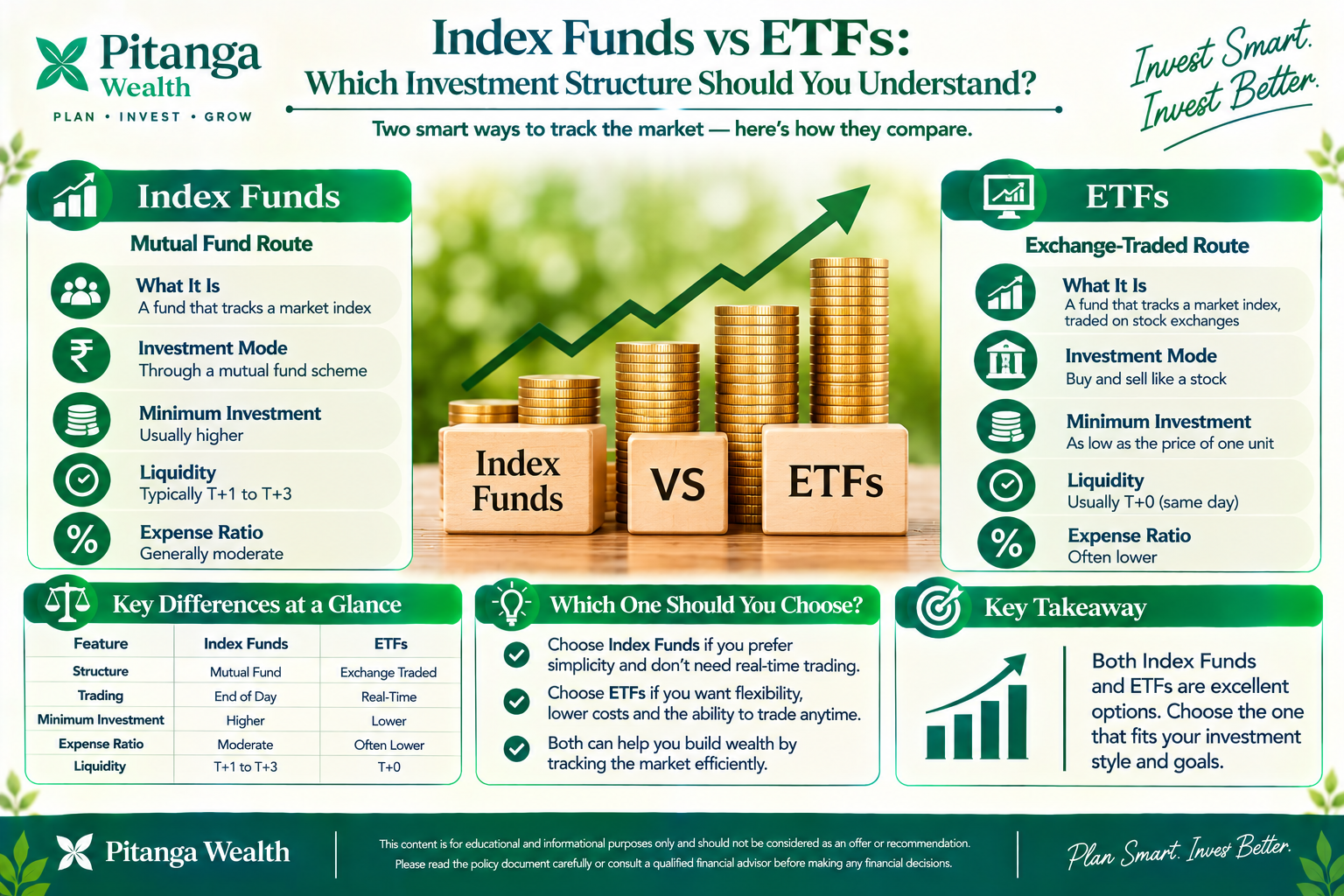
Two investors can follow the same Nifty 50 benchmark but experience noticeably different purchase and sale processes. One sets up a monthly investment through a mutual fund platform and receives units at an applicable net asset value (NAV). The other buys an exchange-traded fund through a broker, watches the order book, and receives an execution price during trading hours. Their market exposure can be broadly similar, yet the practical experience—and sometimes the realised cost—is different. Comparing index funds vs ETFs therefore starts with the investment structure, not with a promise that one will outperform the other.
Passive investing is often described as simple. It can be simpler than selecting individual shares, but investors must still understand what the benchmark contains, how a scheme tries to replicate it, where expenses arise, when units are priced, and how money is withdrawn. This guide examines the Indian investor’s choices using SEBI, AMFI, the Income Tax Department and exchange-related educational sources reviewed on 20 November 2026. It does not recommend a named scheme or promise a result.
Quick Answer: How Are Index Funds and ETFs Different?
An open-ended index mutual fund usually accepts purchases and redemptions directly through the fund or authorised platform at a NAV determined under applicable rules. An exchange-traded fund, or ETF, has units traded through a stock exchange, generally requiring a demat and trading account for ordinary retail deals. Both may track the same stock-market or bond index, but ETF investors face market execution prices, order-book liquidity and trading charges, while index fund investors follow NAV cut-offs and fund redemption arrangements. The right comparison also considers tracking difference, total costs, convenience and the risks of the underlying index. [1][2][3]
Start With the Benchmark, Not the Wrapper
An index tells the scheme what to follow
An index is a defined group of securities calculated according to an index provider’s methodology. A broad-market Indian equity index may include large companies from different sectors. A sector or thematic index can be concentrated in one industry; a debt index can include bonds with particular maturities or issuers. Two schemes called ‘passive’ are not necessarily substitutes if they track different indices. Review the actual benchmark name, constituent rules, rebalancing methodology and total-return version used by the scheme. [1][4]
An investor considering index funds vs ETFs should ask whether the underlying exposure is appropriate before debating the investment channel. A narrow technology index can move differently from a broad diversified index. Market-cap-weighted indices may become concentrated in companies whose market values have grown, while equal-weighted variants have different turnover and rebalancing patterns. A low-fee product tracking an unsuitable index is not improved by its cheapness.
Passive management still requires implementation
Passive schemes seek to mirror a benchmark rather than make broad discretionary bets about which securities will win. A manager must nevertheless handle investor flows, corporate actions, rebalancing, cash positions, transaction costs and settlements. Some schemes use full replication, while permitted approaches may include sampling or other techniques described in scheme documents. These operations create differences between benchmark returns and fund returns. [1][5]
Index rules also change over time. Companies enter or leave an index, weights change, and debt instruments mature or become ineligible. The investor should examine the benchmark methodology rather than treating an index name as a permanent basket. A product tracking an overseas or debt benchmark can add currency, credit, duration or other risks not present in a conventional Indian equity index fund.
What Is an Index Mutual Fund?
Units are created and redeemed through the mutual fund process
A conventional open-ended index mutual fund pools investors’ money and holds assets with the objective of tracking a specified index. Investors ordinarily purchase units through the asset management company (AMC), registrar and transfer agent (RTA), authorised platform or mutual fund distributor. Units are allotted at the applicable NAV, subject to receipt of transaction instructions and funds under the relevant rules. The same concept applies at redemption, although any applicable exit load and the redemption payment timetable must be checked. [1][6]
An index fund does not usually require a stockbroking account when units are held in non-demat mode. That is a practical benefit for someone who prefers a conventional mutual fund folio, consolidated account statement and direct debit mandate. A demat-mode holding may be available under the scheme and platform rules, but it is not the ordinary prerequisite for this fund route. This difference is central to index funds vs ETFs for a first-time investor using SIPs.
NAV is an accounting value, not a live trading quote
The NAV per unit broadly reflects the fund’s assets less liabilities divided by its outstanding units. Ordinary equity index fund purchases do not receive a guaranteed price at the moment the investor clicks the button. The applicable NAV follows the prescribed cut-off and receipt-of-funds rules; for most non-liquid schemes, the day’s NAV is determined after the relevant market valuations are available. A missed cut-off or delayed credit can affect the NAV date. [6][7]
Imagine an investor requests ₹5,000 of an index fund while the last published NAV is ₹25. The investor should not assume exactly 200 units will be allotted: the applicable NAV may differ when the instruction becomes valid. At an eventual illustrative NAV of ₹25.20, ₹5,000 corresponds to about 198.41 units before any applicable transaction adjustments. This illustration explains unit allotment; it is not a forecast or current NAV of any fund.
SIPs are a method of investing, not a return guarantee
A systematic investment plan (SIP) arranges periodic contributions under the scheme’s mandate and operational rules. Many index mutual funds support SIPs, making a monthly routine straightforward. Units purchased vary with the NAV at each valid instalment. Buying across different dates can spread entry points, but the investor can still suffer losses, especially when the underlying index falls or a goal requires withdrawal during a downturn. [8]
A SIP is not unique to index funds: brokers may offer recurring ETF order facilities, sometimes called stock SIPs or ETF SIPs. Such facilities can be operationally different from an AMC mutual fund SIP and may depend on trading hours, cash balance, available whole ETF units and order execution. The relevant scheme or broker terms are decisive.
What Is an Exchange-Traded Fund?
An ETF is a fund whose units trade like securities
An ETF pools assets according to its mandate but generally permits ordinary retail investors to buy and sell listed units on a stock exchange during market sessions. A matching buyer or seller, market maker or other available order-book liquidity is relevant to the actual execution. The investor usually needs both a trading account and a demat account. The fund still has an underlying NAV, but the exchange quotation can be above or below that value. [2][3]
An investor comparing index funds vs ETFs should not confuse the ETF ticker price with the level of the benchmark index. A Nifty-tracking ETF unit might trade around ₹250 while another ETF tracking the same benchmark trades around ₹25 because the unit denominations differ. Neither lower per-unit price nor lower NAV establishes that one scheme is cheaper, safer or more attractive; compare exposure, return percentages, costs and execution conditions.
Market price, NAV, indicative NAV and spread are different
The ETF’s NAV is the accounting valuation of its assets and liabilities. The last traded price is the price of a recent exchange deal. An indicative NAV (iNAV), when made available, gives a reference estimate during trading; it is not a guaranteed bid or offer. The bid–ask spread is the difference between the best displayed buying and selling quotations. Exchange execution also depends on depth and how many units are available at each price. [2][9]
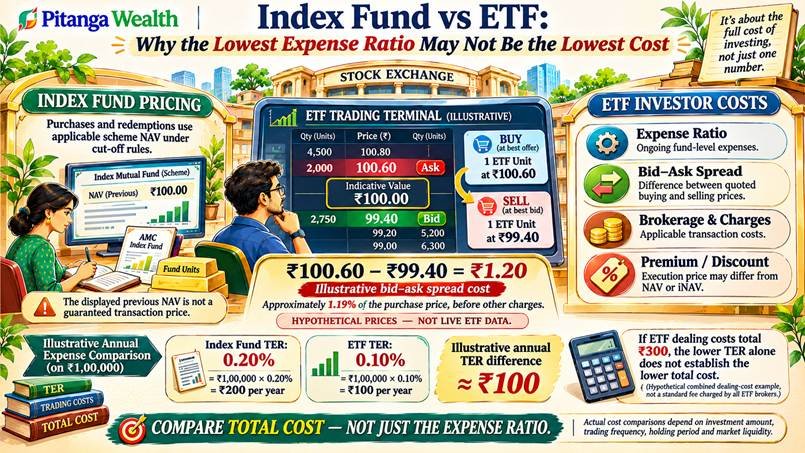
If an ETF’s indicative value is ₹100, a buyer might see a best offer of ₹100.60 while the best bid is ₹99.40. Buying one unit at the offer and immediately selling it at the bid, with no index movement, would produce an illustrative ₹1.20 loss—or roughly 1.19% of the purchase amount—before other fees. Those figures are hypothetical, not normal spreads in every ETF. They show why the apparent ongoing expense ratio alone is incomplete.
Exchange flexibility does not guarantee effortless liquidity
A listed ETF can allow an investor to place an intraday order or limit order. It does not promise instant execution at NAV, sufficient order-book depth or immediate transfer of sale proceeds into a bank account. A market order may execute across available prices when depth is thin; a limit order controls the worst permitted price but may not execute. Check trade volume, spread, fund size, market-maker activity, actual indicative values and settlement arrangements. [2][9]
ETF creation and redemption mechanisms involving authorised or large participants can help align trading prices with portfolio values. Ordinary retail investors should not assume they can redeem a handful of ETF units directly with the AMC at NAV. The applicable route and lot size are specified in the scheme documentation.
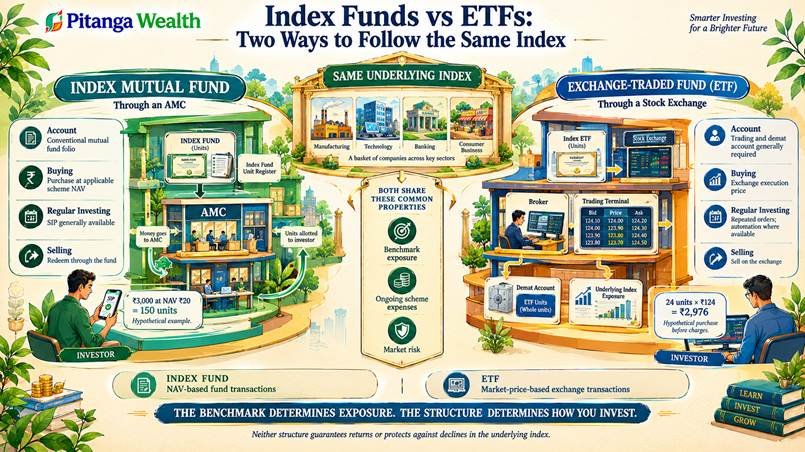
Index Funds vs ETFs: Side-by-Side Comparison
| Feature | Conventional open-ended index mutual fund | Exchange-traded fund (ETF) |
| Underlying strategy | Seeks to track its stated benchmark | Seeks to track its stated benchmark or permitted asset exposure |
| How units are bought | AMC, RTA or authorised mutual fund channel | Stock exchange through broker |
| Typical retail account | Folio; non-demat holding normally possible | Demat and trading account generally required |
| Execution price | Applicable scheme NAV under cut-off rules | Actual exchange execution price |
| Intraday trading | No ordinary exchange-style dealing | Possible during exchange sessions, subject to liquidity |
| Recurring investment | Conventional SIP typically available | Repeated orders; broker automation may be available |
| Unit quantity | Fractional units often allotted by invested amount | Exchange trades generally in whole units |
| Main direct frictions | Scheme expenses; applicable exit load and other charges | Scheme expenses; spread, brokerage, statutory and demat/trade costs |
| How money is withdrawn | Fund redemption and permitted payout process | Exchange sale, settlement and broker withdrawal process |
| Tracking | Benchmark return minus portfolio/operational differences | Benchmark return minus portfolio differences, plus investor execution price effects |
| Liquidity consideration | Fund’s redemption rules and portfolio liquidity | Order-book depth, traded volume and settlement |
| Common risk | Underlying index can fall materially | Underlying index can fall, with exchange-price and liquidity frictions too |
This table describes typical Indian retail arrangements rather than every permitted scheme or operational variation. The right index funds vs ETFs assessment compares instruments that actually track the same benchmark and share comparable investment objectives. A bond ETF, a gold ETF and an equity index fund may follow very different tax and risk rules. [1][2][3]
Two Paths Through the Same Benchmark
Path A: A ₹3,000 monthly index fund SIP
Consider a hypothetical investor choosing an open-ended index fund that tracks a broad Indian equity total-return index. They submit a ₹3,000 monthly SIP mandate, subject to the fund’s minimum instalment and bank debit rules. Each instalment buys units at the applicable NAV after the instruction and payment have met the cut-off requirements. If one month’s NAV is ₹20, ₹3,000 buys about 150 units; if a later month’s NAV is ₹25, the same contribution buys about 120 units. [7][8]
This is not evidence that a SIP creates a profit. The later NAV could subsequently decline to ₹15, and the full holding could fall below invested capital. The purpose of the example is to show how recurring amount-based contributions translate into variable units. An investor should review actual debit dates, instalment failure rules, exit loads and holding-period tax consequences for separate SIP instalments.
Path B: A recurring ETF purchase through a broker
A second investor wants approximately ₹3,000 of exposure to an ETF following the same index. Assume the illustrative best offer is ₹124 per unit, with adequate depth for the order. The investor could buy 24 whole units for ₹2,976 before charges, leaving approximately ₹24 uninvested. If the offer instead moves to ₹128, the same 24 units cost ₹3,072; the investor may need to buy fewer units or provide more funds. This is the basic operational difference from amount-based mutual fund allotment.
The ETF buyer can specify a limit but cannot force a seller to accept it. Repeated smaller trades may incur platform costs and spreads, while larger less frequent trades have different timing and exposure trade-offs. When considering index funds vs ETFs for monthly investing, evaluate these recurring frictions using the actual broker schedule rather than assuming every automated ETF purchase is free or immediate.
Cost Comparison: TER Is Only the Beginning
Expense ratio affects both structures
A mutual fund’s total expense ratio (TER) reflects specified ongoing expenses charged at the scheme level and incorporated into NAV performance. Both index funds and ETFs can have low TER relative to many actively managed products, but the specific TER varies by scheme and plan. Compare the direct plan of an index fund with the appropriate ETF expense disclosure, rather than mixing direct and regular fund plans without noting distribution costs. [3][10]
Expenses matter more as holding periods lengthen, but they are not the only cost. A fund can have a low TER and higher tracking difference because of other operational factors. An ETF investor may encounter dealing costs that a traditional index mutual fund investor does not face in the same way. Neither structure is invariably cheaper for all amounts or investor behaviours.
An illustrative ₹1 lakh cost comparison
Suppose two hypothetical schemes track the same index. The index fund’s TER is 0.20% a year and the ETF’s TER is 0.10% a year. On an unchanged ₹1,00,000 asset value, the annualised difference of 0.10 percentage point equates to roughly ₹100 before investment growth, changes in assets and compounding. This is an explanatory approximation, not a bill or a prediction of annual performance.
Now suppose the investor using the ETF also faces an illustrative combined entry-and-exit spread and dealing cost of ₹300 during a short holding period. The nominal ₹100 TER advantage in the simplified example may be outweighed by that dealing cost. Alternatively, with a larger investment and very tight spreads, the ETF may cost less. The correct comparison is over a specified investment size, trading frequency, horizon and actual charge schedule.
Check the complete transaction chain
For index mutual funds, verify direct or regular plan, TER, exit load if any, transaction timing and the method used to remit and redeem money. For ETFs, inspect TER, brokerage, statutory levies, bid–ask spread, premium or discount to NAV, demat charges, order type and settlement process. Fund disclosures and the broker’s actual contract note—not a promotional ‘zero commission’ slogan—determine what the investor bears.
Some statutory costs apply to both types of investments through different mechanisms. Taxes on gains are separate from purchase and selling frictions. When comparing index funds vs ETFs, do not add an expense ratio twice or present a percentage TER as a separate invoice paid outside NAV unless the actual arrangement says so.
Tracking Error, Tracking Difference and the Right Benchmark
Tracking difference answers a practical return question
Tracking difference compares the fund’s realised return with its benchmark over a specified period. Suppose a total-return benchmark gains a hypothetical 12.0% over a year and a comparable passive scheme records 11.6%. The fund’s tracking difference for that period is minus 0.4 percentage point. The difference can reflect expenses, cash drag, portfolio construction, corporate actions and trading friction. These figures are illustrative, not the return of a named product. [5]
A total-return index (TRI) generally incorporates dividends or other income according to its published methodology. Comparing an equity scheme with a price-only index may exaggerate or distort the performance gap. Check the exact scheme benchmark and period. Two funds tracking the same headline index can report different outcomes because of when their returns and benchmark data are measured.
Tracking error addresses consistency, not certainty
Tracking error is commonly measured as the variability—often annualised standard deviation—of differences between portfolio returns and benchmark returns. A fund might have a fairly consistent negative tracking difference due to costs yet relatively low tracking error; another might have erratic deviations that average out over one year. Compare both metrics over comparable time periods and ensure the methodology is stated. [5]
Neither low tracking error nor a low TER removes the index’s own market risk. An index can drop sharply, and a perfectly tracking fund would broadly participate in that decline. Tracking performance is about following an index, not avoiding losses or guaranteeing outperformance.
ETF execution adds another layer beyond fund tracking
Even if an ETF’s NAV tracks the benchmark closely, the individual investor’s result also depends on where they buy and sell relative to NAV. A premium at purchase and discount at sale can reduce realised returns. Conversely, a favourable trading price may improve them. That is why index funds vs ETFs should include both scheme-level tracking statistics and transaction-level records for the ETF buyer.
A meaningful comparison needs the same underlying index, same currency, similar measurement dates, comparable tax category and a consistent treatment of dividends. Disclosing the ETF’s exchange price without comparing it with the appropriate NAV or iNAV can mislead readers into treating a temporary spread as evidence of manager skill.
Liquidity, Market Hours and Exit Experience
Index fund redemptions follow an AMC timetable
An eligible open-ended index fund redemption is submitted through an authorised mutual fund channel. The applicable NAV follows the scheme’s rules, and money is paid on the prescribed redemption schedule. Portfolio liquidity, exceptional market circumstances, holidays and fund-specific provisions affect the operational outcome. A redemption request is not an instantaneous bank-account transfer at the value shown on a phone screen earlier that day. [6][7]
An ETF sale is a trade, then a settlement and withdrawal
An ETF sell order requires execution at an available exchange price. The resulting sale is settled under the relevant clearing arrangements, after which the broker’s funds-availability and bank-withdrawal processes apply. A successful sale is not the same thing as immediate cash in the investor’s bank. The investor who needs money on a fixed date should allow for market hours, holidays, price risk and these processing steps.
During market stress, a particular ETF can show wider bid–ask spreads or lower order-book depth even if its underlying index remains widely followed. An index fund’s redemption mechanisms avoid the retail order book but do not eliminate the possibility of temporary operational restrictions under the scheme’s rules. Neither route is a substitute for a readily accessible emergency cash reserve.
How the 2026 SEBI Framework Fits In
SEBI’s February 26, 2026 circular on categorisation and rationalisation of mutual fund schemes identifies passive schemes, including index funds and ETFs, within the applicable mutual fund framework. SEBI also notified revised Mutual Funds Regulations in 2026. These rules affect how schemes are structured and disclosed, but do not convert every passive scheme into an equity investment or guarantee that all passive products have identical investment objectives. [11][12]
The practical publishing lesson is to verify a scheme’s current SID, KIM, factsheet, riskometer, benchmark and expense disclosures rather than relying on a generic online description written before a regulatory change. ETF investors should additionally check the actual exchange ticker and ISIN, current quotes, indicative NAV availability and the broker’s trade documentation.
Taxation in India: Same Asset Exposure Can Still Need Verification
Equity-oriented products: understand the qualification
For a conventional domestic equity-oriented index mutual fund and a qualifying domestic equity ETF, capital-gains treatment may broadly align when applicable conditions, including Securities Transaction Tax (STT) requirements, are met. Under the post-July 2024 regime, qualifying short-term gains covered by section 111A generally attract a 20% base rate and eligible long-term gains covered by section 112A generally attract a 12.5% base rate on aggregate gains exceeding ₹1,25,000 in the relevant year, before applicable surcharge and cess. The common equity long-term holding threshold is more than 12 months. [13][14]
Those rules depend on the tax classification of the fund, transaction, tax year, investor residency and statutory conditions. Separate SIP instalments can have separate acquisition dates. A product with a name resembling a stock-market index is not automatically eligible for every concession. The ₹1,25,000 threshold applies in the context of qualifying aggregate section 112A gains, not as a per-fund annual allowance.
Debt, gold and overseas index products are not all taxed alike
An ETF may track a bond index, gold, a foreign index or a specialised benchmark. The tax treatment of those units can differ materially from an equity-oriented Indian index mutual fund, and newer rules for specified mutual funds must be considered where relevant. Do not write that all ETFs attract 20% short-term and 12.5% long-term rates, or that all ETF units qualify for the same holding period. [13][14]
For readers comparing index funds vs ETFs across non-equity categories, identify the particular scheme and actual holding structure first, then check current tax guidance. Transaction costs such as STT, relevant stamp duty, brokerage and demat costs are separate from tax on realised gains. Personal situations involving non-residents, inherited units or older purchases may require professional tax advice.
Which Structure Might Fit Which Investor Preference?
Profile 1: A first-time monthly investor without demat
Someone who wants a predictable contribution routine and is comfortable with end-of-day NAV processing may find an open-ended index mutual fund operationally straightforward. A conventional SIP, direct plan choice and fund statement can reduce trading-related decisions. The person still needs an appropriate benchmark, adequate time horizon and tolerance for market declines.
Profile 2: An experienced exchange investor
Someone already operating a demat and trading account may prefer the flexibility of an ETF order and the ability to choose a limit price. That flexibility is meaningful only if they understand market depth, spreads, orders and settlement. A broker interface does not automatically make the investment suitable, and a low-priced unit is not a bargain by itself.
Profile 3: A person making small frequent contributions
For modest recurring amounts, the ease of amount-based unit allotment may matter more than a small advertised TER difference. Whole-unit ETF purchases, repeated spreads and the specific broker’s charges should be calculated. Some recurring ETF facilities are convenient, but their order and cash-management rules should be reviewed before relying on them.
Profile 4: An investor dealing in large, infrequent orders
A sizeable investor with an established brokerage account may find a liquid ETF attractive if the order book is deep and trading costs are competitive. However, placing a large market order without checking depth can create avoidable slippage. A direct index mutual fund may still be operationally simpler for investors who prefer NAV execution, and neither route is universally best.
Profile 5: A saver with a near-term obligation
If the money is needed for a school fee or house deposit in a few months, a volatile equity index product may not fit the required certainty—regardless of whether it is an ETF or index fund. The asset allocation decision precedes wrapper selection. Do not interpret passive investing as capital protection or as a fixed-income substitute.
Profile 6: A long-horizon portfolio investor
A long-term investor may find either wrapper usable if the index fits their financial plan, the costs and tracking are acceptable, and withdrawals can be managed. If the portfolio also holds active equity funds, sector funds or direct stocks, assess overlap and concentration. Holding two passive products tracking the same benchmark does not necessarily create meaningful additional diversification.
In each scenario, the comparison of index funds vs ETFs turns on a combination of benchmark fit, trading behaviour, fund records and total cost. A conclusion about one investor’s circumstances must not become a universal ranking for others.
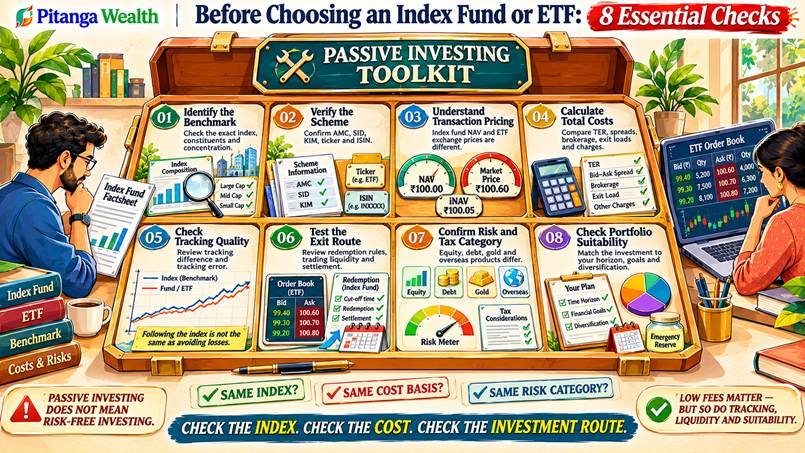
Eight Checks Before Choosing an Index Fund or ETF
1. Identify the exact benchmark. Confirm whether the product follows a broad index, sector, factor, bond, gold or overseas benchmark. Read the actual index rules and current constituents.
2. Check the scheme and legal identity. Verify AMC, scheme, SID, KIM and, for an ETF, the correct exchange symbol and ISIN. Avoid similarly named products or unverified trading links.
3. Understand how the transaction is priced. An index fund uses applicable NAV; an ETF purchase or sale uses an execution price that can differ from NAV and iNAV.
4. Compare the full costs. Review direct-plan TER, ETF TER, exit load if applicable, bid–ask spread, brokerage, levies and relevant demat or platform costs.
5. Inspect tracking difference and tracking error. Use the same benchmark, consistent data periods and correct TRI; compare both cost drag and reliability of tracking.
6. Test the exit route. Understand fund redemption and payout rules or ETF order-book depth, settlement and bank withdrawal processes.
7. Confirm the risk and tax category. Equity, debt, gold and overseas products differ. Check riskometer, asset allocation, expected holding period and applicable tax treatment.
8. Fit the product into a wider plan. Ensure the time horizon, emergency reserve, diversification and loss tolerance make sense. Do not buy merely because the scheme is labelled passive.
These checks make the comparison of index funds vs ETFs more reliable than a one-line advertisement about cheap fees or easy trading. No due-diligence checklist removes market risk, guarantees liquidity or promises positive returns.
Common Misconceptions About Passive Investing
“An ETF always costs less than an index fund”
Not necessarily. An ETF’s published TER may be lower, but the investor’s actual purchase and sale costs can include spreads, brokerage and other charges. The outcome depends on trade size, frequency and holding period. Compare the actual schemes and available dealing prices rather than a headline percentage.
“Index funds cannot lose money because they diversify”
Diversification across an index may reduce exposure to a single company relative to direct ownership, but broad market losses, concentrated factor strategies, sector downturns and valuation risk remain. A perfectly tracking index fund can lose substantial value when its benchmark falls.
“ETF market price and NAV are always identical”
They can differ. Market makers and creation/redemption arrangements can improve alignment but do not eliminate bid–ask spreads, thin trading sessions or temporary premiums and discounts. Investor execution prices are real and matter.
“An index fund SIP always beats an ETF lump-sum investment”
A SIP and a lump-sum order differ in contribution timing. Neither method guarantees superior performance. Comparing different cash-flow timings without adjusting for amounts and dates can produce misleading annual return claims. Assess contribution discipline and the investor’s real goal instead.
“The same index means the same after-cost return”
Schemes tracking the same benchmark can differ in expense ratios, cash positions, rebalancing execution, tracking difference and dealing arrangements. Fund returns calculated at NAV and an ETF holder’s realised trade returns also need not match. Study current factsheets rather than assuming identical outcomes.
Frequently Asked Questions
1. What is the main difference between an index fund and an ETF in India?
An index mutual fund typically offers NAV-based purchases and redemptions through an AMC or authorised platform. An ETF trades on a stock exchange, generally through a demat and trading account. Both can track the same index, but their dealing costs and transaction processes differ. [1][2]
2. Do I need a demat account to invest in an index mutual fund?
Normally not for conventional non-demat units purchased through authorised mutual fund channels. An exchange-traded ETF generally requires a demat and trading account for ordinary retail purchases and sales. Check the actual scheme and platform arrangements. [3]
3. Can I start a SIP in an index fund?
Many index mutual funds accept SIPs, subject to scheme minimums, mandates and cut-off rules. Some brokers offer recurring ETF purchase facilities, but they may differ in execution, whole-unit purchases and charges. SIPs do not guarantee a profit. [8]
4. Can I buy and sell ETFs during the trading day?
Typically yes during relevant exchange sessions if buyers, sellers and sufficient orders are available. Execution is at available market prices, not automatically at the fund’s NAV. A limit order may control price but is not guaranteed to execute. [2]
5. Is an ETF always cheaper than an index fund?
No. Compare TER as well as the ETF bid–ask spread, brokerage, demat or statutory charges, number of trades and holding period. A lower TER may be offset by dealing costs for some investors; another investor may experience the opposite.
6. What is tracking error in a passive fund?
Tracking error describes the variability of the fund’s return differences versus its benchmark over a period. Tracking difference describes the actual return gap over a stated period. Low tracking error does not mean the index cannot decline. [5]
7. What does NAV mean for an index mutual fund?
Net asset value represents the scheme’s assets less liabilities per outstanding unit. Ordinary open-ended fund purchases receive an applicable NAV according to relevant cut-off and payment rules, rather than an intraday stock exchange quote. [6][7]
8. What is iNAV for an ETF?
Indicative NAV is an intraday reference estimate where provided, intended to help assess market prices relative to underlying portfolio value. It is not an offer to buy or sell units at exactly that figure. Check the timing and methodology of its publication. [9]
9. Why can an ETF trade above its NAV?
Orders, market depth, timing and pricing of the underlying assets can produce premiums or discounts to NAV or iNAV. Arbitrage and market making can help, but investors should still examine the bid–ask spread before ordering. [2][9]
10. Are index funds and ETFs risk-free?
No. Both may lose capital when the underlying index falls. An ETF can also involve execution-related pricing and liquidity frictions. An index tracking bonds, overseas equities or commodities introduces asset-specific risks beyond the broad label ‘passive’.
11. Are equity index funds and equity ETFs taxed differently?
Qualifying domestic equity-oriented index funds and ETFs may generally fall under the same relevant capital-gains provisions where statutory conditions are satisfied. Classification, STT, holding period, dates and investor circumstances matter. Do not extend equity rates automatically to all ETFs. [13][14]
12. Is the Nifty 50 the only index passive funds can track?
No. Indian passive schemes can follow different broad-market, sector, thematic, factor, debt and other eligible benchmarks according to their scheme documents. Check index methodology, concentration and risk instead of relying on a familiar label alone. [1][11]
13. Which is better for a beginner who invests ₹2,000 monthly?
There is no universal answer. A conventional index fund SIP may be operationally simpler without demat, while an ETF may suit someone comfortable with exchange orders. Compare the index, costs, unit size, trading access, suitability and time horizon before choosing.
14. How do I compare index funds vs ETFs fairly?
Use products tracking the same exact index, compare consistent TRI-based periods, scheme expenses, tracking statistics, purchase and sale prices, dealing charges, account requirements, liquidity, taxes and personal cash-flow needs. A low ETF TER or high past return alone is not enough.
Conclusion: Choose the Benchmark First, Then the Investing Route
The index explains what the fund is trying to own; the structure determines how the investor deals in its units. An index mutual fund provides a NAV-based subscription and redemption experience and can support conventional SIPs without a normal brokerage account. An ETF allows exchange trading and limit-price control, but the investor must manage whole units, spreads, market depth and settlement. Both remain exposed to the underlying benchmark’s risk.
For a disciplined comparison of these investment structures, assess benchmark suitability, full costs, tracking statistics and withdrawal needs together. Avoid treating low costs as evidence of safety, a SIP as an assurance of profit, or an ETF quote as identical to NAV. Official scheme and exchange information should guide any actual transaction, with qualified individual advice where necessary.
Disclaimer
This article provides general financial and investor education from Pitanga Wealth, not personalised securities, investment, tax, legal or trading advice. It does not recommend a fund, exchange ticker, benchmark allocation or purchase timing. All numbers and investor profiles are hypothetical, not live market quotations or return forecasts. Public information was reviewed on 20 November 2026; rules, classification, taxes and scheme terms can change. Mutual funds and ETFs are subject to market risks, and past performance does not guarantee future results. Verify actual SID, KIM, current factsheet and applicable statutory requirements before any transaction.
Written by Pitanga Wealth Team.
Follow us on Instagram @pitangawealth for more educational insights.
This article is for educational and informational purposes only. It is not investment, tax, legal or insurance advice. Consider your circumstances and relevant documents before making a financial decision.