

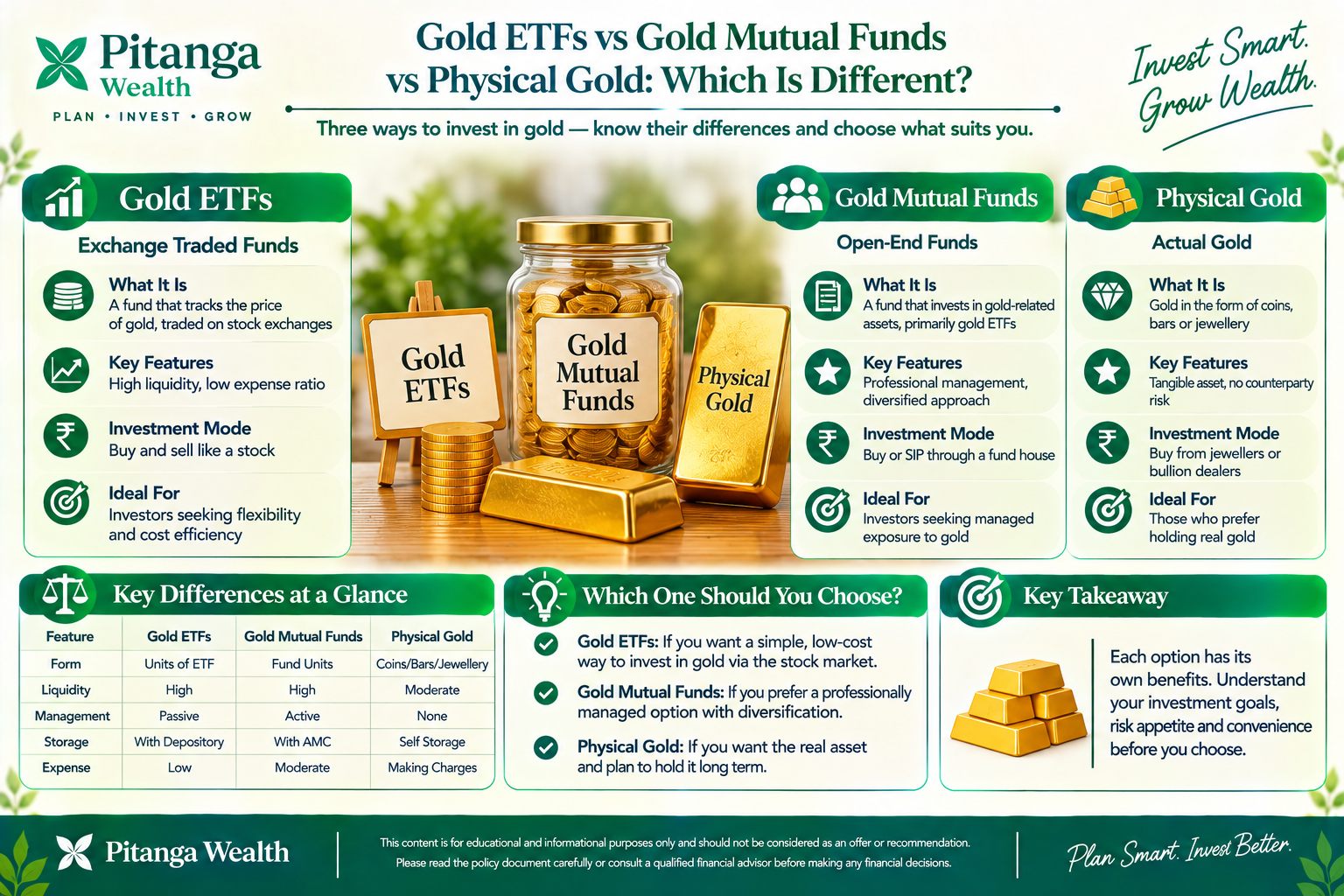
A family buying gold jewellery for a wedding, an investor purchasing exchange-traded gold units, and a salaried person starting a monthly investment in a gold fund may all say they are “investing in gold.” Yet they are not buying the same thing. One person owns a tangible article with craftsmanship and resale conditions; another holds exchange-traded mutual fund units; the third holds units in a mutual fund that may itself own a gold ETF. All three can be affected by gold prices, but their charges, access routes, records, and exit procedures differ.
Comparing exchange-traded and fund-of-funds gold exposure is useful, but a complete comparison also needs physical gold. The purpose is not to declare one route universally superior. It is to understand what is actually owned, how prices are determined, where costs arise, what happens when an investor wants money back, and whether the method suits the stated purpose. This educational guide explains the Indian context using SEBI, AMFI, BIS, CBIC and Income Tax Department information reviewed on 19 November 2026. No gold price, investment return, tax outcome or suitability is guaranteed.
Quick Answer: How Are These Three Ways of Holding Gold Different?
A gold exchange-traded fund (gold ETF) is a mutual fund whose units trade on a stock exchange and aim to reflect domestic gold-price movements, subject to expenses and tracking differences. A gold mutual fund, commonly a gold fund of funds (FoF), typically invests in gold ETFs and can usually be bought or redeemed through the mutual-fund route using applicable NAV-based processing. Physical gold means jewellery, coins or bars held by the buyer, with purity, billing, storage and resale considerations. The right comparison covers the entire journey from purchase to sale—not the gold-price chart alone. [1][2][3]
Start With Ownership: What Do You Actually Hold?
Gold ETF units are securities, not jewellery in a locker
An investor buying a gold ETF through a broker receives exchange-traded units in demat form. The scheme invests according to its offer documents, including eligible physical gold and gold-related investments subject to regulations. The investor owns fund units, rather than specific jewellery or an individual bar allocated in their own name. The investment objective generally concerns tracking the domestic price of gold, with tracking error or difference possible. [1][4]
Holding an ETF therefore removes the practical need for the individual investor to test, insure or store the gold backing the scheme. It does not remove mutual fund expenses, operational risks, market-price movements or the difference between the exchange trading price and the published net asset value (NAV). Those distinctions matter particularly when markets move sharply or a particular ETF has limited trading activity.
Gold mutual fund units generally provide indirect gold exposure
A gold fund of funds is a mutual fund scheme that generally invests predominantly in units of one or more gold ETFs as described in its Scheme Information Document (SID). The investor holds units of the FoF, which in turn holds ETF units. A gold FoF should not be described as a claim that the investor can collect gold jewellery from a branch. Fund selection, cash balances and tracking of the underlying scheme should be checked in the current portfolio and SID. [2][5]
In a gold ETFs vs gold mutual funds comparison, the key structural difference is the wrapper. The ETF itself trades on an exchange. A conventional open-ended FoF normally accepts direct mutual fund purchase and redemption requests, typically without requiring the investor to open a trading or demat account. This can suit investors who want standard fund statements or a scheduled SIP, but the extra investment layer can affect total costs and tracking.
Physical gold is a real object with physical-world frictions
Physical gold may mean an ornament intended for use, an investment coin or a bar. It is bought and later sold, exchanged or pledged under the relevant merchant’s terms. Its eventual value can depend on purity, weight, prevailing buyback rate, deductions, condition, documentation and any recoverable charges. Jewellery combines gold content with design and manufacture; it should not be treated as economically identical to a plain bullion bar.
A physical purchase also brings questions not found in an ETF statement: where the article will be kept, whether it is insured, whether a locker fee applies, who can authenticate it, how the dealer will value it on resale, and whether a loss or theft would be covered. Some people value the ability to wear or gift gold; that benefit cannot be captured by comparing annual returns alone.
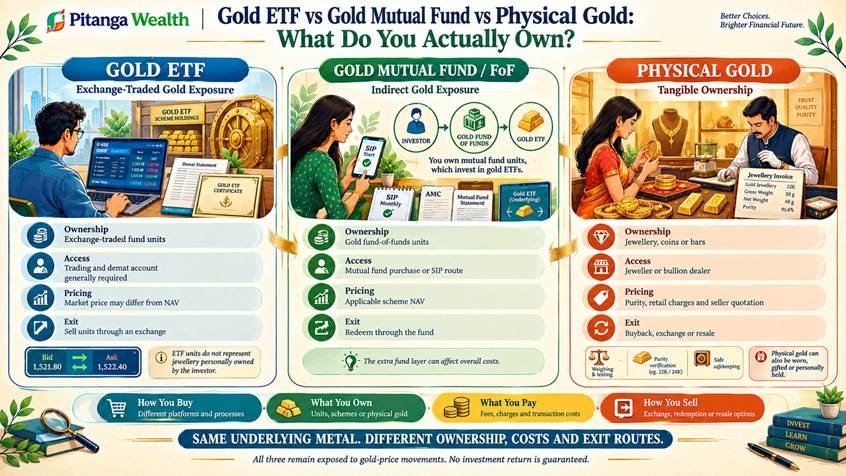
Gold ETFs vs Gold Mutual Funds vs Physical Gold: Side-by-Side Comparison
| Feature | Gold ETF | Gold mutual fund / FoF | Physical gold |
| What investor holds | Exchange-traded mutual fund units | Open-ended FoF units, usually invested in gold ETF(s) | Jewellery, coin or bar |
| How bought | Broker/exchange during trading hours | AMC, RTA or authorised distribution platform | Jeweller, bullion dealer or other seller |
| Demat/trading account | Generally needed for normal exchange purchase | Usually not required for non-demat units | Not required |
| Pricing | Market price may differ from NAV | Applicable scheme NAV under cut-off rules | Retail quote, purity and seller’s terms |
| Regular investing | Manual repeated buys or broker-based facility where offered | SIP commonly available subject to scheme terms | Repeated merchant purchases |
| Main recurring costs | Scheme expenses; brokerage and demat/trade charges as applicable | FoF expenses plus economic effect of underlying ETF costs | Storage, locker/insurance where used |
| Purchase frictions | Bid–ask spread; possible premium/discount | Applicable loads and NAV allotment timing | GST, retail premium, making/wastage charges as applicable |
| Selling | Exchange sale, subject to market depth and settlement | Redemption at applicable NAV with payout timeline | Buyback, exchange or sale to buyer |
| Storage and purity | Managed through fund framework | Indirect through underlying ETF(s) | Buyer verifies purity and arranges safekeeping |
| Physical use | No normal retail jewellery use | No normal retail jewellery use | Can be worn, gifted or physically held |
| Price risk | Gold-price and tracking risk | Gold-price, underlying fund and FoF-layer risk | Gold price plus resale/purity terms |
The table is a practical comparison, not a statement that every scheme or dealer has identical fees. Product documents, exchange data and seller invoices determine actual costs. Comparing gold ETFs vs gold mutual funds should include physical gold’s genuine non-investment uses, rather than dismissing them as financially irrational. [1][2][3]
How Gold ETFs Work in India
The scheme aims to follow gold prices but will not match them perfectly
A gold ETF pools investor money and uses its assets according to the scheme’s approved investment objective. Its NAV reflects valuation of the portfolio after applicable expenses and liabilities. The exchange price of an ETF unit changes with available buyers and sellers, not by continuously guaranteeing execution at the latest NAV. A low quoted expense ratio is relevant, but it is not the only source of difference from underlying gold performance. [1][4]
SEBI’s revised mutual fund framework in 2026 provides for valuation of physical gold held by mutual fund schemes using polled spot prices from recognised domestic stock exchanges that are used to settle physically delivered gold derivatives, with effect from 1 April 2026. This is a valuation methodology; it does not create a fixed price, eliminate tracking error or promise that an ETF will always trade precisely at its NAV. [4]
NAV, exchange price, iNAV and trading spread are different concepts
NAV is an accounting value per fund unit determined under scheme valuation rules. The exchange’s last traded price is what a market participant recently paid. The indicative NAV, where displayed and calculated under relevant rules, may help explain intraday indicative underlying value, but it is not a guaranteed dealing quotation. The bid–ask spread is the gap between the best available buying and selling prices in the order book.
Consider a hypothetical gold ETF with published or indicative value near ₹100 per unit. If an investor buys at ₹101 and later sells at ₹99 while the gold reference value has barely changed, the trade may have lost value because of execution price differences and costs. This is a stylised example, not a live market quote. It illustrates why comparing gold ETFs vs gold mutual funds on annual expense ratio alone can miss an important transaction friction.
Liquidity cannot be assumed from the word ‘exchange-traded’
Some widely held ETFs have active orders and relatively small spreads; another issue or trading period may have fewer buyers. Before buying, an investor can look at traded volume, depth of bids and offers, spread, observed premium or discount to NAV or iNAV, fund size, tracking difference and the ETF’s current scheme disclosures. Market makers and creation/redemption mechanisms can help price alignment but do not promise frictionless execution for every retail order.
When placing an order, a limit order can give more control over the maximum purchase or minimum sale price than an unrestricted market order, though the limit may not execute. Verify the instrument ticker and ISIN; similarly named products may have different objectives. Do not place a trade merely because a social-media screenshot shows an attractive percentage return.
How Gold Mutual Funds and Gold Funds of Funds Work
A fund-of-funds adds a layer between the investor and the ETF
A typical gold FoF invests in the units of an underlying gold ETF. When the underlying ETF moves with domestic gold prices, the FoF’s NAV broadly follows that exposure after its own cash positions, costs and portfolio mechanics. Its NAV will not necessarily equal the gold ETF’s market price at every moment. Read the SID to confirm the scheme’s exact objective and whether it invests in one or several ETFs. [2][5]
A common mistake in gold ETFs vs gold mutual funds comparisons is to assume that the FoF is managed like an equity fund selecting individual companies. The fund’s gold allocation is generally achieved through ETF units, not through stock selection. Conversely, the investor must not assume the FoF directly holds a personal allocation of bullion. The underlying ETF and the outer FoF are two separate investment layers.
SIP convenience is real, but it does not make returns predictable
Many gold FoFs accept systematic investment plans, subject to minimum amounts and AMC procedures. A SIP spreads the timing of purchases and may help investors maintain a routine, but it does not guarantee a positive return, remove the risk of buying at high prices or assure that the average purchase price will be lower than a one-time investment. Fund cut-off, bank mandate, business-day and NAV applicability rules determine individual allotments. [2]
An investor can also buy gold ETF units repeatedly using a broker or an automated facility where genuinely offered. Therefore ‘SIP available’ is a convenience distinction rather than proof that one product has superior economic returns. Compare the investment mechanism that is genuinely available and usable for that investor, including trading access and order fees.
Look through to both fund layers when checking expenses
A FoF has its own scheme expenses, and its underlying ETF also incurs expenses reflected in the ETF’s NAV. The combination can be more expensive than directly holding an ETF, although the disclosed outer and underlying expense treatments must be evaluated using current regulation and scheme documentation rather than simply adding two advertised percentages without qualification. The exact overall economic cost varies by scheme, plan and timing.
For example, an underlying ETF might have an illustrative annual expense ratio of 0.45% and a FoF layer might add costs under its permitted structure. Those invented numbers are not a quotation or a statement that a particular investor pays a fixed 0.45% bill. In all cases, the expense ratio is typically reflected in NAV over time, not collected as a separately issued invoice to each holder. Exit loads, if applicable, must be read separately.
Physical Gold in India: Jewellery, Coins and Bars Are Not Equivalent
Jewellery has value as an object, but resale proceeds may differ
Jewellery may be bought for personal use, ceremonies or gifts. A design can be meaningful for the owner even if it does not command the same premium on resale. Retail invoices may include making charges, wastage-related pricing, stones, taxes and other components. A future jeweller may pay based on assessed gold purity and weight, not the complete original invoice. A buyback or exchange promise should be checked in writing, including deductions and whether cash payment is available.
If the purpose is simply economic exposure to gold prices, compare the expected premium, taxes and buyback spread on an item to the ongoing and transaction costs of a fund. If the purpose is wearing a specific ornament, an ETF cannot fulfil it. A good comparison begins with the objective rather than pretending every form of gold serves the same function.
Gold coin and bar purchases require proof of purity and terms
A coin or bar may avoid jewellery-style design charges, but it can still carry a retail premium over benchmark metal value, a purchase tax, a dealer spread and storage costs. Buyback eligibility, invoice, packaging, hallmark or refinery certification, weight and purity must be assessed. A premium paid on purchase is not automatically recoverable when the item is resold.
BIS guidance distinguishes the mandatory hallmarking framework for jewellery or artefacts from gold bullion and coins. It explains that approved refinery/mint rules apply to eligible hallmarking of bullion and coins, and that consumers should verify relevant product authenticity rather than assuming a coin has the same hallmark status as jewellery. [3]
HUID verification is useful, but it is not a return guarantee
BIS’s hallmark system includes the BIS mark, purity or fineness, and a six-character HUID for applicable hallmarked gold jewellery. Consumers can use the official BIS Care application to verify the HUID. Jewellery consumers should request a clear invoice showing details such as purity, weight and applicable charges, and should check the current BIS rules for the category and seller. [3]
Hallmarking relates to the tested purity or identity of an article. It does not guarantee future market value, a particular merchant’s repurchase policy, freedom from theft, or zero loss upon exchange. For physical gold, practical due diligence must include both authenticity and how the owner would actually sell or use the item.
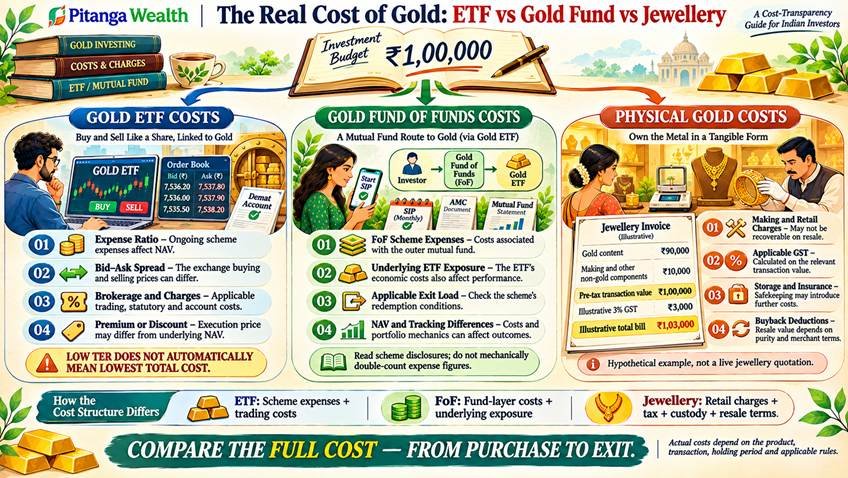
Cost Comparison: Where Does the Money Go?
ETF costs are not limited to the TER
For an ETF purchase, the investor should assess the scheme’s total expense ratio (TER), any brokerage, applicable statutory charges, demat or platform charges, and the bid–ask spread. There may also be a premium or discount to underlying portfolio value. TER affects performance through daily NAV calculations; it is not a per-trade brokerage charge. Trading frequently can magnify spread and brokerage frictions even when the scheme itself has low annual costs. [1]
FoF costs include NAV-based fund expenses and possible exit loads
A gold FoF may offer convenient investments and redemptions, but the investor should read the SID and factsheet for scheme expense ratio, direct and regular plans where available, underlying ETF exposure, tracking difference, riskometer, cut-off procedures and exit loads. A regular plan may involve distributor remuneration reflected in the scheme’s expense structure; check the actual document and platform disclosures rather than assuming ‘no upfront fee’ means no ongoing cost.
When evaluating gold ETFs vs gold mutual funds, determine the total cost over a plausible holding period. A small transaction made once and a larger portfolio held for years do not produce the same relative cost ranking. No universal ‘cheapest’ conclusion is reliable without size, dealing frequency, spreads, scheme expenses and account charges.
Physical gold adds retail transaction and safekeeping costs
For jewellery purchases, the CBIC’s GST sectoral FAQ states that GST is payable at 3% on the total transaction value of jewellery, whether making charges are shown separately or not, under the cited treatment. The treatment for a genuinely separate job-work service or a different type of transaction must be distinguished; avoid automatically charging an extra 5% tax on making charges in the same retail jewellery sale. Verify the current invoice and applicable law. [6]
Retail physical gold also has possible premiums, making charges, safe custody costs, insurance, and a gap between the dealer’s selling and buying prices. An ETF investor does not buy a jewellery item and does not simply pay the same retail jewellery GST at the ETF-unit purchase counter. But fund structures have their own market and operational costs. These are different transaction chains, not interchangeable charges.
A Worked ₹1,00,000 Comparison: Why Costs Matter
Suppose three investors each start with a ₹1,00,000 budget and want exposure to gold. Do not assume they acquire an identical weight of gold or receive identical proceeds. This example intentionally uses hypothetical costs to explain the structure, not forecast returns or recommend a product.
| Route | Illustrative starting issue | What to check later |
| Gold ETF | A portion of the budget meets exchange spread, brokerage or other charges; units remain exposed to ongoing TER | Sale execution price versus NAV, settlement and tax |
| Gold FoF | Units allotted at applicable NAV; ongoing fund costs and possibly exit load affect proceeds | Redemption NAV, underlying ETF exposure and payout time |
| Jewellery | Invoice may include gold value, making charges, stones or tax; therefore ₹1,00,000 is not necessarily ₹1,00,000 of saleable metal | Purity, deductions, resale quote and physical handling |
Imagine a hypothetical jeweller’s article with a pre-tax bill of ₹1,00,000 comprising ₹90,000 attributable to gold content and ₹10,000 attributable to making and other non-gold components, excluding stones for simplicity. Under the 3% illustrated GST treatment of the total value, the tax would be ₹3,000 and the total bill ₹1,03,000. If the shopper’s entire spending limit is ₹1,00,000, the mix must instead be scaled down. The ₹10,000 making component cannot automatically be treated as recoverable metal value. Actual invoices vary, and a resale value is not calculated here. [6]
By contrast, a gold ETF or FoF records ownership in fund units. A mutual fund investment amount is not identical to a net gold weight held personally, and NAV growth does not represent a promise of sale proceeds. This is why a fair gold ETFs vs gold mutual funds analysis uses an after-cost comparison over the intended holding period instead of comparing jewellery bills with fund factsheet returns.
Liquidity, Access and Settlement: What Happens When You Need Cash?
Selling an ETF involves a market trade
A gold ETF can normally be sold through an exchange during relevant trading sessions, subject to available buyers, price limits and exchange rules. Order execution does not mean funds have already reached the linked bank account. The broker and clearing system follow applicable settlement and withdrawal arrangements. On an inactive day, the price available to an investor may differ more noticeably from theoretical value.
Redeeming a FoF uses the scheme’s process
A conventional open-ended gold FoF investor submits a request through an AMC or authorised platform. The applicable NAV depends on cut-off and transaction rules, and proceeds follow the permitted redemption payment timeline. The holder should check exit loads, bank registration, holidays and whether special restrictions are in force. The FoF does not provide intraday control over an exact exchange execution price in the same manner as a limit order.
Selling jewellery requires a buyer who accepts the terms
Physical gold can be taken to a jeweller or bullion dealer, but the buyer may assay or value the item, deduct charges, require identity documents or follow payment restrictions. Some items are easy to resell locally; others carry larger appraisal or marketing complications. A locker may only be accessible at certain times. Do not assume instant cash just because gold is commonly recognised.
For gold ETFs vs gold mutual funds, ‘liquidity’ therefore means different processes: an exchange order versus a NAV-based redemption. Physical sale is a third process with authentication and merchant pricing. An investor with a fixed, urgent cash need should assess all three operational routes carefully, not merely the historical gold-price chart.
Tracking Difference and Risk: Gold Can Fall in All Three Forms
Gold-price risk is shared, even if ownership differs
Gold prices can decline in rupee terms over days, months or years. They are influenced by international prices, rupee movements, domestic duties, physical premia, global real interest rates, investor demand and other market conditions. Gold does not pay a corporate dividend, contractual bond coupon or guaranteed interest simply because it has been held for a long period. A rise in the price of gold is possible, not assured.
Funds have tracking difference and operational considerations
An ETF’s return can diverge from the chosen gold reference because of expenses, portfolio holdings, cash, valuation and market execution. A FoF can add the outer scheme’s costs and portfolio cash effects. Compare published tracking error and tracking difference using consistent periods, not just whether a scheme had the highest one-year return. SEBI explains tracking error as variability in the difference between fund and benchmark returns; the related concept of tracking difference measures the actual performance gap over a period. [4][7]
Physical ownership adds theft, purity and buyback risks
Coins and jewellery do not have ETF tracking error, but they face different issues: safekeeping, authenticity, scratches or design-related deductions, and merchant buyback policies. A claimed ‘guaranteed repurchase’ should be read with its conditions. Property insurance or locker arrangements must be checked rather than assumed. A fund’s custody arrangements and an individual’s home or bank locker solve different problems.
Gold should therefore be considered within the wider portfolio. Concentration in a single commodity can create volatility, and gold’s return may lag other assets for extended periods. A personal allocation depends on cash-flow needs, obligations and tolerance for fluctuations; this guide does not prescribe a percentage.
Taxation of Gold ETFs, Gold FoFs and Physical Gold in 2026
Why the date of purchase and sale matters
Indian tax rules for non-equity mutual funds and gold products have changed materially over recent years. The revised definition of a ‘specified mutual fund’ applicable from financial year 2025–26 focuses on schemes with qualifying debt and money-market exposures rather than automatically treating all gold schemes as section 50AA investments. Earlier acquisition periods and transfers may have transitional consequences. AMFI’s tax material and the Income Tax Department’s capital-gains guidance are useful starting points, but individual classification should be confirmed for the actual transaction. [8][9]
Current general holding-period framework for common purchases
For a conventional India-listed gold ETF under the post-April-2025 framework, long-term treatment generally applies when units are held for more than 12 months. For an unlisted gold FoF, the corresponding threshold is generally more than 24 months. Physical gold generally uses a more-than-24-month holding period. Long-term gains in these common cases are generally subject to a 12.5% base rate without indexation, before applicable surcharge and cess; short-term gains are normally taxed under the applicable slab or other relevant provisions. Product-specific classification, residence, acquisition date and transaction details can change the answer. [8][9][10]
These broad labels do not mean every gold-related security or scheme is taxed identically. A gold ETF is not an equity-oriented ETF merely because it trades on an exchange, and the special equity capital-gains exemption should not automatically be applied. A resident investor holding old units, an NRI, an HUF, a business inventory holder or a person transferring inherited jewellery may need a different analysis.
GST on physical purchases is different from tax on investment gains
GST can arise on the retail purchase of physical gold or jewellery according to the supply and invoice. Capital gains tax concerns the taxable gain arising on a later relevant transfer. They are different stages of the transaction. An investor should not deduct or add the same amount twice when assessing costs. For jewellery, the CBIC’s stated 3% total-transaction-value treatment is particularly relevant to retail invoices; obtain an itemised bill. [6]
For comparing gold ETFs vs gold mutual funds, tax should not be reduced to a one-line slogan that one route is ‘always tax free’ or ‘always 20%’. Verify the assessment year or tax year, current Income-tax Act provisions, settlement and holding dates, and product structure. Where the amount is material, seek qualified tax advice and preserve statements needed for reporting.
Six Practical Investor Profiles: Which Difference Matters Most?
Profile 1 — A buyer planning wedding jewellery
The objective is a wearable object. Hallmarking, HUID verification where applicable, design, invoice transparency, making charges and exchange policy are central. An ETF might provide economic price exposure while saving, but its units are not an ornament and selling them to fund jewellery later can involve price movement, timing and tax.
Profile 2 — A person with a demat account who prefers exchange orders
An ETF may fit their operational preferences if they understand limit orders, spreads, NAV comparisons, scheme expenses and demat charges. They should examine trading liquidity and avoid choosing an ETF solely because the exchange quotation per unit appears inexpensive. Different unit denominations do not prove different value.
Profile 3 — A monthly investor without a trading account
A gold FoF may provide a convenient mutual fund SIP and statement process. The person should read the SID, understand the underlying ETF exposure, check expense layers and exit loads, and remember that regular instalments do not ensure profits. Some investors may prefer a different portfolio structure altogether.
Profile 4 — A family inheriting old jewellery
The relevant questions include item authenticity, records, ownership, valuation, custody and applicable transfer or tax consequences. Selling sentimental jewellery merely because a financial comparison says ETFs are cheaper may ignore the family’s purpose. A professional appraisal may be more useful than a historical gold-chart screenshot.
Profile 5 — An investor needing cash on a specific near-term date
None of the three choices is a guaranteed cash equivalent. Gold prices can move unfavourably; ETFs depend on market execution, FoFs on redemption processing and jewellery on finding a buyer at an acceptable net price. Match the availability of funds to the spending date rather than depending on future market recovery.
Profile 6 — Someone evaluating diversification
Gold exposure might be one component of a wider investment plan, but it does not diversify away every risk. A gold FoF that owns a gold ETF is not diversified across unrelated asset classes merely because there are two fund layers. Compare gold exposure with the rest of the portfolio and consider concentration, liquidity, taxation and the need for a cash reserve.
These scenarios show why gold ETFs vs gold mutual funds should be evaluated together with physical gold only after the intended use has been defined. The question is not which option has the most enthusiastic advertisement, but what outcome and obligations the investor actually needs.
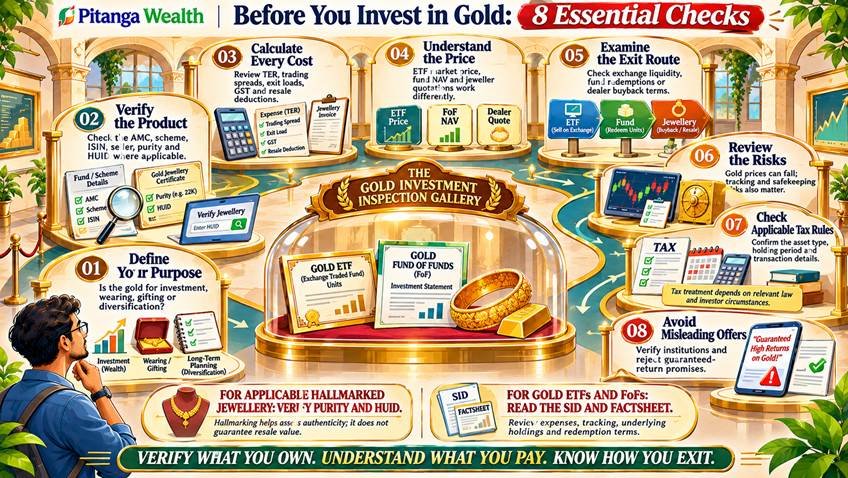
Eight Checks Before Choosing a Gold Investment Route
1. Write down the purpose. Is the gold for wearing, gifting, holding an object, diversifying a portfolio or eventually spending money on something else? The objective influences which risks matter.
2. Verify the exact product. Identify the AMC, gold ETF or FoF name, SID, ISIN and listing details; for physical gold, verify the seller, invoice, purity and applicable HUID.
3. Calculate the full cost. Check TER, underlying exposure, spread, brokerage, exit load, making charges, GST, buyback deductions and storage where relevant.
4. Understand pricing. ETF exchange price is not automatically equal to NAV; a FoF uses applicable NAV; a physical item uses a merchant quote and purity assessment.
5. Check the exit route. Could units actually be sold with sufficient market depth, redeemed by the fund or bought back by a dealer when money is needed?
6. Read the risks and source documents. Gold-price volatility, tracking, counterparty, safekeeping, scheme terms and concentration are not eliminated by a product name.
7. Check taxation with current rules. Review asset category, acquisition date, holding period, gain classification, surcharge, cess and applicable reporting records.
8. Avoid misleading promotions. Be suspicious of guaranteed gold returns, ‘free’ gold without conditions, unverified apps or payments into personal accounts. Verify the regulated institution or seller independently.
When comparing gold ETFs vs gold mutual funds, use exactly the same investment time horizon and realistic costs. When comparing both with physical gold, include the monetary and practical value of physically possessing an article, without pretending it is an assured investment return.
Common Misconceptions About Buying Gold
“A gold ETF is exactly the same as a gram of jewellery”
No. An ETF unit represents an investment in the scheme, subject to its stated unit structure and underlying valuation. It does not give the ordinary retail holder a personal piece of jewellery. Scheme mechanisms for large authorised participants, where they exist, should not be confused with general household redemption rights.
“A gold mutual fund is a fund that owns gold companies”
A typical gold FoF commonly invests in gold ETF units. An equity fund invested in gold-mining companies is an economically different product, affected by business and equity-market risks. Always read the portfolio and objective rather than interpreting the word ‘gold’ alone.
“Physical gold is free from investment expenses”
A buyer may face GST, retail premium, making charges, verification, storage and eventual buyback deductions. Different physical products have different cost structures. Holding an ornament at home may remove a recurring financial-statement fee without removing physical risk.
“The lowest ETF TER guarantees the best investor result”
No. Trading price, spread, tracking difference, liquidity and brokerage can affect an investor’s realised return. Similarly, a FoF’s SIP convenience cannot by itself justify ignoring the total cost or outcome.
“Gold never loses value and always protects inflation”
Gold prices fluctuate in rupees. It may be useful in some portfolio contexts but can experience long periods of weak or negative real returns. There is no fixed coupon, guaranteed principal return or universal inflation protection.
Frequently Asked Questions
1. What is the difference between a gold ETF and a gold mutual fund?
A gold ETF trades on an exchange, with units usually held in demat form. A typical gold mutual fund or gold FoF buys ETF units and offers ordinary fund purchase and redemption processing. Both carry gold-price risk, but transaction mechanics and total costs differ. [1][2]
2. Do I need a demat account for a gold ETF?
Generally yes for normal retail exchange buying and selling. A standard non-demat investment in an open-ended gold FoF normally does not require the investor to open a stock trading account. Check the scheme and platform requirements. [1][2]
3. Can I invest monthly in a gold mutual fund through SIP?
Many gold FoFs permit SIPs under their rules. Minimums, bank mandates and applicable NAV are scheme-specific. SIPs do not guarantee profit or eliminate the possibility of buying gold at relatively high prices.
4. Which has lower costs, a gold ETF or gold FoF?
A direct ETF holding may avoid the FoF layer, but ETF investors can pay brokerage, demat fees and trading spreads. Compare actual scheme expenses, total dealing costs, frequency of investment and time horizon before deciding. There is no universal result.
5. Can a gold ETF be exchanged for gold jewellery?
Ordinary retail ETF units are not a jewellery redemption voucher. Schemes may have specialised creation or redemption mechanisms under their documents, but those should not be described as a standard option to obtain ornaments.
6. Is physical gold safer than a gold ETF?
They have different risk categories. Physical gold has safekeeping, purity and dealer-bid risks; ETF units have market-price, liquidity, tracking and investment-platform risks. Neither provides a guaranteed positive return.
7. Why can a gold ETF’s price differ from its NAV?
Exchange prices reflect orders, liquidity and the bid–ask spread. NAV reflects the scheme’s portfolio valuation. Market-making mechanisms can help align prices but cannot guarantee every trade occurs at the same value as NAV. [1]
8. What does tracking error mean in a gold ETF?
It describes how variable the ETF’s return difference is relative to its chosen gold benchmark. Tracking difference looks at the accumulated performance gap over a specified period. Use official scheme factsheets and consistent comparison periods. [4][7]
9. What is a HUID and how can I verify it?
HUID is the hallmark unique identification code used for applicable BIS-hallmarked jewellery. Consumers can check it using the BIS Care application and the official BIS information. It verifies an aspect of hallmarking, not the item’s future selling price. [3]
10. Are jewellery making charges recoverable when selling gold?
Not necessarily. The buyer may value gold content and apply their own deductions or exchange conditions. Ask the jeweller for an itemised invoice and written buyback terms before purchase.
11. Is GST charged on physical gold jewellery in India?
CBIC’s retail jewellery FAQ states a 3% GST treatment on the total transaction value, including making charges whether itemised or not, for the situation it describes. Transaction structure and current tax law matter, so check the actual invoice. [6]
12. How are gold ETF, gold FoF and physical gold gains taxed in 2026?
For common new holdings under current rules, listed gold ETF gains generally qualify as long-term after more than 12 months, while unlisted gold FoF units and physical gold generally use more than 24 months. Applicable long-term gains generally have a 12.5% base tax before cess/surcharge. Older acquisitions, residency and transaction facts require individual verification. [8][9][10]
13. Can I sell gold ETF units whenever I need money?
You can generally submit an exchange sale during trading hours, but execution, available prices, liquidity, settlement and broker withdrawal rules apply. This is not the same as guaranteed instant conversion into cash at the fund’s NAV.
14. Are gold ETFs vs gold mutual funds always better than buying jewellery?
No. Those investment routes offer paper or demat exposure, whereas jewellery can be used, worn and gifted. Compare all-in costs, access, liquidity, risk, tax and the intended purpose. There is no universal ranking suitable for every household.
Conclusion: Match the Gold Route to Its Real Purpose
The most important conclusion is not that one gold format wins every comparison. ETFs, gold FoFs and physical objects may respond to the same underlying metal price, yet they are not interchangeable in ownership, transaction process or practical use. The ETF route asks investors to understand exchange prices and NAV; the FoF route asks them to evaluate the extra fund layer and NAV-based processing; physical gold asks them to verify the item and the terms on which it can be stored, used and resold.
For an investor comparing gold ETFs vs gold mutual funds, the disciplined questions are: what exactly do I own, what are all the costs, how do I exit, and what happens if gold prices fall? Add physical gold to that comparison with honest attention to jewellery’s use value and costs. Read official fund documents or BIS information, retain records, and assess the decision within your whole financial plan rather than assuming gold is always safe or always profitable.
Disclaimer
This article is general investor education from Pitanga Wealth, not personalised investment, tax, legal, commodity-trading or securities advice. It does not recommend a specific fund, dealer, gold product or allocation. Hypothetical costs and examples are illustrative only, not live quotations or return forecasts. Official sources were reviewed on 19 November 2026; regulations, taxation, offer documents and market conditions can change. Mutual fund investments are subject to market risks. Past performance is not indicative of future results. Gold prices can decline, and no form of gold ownership guarantees capital preservation, liquidity or returns.
Written by Pitanga Wealth Team.
Follow us on Instagram @pitangawealth for more educational insights.
This article is for educational and informational purposes only. It is not investment, tax, legal or insurance advice. Consider your circumstances and relevant documents before making a financial decision.