

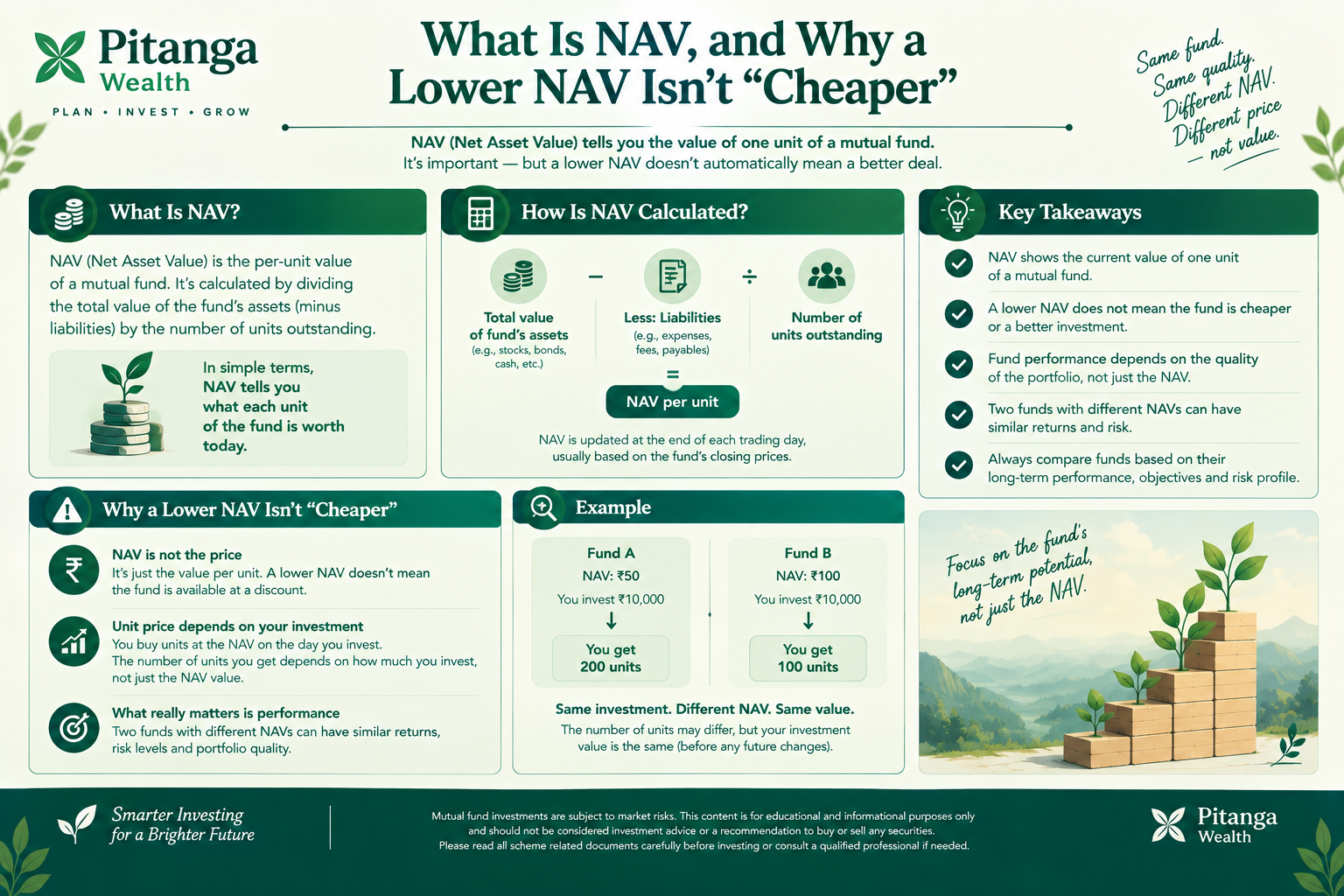
Imagine you’re comparing two mutual fund schemes.
One has a Net Asset Value (NAV) of ₹15 per unit, while another has an NAV of ₹150 per unit.
At first glance, the first fund might seem more affordable. After all, ₹15 looks much cheaper than ₹150.
But here’s the surprising part: the fund with the lower NAV is not necessarily cheaper, undervalued, or a better investment.
This is one of the most common misunderstandings among new mutual fund investors.
So, what is NAV in mutual funds, how is it calculated, and what does it actually tell you about your investment?
Let’s understand it step by step.
What Is NAV in Mutual Funds?
NAV stands for Net Asset Value.
It represents the net value of a mutual fund scheme’s assets, after accounting for its liabilities, divided by the number of outstanding units.
In simple terms, NAV tells you the value of one unit of a particular mutual fund scheme on a given valuation date.
Mutual funds collect money from investors and invest it in assets according to their investment objectives.
Depending on the scheme, these investments may include shares, bonds, money market instruments, or other permitted securities.
The value of these investments can change over time.
As the value of the scheme’s underlying investments changes, its NAV can also change.
NAV is therefore an important measure for valuing mutual fund units, but it does not independently tell you whether a scheme is attractive or suitable.
How Is NAV Calculated?
To understand what is NAV in mutual funds, it helps to look at the calculation.
The basic formula is:
NAV per Unit = (Total Scheme Assets − Total Scheme Liabilities) ÷ Total Outstanding Units
The assets may include the market or fair value of investments, cash, receivables, and accrued income.
Liabilities may include expenses payable and other obligations of the scheme.
After subtracting liabilities from assets, the remaining value is divided by the number of outstanding units.
A Simple NAV Calculation Example
Consider a hypothetical mutual fund scheme with the following details:
| Particulars | Amount |
| Total scheme assets | ₹12 crore |
| Total scheme liabilities | ₹2 crore |
| Net assets | ₹10 crore |
| Outstanding units | 50 lakh |
| NAV per unit | ₹20 |
The calculation is:
₹10 crore ÷ 50 lakh units = ₹20 per unit
This means that the scheme’s calculated net asset value is ₹20 for each outstanding unit.
The example is purely illustrative and does not represent an actual mutual fund.

Why Does Mutual Fund NAV Change?
A mutual fund’s NAV changes primarily because the value of its underlying investments changes.
For example, an equity mutual fund invests in shares of different companies.
If the market value of its holdings increases, the scheme’s net asset value may rise.
If those investments lose value, the NAV may decline.
For debt mutual funds, changes in bond prices, interest rates, credit conditions, accrued income, and other factors can influence NAV.
Fund expenses, distributions, and other scheme-level transactions can also affect the calculation.
The important distinction is that NAV reflects the value of the fund’s underlying assets and liabilities. It is not simply a price that investors bid up or down throughout the day, as happens with shares traded on a stock exchange.
Why a Lower NAV Does Not Mean a Cheaper Mutual Fund
This is the most important concept to understand when learning what is NAV in mutual funds.
Many investors compare NAV figures as though they were comparing the market prices of two company shares.
However, the NAV of a mutual fund is not a direct measure of whether its underlying portfolio is undervalued or overvalued.
A fund with an NAV of ₹10 is not automatically more attractive than a fund with an NAV of ₹100.
The two funds may have different investment histories, portfolios, expense structures, distribution options, and performance records.
The NAV figure alone does not reveal any of these differences.
Example: ₹10 NAV vs ₹100 NAV
Suppose you invest ₹10,000 in each of two hypothetical mutual fund schemes.
| Particulars | Fund A | Fund B |
| Initial NAV | ₹10 | ₹100 |
| Investment | ₹10,000 | ₹10,000 |
| Units allotted | 1,000 | 100 |
| NAV after a hypothetical 10% increase | ₹11 | ₹110 |
| Investment value | ₹11,000 | ₹11,000 |
Both investments have increased by the same percentage.
Even though Fund A gave you more units, it did not create a higher investment value.
More units do not automatically mean more wealth.
This illustration assumes the same percentage change in both schemes and ignores any applicable transaction-related deductions. It does not predict actual fund performance.
Does Having More Mutual Fund Units Mean Better Returns?
No.
The number of units you receive depends on the investment amount and the applicable NAV.
For example, a ₹5,000 investment at an NAV of ₹10 would provide 500 units.
The same investment at an NAV of ₹50 would provide 100 units.
But what matters for investment performance is the change in the value of those units, along with any relevant distributions and cash flows.
A higher unit count does not give the investor an automatic financial advantage.
Think of NAV as a way to measure and account for your ownership in a scheme, rather than a discount label.
Is a Mutual Fund With a High NAV Overvalued?
Not necessarily.
A high NAV does not mean that a mutual fund has reached its maximum potential or has become too expensive to invest in.
For instance, a scheme that has existed for many years may have accumulated changes in NAV as the value of its underlying investments evolved.
Another scheme may have been launched recently and therefore have a much lower NAV.
These differences do not establish which scheme is better.
To evaluate whether a fund’s investments are expensive or attractively valued, an investor would need to examine relevant information about its underlying portfolio and investment strategy.
For an equity-oriented fund, this might include portfolio valuations, market conditions, investment style, and concentration.
For a debt-oriented fund, factors such as credit quality, interest-rate sensitivity, maturity profile, and yield characteristics may be more relevant.
NAV alone cannot answer those questions.
Why Do New Mutual Fund Offers Often Start at ₹10 NAV?
A New Fund Offer, commonly called an NFO, is the initial offering period of a newly launched mutual fund scheme.
Many NFOs offer units at an initial face value of ₹10 per unit.
This can create the impression that a newly launched fund is available at a bargain price.
However, the initial NAV is an accounting starting point, not evidence that the underlying investments are inexpensive.
An established fund with an NAV of ₹150 may be more appropriate for a particular investor than a newly launched scheme with an NAV of ₹10, or the reverse may be true.
The decision depends on the scheme’s investment objective, portfolio strategy, risk profile, expenses, and suitability.
An NFO should not be selected simply because its initial NAV is low.
Is NAV the Same as a Stock Price?
Although both figures are expressed as prices per unit or share, they represent different things.
| Factor | Mutual Fund NAV | Stock Market Price |
| What it represents | Net asset value per mutual fund unit | Market price of a company’s share |
| How it is determined | Based on scheme assets, liabilities, and outstanding units | Determined by trading and market demand and supply |
| How frequently it changes | Generally calculated for each business day’s valuation | Can change throughout market trading hours |
| Does a lower figure indicate better value? | No | Not by itself |
| What should be evaluated? | Scheme portfolio, strategy, risk, costs, and performance | Company fundamentals, valuation, financial position, and risks |
A mutual fund NAV is not equivalent to a stock’s valuation multiple.
A ₹20 NAV does not mean that the fund’s underlying investments are trading at a discount.
When Is Mutual Fund NAV Calculated?
For most conventional mutual fund schemes, NAV is calculated at the end of each business day’s valuation process.
It is based on the value of the scheme’s investments and other relevant assets and liabilities.
The declared NAV is generally available through the asset management company’s website and AMFI’s NAV information services.
Unlike a stock’s market price, the NAV of a conventional open-ended mutual fund is not continuously quoted and traded throughout the day.
Certain products, such as exchange-traded funds, have additional exchange-traded market prices, which should not be confused with the scheme’s NAV.
Which NAV Applies When You Invest?
Understanding what is NAV in mutual funds also means knowing that the NAV displayed when you place a transaction is not necessarily the NAV that will apply to it.
For purchases of mutual fund units in India, the applicable NAV depends on the relevant transaction rules, cut-off timing, and when the funds become available for utilisation by the mutual fund.
For redemptions, valid transaction submission and applicable cut-off rules are important.
Different provisions can apply to liquid and overnight funds and to particular transaction types.
This means placing an investment instruction before a cut-off time does not, by itself, guarantee that day’s NAV for every purchase.
Investors should check the latest applicable rules and transaction confirmation rather than assume that the NAV shown on their screen is the final allotment NAV.

What Is the Difference Between NAV and AUM?
NAV and AUM are two different mutual fund terms.
NAV — Net Asset Value
The calculated net value per outstanding unit of a mutual fund scheme.
AUM — Assets Under Management
The total assets managed by a fund or asset management company, depending on the context in which the figure is reported.
For example, a mutual fund scheme may manage a substantial investment portfolio while still having a relatively low NAV per unit.
Another scheme may have a higher NAV but manage a smaller pool of assets.
Neither figure, on its own, establishes which scheme will perform better.
AUM can be useful for understanding a fund’s size and certain operational considerations, while NAV helps calculate unit holdings and their value.
What Is the Difference Between NAV and Expense Ratio?
These terms are connected but measure different things.
NAV represents the calculated net value per mutual fund unit.
The expense ratio represents the expenses charged to a mutual fund scheme in relation to its assets, as defined under the applicable framework.
Permitted recurring expenses are reflected in the scheme’s NAV calculation.
This means the published NAV already incorporates the effect of expenses charged to the scheme.
When comparing mutual funds, investors should examine the relevant expense ratio rather than assume that a lower NAV indicates a lower-cost investment.
Different plans of the same scheme may have different expense ratios and NAV histories.
For example, direct and regular plans can have different expenses, which may contribute to differences in their NAVs over time.
The actual cost comparison should be based on disclosed expenses, not the NAV figure alone.
Does NAV Affect SIP Investments?
Yes, NAV affects the number of units allotted through a Systematic Investment Plan (SIP).
In a SIP, a fixed investment amount is typically invested at regular intervals, subject to the chosen arrangement.
When the applicable NAV is lower, the same contribution generally purchases more units.
When the applicable NAV is higher, the same contribution generally purchases fewer units.
This is often discussed as rupee-cost averaging.
However, receiving more units during periods of lower NAV does not guarantee a profit.
A scheme’s NAV may continue to fall, and the eventual outcome depends on the investment’s performance, the timing and amount of contributions, and other relevant factors.
SIPs are an investment method, not a guarantee against losses.
Does NAV Matter When Redeeming Mutual Fund Units?
Yes.
NAV plays an important role in calculating the gross value of units being redeemed.
Consider an investor holding 200 units of a mutual fund scheme.
If the applicable NAV is ₹75, the gross redemption value would be:
200 × ₹75 = ₹15,000
However, the amount ultimately received may be affected by applicable exit loads, tax deductions where relevant, or other permitted transaction adjustments.
The investor’s actual gain or loss also depends on the cost of acquiring those units and any relevant distributions.
Therefore, NAV helps calculate redemption value, but it should not be confused with the investor’s net profit.
What Should Investors Compare Instead of NAV?
Rather than choosing a mutual fund based on its NAV, investors should consider factors that help explain how the scheme operates and what risks it carries.
Investment Objective
Understand what the scheme is trying to achieve and whether that objective is relevant to your financial needs.
Fund Category and Strategy
Compare schemes with broadly comparable investment mandates.
An equity fund and a short-duration debt fund serve different purposes and carry different risks.
Underlying Portfolio
Review what the scheme actually invests in, including concentration, sector exposure, credit quality, or other relevant portfolio characteristics.
Risk Profile
Consider market volatility, interest-rate risk, credit risk, concentration, and other risks relevant to the scheme.
Expense Ratio
Understand the ongoing costs associated with the plan and how they may affect long-term investment outcomes.
Performance Over Relevant Periods
Review historical performance alongside the relevant benchmark and comparable funds, without treating past returns as a promise of future results.
Investment Horizon
A scheme should be evaluated against the time period for which the investor expects to remain invested.
Suitability
An investment that is appropriate for one person’s circumstances may be unsuitable for another.
The fund’s NAV should not override these more important considerations.

Common Mistakes Investors Make About NAV
Choosing the Fund With the Lowest NAV
A low NAV does not mean the scheme is undervalued.
Assuming a High NAV Means Limited Growth
A higher NAV does not automatically indicate that future appreciation is impossible.
Buying an NFO Just Because Its NAV Starts at ₹10
The starting NAV does not establish that a newly launched fund is attractively priced.
Comparing NAVs Across Unrelated Fund Categories
NAV figures do not provide a meaningful basis for comparing schemes with different investment objectives.
Confusing More Units With Higher Returns
The number of units does not determine the percentage return on an investment.
Ignoring the Expense Ratio
A lower NAV does not mean lower fund management expenses.
Assuming NAV Cannot Fall Further
Mutual fund investments are subject to market and scheme-specific risks. A low NAV can decline further.
Frequently Asked Questions
1. What is NAV in mutual funds?
NAV, or Net Asset Value, is the net value of a mutual fund scheme’s assets after liabilities, divided by its outstanding units. It represents the calculated value of one unit on a particular valuation date.
2. Is a lower NAV better in mutual funds?
No. A lower NAV does not automatically mean that a mutual fund is cheaper, undervalued, or likely to deliver higher returns.
3. Is a mutual fund with ₹10 NAV better than one with ₹100 NAV?
Not necessarily. The NAV figures alone do not indicate which scheme is better. Investment strategy, underlying assets, costs, risk, and suitability matter more.
4. Does a higher NAV mean a mutual fund is expensive?
No. A higher NAV may reflect the scheme’s investment history and changes in underlying asset values. It does not independently indicate overvaluation.
5. Why does mutual fund NAV change daily?
NAV changes as the value of the scheme’s underlying assets and liabilities changes. Market movements, income, expenses, and other relevant factors can affect it.
6. Does NAV affect SIP returns?
NAV determines the number of units purchased through each SIP instalment. The overall investment outcome depends on how those units perform over time and other relevant factors.
7. Can a mutual fund NAV become zero?
A scheme’s NAV can decline significantly if its net assets lose substantial value. Investors should not assume that a low NAV creates a floor below which losses cannot occur.
8. Where can I check the NAV of a mutual fund?
You can check published NAV information through the relevant asset management company’s official website or the Association of Mutual Funds in India (AMFI).
9. Is NAV the same as the price of a stock?
No. Mutual fund NAV is calculated from the scheme’s net assets per unit, whereas a listed company’s stock price is determined through market trading.
10. Should I invest in an NFO because its NAV is ₹10?
Not solely for that reason. The initial NAV is not evidence of a bargain. Review the NFO’s investment objective, strategy, risks, expenses, and suitability.
Final Thoughts
Understanding what is NAV in mutual funds can help investors avoid one of the most common mistakes in fund selection.
A lower NAV does not automatically make a scheme cheaper, and a higher NAV does not automatically make it expensive.
NAV is useful for understanding unit allotment, tracking investment value, and calculating redemption amounts.
But it does not independently measure the quality of a mutual fund or its potential to deliver returns.
Instead of focusing on how many units an investment can purchase, consider the scheme’s objective, portfolio, costs, risks, and relevance to your financial goals.
At Pitanga Wealth, we believe that understanding the fundamentals of an investment is more valuable than making decisions based on a single number.
Explore our financial education resources to learn more about mutual funds, investment terminology, and the risks involved in financial decision-making.
Important Disclaimer
This article is intended solely for general financial education and information. It does not constitute personalised investment advice, a recommendation to invest in any specific mutual fund, or an assurance of investment returns.
All numerical examples are hypothetical and are used only to explain concepts. Mutual fund investments are subject to market risks. Investors should read all scheme-related documents carefully before investing.
The applicable NAV, transaction rules, expense ratios, taxation, and other conditions depend on the relevant scheme and prevailing regulations.
Distributor Disclosure: Pitanga Wealth is an AMFI-Registered Mutual Fund Distributor (ARN-134606). It may receive commissions from eligible mutual fund distribution activities. AMFI registration does not constitute registration as an investment adviser with SEBI.
Written by the Pitanga Wealth Team.
Follow @Pitangawealth on Instagram for more accessible financial education.
This article is for educational and informational purposes only. It is not investment, tax, legal or insurance advice. Consider your circumstances and relevant documents before making a financial decision.