

Active vs passive funds is a question that trips up almost every new investor. A friend of mine was staring at two funds on her investment app a while ago, and she asked me which one was “the smart choice.” One was an index fund with a very low annual cost and nothing much to read about it. The other was an actively managed fund with a fund manager’s photo, a long commentary, and a recent run of strong numbers. Every article she’d read seemed convinced that one of them was obviously better, and each article picked a different one.
The honest answer is that active vs passive funds isn’t a contest with a permanent winner. They’re two different approaches to the same goal, with different costs, different kinds of risk, and different things you have to believe for each to make sense. Here’s what actually separates them, so the choice rests on understanding rather than on whichever article you read last.

What Is an Active Fund?
An actively managed fund has a fund manager and a research team who decide which securities to buy, hold, and sell. The aim is usually to do better than a chosen benchmark index, for example by picking companies the team thinks are undervalued, or by changing the portfolio when their view of the market shifts.
That discretion is the whole point of an active fund, and it’s also where the risk sits. Skilled decisions can add value over a benchmark. Poor decisions, or even reasonable decisions that simply don’t work out over a given period, can leave the fund behind the benchmark. Nothing about the structure guarantees that the manager’s judgement will pay off.
What Is a Passive or Index Fund?
A passive fund doesn’t try to beat the market. It tries to mirror a specific index, such as a broad market index, by holding the same securities in roughly the same proportions. There’s no manager deciding which companies look attractive; the index’s rules decide what’s in the portfolio, and the fund follows along. Index funds and index-based exchange-traded funds (ETFs) both fall under this passive approach.
Because it mirrors an index, a passive fund aims to deliver the index’s return minus its own costs. That means it will, by design, never beat its index. What it offers is predictability about what it holds, and typically a lower cost for getting there.
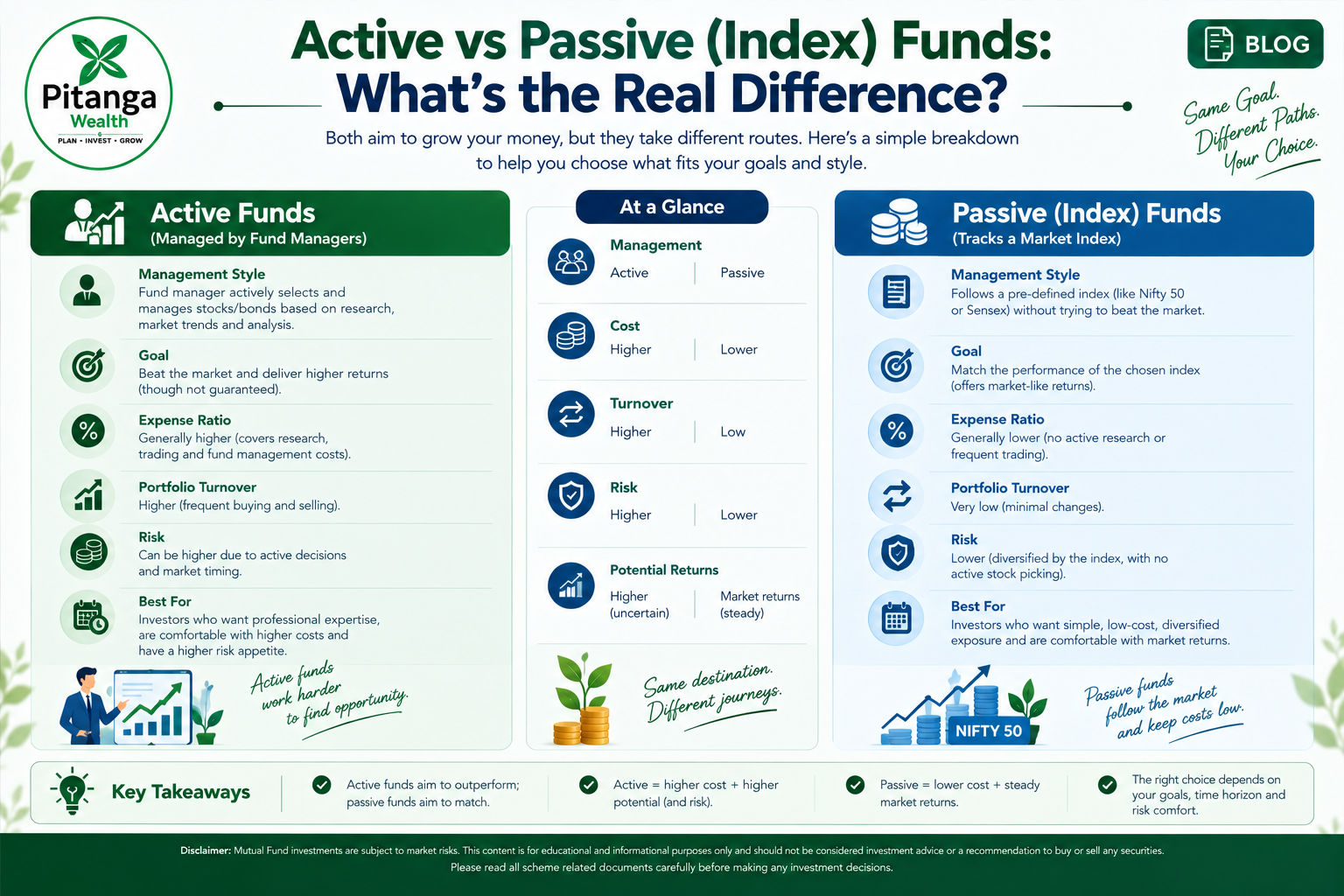
Active vs Passive Funds: The Core Differences
| Active Fund | Passive (Index) Fund | |
| Objective | Try to outperform a benchmark | Try to match an index |
| Who decides holdings | Fund manager and research team | The index’s rules |
| Typical running cost | Generally higher | Generally lower |
| Source of risk beyond the market | Manager decisions may not work out | Tracking difference from the index |
| What you can predict | Less, since holdings change at the manager’s discretion | More, since holdings follow the index |

The Cost Difference, and Why It Matters
Cost is the most visible gap in the active vs passive funds comparison. Running a research-led, actively managed portfolio generally costs more than running a fund that follows an index mechanically, and that difference usually shows up as a higher expense ratio for active funds. Expense ratios vary by fund and change over time, so this article deliberately doesn’t quote figures, but the direction is consistent: passive tends to cost less.
Why this matters: costs are deducted from your investment’s returns every year, quietly, whether the fund has a good year or a poor one. Over long holding periods, a lower cost compounds in your favour, and an active fund has to earn back its higher cost before it adds any value over a cheaper alternative. That’s a real consideration, though it isn’t the only one.
Does Active Actually Beat Passive? An Honest Answer
This is the question at the heart of active vs passive funds, and it’s the one most people really want answered. It deserves a careful response instead of a confident slogan in either direction.
Results have been mixed across markets, categories, and time periods. Some active funds have beaten their benchmarks over certain stretches; many have not; and which funds fall into which group isn’t something anyone can reliably know in advance. Whether active management adds value also tends to differ between market segments, since a segment with fewer well-researched companies may leave more room for a skilled manager than one that’s heavily followed. We aren’t going to quote a specific percentage here, because any such number depends on the category, the period, and how the comparison is done, and it changes over time.
What can be said fairly: a passive fund gives you the market’s return less a low cost, with no manager risk. An active fund gives you the chance of beating that return, along with the chance of falling behind it. Which of those trade-offs suits you depends on what you believe, and what you’re comfortable with.
What Is Tracking Error, and Why Index Funds Aren’t Identical to Their Index
Passive funds aim to match their index, but they rarely match it perfectly. The gap between the fund’s return and the index’s return is called tracking difference, and how much that gap varies over time is called tracking error. It arises from things like the fund’s costs, how it handles cash flows from investors, and the practical difficulties of replicating an index exactly.
When comparing two index funds that follow the same index, a smaller tracking difference generally means the fund is doing its replication job more faithfully, which is worth checking rather than assuming all index funds behave identically.
Passive Doesn’t Mean Safe
This is a common misunderstanding worth stating directly. An index fund that tracks an equity index will fall when that index falls, because it holds the same securities. “Passive” describes how the fund is run, not how risky it is.
Index composition is also worth understanding. Many indices are weighted by company size, which can mean a small number of large companies or sectors make up a significant share of the index. A fund following that index inherits that concentration, whether or not that’s what you assumed you were getting.

Who Might Lean Toward Which
Here is how the active vs passive funds choice tends to break down in practice:
- Passive tends to suit investors who want low-cost, rules-based exposure to a market or segment, who’d rather not depend on a manager’s judgement, and who value knowing in advance roughly what they hold.
- Active tends to suit investors who are comfortable paying more for the possibility of outperformance, who are willing to research or take advice on manager quality, and who accept that the extra cost carries no guarantee of extra return.
- A blend is common. Many investors use passive funds for broad core exposure and active funds in areas where they believe skilled management can add value, though the right mix depends on your goals and comfort.
A Note on How We’re Paid
Since this is a topic where our own incentives matter, it’s worth saying plainly: Pitanga Wealth is a mutual fund distributor, and distributor commission on a regular plan is generally linked to the fund’s expense ratio, so lower-cost index funds typically mean lower commission. We’re telling you this because you should know where we sit, and because it doesn’t change what we think is the sensible way to approach this decision, which is to match the fund type to your needs rather than to what pays more.
How to Evaluate Funds on Either Side
For an index fund: check which index it follows and whether you understand what’s in it; look at its expense ratio and tracking difference compared with other funds following the same index; and consider fund size and trading liquidity if it’s an ETF.
For an active fund: look at how consistent the fund’s process has been across different market conditions, not just recent performance; check how closely its portfolio overlaps with its benchmark, since a fund that mostly mirrors the index while charging active fees is worth questioning; and understand the manager’s approach before assuming it will work in conditions you haven’t seen it through.
Common Mistakes People Make
A few patterns show up repeatedly when people weigh active vs passive funds.
Choosing an active fund on recent performance alone. A strong recent stretch tells you what happened, not why, or whether it will continue.
Choosing a passive fund purely because it’s cheap, without understanding the index. Low cost is a real advantage, but it doesn’t replace knowing what the index actually holds.
Assuming passive means low-risk. Passive funds follow their index down as well as up.
Holding several index funds without noticing they track overlapping indices. This can leave you with far less diversification than the number of funds suggests.
Comparing an active fund against the wrong benchmark. A fund can look like it’s lagging or leading simply because it’s being measured against an index that doesn’t match its actual strategy.
Frequently Asked Questions
Are index funds better than active funds? Neither is better in every situation. Index funds typically cost less and remove manager risk; active funds offer the possibility of beating a benchmark, with the possibility of trailing it as well. The better choice depends on your goals, costs you’re comfortable with, and how you view manager skill.
Do index funds guarantee market returns? No. An index fund aims to match its index, less costs, so its return can differ slightly from the index, and if the index falls, the fund falls with it.
What is the difference between an index fund and an ETF? Both follow an index passively. An index fund is bought and sold at the day’s NAV directly through the fund house or a platform, while an ETF trades on a stock exchange during market hours and requires a demat account.
Can I hold both active and passive funds in the same portfolio? Yes, and many investors do, since active vs passive funds isn’t strictly an either-or decision. A common approach uses passive funds for broad core exposure and active funds selectively, though the right split depends on your goals and risk comfort.
Why do some active funds charge so much more than index funds? Active funds typically fund a research team and ongoing portfolio decisions, which costs more than following an index mechanically. Whether that extra cost is justified depends on whether the fund’s decisions add value beyond it, which can’t be known in advance.
Is tracking error something I need to worry about? It’s worth a quick check when comparing index funds that follow the same index, since a smaller gap generally indicates more faithful replication, but it’s one factor among several rather than a reason for alarm by itself.
If you’re weighing active vs passive funds for your own portfolio, our team at Pitanga Wealth can help you think through which mix suits your goals, and we’ll tell you honestly where each fits.
Mutual Fund investments are subject to market risks. Read all scheme-related documents carefully before investing. Index funds and ETFs are subject to market risk and tracking error; actively managed funds may underperform their benchmarks. This article is for educational purposes only and should not be construed as investment advice or a recommendation to invest in any particular scheme or approach. Distributors earn commission on regular plans. Pitanga Wealth is an AMFI-Registered Mutual Fund Distributor (ARN-134606).
Written by the Pitanga Wealth team.
Follow us on Instagram: We break down investing choices like this one in plain language — follow @pitangawealth for more.
This article is for educational and informational purposes only. It is not investment, tax, legal or insurance advice. Consider your circumstances and relevant documents before making a financial decision.