

A colleague once told me, half-joking, that he’d been meaning to “seriously start” retirement planning since he was 28. He’s 44 now. Each decade came with a good reason to push it further out — first it was paying off education loans, then it was saving for a wedding, then a home down payment, then his kids’ school fees. None of those reasons were wrong exactly. But retirement planning by decade doesn’t wait for a quieter year that never quite arrives — the strategy that actually works is the one that adapts to whatever decade you’re in right now, rather than waiting for an ideal moment to begin.
Treating retirement planning as one flat strategy from your 20s to your 60s is where a lot of people go wrong, not because they’re careless, but because nobody tells them the approach is supposed to change as life does. Here’s what that actually looks like, decade by decade.

Why One Strategy Doesn’t Work Across Every Decade
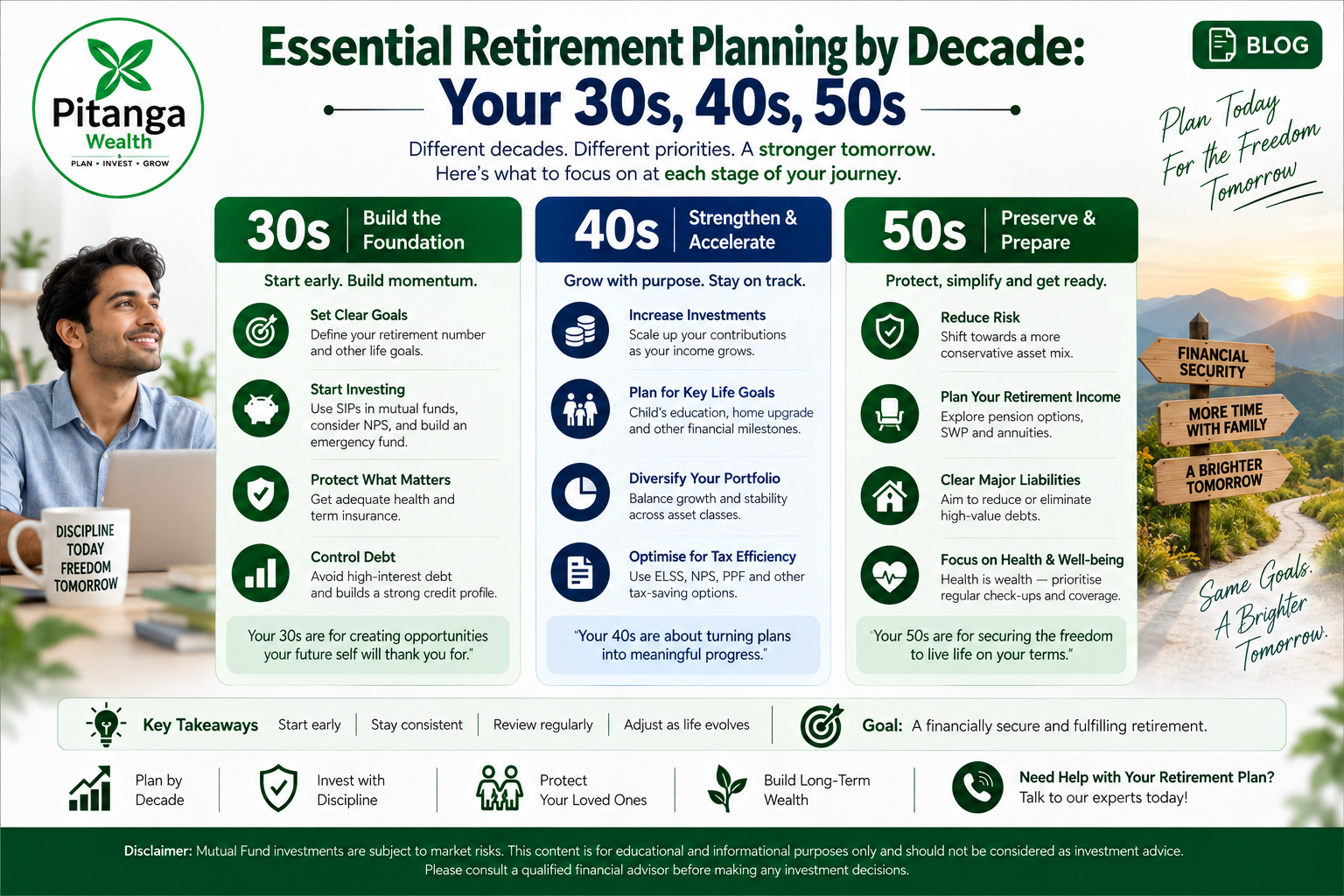
Your income, obligations, and the amount of time your money has to grow all shift dramatically between your 30s and your 50s. A strategy built for someone with three decades of working life ahead looks nothing like one built for someone with one decade left — the risk that made sense earlier can become a genuine liability later if it isn’t adjusted. This is really the whole argument for retirement planning by decade instead of a single fixed plan: the right approach is a moving target, not a formula set once and forgotten.
Your 30s: Time Is the Asset You Won’t Get Back
If there’s one advantage your 30s have over every later decade, it’s runway — the sheer number of years left for money to compound before retirement. This is generally the decade where a higher allocation toward equity mutual funds tends to make the most sense for long-term goals, since there’s more time to potentially ride out volatility along the way, though this comes with no guarantee and requires genuine comfort with market ups and downs.
A few things worth prioritising in this decade:
- Start a retirement-specific SIP now, even if it’s modest. The habit and the time in the market both matter more at this stage than the exact amount.
- Get adequate term life insurance sorted early, while premiums are typically lower and before dependents or liabilities complicate the calculation.
- Resist letting your entire salary increase flow into lifestyle upgrades. A rising income is also the easiest moment to raise your retirement savings rate, since you’re adjusting to more money either way.
Your 40s: Juggling Retirement With Everything Else at Once
Retirement planning by decade gets genuinely harder here, not because the concept changes, but because the competing demands multiply. This is usually the most financially crowded decade — children’s education costs are real and immediate, a home loan may still be running, aging parents might need support, and retirement can quietly slip to the bottom of the list because it doesn’t demand attention the way a school fee deadline does.
The risk specific to this decade is neglect by priority, not lack of income. A few things worth focusing on:
- Don’t let retirement contributions stay flat while your income grows. A step-up SIP, increasing your contribution as your income rises, helps retirement keep pace with your other, more visible goals instead of being funded with whatever’s left over.
- Reassess your life insurance cover. The number that made sense in your early 30s often no longer reflects your current dependents, debts, and responsibilities.
- Start getting a realistic sense of where you actually stand, rather than assuming things are broadly fine because you’ve “been investing for years.”

Your 50s: Shifting From Growth to Protecting What You’ve Built
This is where retirement planning by decade looks most different from the earlier stages. With retirement now a decade or less away for many people at this stage, the priority reasonably shifts from maximising growth to protecting the corpus you’ve already built. A market downturn that would have been a recoverable blip in your 30s can meaningfully affect a retirement timeline if it hits shortly before you actually need the funds.
What tends to matter most here:
- Gradually shift a portion of your portfolio toward more conservative instruments, rather than an abrupt, all-at-once move — a gradual glide path tends to reduce the risk of poor timing compared to a sudden shift.
- Take a serious, honest look at whether your corpus is actually on track, since this is close to the last stretch where meaningful adjustments (working a few years longer, increasing contributions, adjusting the retirement lifestyle target) are still realistically possible.
- Revisit your health insurance cover specifically. Healthcare costs tend to rise with age, and this is the decade where adequate health cover stops being optional and starts being central to protecting the retirement corpus itself from a large, unplanned medical expense.

A Rough Way to Check If You’re on Track
There’s no single number that applies to everyone, since it depends on your expected retirement age, desired lifestyle, and existing savings — but a commonly used approach is checking your accumulated retirement savings as a multiple of your current annual income at different ages, as a rough directional benchmark rather than a precise target. This kind of thumb-rule benchmark is meant to prompt a real conversation about where you stand, not to be treated as a fixed pass-or-fail number, since individual circumstances vary considerably.
The One Thing That’s True in Every Decade
Whatever decade you’re in, the pattern that causes people to fall behind is the same: treating retirement planning as something you’ll properly get to later, once things settle down. Things rarely settle down in the way people expect, and retirement planning by decade works precisely because it meets you wherever you currently are, rather than requiring an ideal starting point that may never actually arrive.
Common Mistakes by Decade
In your 30s: not starting because the amount feels too small to matter. A modest SIP started now typically has a meaningfully longer runway than a larger one started a decade later.
In your 40s: letting retirement get fully deprioritised behind more urgent-feeling goals. Other goals deserve funding too, but retirement contributions dropping to zero during this decade is a pattern that’s genuinely hard to make up for later.
In your 50s: either staying too aggressively invested out of habit, or panicking and moving everything to cash at once. Both extremes carry real risk — the first from a poorly timed downturn, the second from giving up growth potential you may still need over a retirement that could last 20-plus years.
Frequently Asked Questions
Is it too late to start retirement planning in my 40s or 50s? No — while starting earlier generally gives more flexibility, meaningful progress is still possible later, particularly by increasing contribution rates and being realistic about the required corpus and retirement timeline.
Should my asset allocation really change every decade, or just once closer to retirement? A gradual shift, rather than one abrupt change close to retirement, tends to reduce the risk of poor timing. Many people begin gently adjusting their mix starting in their 40s or 50s rather than making one large shift right before retiring.
How do I know if I’m actually on track for retirement? A rough benchmark based on your accumulated savings relative to your income at different ages can offer a directional sense, but a proper assessment factoring in your specific goals, expenses, and timeline gives a far more accurate picture than any generic rule of thumb.
Does retirement planning by decade mean I need a completely different portfolio every ten years? Not necessarily a complete overhaul — it’s more about a gradual shift in emphasis (growth versus preservation) and ensuring contribution levels keep pace with income and responsibilities, rather than restructuring everything abruptly at each decade mark.
What’s the biggest retirement planning mistake people make in their 30s specifically? Waiting for a “better time to start,” which often keeps getting pushed further out as new financial priorities appear. Starting modestly and early tends to outperform waiting for an ideal, uninterrupted moment that rarely comes.
Should I prioritise my children’s education or my own retirement if I can’t fully fund both? This is a genuinely personal decision, but it’s worth knowing that education costs often have financing options (education loans, for instance), while there’s no equivalent “retirement loan” — a factor many financial planners consider when discussing this trade-off with families.
If retirement planning by decade has you wondering what your own plan should look like right now — whether you’re just starting out or reassessing where you stand — our team at Pitanga Wealth can help you build a plan suited to your decade.
Mutual Fund investments are subject to market risks. Read all scheme-related documents carefully before investing. The information in this article is for educational purposes only and should not be construed as investment advice or a recommendation to invest in any particular scheme or product. Pitanga Wealth is an AMFI-Registered Mutual Fund Distributor (ARN-134606).
Written by the Pitanga Wealth team.
📲 Wherever you are in your retirement journey, we share stage-by-stage money guidance on Instagram — follow @pitangawealth for more.
This article is for educational and informational purposes only. It is not investment, tax, legal or insurance advice. Consider your circumstances and relevant documents before making a financial decision.