

A relative of mine needed money quickly a couple of years ago — a medical expense that couldn’t wait. His instinct was to redeem a large chunk of equity mutual funds he’d been holding for almost a decade, funds that were meant for his retirement, not for emergencies. Someone mentioned, almost in passing, that he could borrow against those same investments instead of selling them. He hadn’t known that was even an option. He ended up doing exactly that — the emergency got sorted, and his retirement investments stayed exactly where they were, still invested, still working toward the goal they were originally meant for.
A loan against mutual funds is one of those financial tools that’s been around for years but remains genuinely underused, mostly because people simply don’t know it exists as an alternative to redeeming investments. Here’s how it actually works, what it costs, and where the real risks are.

What Is a Loan Against Mutual Funds?
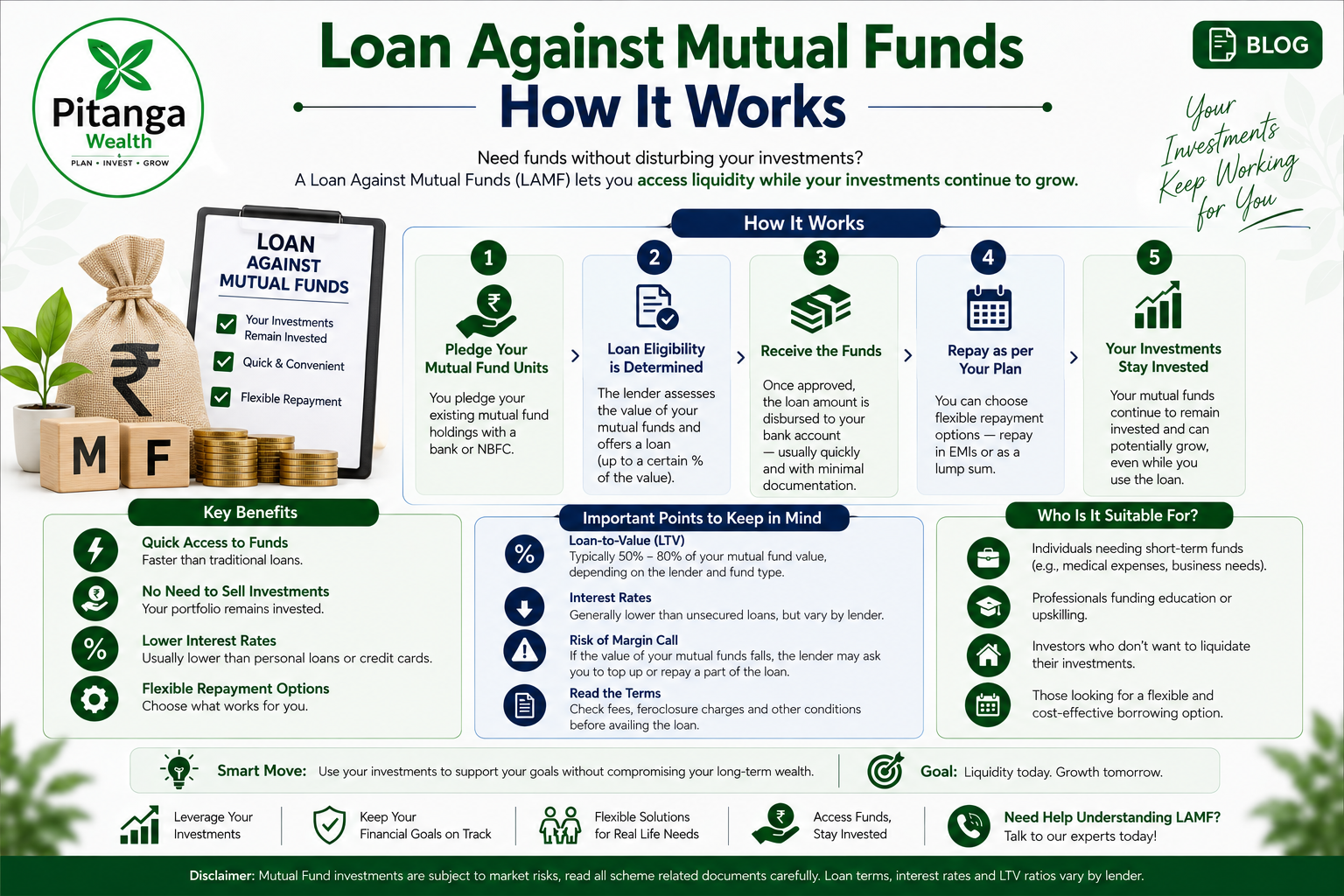
A loan against mutual funds lets you borrow money from a bank or NBFC by pledging your mutual fund units as collateral, without actually selling them. The units get marked with a “lien” in favour of the lender — meaning you can’t redeem or transfer them while the loan is active — but you remain the owner, and the investment continues to be part of the market the way it always was.
This is fundamentally different from redeeming your investment. Redemption converts your units to cash permanently, potentially triggering capital gains tax and definitely ending your exposure to any future growth in that investment. A loan against mutual funds keeps the underlying investment intact — you’re borrowing against its value, not liquidating it.
How the Process Actually Works
The mechanics are fairly straightforward once you understand the lien concept:
- You approach a bank, NBFC, or platform offering this facility and specify which mutual fund units you want to pledge.
- The lender marks a lien on those units through the fund’s registrar (like CAMS or KFintech) or your depository, which restricts you from redeeming them without the lender’s consent.
- The lender sanctions a loan amount based on the value of the pledged units and the applicable loan-to-value (LTV) ratio for that fund category — more on this below.
- Funds are disbursed, often as an overdraft-style facility rather than a lump sum, meaning you can draw what you need and pay interest only on the amount actually utilised, though this structure varies by lender.
- You repay at your own pace (subject to the lender’s terms), and once the loan is closed, the lien is removed and your units are free again.
Because the process runs through the fund’s registrar or your demat account rather than requiring you to actually sell anything, it’s usually faster to set up than many people expect, and doesn’t require the extensive documentation a fresh loan application from scratch might.

Which Mutual Funds Actually Qualify
Not every mutual fund scheme can be pledged — lenders typically maintain an approved list of eligible schemes, and this varies from one lender to another. Broadly, both equity and debt mutual funds can qualify, but they’re treated differently:
- Debt mutual funds are generally considered lower risk collateral by lenders, since their value is less volatile, and they often come with a higher LTV ratio as a result.
- Equity mutual funds are treated more conservatively because their value can fluctuate more, which typically means a lower LTV ratio compared to debt funds.
The exact list of eligible schemes and the LTV offered for each is specific to the lender, so it’s worth checking directly rather than assuming any fund you hold automatically qualifies.
How Much Can You Actually Borrow?
This depends on the loan-to-value ratio the lender applies to your specific fund category — essentially, what percentage of your investment’s current value they’re willing to lend against. Debt funds often carry a comparatively higher LTV than equity funds, reflecting their lower volatility, though the exact percentages vary by lender and can change over time, so it’s not something to treat as a fixed, universal number.
It’s also worth understanding that this borrowing limit is tied to the current market value of your holding, not a fixed amount decided once — which becomes important in the next section.
What Happens If the Fund’s Value Falls
This is the part of a loan against mutual funds that’s genuinely important to understand, and it’s often glossed over. Since your loan eligibility is based on the current value of your pledged units, a significant fall in that value — particularly relevant for equity funds — can trigger what’s usually called a margin call.
In practice, this means the lender may ask you to either pledge additional units to maintain the required collateral value, or repay part of the loan to bring the loan-to-value ratio back within their limit. If this isn’t done within the lender’s specified timeframe, they generally have the right to sell (redeem) enough of your pledged units to recover the shortfall, even if you’d rather have kept the investment untouched.
This is precisely why understanding your own risk tolerance matters here — pledging equity funds for a loan carries a different risk profile than pledging debt funds, and it’s worth thinking through what you’d do if a margin call happened at an inconvenient time, not just assuming it won’t.

Your Investment Keeps Working While the Loan Is Active
One of the genuine advantages of a loan against mutual funds, compared to redeeming the investment outright, is that your pledged units continue to be part of the market and continue earning (or losing, since markets move both ways) exactly as they would have without the loan. You’re not missing out on any dividends, NAV appreciation, or the compounding that comes from staying invested — you’ve simply used the investment as collateral rather than converting it to cash.
This is the core reason this option makes sense for some situations: a temporary cash need doesn’t have to mean permanently interrupting a long-term investment strategy.
Interest Rates and Costs
Interest rates on a loan against mutual funds are generally lower than unsecured personal loans, since the lender has collateral backing the loan — but the exact rate varies by lender, your loan amount, and current market conditions, so it’s not something with a fixed number worth quoting here. Many facilities are structured as an overdraft, where you’re charged interest only on the amount actually drawn, not the full sanctioned limit, which can make the effective cost lower than a traditional term loan if you don’t need the full amount immediately.
It’s worth comparing the specific rate and any processing fees or charges across a few lenders before choosing, the same way you’d compare rates on any other loan product.
Loan Against Mutual Funds vs Other Options
Compared to redeeming your investment: you avoid triggering capital gains tax on the redemption and keep your long-term compounding intact, but you take on interest cost and the margin-call risk described above.
Compared to a personal loan: a loan against mutual funds is typically faster to process and often carries a lower interest rate, since it’s secured — but it does carry the specific risk that a market fall could force a partial liquidation of your holdings if you can’t meet a margin call.
Compared to a credit card cash advance or short-term informal borrowing: this route is generally more structured and cost-effective for a planned, moderate cash need, though it’s not a substitute for an emergency fund built for quick, unrestricted access.
Common Misconceptions
“I lose ownership of my mutual funds once I pledge them.” Not true — you remain the legal owner throughout; the lien simply restricts redemption without the lender’s release.
“This only works for debt funds.” Equity funds can typically be pledged too, just usually at a lower LTV than debt funds, subject to the lender’s specific policy.
“The loan amount stays fixed regardless of what happens to the fund’s value.” This isn’t accurate either — as covered above, a fall in value can trigger a margin call, so the loan and the pledged value remain linked throughout the loan’s tenure.
Frequently Asked Questions
Can I redeem part of my mutual fund units while a loan against them is active? Generally no, not without the lender’s consent, since the units are under lien for the full pledged amount. Partial redemption typically requires first reducing the loan or getting specific approval from the lender.
Is a loan against mutual funds better than an overdraft against a fixed deposit? Both are secured lending options with broadly similar logic — borrowing against an existing asset rather than liquidating it. Which is more suitable depends on your specific rates, existing holdings, and how each lender structures the facility, so it’s worth comparing rather than assuming one is universally better.
What happens to my loan if I want to switch mutual fund schemes? Switching a pledged scheme generally isn’t straightforward while the lien is active, since the lender’s collateral is tied to the specific units pledged. This is worth checking with your specific lender before assuming you can freely switch funds mid-loan.
Do SIPs continue on a mutual fund that’s pledged for a loan? This depends on the lender and how the pledge is structured — some allow the SIP to continue on the same folio while only the pledged units remain restricted, but it’s not universal, so it’s worth confirming with your lender.
Is there a minimum investment value required to get a loan against mutual funds? Most lenders set a minimum eligible portfolio value, which varies by lender, so it’s worth checking directly rather than assuming any amount qualifies.
Can NRIs get a loan against mutual funds in India? Some lenders do offer this to NRIs, subject to their specific eligibility criteria and applicable FEMA regulations, though availability and terms can differ from what’s offered to resident investors — this is worth confirming with the specific lender.
If you’re weighing a loan against mutual funds versus redeeming your investments for a cash need, our team at Pitanga Wealth can help you think through which option actually fits your situation.
Mutual Fund investments are subject to market risks. Read all scheme-related documents carefully before investing. Loan terms, interest rates, loan-to-value ratios, and eligible schemes vary by lender and are subject to change; this article is for educational purposes only and does not constitute financial or lending advice. Pitanga Wealth is an AMFI-Registered Mutual Fund Distributor (ARN-134606).
Written by the Pitanga Wealth team.
This article is for educational and informational purposes only. It is not investment, tax, legal or insurance advice. Consider your circumstances and relevant documents before making a financial decision.