

Health insurance claim documents are one of those things nobody thinks about until they urgently need them — and by then, it’s often the worst possible time to be searching for a folder or scanning old emails. A friend once described the moment her father was being admitted for emergency surgery, and a hospital staff member asked her for the policy number and ID proof right there at the admission desk — while she was still processing what was happening. She didn’t have the policy document with her. It was at home, in a drawer, and the hospital was forty minutes away. The surgery went ahead, thankfully, but the delay in submitting paperwork added hours of unnecessary stress to an already difficult day.
This guide walks through exactly what’s needed for both major types of claims, so the paperwork is one less thing to figure out during an actual emergency.
Two Very Different Claim Processes: Cashless vs Reimbursement
Before getting into the specifics, it helps to understand that there are two distinct claim routes, and the exact health insurance claim documents required differ depending on which one applies to your situation.
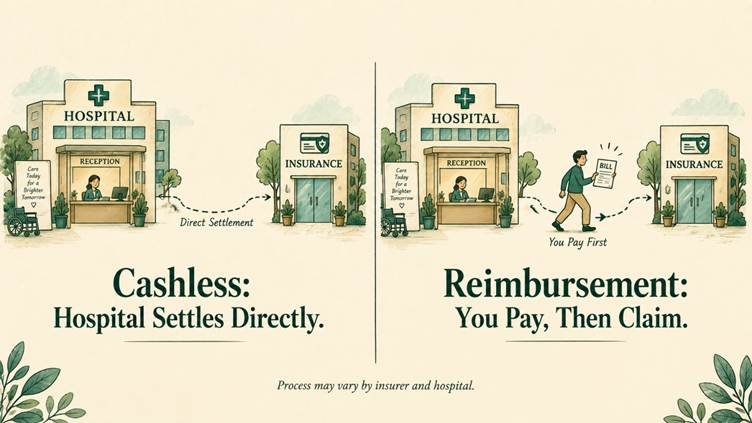
Cashless claims happen when you’re treated at a hospital within your insurer’s network, and the insurer settles the bill directly with the hospital — you typically don’t pay upfront (beyond any non-covered items or co-payment, depending on your policy).
Reimbursement claims happen when you pay the hospital bill yourself first, then submit documents to your insurer afterward to be paid back. This applies if you’re treated at a non-network hospital, or in some cases even at a network hospital if the cashless process wasn’t used for whatever reason.
The documents each route requires overlap significantly, but the process and timing are different enough that it’s worth planning for both.
Documents Needed for a Cashless Claim
For planned (non-emergency) hospitalisation, most insurers require pre-authorisation, ideally a few days before admission. For emergency hospitalisation, this happens at the time of admission instead. Either way, you’ll typically need:
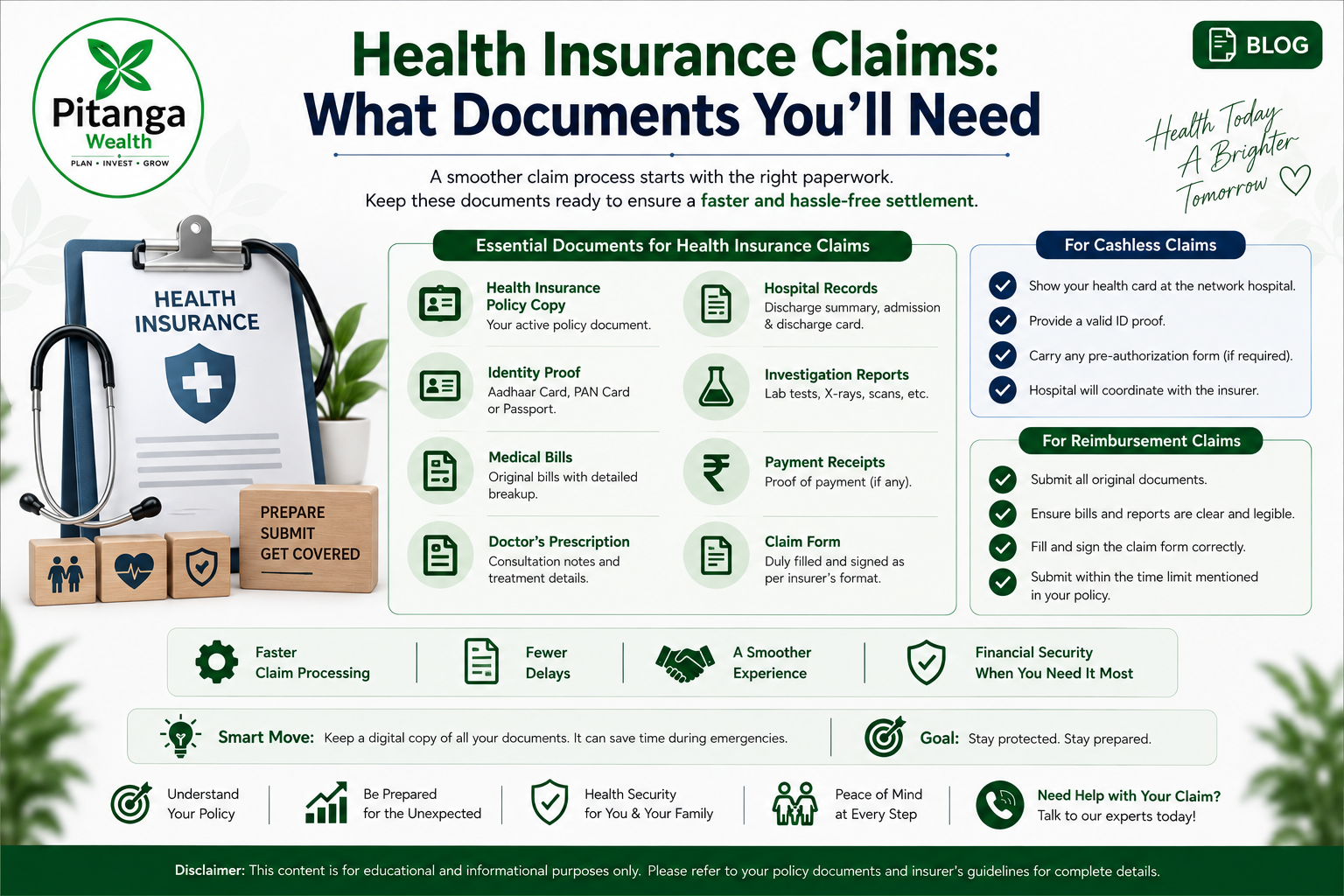
- Health insurance policy number and a copy of the policy document or e-card, so hospital staff can verify your coverage
- A government-issued photo ID (Aadhaar, PAN, passport, or similar) for the patient
- A duly filled and signed pre-authorisation form, usually provided by the hospital’s insurance desk, which the treating doctor also fills in with clinical details
- Details of the diagnosis and proposed treatment, provided by the hospital directly to the insurer as part of the pre-authorisation
- KYC documents, if requested, particularly for higher claim amounts, as per current regulatory requirements
Most of this process is coordinated through the hospital’s dedicated insurance or TPA (Third Party Administrator) desk, but having your policy number and ID ready yourself, rather than relying entirely on the hospital to look it up, tends to speed things up meaningfully — as the story above illustrates.
Documents Needed for a Reimbursement Claim
This is typically a longer list, since you’re submitting proof of everything after the fact rather than the hospital coordinating with the insurer in real time:
- Duly filled and signed claim form, available from your insurer or their website
- Original hospital bills and payment receipts, itemised where possible
- Discharge summary, issued by the hospital, detailing the diagnosis, treatment given, and course of the hospitalisation
- All original diagnostic reports — blood tests, imaging, pathology reports — related to the treatment
- Doctor’s prescriptions and consultation notes, especially for any medication or follow-up treatment claimed
- Original pharmacy bills, if medicines were purchased separately from the hospital
- A copy of your policy document or policy number
- KYC documents and a cancelled cheque or bank account details, for the reimbursement to be credited
- FIR or medico-legal certificate, specifically for accident-related claims, if applicable
Insurers generally require original documents for reimbursement claims (not photocopies), so it’s worth keeping copies for your own records before submitting the originals.

Don’t Forget Pre- and Post-Hospitalisation Documents
Most health insurance policies also cover a window of expenses before and after the hospitalisation itself — commonly a set number of days on either side, as defined in your specific policy. These claims need their own supporting documents, separate from the hospitalisation claim itself:
- Doctor consultation and diagnostic bills from before admission, if related to the same illness or condition
- Follow-up consultation and medicine bills after discharge, again tied to the same treatment
- Prescriptions supporting each of these expenses
These are easy to forget because they happen outside the hospital stay itself, but they can add up to a meaningful portion of total treatment cost, so it’s worth keeping every related bill and prescription rather than assuming only the hospitalisation bill matters.
Why Claims Actually Get Delayed or Rejected
Understanding the common documentation issues is often more useful than just having a checklist, because most delays come down to a handful of repeat problems:
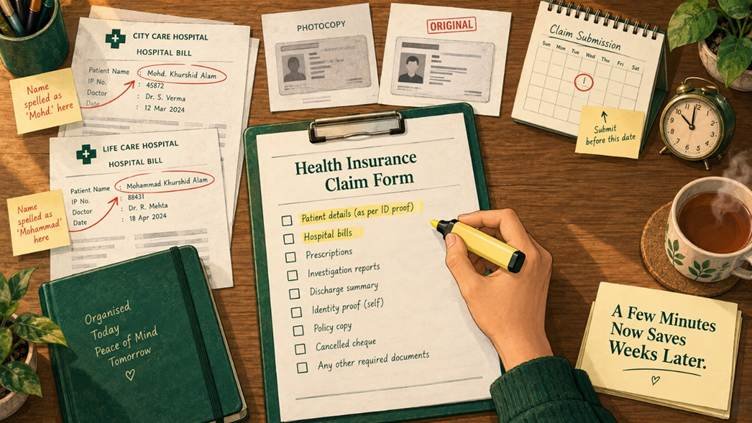
Mismatched names or details across documents. If the name on the bill, the policy, and the ID proof don’t match exactly (including spelling), it can trigger delays while the insurer seeks clarification.
Late intimation. Most policies require you to inform the insurer within a specific window (often 24–48 hours for planned hospitalisation, sometimes a bit longer for emergencies) — missing this window, even if all other paperwork is fine, can complicate the claim.
Missing original documents for reimbursement. Submitting photocopies where originals are required is one of the most common, avoidable causes of delay.
Incomplete claim forms. A claim form missing a signature, a date, or a section left blank can bounce the entire submission back for correction, adding days to the process.
Bills that don’t clearly itemise the treatment. Vague or non-itemised hospital bills can trigger requests for clarification from the insurer, particularly for reimbursement claims.
Treatment for a pre-existing condition within the waiting period. If a claim relates to a condition that falls within your policy’s pre-existing disease waiting period, it can be rejected regardless of how complete the documentation is — this isn’t a paperwork issue exactly, but it’s worth knowing your policy’s specific waiting period terms so you’re not caught off guard.
None of these are exotic problems — they’re mostly administrative details that are entirely avoidable with a bit of preparation, which is exactly why having a documents checklist ready in advance matters more than it might seem.
A Simple Way to Stay Prepared
Rather than scrambling to gather health insurance claim documents during an actual emergency, it’s worth keeping a dedicated folder — physical or digital — with the essentials always ready:
- A photocopy or scan of the policy document and policy number
- Photo ID copies for every family member covered under the policy
- Your insurer’s claim helpline number and the TPA’s contact details, if applicable
- A note of the specific claim intimation window your policy requires
- Bank account details for reimbursement, kept updated with your insurer
Keeping this together — even just as a folder on your phone — removes a significant amount of stress from a situation that’s already stressful enough without a paperwork scramble on top of it.
The health insurance claim documents you’ll need don’t change from one hospitalisation to the next — what changes is whether you’ve kept them ready before you actually need them.
Frequently Asked Questions
What health insurance claim documents are needed most urgently in an emergency? At minimum, your policy number, a photo ID, and any hospital-provided pre-authorisation paperwork. Everything else — original bills, discharge summary, diagnostic reports — can typically be assembled over the following days for a reimbursement claim, or coordinated directly between the hospital and insurer for a cashless one.
Can I submit photocopies instead of original documents for a reimbursement claim? Generally, insurers require original bills and reports for reimbursement claims, not photocopies. It’s worth keeping your own copies before submitting the originals, since you won’t get them back once processed.
How long do I have to submit health insurance claim documents after discharge? This varies by insurer and policy, but there’s typically a defined window (commonly around 15–30 days post-discharge for reimbursement claims) specified in your policy document — it’s worth checking your specific policy’s terms rather than assuming a standard timeline applies.
What happens if I don’t have all the documents ready at the time of claim submission? Most insurers allow you to submit available documents and follow up with the remaining ones, but incomplete submissions can delay processing. It’s generally better to submit as complete a set as possible from the start.
Do I need separate documents for each family member on a family floater policy? Yes — even on a family floater plan, claim documents (bills, reports, prescriptions) need to be specific to whichever family member was treated, along with their individual ID proof.
Is a discharge summary really necessary if I have all the bills? Yes, it’s one of the most important documents in a reimbursement claim, since it’s the hospital’s official record of diagnosis and treatment — bills alone don’t establish the medical basis for the claim the way a discharge summary does.
If you’re trying to make sense of your health insurance policy’s specific claim process — or want help getting the right documentation together before you actually need it — our team at Pitanga Wealth can walk you through it.
Insurance is the subject matter of solicitation. Please read the policy wordings, exclusions, and claim procedure carefully, as these can vary by insurer and policy. This article is for general educational purposes only and does not constitute insurance advice; actual documentation requirements depend on your specific insurer and policy terms. Pitanga Wealth is an AMFI-Registered Mutual Fund Distributor (ARN-134606); mutual fund investments are subject to market risks.
Written by the Pitanga Wealth team.
Enjoyed this breakdown? We post explainers like this regularly on Instagram — follow @pitangawealth to catch them as they drop
This article is for educational and informational purposes only. It is not investment, tax, legal or insurance advice. Consider your circumstances and relevant documents before making a financial decision.