

Can NRIs invest in Indian mutual funds? It’s one of the most searched questions among people who’ve recently moved abroad, and the confusion around it isn’t entirely their fault. A common story goes something like this: someone moves abroad for work, and within a year or two, well-meaning relatives start telling them conflicting things — “NRIs can’t invest in Indian mutual funds anymore,” or “it’s way too complicated now,” or “you’ll need a broker who specialises in NRI accounts and it’ll cost you extra.” Most of this is either outdated, exaggerated, or only partly true, and it stops a lot of NRIs from continuing to build wealth in India even though they’d genuinely like to.
The short answer is yes, in almost all cases — but the process has a few extra steps compared to resident Indian investors, and there’s one specific complication worth understanding upfront if you live in the US or Canada. This guide walks through what actually changes once you’re investing as an NRI.

The Short Answer: Yes, With Some Additional Requirements
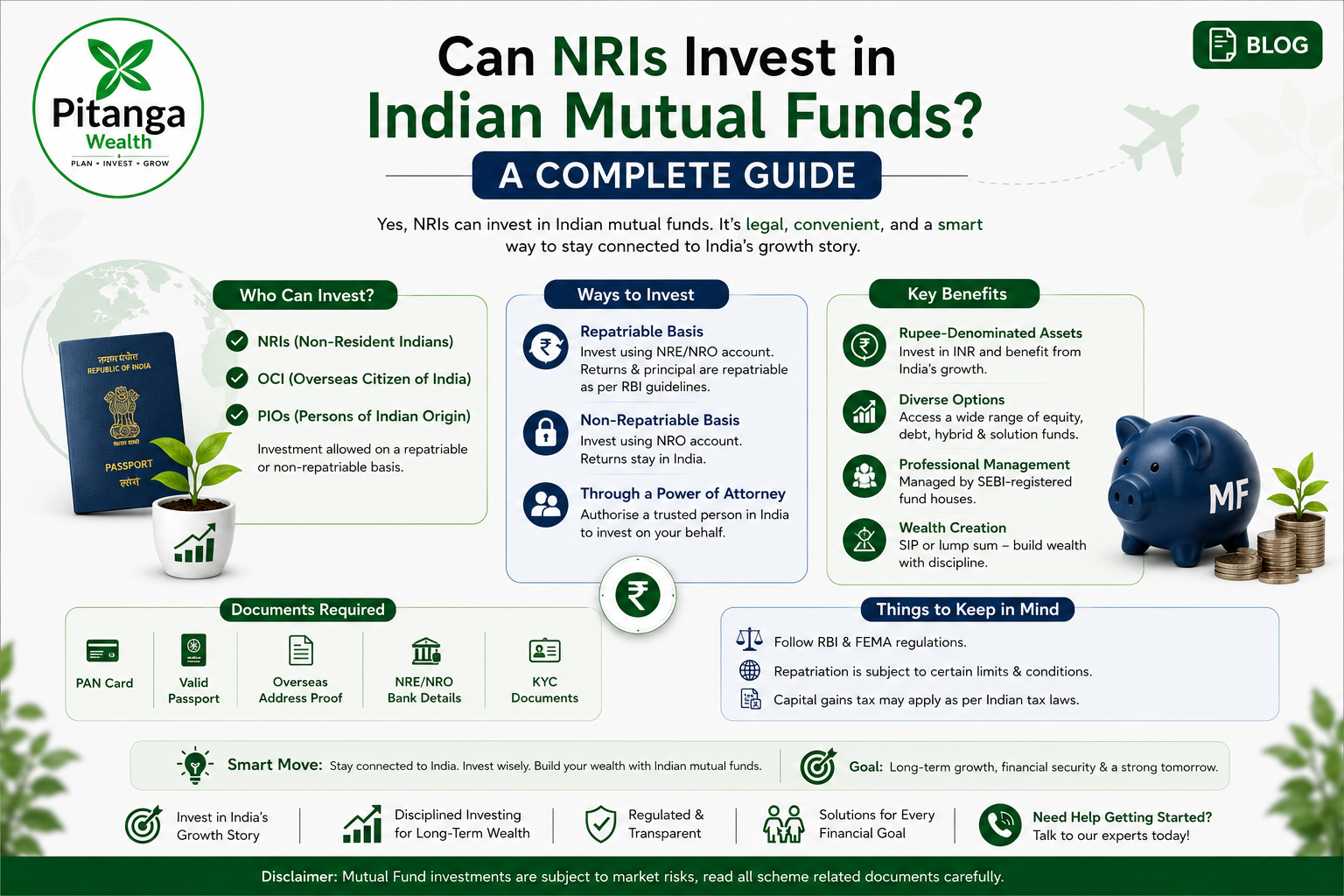
To directly answer whether NRIs can invest in Indian mutual funds: they’re permitted to under FEMA (Foreign Exchange Management Act) regulations, on either a repatriable or non-repatriable basis depending on which bank account they invest through. The core process — choosing a fund category, completing KYC, and investing via SIP or lump sum — is broadly similar to how resident Indians invest. What’s different is mainly around documentation, the account the money flows through, and how proceeds are eventually taxed and repatriated.
What’s Different About Investing as an NRI
You’ll need NRI-specific KYC, which is more extensive than resident KYC. This typically includes:
- A valid passport with visa or residency proof for your country of residence
- Overseas address proof (utility bill, bank statement, or similar)
- PAN card, which remains mandatory
- Passport-sized photographs
- An In-Person Verification (IPV), which can often now be completed via video KYC rather than requiring physical presence, depending on the fund house or platform
Your investment must be funded through an NRE or NRO account, not through a regular resident savings account, since FEMA rules require the money to flow through the correct channel depending on whether it originated abroad or within India. If you’re not clear on the difference between these two account types, it’s worth understanding that before you start investing, since it directly affects how your investment proceeds can later be repatriated.
Repatriation depends on the account used. Investments made through an NRE account are generally fully repatriable — both the investment amount and any gains. Investments made through an NRO account are subject to repatriation limits (currently up to USD 1 million per financial year, along with the required tax certification), similar to how NRO funds work more broadly.

The US and Canada Complication
This is worth calling out specifically because it trips up a meaningful number of NRIs. Due to FATCA (for US-based NRIs) and CRS-related compliance requirements (relevant for Canada and several other countries), many Indian mutual fund houses have historically restricted or limited fresh investments from NRIs based in the US and Canada, because of the additional reporting burden these regulations place on the fund house.
This isn’t a blanket rule across the entire industry, and it has shifted over time — some fund houses accept US/Canada NRI investments with additional documentation (like a W-9 form), while others don’t accept fresh investments from these regions at all. Because this varies by fund house and can change, if you’re an NRI based in the US or Canada, it’s worth checking directly with the specific fund house or your investment platform about their current policy before assuming either way.
How Taxation Works for NRI Mutual Fund Investors
Mutual fund taxation for NRIs follows broadly the same capital gains structure as for resident investors — equity fund gains and debt fund gains are taxed differently, and short-term versus long-term holding periods matter, as per current tax provisions. The key difference for NRIs is TDS (tax deducted at source), which is generally applicable on mutual fund redemptions for NRI investors, at rates that can differ from what a resident investor experiences on the same transaction.
NRIs may also be able to claim relief from double taxation under a DTAA (Double Taxation Avoidance Agreement) between India and their country of residence, which can reduce the effective tax burden, subject to submitting the required documentation. Because tax rates, TDS provisions, and DTAA terms can change and depend on individual circumstances, this is genuinely an area where getting specific advice from a CA familiar with NRI taxation is worth the cost — general guidance in an article like this one shouldn’t be treated as a substitute for that.
Can Someone in India Manage Your Investments for You?
Yes — many NRIs set up a Power of Attorney (POA) in favour of a trusted person in India (often a parent, sibling, or spouse) to handle day-to-day investment operations, such as placing transactions or completing paperwork, without requiring the NRI’s physical presence or signature for every action. The POA needs to be properly executed and registered with the fund house, and its scope is usually limited to what’s explicitly authorised in the document — it’s not a blank cheque, and the underlying investment remains legally the NRI investor’s own.
This is a common and practical setup for NRIs who want to continue investing in India but find the time-zone and paperwork logistics difficult to manage entirely on their own from abroad.
Which Route Should You Invest Through — Direct, Distributor, or Demat?
Once the question of whether NRIs can invest in Indian mutual funds is settled, the next practical decision is how to actually place the investment. NRIs generally have a few routes available:
- Through a mutual fund distributor, who helps with the KYC process, fund selection guidance, and paperwork — often the more manageable route for NRIs juggling time zones and unfamiliar compliance requirements, since the distributor typically handles a lot of the coordination.
- Directly with the fund house or an online platform, which can work well if you’re comfortable managing KYC, transactions, and tracking multiple funds yourself without guidance.
- Through a demat account, holding mutual fund units in electronic form alongside other securities, which some NRIs prefer if they’re already maintaining a demat account for stocks or bonds in India.
None of these routes changes the underlying investment or its returns — they differ in convenience, guidance, and how much of the process you handle yourself versus delegate. For NRIs dealing with unfamiliar compliance steps for the first time, going through a distributor who regularly works with NRI clients often reduces the number of things that can go wrong with documentation or account setup. Whichever route you choose, the underlying answer to whether NRIs can invest in Indian mutual funds doesn’t change — only how much of the process is handled for you.
Common Misconceptions Worth Clearing Up
“NRIs can’t do SIPs.” This isn’t true — the question of whether NRIs can invest in Indian mutual funds through a SIP comes up often, and the answer is yes: NRIs can set up SIPs the same way resident investors do, funded through their NRE or NRO account, with standing instructions for the recurring debit.
“You need an NRI-specific mutual fund.” There’s no separate category of “NRI mutual funds” — NRIs invest in the same funds available to resident investors, subject to the fund house’s specific policy on accepting NRI investments (particularly relevant for the US/Canada situation above).
“Once you become an NRI, you must sell your existing mutual fund investments.” This also isn’t accurate. Existing investments made while you were a resident can generally continue to be held; what typically needs updating is your KYC status and bank account details to reflect your new NRI status, rather than a forced liquidation.
To sum up: can NRIs invest in Indian mutual funds? Yes — the eligibility was never really the obstacle. The real work is in getting the account structure, KYC, and documentation right the first time, so the process doesn’t create friction later.

Frequently Asked Questions About NRI Mutual Fund Investment
Can NRIs invest in Indian mutual funds through a lump sum, or only SIP? Yes — NRIs can invest in Indian mutual funds through either a lump sum or SIP, the same choices available to resident investors, funded through the appropriate NRE or NRO account.
Do NRIs need a separate PAN card to invest? NRIs need a PAN card to invest in Indian mutual funds, same as resident investors — it’s not a separate NRI-specific PAN, just the standard requirement applied to everyone.
What happens to my mutual fund investments if I move back to India permanently? Your residency status with the fund house typically needs to be updated once you return, along with your KYC and bank account details, similar to how the reverse update happens when you first become an NRI.
Is there a minimum investment amount for NRIs that’s different from residents? Generally no — minimum investment amounts for a given scheme are usually the same regardless of residency status, though it’s worth confirming with the specific fund house since policies can vary.
Can I invest in Indian mutual funds if I’m not sure whether my country of residence has restrictions? It’s worth checking directly with the fund house or your investment platform, since restrictions (like those tied to FATCA/CRS) are specific to certain countries — mainly the US and Canada — rather than a universal rule for all NRIs.
Do NRIs get the same mutual fund returns as resident investors? Yes — an NRI’s returns from a given scheme are identical to a resident investor’s returns in the same scheme, since the underlying investment and its performance don’t distinguish based on the investor’s residency status. What differs is the taxation and repatriation process around those returns, not the returns themselves.
Is it harder for NRIs to switch or redeem mutual fund investments compared to residents? The transaction process itself (switching between schemes, redeeming units) works the same way for NRIs as for residents through most platforms. What can add friction is TDS on redemption and, depending on the bank account involved, the documentation needed for repatriating the proceeds abroad — the investment transaction itself isn’t inherently harder.
If you’re an NRI wondering whether — and how — you can invest in Indian mutual funds, from setting up the right account to understanding taxation and repatriation, our team at Pitanga Wealth can help you navigate the process from wherever you’re based.
Mutual Fund investments are subject to market risks. Read all scheme-related documents carefully before investing. Tax and FEMA/RBI regulations for NRIs are subject to change and can vary based on individual circumstances and country of residence; this article is for educational purposes only and does not constitute tax, legal, or investment advice. Pitanga Wealth is an AMFI-Registered Mutual Fund Distributor (ARN-134606).
Written by the Pitanga Wealth team.
Enjoyed this breakdown? We post explainers like this regularly on Instagram — follow @pitangawealth to catch them as they drop
This article is for educational and informational purposes only. It is not investment, tax, legal or insurance advice. Consider your circumstances and relevant documents before making a financial decision.